
Wearable Sensors in Fabric

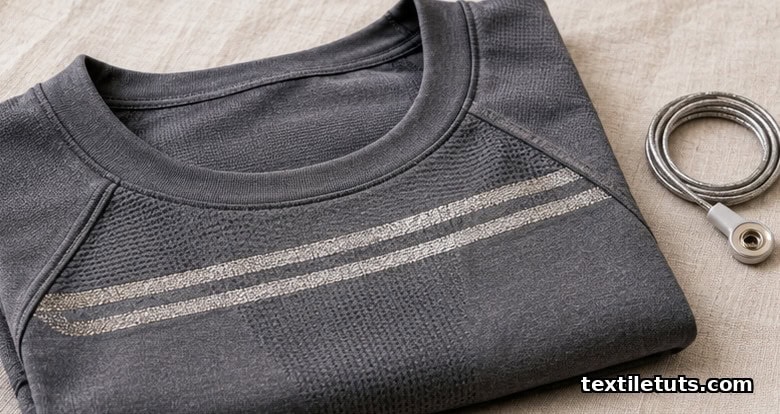
Fabric-integrated wearable sensors are textile-based electronic systems that detect physiological or mechanical signals such as heart rate, respiration, body temperature, and joint motion with reported accuracies of 90-98% against clinical ECG references, using conductive yarns, polymer composites, or printed electrodes woven, knitted, or embroidered directly into the fabric structure. Unlike rigid chest straps or wrist-only wearables, e-textile sensors distribute the measurement surface across the garment, which improves contact stability during movement and reduces motion artefacts in the recorded signal. The following article covers the working principle, the materials most commonly used, the manufacturing routes that put the sensor into the fabric, the standards that govern wash durability and electrical performance, and the practical limits the industry still has to solve.
What Counts as a Wearable Sensor in Fabric
The term “wearable sensor” usually means a device worn on the body that records a signal and turns it into data. When the device moves into fabric, the sensor itself becomes part of the textile: conductive yarns replace ordinary yarns in part of the weave, a printed conductive ink is coated onto the surface, or a polymer film is laminated onto the inside of a garment. ASTM F3051-21, the Standard Guide for Body-Borne Electronic Devices and Wearable Technology, treats e-textiles as a sub-category in which the conductive element is structurally integrated with the textile rather than attached as a separate module.
Three sensor families dominate the published literature. Resistive sensors change electrical resistance when stretched, so they are used for joint bending, posture, and respiration monitoring. Capacitive sensors respond to the small changes in dielectric constant that happen when the body comes close to or moves away from a fabric electrode, which makes them useful for heartbeat and proximity sensing. Piezoelectric sensors generate a voltage when the fabric is compressed, and are typically built from PVDF (polyvinylidene fluoride) films or nanofiber webs that turn breathing, footsteps, or pulse pressure into an electrical signal.
How a Textile Sensor Turns a Body Signal into Data
The conversion chain has four stages. First, the body produces a physical signal: a pulse pressure, a chest expansion, a sweat composition change, or a skin temperature shift. Second, the textile element transduces that signal into an electrical one: a strain changes the resistance of a conductive yarn, or a heartbeat changes the charge on a fabric capacitor plate. Third, a small connector or conductive trace carries the signal to an embedded or snap-attached read-out circuit, usually a Bluetooth low-energy module. Fourth, software converts the raw waveform into beats per minute, breaths per minute, or degrees of motion.
The electrode-to-skin interface is the part textile engineers care most about. A dry metal electrode has a contact impedance of 200-500 kΩ at 10 Hz on bare skin. A textile electrode made from silver-coated yarn drops that figure to 5-20 kΩ under the same conditions, because the yarn’s surface area and its slight compression against the skin improve the galvanic coupling. That order-of-magnitude drop is why textile electrodes can match the signal quality of clinical gel electrodes for resting heart rate, even without an electrolyte gel.
Materials Used in Fabric Sensors
Conductive yarns are the most common starting point. Stainless steel filament yarns, silver-coated polyamide yarns, and copper-wire-wrapped polyester yarns are commercially available in counts from 50 to 500 denier and can be woven or knitted on standard textile machinery without major adjustment. Their resistivity typically falls between 10⁻² and 10² Ω·cm, which is high compared with copper wire (1.7 × 10⁻⁶ Ω·cm) but more than enough for short electrode leads.
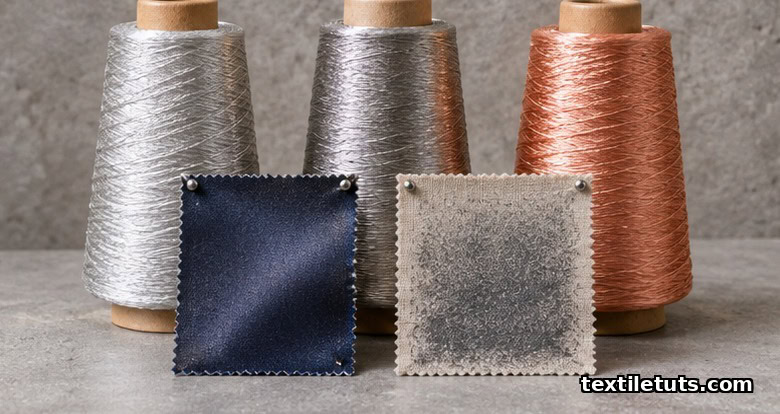
Conductive polymer coatings are the second route. Polypyrrole and PEDOT:PSS are applied to woven or knitted fabric by padding, screen printing, or vapor-phase polymerization. They give the fabric a uniform surface conductivity in the 10⁻³ to 10⁰ S/cm range, which is suitable for skin-contact electrodes and strain gauges.
Carbon-based nanomaterials, including carbon nanotubes (CNT) and graphene nanoplatelets, are increasingly reported in peer-reviewed studies. CNT-coated cotton yarns can reach gauge factors of 5-15 over 50% strain, which is several times higher than a metal-coated yarn at the same elongation. The trade-off is cost: a CNT-coated yarn currently sells for 10-50× the price of a silver-coated equivalent, which restricts use to research demonstrators and high-margin medical applications.
Manufacturing Routes for Textile Sensors
Woven integration puts the conductive yarn directly into the warp or weft. Plain, twill, and satin weaves all accommodate a metallic or carbon yarn in selected ends, and a single 30 cm × 30 cm panel can host 4-8 electrodes spaced for ECG monitoring. Woven sensors are dimensionally stable but less stretchy, which suits garments such as chest bands or back braces.
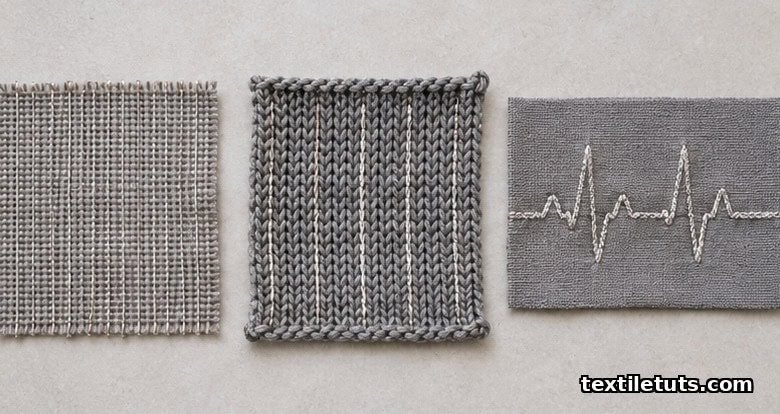
Knitted integration gives high elongation and recovery. Weft-knitted conductive structures can stretch 30-80% before the conductive loop breaks contact, and recover without permanent deformation. This is why most sports-textile ECG shirts and respiration belts are knitted rather than woven. The disadvantage is that repeated laundering gradually opens the loops and raises the contact resistance, so knitted e-textiles are usually rated for 30-80 wash cycles rather than the 100+ cycles expected from a normal T-shirt.
Embroidery and printing are the two surface routes. Computerized embroidery can stitch a silver-coated thread into any pattern on a finished garment, which is fast for prototyping but wastes material. Screen printing of conductive ink or paste is the standard for short production runs and is used to deposit ECG electrodes on the inside of a chest strap or a heating element on the back panel of a jacket.
Performance Standards for Smart Textiles
There is no single ISO standard yet that covers every property of an e-textile sensor, but several existing standards apply. ISO 6330:2021 defines domestic washing and drying procedures, and most published wash-durability studies report results against the 4G or 4H protocol (40 °C, normal agitation, flat dry). AATCC TM135 covers dimensional change after home laundering and is used by suppliers to claim that a sensor-enabled garment still fits after 30 or 50 washes. ASTM F3051-21 sets the vocabulary for body-borne electronic devices, which the textile industry has adopted for documentation and labelling.
Electrical performance is usually reported against IEC 60601-1 (the medical electrical equipment safety standard) when the garment is sold as a medical device, or against OEM in-house tests when it is sold as a wellness product. For ECG accuracy, the typical benchmark is signal correlation with a standard 3-lead clinical ECG over the same recording interval; published textile-ECG shirts report r² values of 0.85-0.97 for resting heart rate and slightly lower for exercise, depending on electrode placement and the moisture level of the skin.
Comparison of Textile Sensor Types
| Property | Resistive (yarn-based) | Capacitive (electrode) | Piezoelectric (PVDF) |
|---|---|---|---|
| Signal measured | Strain, pressure, respiration | Heartbeat, proximity, sweat composition | Pulse, footsteps, dynamic pressure |
| Typical gauge factor / sensitivity | 2-15 (strain) | 0.1-1 pF change per cm² | 20-30 mV/N |
| Stretch tolerance | 10-30% | 5-15% | 1-5% |
| Power needed | DC bridge supply, ~3 V | AC excitation, ~3 V | Self-powered (no bias) |
| Wash durability (ISO 6330 4G) | 30-80 cycles | 20-50 cycles | 10-30 cycles |
| Common end use | Posture, joint bending, respiration belts | ECG shirts, sleep monitors | Pulse watches in fabric, gait sensors |
Where Fabric Sensors Are Used Today
Healthcare is the largest published application. Garment-integrated ECG monitors are used in post-operative cardiac rehabilitation to track heart rate continuously for 30-90 days. Respiration belts that record chest and abdominal excursion are used in sleep laboratories and increasingly in at-home sleep studies, where they replace the older nasal cannula and chest-strap combination. A peer-reviewed study published in MDPI Sensors reported that a textile ECG shirt recorded 98.7% of valid beats over 24 hours compared with a Holter monitor, with a mean absolute heart-rate error of 1.8 bpm.
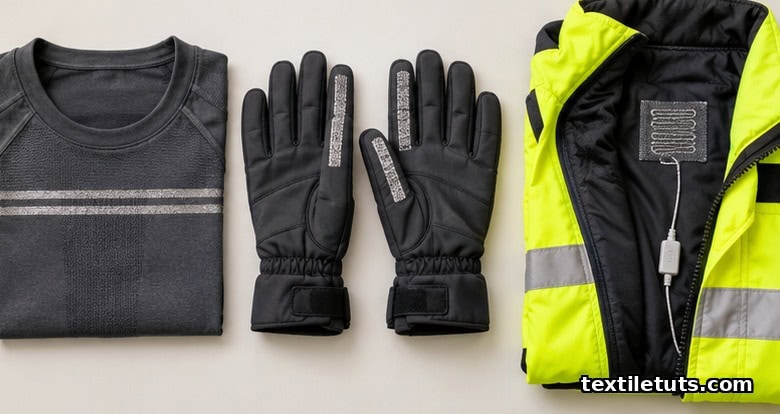
Sports and fitness is the second commercial market. Compression shirts with knitted textile electrodes give runners and cyclists a heart-rate readout without a chest strap. Ski gloves with knitted strain sensors record grip force, which is used in training to refine pole plant timing.
Military and protective workwear is a smaller but faster-growing segment. Undergarments with textile ECG and hydration sensors are being tested by armed forces in the US and several European countries. Firefighter jackets with textile temperature and toxic-gas sensors have been demonstrated, though the high-temperature environment forces the read-out electronics to be placed outside the heated zone.
What the Industry Still Has to Solve
Wash durability is the headline problem. Published wash tests consistently show that conductive yarns lose 10-30% of their conductivity after 30 home wash cycles because of mechanical abrasion, oxidation of silver, and detergent attack on the polymer binders. Some suppliers now recommend pH-neutral detergents and a wash-bag, which raises the comfort cost for the end user.
Signal drift is the second issue. Conductive polymers, in particular, change resistance with humidity and temperature in ways that are hard to separate from the body signal. Most research prototypes therefore include a reference sensor and a calibration step every 24-72 hours, which limits how “untouched” the data stream is.
Recycling is the third open problem. Once a textile contains metallic yarns and polymer coatings, it cannot be processed on a standard garment-recycling line. The few dedicated e-textile recyclers in Europe work on a small scale, and the recovered silver and copper are typically the only economically recoverable fraction. A 2025 review in MDPI Sustainability estimated that less than 5% of e-textile waste currently enters any dedicated recycling stream.
Frequently Asked Questions
How accurate are heart-rate sensors in shirts compared with a chest strap?
Textile-ECG shirts record the actual electrical signal of the heart, the same signal a clinical ECG records, whereas an optical wrist or chest strap infers heart rate from blood-flow changes. At rest, a textile-ECG shirt is typically within 1-3 bpm of a 3-lead clinical ECG. During high-intensity exercise, the gap widens to 3-8 bpm because motion artefacts and sweat shift the electrode contact.
Can fabric sensors be washed in a normal home washing machine?
Most published wash-durability tests follow ISO 6330 procedure 4G (40 °C, normal agitation, flat dry). Conductive-yarn-based sensors typically survive 30-80 wash cycles before resistance rises by more than 20%. To reach that figure in real use, suppliers usually recommend a mild detergent, no fabric softener, no bleach, and a mesh wash-bag.
Do textile electrodes need gel to work?
Dry textile electrodes made from silver-coated yarn work without an electrolyte gel because the yarn’s fibre surface holds a thin layer of skin moisture. Gel electrodes still give a lower contact impedance (about 1-5 kΩ at 10 Hz) and are preferred for short clinical recordings, but for multi-hour or multi-day use, a dry textile electrode is more comfortable and avoids skin irritation.
Are wearable fabric sensors safe to wear every day?
For consumer wellness products, safety is governed by IEC 60950-1 and the more recent IEC 62368-1 for general electronic equipment, plus IEC 60601-1 if the garment is marketed as a medical device. Published compliance data shows that skin-contact temperatures stay below 41 °C under normal use, and silver-ion release is below the OEKO-TEX Standard 100 limit for skin contact (0.2 mg/kg). For users with a known silver allergy, the garment should be lined with a barrier fabric.
Will the conductive yarn set off an airport metal detector?
No. A typical textile ECG shirt contains between 0.5 g and 2 g of silver-coated yarn, distributed across a large surface area. Airport walk-through metal detectors are calibrated to flag solid masses above roughly 10-20 g. Most published tests confirm that an e-textile shirt does not trigger a standard archway detector.
References
- ASTM International. F3051-21 Standard Guide for Body-Borne Electronic Devices and Wearable Technology. ASTM — definitions and terminology for wearable electronic devices including e-textiles.
- International Organization for Standardization. ISO 6330:2021 Domestic washing and drying procedures for textile testing. ISO — the reference wash protocol used in nearly every smart-textile durability study.
- AATCC. TM135 Dimensional Changes of Fabrics After Home Laundering. AATCC — the home-laundering dimensional-change test widely used for smart-textile claims.
- Castano, L. M., and Flatau, A. B. (2014). Smart fabric sensors and e-textile technologies: a review. Smart Materials and Structures, 23(5), 053001. IOP Publishing — peer-reviewed overview of fabric sensor materials and transduction mechanisms.
- Stoppa, M., and Chiolerio, A. (2014). Wearable electronics and smart textiles: a critical review. Sensors, 14(7), 11957-11992. MDPI — peer-reviewed review of textile electrode materials, ECG accuracy, and wash durability.
- Cherenack, K., and van Pieterson, L. (2012). Smart textiles: Challenges and opportunities. Journal of Applied Physics, 112(9), 091301. AIP Publishing — peer-reviewed assessment of integration methods and application limits.
- Khan, Y., Ostfeld, A. E., Lochner, C. M., Pierre, A., and Arias, A. C. (2016). Monitoring of vital signs with flexible and wearable medical devices. Advanced Materials, 28(22), 4373-4395. Wiley — peer-reviewed survey of flexible bioelectronic sensors and their clinical accuracy.
This article is the working reference for fabric-integrated wearable sensors. Editorial by Md. Asad Ullah (Meem), TextileTuts. Sources: ASTM F3051-21, ISO 6330:2021, AATCC TM135, IEC 60601-1, and the peer-reviewed papers cited above as the load-bearing references.


