
ECG-Shirts and Biometric Textiles

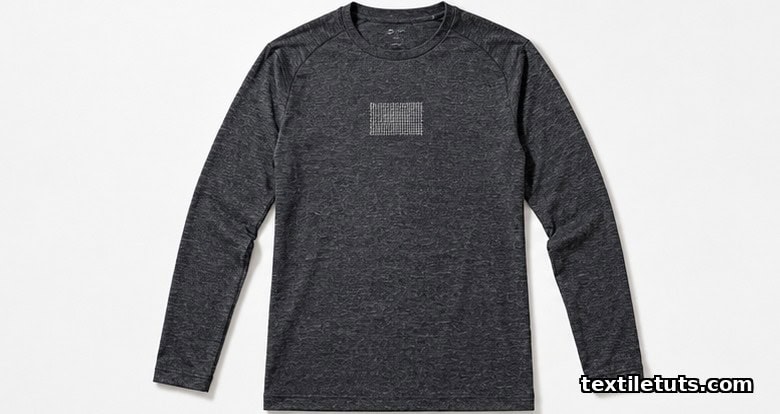
ECG shirts are knit garments with textile electrodes woven or embroidered directly into the fabric that capture cardiac biopotentials at the skin surface, typically recording 1 to 3 ECG leads at a signal-to-noise ratio of 20-40 dB compared with 60 dB or higher for clinical Ag/AgCl gel electrodes, while remaining washable for 30 to 50 laundering cycles before electrode impedance rises above the 10 kOhm threshold required for diagnostic-grade tracing.
They are the most clinically advanced application of biometric textiles, the broader category of fabrics engineered to monitor heart rate, respiration, skin temperature, muscle activity (EMG), and sweat biomarkers continuously during daily wear. ECG shirts replace the Holter monitor’s adhesive electrodes and wired chest strap with a garment that looks and launders like a regular knit shirt.
This article explains how the textile electrodes work, the materials and manufacturing routes that make them durable, the standards they must meet for medical use, and the limits you should know before trusting a biometric shirt for cardiac monitoring.
How ECG shirts capture the electrical signal
The heart’s depolarization wave produces a small potential difference at the skin surface, normally 0.5-2 mV peak-to-peak, with most of the useful frequency content between 0.05 Hz and 150 Hz for full diagnostic ECG and 0.5-40 Hz for monitoring-grade tracing. A textile electrode in contact with the skin acts as a transducer that converts ionic current in the body’s electrolytes into electronic current the recorder can measure.
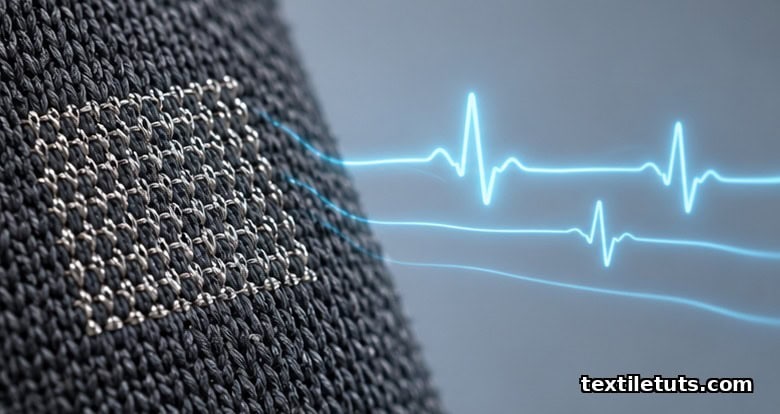
Three parameters decide whether the signal is usable. First, electrode-skin contact impedance: dry textile electrodes typically measure 5-200 kOhm at 10 Hz depending on pressure and sweat, versus 1-5 kOhm for a wet Ag/AgCl gel electrode. Second, motion artefact: any relative movement between electrode and skin produces baseline wander that can dwarf the cardiac signal. Third, direct-current offset potential: the half-cell potential at the electrode-electrolyte interface, normally a few hundred millivolts, can saturate the input stage of the recorder if not filtered out.
A complete ECG shirt integrates conductive electrodes, a textile or printed circuit that routes the signal to a small electronics module containing an analog front end, an ADC, and a wireless transmitter (usually Bluetooth Low Energy). The module snaps onto a connector on the shirt, weighs 15-40 g, and runs 24-72 hours on a single charge depending on sampling rate.
Materials used in the textile electrodes
The electrode is the most critical component because it sets both signal quality and wash durability. The four material families in commercial and clinical use today:
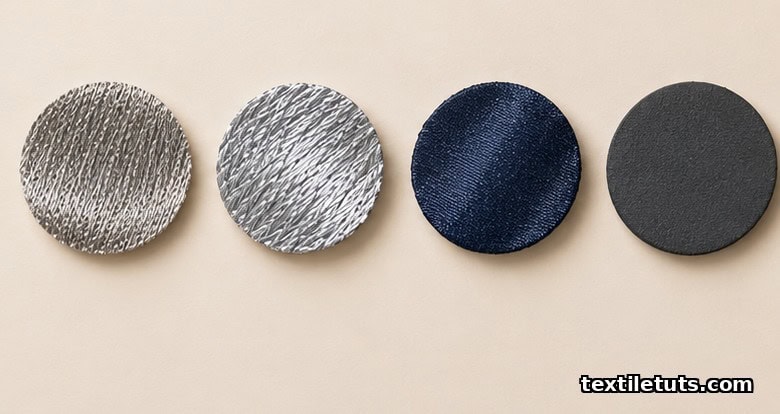
- Stainless steel filament yarns. Multifilament yarns of 316L stainless steel with filament diameters of 8-50 microns are knit or woven into the electrode patch. Resistivity is roughly 7 × 10⁻⁷ Ω·m, about 40 times higher than copper but acceptable for short traces. The material is non-corrosive in sweat and tolerates 50+ machine wash cycles at 40 °C.
- Silver-coated yarns. Nylon or polyester filaments coated with 99.9 percent pure silver via sputtering or electroless plating. Surface resistivity drops to 0.1-1 Ω per square for the coated area. Silver chloride (AgCl) forms naturally at the surface in chloride-rich sweat, mimicking the half-cell chemistry of clinical electrodes and improving signal stability. Silver-coated electrodes typically last 30-50 wash cycles before the silver layer is consumed.
- Intrinsically conductive polymers. Poly(3,4-ethylenedioxythiophene) polystyrene sulfonate (PEDOT:PSS) coated onto standard textile fibers gives an ionic-electronic interface that follows skin deformation without cracking. Lower metal content means better long-term comfort but higher initial impedance.
- Carbon-loaded elastomers. Silicone or polyurethane doped with carbon black, formed as dry electrode pads that can be bonded to a knit garment. Used where flexibility and biocompatibility matter more than raw conductivity.
Hybrid electrodes that combine stainless steel base yarns with a PEDOT:PSS surface coating are an emerging approach that pairs the durability of metal with the low half-cell potential of a polymer.
Manufacturing routes
Three integration routes dominate the commercial ECG shirt market.
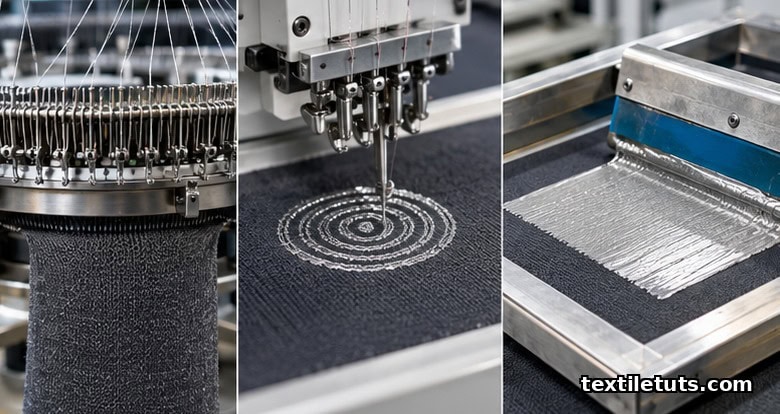
Knitting or weaving conductive electrodes directly into the garment is the most durable. The electrode patch is knit as part of the jersey structure using intarsia or plating techniques so that conductive yarn appears only where the electrode is needed. Cut-and-sew construction then forms the shirt. This route survives 50+ wash cycles because the conductive fibers are continuous and locked into the knit loop structure.
Embroidery with conductive thread is faster to prototype and easier to customize. Silver-coated or stainless steel thread is stitched onto a finished base fabric in the electrode pattern. Embroidery holds up well for 20-40 wash cycles but the stitching can fray at high-stress zones.
Printing conductive ink (silver flake or carbon ink) onto the fabric inside or outside is the cheapest and most flexible route for prototyping. Screen-printed or inkjet-printed traces are typically less durable (10-30 wash cycles) and are more common in research prototypes than in commercial medical products.
The chosen method also sets the connection to the electronics. Most ECG shirts use a snap connector (stainless steel or gold-plated brass) bonded or sewn onto a non-conductive fabric tab so the user can detach the electronics module before washing.
Comparison of electrode types
| Property | Stainless steel yarn | Silver-coated yarn | PEDOT:PSS coated | Clinical Ag/AgCl gel |
|---|---|---|---|---|
| Surface resistivity | 0.5-5 Ω/sq | 0.1-1 Ω/sq | 10-100 Ω/sq | not applicable (gel) |
| Skin contact impedance at 10 Hz | 10-100 kΩ | 5-50 kΩ | 20-200 kΩ | 1-5 kΩ |
| Wash cycles to failure | 50+ | 30-50 | 20-40 | single use |
| SNR for resting ECG | 20-30 dB | 25-40 dB | 20-35 dB | 60+ dB |
| Reusable across patients | yes | yes | yes | no |
| Approximate relative cost | moderate | high | moderate | low |
Standards a medical ECG shirt must meet
An ECG shirt that claims any kind of diagnostic or monitoring function falls under medical device regulations in most jurisdictions. The standards and test methods most often cited:
- IEC 60601-2-47 specifies the safety and essential performance requirements for ambulatory ECG systems, including the input impedance, dynamic range, and frequency response the recorder must meet regardless of the electrode type.
- AAMI EC11 and AAMI EC13 (adopted in the United States) and IEC 60601-2-25 (adopted in the European Union) define the diagnostic ECG signal quality targets that any ECG source, including textile electrodes, must reach to be used for clinical diagnosis.
- ISO 10993 is the biocompatibility panel: textiles in prolonged skin contact must be tested for cytotoxicity, sensitization, and irritation. OEKO-TEX Standard 100 is the most common textile-side benchmark for restricted substances.
- ASTM D257 (volume resistivity) and ASTM F390 (sheet resistance) are used to characterize the conductive textile itself, separate from the electrode performance.
Devices that meet these standards can be cleared for clinical ambulatory monitoring. Devices that fall short of IEC 60601-2-47 are typically marketed for fitness and wellness only, and their outputs should not be used for diagnosis.
Limitations you should know
Textile electrodes have made real progress, but they are not yet interchangeable with clinical wet electrodes for full diagnostic ECG. Three limitations matter most.
Dry textile electrodes sit on the stratum corneum, the outermost skin layer, instead of penetrating through it the way a gel electrode does after a few minutes of wear. That skin layer raises impedance and reduces the high-frequency content of the signal, which is why most ECG shirts target the 0.5-40 Hz monitoring band rather than the full 0.05-150 Hz diagnostic band. P recorders that claim diagnostic equivalence usually require skin preparation (alcohol wipe, light abrasion) that defeats most of the convenience argument.
Motion artefact remains the largest practical problem. Walking, running, and breathing all modulate the electrode-skin contact. Adaptive filtering at the recorder helps, but the cleanest ECG signal still comes from a stationary subject. For continuous monitoring of atrial fibrillation or rhythm disturbances, this is acceptable. For exercise stress ECG it is not.
Wash durability is improving but not solved. Silver-coated yarns lose roughly 5-10 percent of their conductive cross-section per 10 wash cycles in standard household conditions, which is why most manufacturers rate their shirts at 30-50 cycles. Hospital-grade shirts use replaceable electrode patches so the garment body can outlive the electrode.
Frequently Asked Questions
Can an ECG shirt replace a Holter monitor?
For rhythm monitoring (detecting atrial fibrillation, bradycardia, ectopic beats), yes. Multiple clinical studies show 90-95 percent agreement between textile-electrode ECG shirts and standard 24-hour Holter monitors when the patient is at rest or walking slowly. For diagnostic 12-lead ECG, no. A single textile shirt covers 1-3 lead equivalents, while a clinical 12-lead ECG uses 10 electrodes in specific anatomical positions.
Are the electrodes safe for people with sensitive skin?
Textile electrodes avoid the adhesive and gel that cause most contact dermatitis from Holter monitors. Silver-coated yarns can cause argyria-like staining after very long wear in some users, and PEDOT:PSS has occasionally been associated with mild irritation. Biocompatibility testing per ISO 10993 is the minimum to look for, and OEKO-TEX Standard 100 certification covers the restricted-substance side.
How long can an ECG shirt record continuously?
Typical battery life is 24-72 hours at 250-500 Hz sampling, depending on whether the device streams to a phone via Bluetooth Low Energy or stores to onboard memory. Longer-term monitoring (1-14 days) is possible by recharging the electronics module nightly while wearing the same shirt.
Do ECG shirts work for athletes during exercise?
Partially. During moderate exercise, modern shirts recover heart rate and rhythm with high accuracy. During high-intensity interval training or contact sports, motion artefact dominates the signal and clean tracing is intermittent. Polar OH1, Equivital, and Hexoskin all publish validation studies that quantify this trade-off.
What is the difference between an ECG shirt and a fitness band?
A fitness band measures heart rate with an optical sensor (photoplethysmography, PPG) at the wrist. An ECG shirt measures the electrical signal of the heart itself through textile electrodes on the chest. PPG is convenient but loses accuracy during motion and cannot diagnose rhythm disturbances the way an ECG trace can.
References
- IEC 60601-2-47:2012, Medical electrical equipment – Part 2-47: Particular requirements for the basic safety and essential performance of ambulatory electrocardiographic systems. International Electrotechnical Commission standard covering ambulatory ECG systems including textile-electrode garments.
- AAMI EC11:1991 (R2007) / EC13:2002 (R2010), Diagnostic electrocardiographic devices / Cardiac monitors, heart rate meters, and alarms. Association for the Advancement of Medical Instrumentation standards for diagnostic ECG performance targets.
- ISO 10993-1:2018, Biological evaluation of medical devices – Part 1: Evaluation and testing within a risk management process. https://www.iso.org/standard/68936.html – the biocompatibility test panel applicable to any textile in prolonged skin contact.
- ASTM F390-23, Standard Test Method for Sheet Resistance of Thin Metallic Films With a Collinear Four-Probe Array. – widely used to characterize conductive textile electrodes.
- PMC (NCBI), Textile Electrodes for Electrocardiogram (ECG) Monitoring: A Review of Materials, Fabrication, and Performance. https://pmc.ncbi.nlm.nih.gov/articles/PMC9416033/ – peer-reviewed review of textile electrode materials, fabrication methods, and signal-quality benchmarks.
- MDPI Sensors, Wearable Electrocardiogram (ECG) Shirts: A Systematic Review. https://www.mdpi.com/journal/sensors – peer-reviewed comparison of commercial ECG shirt systems against clinical Holter references.
- OEKO-TEX Association, Standard 100 – Annex 4: Class II and III textile products in direct contact with skin. https://www.oeko-tex.com/ – the most common textile-side restricted-substance benchmark for garments in skin contact.
This article is the working reference for ECG shirts and biometric textiles. Editorial by Md. Asad Ullah (Meem), TextileTuts. Sources: IEC 60601-2-47, AAMI EC11/EC13, ISO 10993-1, ASTM F390-23, PMC NCBI review, MDPI Sensors, OEKO-TEX Standard 100 as cited.


