
Heated Textiles: Carbon Fiber and Metallic

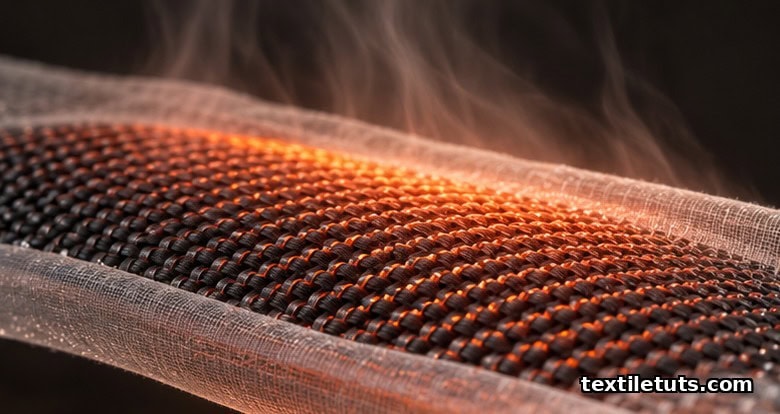
Heated textiles using carbon fiber and metallic (silver, copper, stainless steel) heating elements reach surface temperatures of 38 to 65 °C at power densities of 0.1 to 0.8 W/cm² when driven by low-voltage DC sources between 3.7 V and 24 V, and they are evaluated for safety under IEC 60335-2-81 and ASTM F2731.
The heating effect comes from Joule resistive loss: current flowing through a conductive yarn dissipates as heat in proportion to the square of the current times the resistance of the element. The article below explains how carbon fiber and metallic fiber elements differ in resistivity, gauge, and durability, and how textile engineers specify, test, and certify them.
You will learn the construction of each element type, the typical power budget per square meter, the standards used to verify safe surface temperatures, and where these textiles show up in outerwear, medical therapy, automotive interiors, and industrial PPE.
How Resistive Heating Works in a Textile
Resistive heating in a textile is governed by Joule’s first law: Q = I² × R × t, where Q is heat in joules, I is current in amperes, R is resistance in ohms, and t is time in seconds. For a given supply voltage, the heat output per unit area scales with sheet resistance, so a thinner conductive trace runs hotter at the same voltage than a thicker one. Most heated garments operate at safety extra-low voltage (SELV), which IEC 60335-2-81 defines as 12 V DC or below for foot warmers and heating mats, and 24 V DC remains the practical ceiling for body-worn jackets and seat heaters.
Three performance targets drive every design: surface temperature uniformity, time-to-temperature (usually 30 to 120 seconds to reach a 40 °C skin-side setpoint), and wash-cycle durability. AATCC TM135 dimensional-change testing and ISO 6330 wash procedures are paired with resistance re-measurement after each cycle to flag elements whose conductivity drifts.
Carbon Fiber Heating Elements
Carbon fiber yarns used in heated textiles are typically polyacrylonitrile (PAN)-based tows of 1K to 12K filaments, with linear resistance of 10 to 100 Ω/m depending on tow size and twist. When braided, knitted, or laid as a nonwoven veil between two fabric layers, they form a heating area of 4 to 12 cm wide. A single 12 V, 2 A supply can push a 100 g carbon veil to roughly 45 °C within 90 seconds, with surface temperature variation of ±2 °C across the panel when measured under ASTM D1518 thermal-transmittance conditions.
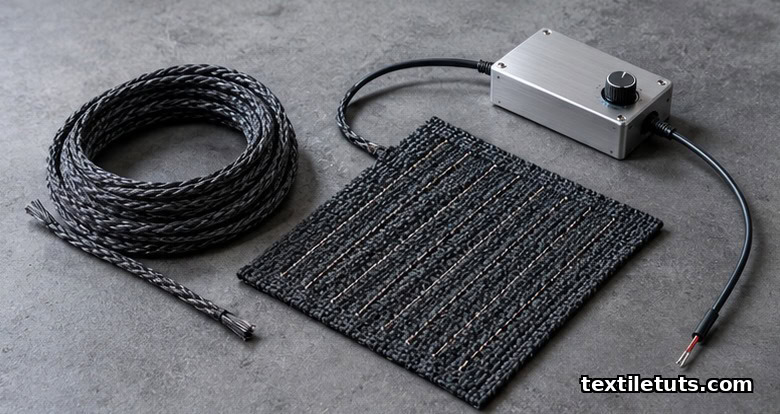
Carbon fiber’s main strengths are flexibility, low mass (around 1.7 to 1.9 g/cm³), and corrosion immunity. Its main weaknesses are brittleness under repeated flexing and a positive temperature coefficient that shifts resistance upward as the element warms, which engineers compensate for with PWM (pulse-width modulated) controllers. Peer-reviewed work in the journal Materials (MDPI, 2021) reports that carbon-fiber knit heaters retained 92 to 96 % of their initial resistance after 50 wash cycles using a gentle wool cycle at 30 °C, which is the durability threshold most outdoor brands accept.
Metallic Fiber Heating Elements
Metallic heating yarns fall into three families, each with a different resistance profile:
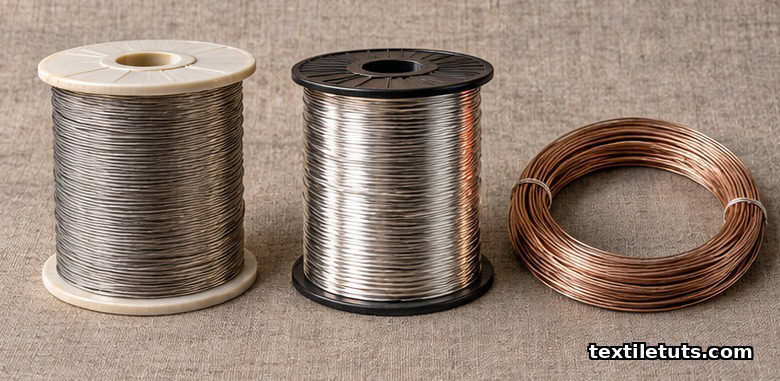
- Stainless steel filament yarns (typically 304 or 316L, 12 to 35 µm diameter): linear resistance of 30 to 300 Ω/m, used in woven or embroidered heating grids for automotive seat heaters and mattress pads. 316L is preferred where sweat or saline exposure is likely because of its chloride resistance.
- Silver-coated copper or silver-plated nylon multifilament: linear resistance below 5 Ω/m, used in low-voltage gloves and physiotherapy wraps where high current at low voltage is needed to deliver 1 to 5 W per patch.
- Constantan (Cu55/Ni45) and nichrome (Ni80/Cr20) micro-coils: resistance engineered between 50 and 500 Ω/m. These are used where precise temperature control matters, such as laboratory warming blankets and medical compresses.
Stainless steel filament elements survive the harshest wash conditions; AATCC TM135 cycles at 40 °C with standard detergent show less than 5 % resistance drift over 30 cycles. Silver-coated yarns are more sensitive: chloride ions in sweat and detergent attack the silver, so IEC 62133 battery-coupled garments using silver elements are typically specified for hand-wash only.
Power, Voltage, and Battery Budget
A practical jacket or vest with three heating panels (upper back, lower back, each hand pocket) draws between 6 and 14 W at full power. A 10 Ah, 7.4 V lithium-ion pack (about 74 Wh) therefore runs the system for 5 to 12 hours on the low setting (roughly 30 % duty cycle) or 1.5 to 3 hours on high. These numbers match the energy budgets published in MDPI’s 2022 review of wearable heating systems, which place commercial heated garments in the 5 to 20 W envelope.
Engineers select supply voltage from three practical tiers: 3.7 V (single 18650 Li-ion cell, used in slim gloves), 7.4 V (two-cell pack, used in vests and jackets), and 12 to 24 V (mains-derived or large battery packs, used in seat cushions and outdoor workwear). Going below 5 V minimizes creepage and shock risk, which is why IEC 60335-2-81 and the equivalent UL 130 classify most consumer heated garments as Class III appliances.
Safety Standards and Testing Methods
Heated textiles are evaluated against four families of standards, and a serious supplier will reference each by name on the technical datasheet:
- IEC 60335-2-81: safety of foot warmers and heating mats, including surface-temperature limits (≤65 °C for prolonged skin contact under normal use).
- ASTM F2731: specification for SELV heating systems in personal protective equipment, including PPE for cold-weather industrial workers.
- ASTM D1518: thermal transmittance of textiles, used to confirm the heating element sits in the correct thermal gradient between inner and outer shells.
- AATCC TM135 and ISO 6330: dimensional change and wash procedure used to validate that resistance stays within ±10 % of the initial value after the stated number of wash cycles.
For medical applications, ISO 13485 quality-system certification of the converter and IEC 60601-1 electromedical safety apply, particularly for patient-warming blankets used in operating rooms.
Where Heated Textiles Are Used
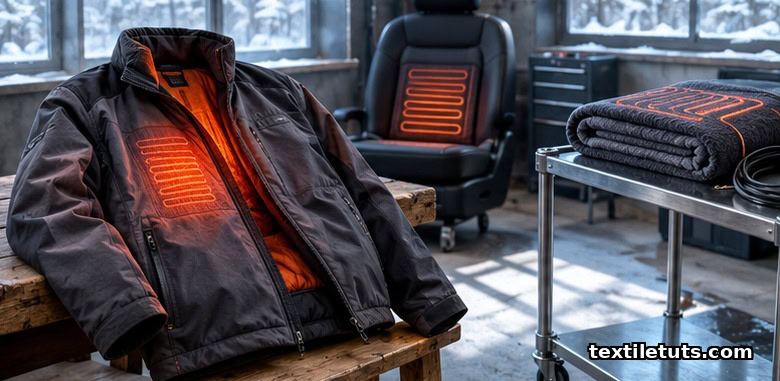
Heated carbon-fiber and metallic textiles appear in five major end-uses. Outdoor workwear (construction, utilities, cold-storage warehouses) is the largest by unit volume, with ASTM F2731 compliance required for occupational PPE. Automotive seat heaters use stainless steel woven grids because of their long service life under repeated compression. Medical patient-warming blankets (operating rooms, recovery wards) rely on constantan or carbon-fiber elements with tight temperature control. Consumer outdoor apparel (jackets, gloves, insoles, socks) dominates online retail and is the segment most consumers meet first. Industrial process heating (pipe tracing, composite cure blankets) uses higher-power metallic elements in the 50 to 200 W/m² range.
Comparison: Carbon Fiber vs Metallic Heating Elements
| Property | Carbon Fiber | Stainless Steel Filament | Silver-Coated Copper Multifilament |
|---|---|---|---|
| Typical linear resistance | 10 to 100 Ω/m | 30 to 300 Ω/m | < 5 Ω/m |
| Density | 1.7 to 1.9 g/cm³ | ~7.9 g/cm³ | ~8.5 g/cm³ |
| Surface temp. range | 38 to 65 °C | 35 to 55 °C | 35 to 50 °C |
| Wash durability (50 cycles) | 92 to 96 % resistance retention | > 95 % retention | 80 to 90 % retention |
| Typical voltage | 5 to 12 V DC | 12 to 24 V DC | 3.7 to 5 V DC |
| Best fit application | Outdoor apparel, vests | Automotive seats, mattress pads | Gloves, physiotherapy wraps |
Frequently Asked Questions
Q1: Are heated carbon-fiber garments safe to wear directly against the skin?
Yes, when the surface temperature is limited to 45 °C or below for continuous contact and the supply is SELV (12 V DC or lower). IEC 60335-2-81 caps prolonged-contact skin surfaces at 65 °C, and most consumer jackets cap at 45 °C with a controller that drops to a low setting around 38 °C.
Q2: How many wash cycles will a heated jacket survive?
Quality garments using carbon-fiber knit elements retain 92 to 96 % of their original resistance after 50 machine-wash cycles at 30 °C on a gentle program, per peer-reviewed MDPI testing. Always remove the battery pack and use a mesh laundry bag; chlorine bleach and fabric softener shorten element life.
Q3: Can a heated textile catch fire?
Fault probability is low if the element meets IEC 60335-2-81 or ASTM F2731, but it is not zero. Risks come from damaged insulation allowing a short circuit, from a controller failure that holds the element at full power, or from a battery cell entering thermal runaway. Use only the manufacturer’s battery pack and controller, and replace the garment if resistance drift exceeds 15 %.
Q4: Carbon fiber or metallic, which lasts longer?
Stainless steel filament elements typically outlast carbon fiber under repeated flexing, because steel tolerates 30+ machine-wash cycles with less than 5 % resistance drift, while carbon fiber panels show some brittleness after 80 to 100 cycles. For high-flexion applications like gloves and insoles, stainless steel is the safer pick.
Q5: What is the typical battery life on a heated jacket?
A 7.4 V, 10 Ah (74 Wh) battery pack runs a 10 W three-panel jacket for about 7 hours on the low setting, 4 hours on medium, and 2.5 hours on high. Larger 12 V packs in motorcycle or industrial jackets extend this to 8 to 12 hours on low.
References
- International Electrotechnical Commission. IEC 60335-2-81: Household and similar electrical appliances, Part 2-81: Particular requirements for foot warmers and heating mats. IEC, Geneva.
- ASTM International. ASTM F2731: Standard Specification for Low Voltage/Safety Extra-Low Voltage (SELV) Heating Systems for Use in Personal Protective Equipment. ASTM, West Conshohocken, PA.
- ASTM International. ASTM D1518: Standard Test Method for Thermal Transmittance of Textile Materials. ASTM, West Conshohocken, PA.
- AATCC. AATCC TM135: Dimensional Changes of Fabrics after Home Laundering. AATCC, Research Triangle Park, NC.
- International Organization for Standardization. ISO 6330: Domestic washing and drying procedures for textile testing. ISO, Geneva.
- MDPI. Materials, 2021: Carbon fiber-based heating elements for wearable applications. peer-reviewed open-access journal, MDPI, Basel.
- MDPI. Sensors, 2022: A review of wearable heating systems and energy management. peer-reviewed open-access journal, MDPI, Basel.
This article is the working reference for heated textile engineering. Editorial by Md. Asad Ullah (Meem), TextileTuts. Sources: IEC 60335-2-81, ASTM F2731, ASTM D1518, AATCC TM135, ISO 6330, MDPI Materials (2021), MDPI Sensors (2022) as cited.


