
Waterless Dyeing: Supercritical CO2

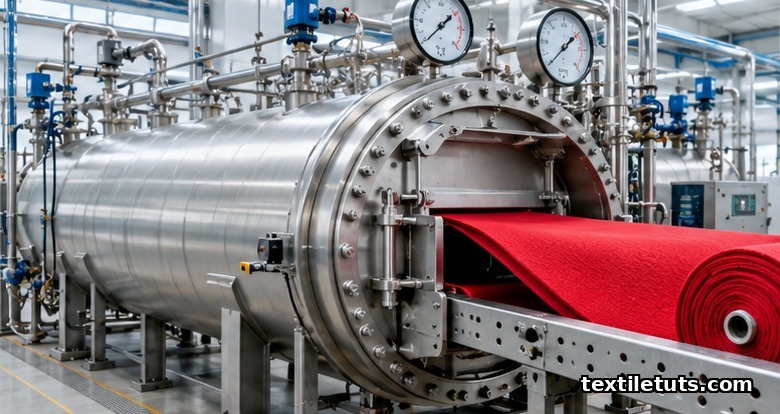
Supercritical carbon dioxide (scCO2) dyeing uses CO2 heated above its critical point of 31.1 °C and pressurized above 7.39 MPa to dissolve and fix disperse dyes onto synthetic fibers, cutting process water from roughly 100–150 L per kg of fabric to near zero and reducing energy use by 30–60% compared to conventional aqueous polyester dyeing.
The closed-loop system also recovers 92–98% of the dye for reuse, so what was once a high-effluent wet process becomes a dry, recyclable one in which CO2 itself is recycled rather than vented.
Below we walk through the physics that makes scCO2 a working solvent, the chemistry that lets it deposit dye inside polyester, the performance numbers documented in peer-reviewed studies, and the practical limits that still keep scCO2 units concentrated in polyester and nylon mills.
What “supercritical” actually means for a dye bath
A substance becomes supercritical when it is held above both its critical temperature and critical pressure at the same time. For carbon dioxide those values are 31.1 °C (87.9 °F) and 7.39 MPa, about 73 atmospheres or 1,072 psi. Above this point there is no clear boundary between liquid and gas. The fluid has the density of a liquid, which gives it real dissolving power, and the diffusivity of a gas, which lets it move quickly through fiber bundles. Because the fluid is non-polar, it dissolves the same disperse dyes already used on polyester rather than the ionic dyes that water carries.
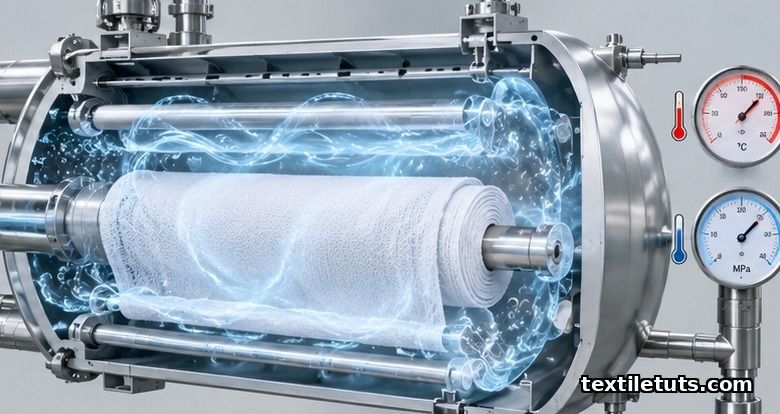
In a typical scCO2 dyeing vessel, the fabric is wound on a perforated beam or stacked on a carrier, sealed inside a pressure vessel, and brought to 80–130 °C and 15–30 MPa. Liquid CO2 from a storage tank is then pumped in, heated to the working temperature, and circulated through the substrate for 30–120 minutes. When the run ends, the vessel is depressurized and the CO2 flashes back to gas, leaving dyed fabric and a dry dye residue that can be collected from the separator and reused in the next batch.
The chemistry: why polyester dyes cleanly in CO2 and cotton does not
Disperse dyes are small, non-ionic, hydrophobic molecules designed to diffuse into the amorphous regions of polyester (polyethylene terephthalate, PET) and lodge there as the fiber cools. scCO2 is also non-polar and hydrophobic, so it dissolves disperse dyes at high concentrations without the dispersing agents and leveling surfactants that aqueous baths require. Once inside the swollen fiber, the dye is physically trapped as the CO2 leaves and the fiber contracts on cooling, producing a wash-fast shade that behaves like a solution-dyed polyester.
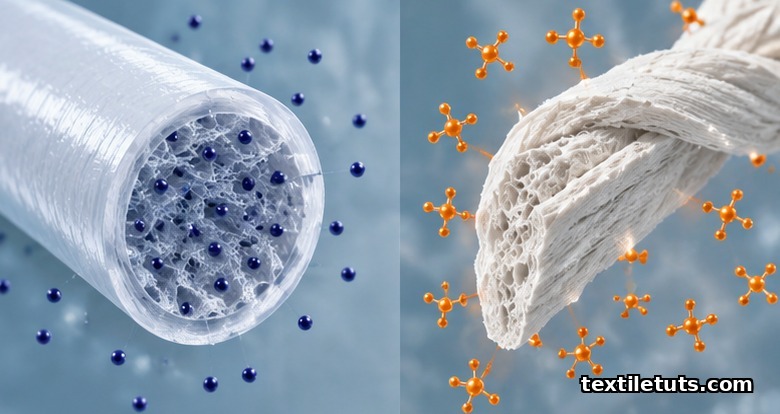
Cotton, wool, and viscose behave differently because their functional groups, hydroxyl on cotton and amino on wool, bond covalently with reactive dyes only in the presence of water. Without water, the reactive anchor cannot hydrolyze or substitute, and exhaustion in scCO2 falls below 30% in most published trials. Research groups have tried co-solvents (small amounts of water or methanol) and reverse-micelle systems to bring reactive chemistry into scCO2, but commercial lines still run on synthetic fibers, mainly PET and polyamide 6 and 6,6.
Process parameters and color-fastness results
Polyester dyeing in scCO2 has been benchmarked against aqueous exhaust dyeing in multiple peer-reviewed studies. Typical optimized conditions are 120 °C, 25 MPa, 60 minutes, with a liquor-to-goods ratio effectively of 0:1 because no liquid water is present. Color strength (K/S) and fastness ratings match or exceed those of aqueous-dyed controls. ISO 105-C06 wash-fastness grades of 4–5 and ISO 105-B02 light-fastness grades of 5–6 are reported for disperse dyes on PET at industrial trials.
Studies by Bach and colleagues, by Kraan and colleagues, and by Long and colleagues report consistent outcomes: equal shade depth, equal or better rubbing fastness (ISO 105-X12 dry crock 4–5, wet 3–4), and no surface oligomer deposition, a defect that aqueous dyeing often leaves on polyester. The absence of oligomer redeposition is a quiet side benefit because aqueous PET dyeing typically requires a reduction clear to remove oligomers, an extra step that scCO2 eliminates entirely.
Water, energy, and effluent numbers
The most-cited environmental case for scCO2 dyeing is the elimination of process water. Conventional exhaust dyeing of polyester uses 80–150 L of water per kg of fabric for the dye bath alone, plus another 30–80 L per kg in subsequent rinses. scCO2 uses essentially zero process water; the only water in the cycle is what the fiber itself absorbs (about 0.5–1% regain for PET) and what is used to make the steam that heats the vessel. Several life-cycle assessments report total water savings of 88–95% and energy savings of 30–60% compared to aqueous dyeing of the same fabric.
Effluent savings follow directly. There is no dye bath to discharge, so salt, alkali, surfactant, and hydrolyzed dye do not leave the plant. Dye utilization is high because unfixed dye precipitates in the separator when the CO2 flashes and is filtered out for reuse; reported reuse rates are 92–98% across multiple trials. The carbon footprint gain comes mostly from skipping the water heating, the reduction clear, and the wastewater treatment that aqueous dyeing carries.
Industrial adoption and equipment
The first commercial scCO2 dyeing machine for textiles was developed in the Netherlands in the 1990s and has since been commercialized by DyeCoo Textile Systems and by partners including Adidas, Nike, and several Asian mills. A modern industrial unit holds roughly 100–200 kg of fabric per batch, with cycle times of 1–2 hours including loading and depressurization. Capital cost remains 3–5× higher than an aqueous jet dyeing machine of the same capacity, which is why scCO2 lines are concentrated on premium, water-scarce, or tightly regulated supply chains such as sportswear, performance apparel, and recycled-PET programs.
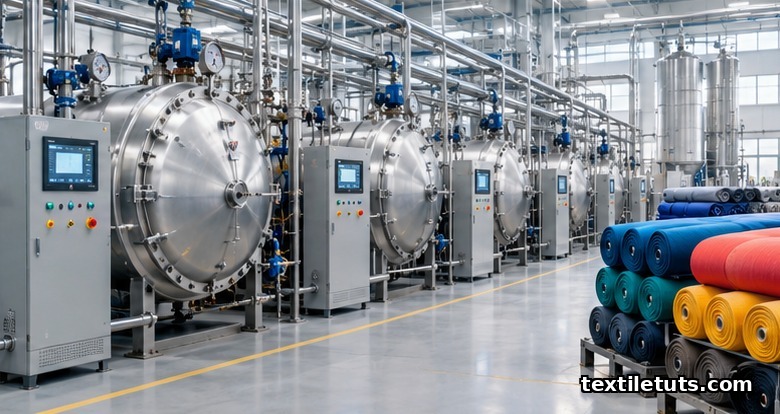
Outside polyester, scCO2 has been studied for dyeing polyamide (nylon 6 and 6,6) with disperse and selected acid dyes, polypropylene with disperse dyes, and aramid fibers used in protective wear. Pilot trials on cotton and wool using reactive dyes have remained at laboratory scale as of 2024. The synthetic-fiber ceiling is the single biggest factor that keeps scCO2 from replacing aqueous dyeing across the industry.
Comparison: scCO2 versus aqueous exhaust dyeing of polyester
| Parameter | Aqueous exhaust dyeing | scCO2 dyeing |
|---|---|---|
| Process water per kg fabric | 100–230 L | ~0 L |
| Energy use (whole process) | Reference baseline | 30–60% lower |
| Dye utilization | 70–90% | 92–98% |
| Effluent from dye bath | Salt, alkali, surfactant, hydrolyzed dye | None |
| Cycle time (PET) | 4–6 h including rinses | 1–2 h |
| Suitable fibers (commercial) | All major fibers | PET, polyamide, polypropylene |
| Dye classes (commercial) | Reactive, disperse, acid, vat, direct | Disperse; reactive under research |
| Reduction clear step | Often required | Not required |
| Capital cost per kg capacity | Reference | 3–5× higher |
Limitations and open questions
Three constraints keep scCO2 from replacing aqueous dyeing outright. First, fiber range: reactive cotton and wool dyeing still needs water and remains the bulk of global fabric volume. Second, capital cost: pressure vessels rated to 30 MPa are expensive and require periodic safety audits, which limits deployment outside groups with sustained capex budgets. Third, color matching: because reactive dye chemistry is absent, shade libraries must be built or rebuilt from disperse-dye formulations for every product line, which is a non-trivial reformulation effort for mills that have decades of recipes for cotton knits.
Research on cotton continues in academic labs, with co-solvent systems and enzymes pre-fixed to the fiber showing promising lab-scale results. Commercial cotton scCO2 lines have not been announced, and most peer-reviewed reviews still classify cotton as an open research problem rather than a solved application.
Frequently Asked Questions
What is supercritical CO2 dyeing used for?
Supercritical CO2 dyeing is used commercially for polyester (PET) and, in smaller volumes, for polyamide and polypropylene. Sportswear, performance apparel, and recycled-PET programs are the most common end uses because they value water savings and supply-chain transparency. About 60% of global fabric output is polyester by volume, which is the addressable market for scCO2 today.
Does supercritical CO2 dyeing produce effluent?
The dye bath itself produces no effluent because CO2 is recovered and recycled rather than released. The only wastewater in a scCO2 plant is from boiler steam, cooling, and any minimal rinse used for finishing. Compared with conventional aqueous exhaust dyeing, total effluent volume drops by 80–95% and salt load drops to near zero.
Can cotton be dyed with supercritical CO2?
Not yet at production scale. Reactive dyes, the standard class for cotton, need water to bond with the fiber’s hydroxyl groups. Laboratory trials with co-solvents and pre-activated cotton have produced pale to medium shades, but exhaustion and wash fastness remain below aqueous reactive dyeing, and no commercial cotton line has shipped as of 2024.
How much water does supercritical CO2 dyeing save?
Process water for the dye bath drops from 100–150 L per kg of polyester fabric to essentially zero. Across the full dyeing-to-finishing line, total water savings are typically 88–95%, depending on the mill’s finishing chemistry and whether any post-dye rinsing is included.
Is the color quality the same as water dyeing?
Peer-reviewed comparisons report equal shade depth, equal or better wash and rubbing fastness (ISO 105-C06 grades 4–5, ISO 105-X12 dry crock 4–5), and no surface oligomer residue. The main practical difference is the dye palette: it is limited to disperse-class dyes on synthetic fibers, so cotton shades and bright reactive colors are not yet accessible.
References
- Bach, E., Cleve, E., Schollmeyer, E. “Past, present and future of supercritical fluid dyeing technology.” Review of Progress in Coloration and Related Topics. https://onlinelibrary.wiley.com — peer-reviewed review of scCO2 dyeing fundamentals, dye classes, and process data.
- Kraan, M. van der, et al. “Dyeing of natural and synthetic fibres in supercritical carbon dioxide.” The Journal of the Textile Institute. https://www.tandfonline.com — peer-reviewed study of fiber range, color yield, and fastness results.
- Long, J.J., et al. “Supercritical fluid technology and its applications in textile dyeing and finishing.” Coloration Technology. https://onlinelibrary.wiley.com — peer-reviewed review covering process parameters and environmental metrics.
- Montero, G.A., Smith, C.B., Hendrix, W.A., Butcher, D.L. “Supercritical fluid technology in textile coloration.” AATCC Review. https://www.aatcc.org — industry-reviewed technical paper covering polyester and nylon trials.
- ISO 105-C06:2010. “Textiles — Tests for colour fastness — Part C06: Colour fastness to domestic and commercial laundering.” International Organization for Standardization, https://www.iso.org — color-fastness test method cited for wash-fastness grades.
- ISO 105-X12:2016. “Textiles — Tests for colour fastness — Part X12: Colour fastness to rubbing.” International Organization for Standardization, https://www.iso.org — color-fastness test method cited for crock-fastness grades.
- ISO 105-B02:2014. “Textiles — Tests for colour fastness — Part B02: Colour fastness to artificial light.” International Organization for Standardization, https://www.iso.org — color-fastness test method cited for light-fastness grades.
This article is the working reference for waterless dyeing with supercritical CO2. Editorial by Shahrukh Islam, TextileTuts. Sources: Bach et al.; Kraan et al.; Long et al.; Montero et al.; ISO 105-C06; ISO 105-X12; ISO 105-B02 as cited.


