
Water Vapor Permeability: ISO 15496

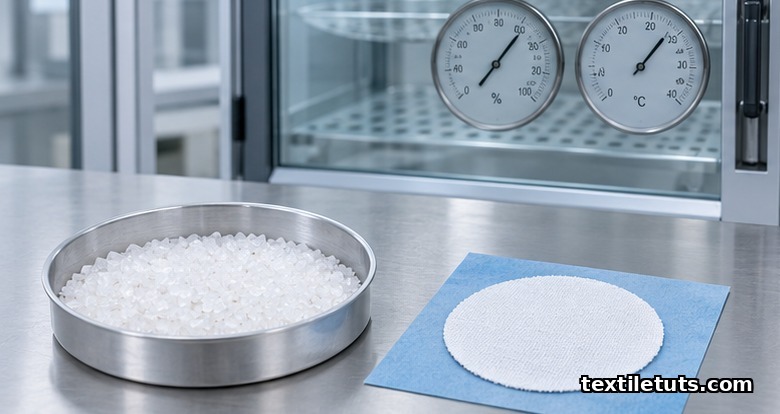
ISO 15496 specifies a dish-method test for the water vapor permeability of textiles in which a sealed specimen is mounted over a dish of potassium acetate desiccant, held at 23 °C and 50 % relative humidity, and the mass loss recorded at 1, 4, 8, and 15 hours gives a permeability index that, for woven cotton shirting, typically falls between 0.35 and 0.55 (dimensionless) and for high-performance sportswear laminates between 0.60 and 0.80. Because every variable (specimen size, dish geometry, desiccant mass, weighing schedule) is fixed by the standard, the result is reproducible across labs to within roughly ±5 %, which is why the method became the QC workhorse for routine batch release even though ISO 11092 (sweating hot-plate) and ASTM E96 still govern most research and specification work.
This article walks through what the standard actually measures, the apparatus and conditions it requires, the calculation that converts dish mass loss into a permeability index, and where ISO 15496 sits among the family of water vapor transmission tests used in the textile industry. By the end you should be able to read an ISO 15496 report critically, spot the common lab errors that inflate or depress the index, and choose the right standard for the question you are trying to answer.
What ISO 15496 Measures and What It Does Not
ISO 15496:2004, “Textiles — Measurement of water vapour permeability of textiles for the purpose of quality control,” is a quality-control test, not a physiological-comfort test. It measures the steady-state mass of water vapor that passes through a flat specimen under a fixed vapor-pressure gradient and reports it as a dimensionless permeability index relative to a reference fabric run in parallel [1]. It does not measure evaporative cooling, thermal resistance, or the comfort sensation a wearer feels; for those you need ISO 11092 on a sweating guarded-hotplate, or the Hohenstein skin model [2].
The distinction matters because the dish method’s vapor-pressure gradient (about 2.5 kPa across the specimen at 23 °C / 50 % RH with dry potassium acetate on the underside) is steeper than the gradient between skin and a calm indoor environment, and far steeper than the gradient a sweating person generates during exercise. A fabric that scores 0.50 on ISO 15496 may still feel clammy on a hot day, while a fabric that scores 0.80 may not be waterproof enough for rainwear. The number is a material constant, not a comfort verdict.
Test Conditions and Apparatus
The standard fixes every environmental and geometric parameter so that two labs in two countries can compare results without cross-calibration:
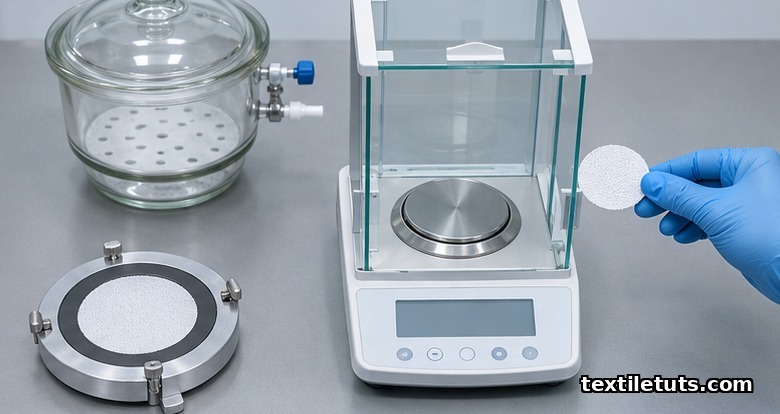
- Climate: 23 °C ± 1 °C and 50 % RH ± 2 % RH, the same ISO 139 atmosphere used for most textile conditioning.
- Specimen: circular test area of 0.005 m² (about 80 mm diameter), cut to avoid selvage, creases, or contamination.
- Desiccant: dry potassium acetate (CH₃COOK), pre-conditioned to constant mass, placed in the dish to a fill height of about 12 mm below the specimen.
- Seal: a flat rubber gasket and a clamping ring that compress the specimen uniformly against the dish rim; any leak path under the gasket destroys the result.
- Balance: readable to 0.001 g, calibrated.
- Reference fabric: a cotton woven of known permeability, supplied or qualified by the lab, run alongside each batch.
Pre-conditioning is 24 hours in the 23 °C / 50 % RH room before the first weighing. The standard explicitly forbids touching the test face of the specimen with bare fingers because skin oils block vapor channels and depress the index.
Step-by-Step Procedure
The dish is assembled with desiccant, sealed with the specimen, weighed on the analytical balance, and placed specimen-up in the conditioned cabinet. Four weighings follow the initial one: at 1 hour, 4 hours, 8 hours, and 15 hours, with the dish returned to the cabinet between each weighing. The 1-hour reading is treated as a transient and discarded; the slope of mass loss between 4 and 15 hours is the steady-state vapor flux used in the calculation.
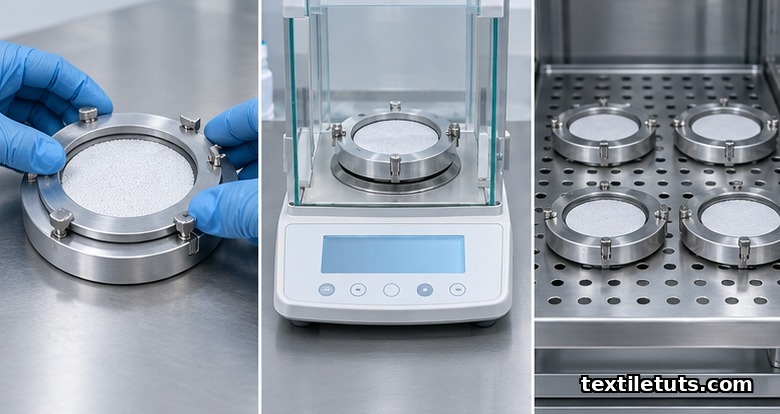
Two dishes are run for each specimen: one with the fabric face up (the “dry-side” configuration) and one with the face down (the “wet-side” configuration, which simulates the standard orientation when the dish is inverted inside the cabinet). The reported index is the average of the two orientations, expressed as a decimal between 0 (impermeable) and 1 (fully permeable).
Quality-control labs usually run three specimens per sample and average them. If any single specimen deviates from the mean by more than 10 %, the result is rejected and the sample re-cut, because fabric variability in mass per unit area is the single largest contributor to scatter in this test.
Calculation of Water Vapor Permeability Index
The index i for each orientation is the specimen’s steady-state mass loss rate divided by the reference fabric’s steady-state mass loss rate, both measured in the same cabinet at the same time:
i = (Δm_specimen / Δt) ÷ (Δm_reference / Δt)
where Δm is the mass loss in grams between the 4-hour and 15-hour weighings, and Δt is 11 hours. Because the reference fabric cancels environmental drift (a slow barometric change, a brief door opening, a 0.5 °C temperature oscillation) the index is far more stable between labs than an absolute permeability figure would be.
For routine QC the final report records: specimen identification, orientation, individual indices, average index, reference fabric identity, balance ID, climate log start and end time, and the name of the operator. A test report missing any of these should be treated as incomplete by the receiving party.
Where ISO 15496 Fits Among the Other Vapor Tests
The textile industry uses a small family of related standards, and choosing the wrong one is a frequent source of confusion on buyer specifications:
| Standard | Method | Typical Result | Best Use |
|---|---|---|---|
| ISO 15496 (dish method) | Mass loss of desiccant dish at 23 °C / 50 % RH | Dimensionless index 0 to 1 | Batch-to-batch QC, supplier audits, low-cost screening |
| ISO 11092 (sweating guarded-hotplate) | Heat flux to maintain plate at 35 °C under vapor gradient | Water-vapor resistance Ret (m²·Pa/W) | Physiological comfort claims, technical sportswear R&D |
| ASTM E96 (water method, desiccant method) | Mass change of dish or cup | Permeance (g/Pa·s·m²) or WVTR (g/m²·day) | Construction materials, coated fabrics, packaging laminates |
| AATCC TM 204 | Hydrostatic pressure plus MVTR, optional | Combined moisture management index (OMMC) | Moisture-management finishes on knit fabrics |
| JIS L 1099 (A-1 calcium chloride, B-1 potassium acetate) | Dish methods similar to ISO 15496 | g/m²·h | Japanese apparel buyer specifications, especially waterproof breathable laminates |
The choice is set by the question: a sportswear brand building a “breathable” claim needs ISO 11092; a workwear buyer checking that a finishing batch matches the previous one needs ISO 15496; a military procurement spec covering tent fabric may demand ASTM E96. Citing ISO 15496 in a comfort claim, or ISO 11092 in a batch-release QC report, is technically defensible but commercially awkward and usually flagged by an experienced buyer [3].
Common Sources of Error and How Labs Avoid Them
Three errors account for most of the spread seen in inter-laboratory comparisons. First, gasket leak: a single millimetre of unsealed specimen edge doubles the apparent permeability because vapor short-circuits around the fabric. The fix is to inspect the rubber gasket for nicks before every assembly and to discard gaskets older than 50 cycles.
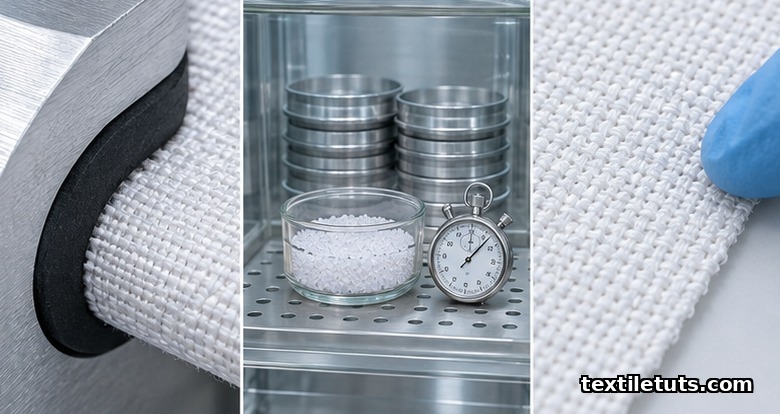
Second, desiccant hydration: potassium acetate picks up water from the room air during dish assembly. If the operator takes more than 60 seconds to load and weigh, the desiccant is no longer “dry” at t = 0, and the early weighings inflate the apparent flux. Trained labs keep a desiccator cabinet next to the balance and pre-weigh the empty dishes.
Third, specimen contamination: hydrophobic finishes (silicone softeners, fluorocarbon DWR) migrate under finger pressure and locally close the pore structure, depressing the index by 5 to 15 %. The standard requires handling specimens only by the edges with clean nitrile gloves; cotton gloves are not acceptable because they shed lint.
For coated or laminated fabrics, the standard also requires that the specimen be free of pinholes larger than 0.2 mm. A single laser-cut edge defect in a PTFE laminate can raise the apparent index from 0.05 to 0.40, and the test gives no warning of which specimen was defective without a follow-up bubble-leak check [4].
Frequently Asked Questions
What is a good water vapor permeability index for a regular woven shirt?
For a 100 % cotton poplin shirting at 120 g/m², an ISO 15496 index between 0.35 and 0.55 is typical; for a polyester/cotton blend at the same mass, 0.30 to 0.45; for a lightweight linen at 150 g/m², 0.50 to 0.65. Values above 0.70 for a woven fabric usually indicate an open construction that will also leak wind and rain, and should be checked against other performance properties before release [5].
How does ISO 15496 differ from ISO 11092?
ISO 15496 is a dish method that reports a dimensionless index and is intended for QC; it takes one working day and uses inexpensive equipment. ISO 11092 uses a sweating guarded-hotplate, reports water-vapor resistance in m²·Pa/W, simulates skin-like conditions, takes several hours per specimen, and costs an order of magnitude more. They are complementary, not interchangeable, and buyer specifications should name which one they require.
Can ISO 15496 be used on waterproof breathable laminates?
Yes, and it often is, because the method discriminates between good and bad laminates quickly. A well-made PTFE or PU hydrophilic laminate typically scores 0.55 to 0.75, while a defective laminate with micro-cracks scores above 0.85. The test does not, however, replace a hydrostatic head test (ISO 811) for waterproofness, and a fabric that scores well on ISO 15496 can still fail ISO 811.
Why is a reference fabric run in parallel with every batch?
The reference fabric cancels environmental drift between cabinets and across days, so two labs running the same specimen weeks apart get the same index even if their absolute mass-loss rates differ by 20 %. The reference also acts as a positive control: if the reference’s index moves more than 5 % from its established baseline, the batch is invalidated and the cabinet is checked for temperature, humidity, or balance drift.
How long does an ISO 15496 test take in practice?
One full test cycle is 15 hours plus 1 hour of setup, so most labs schedule it as an overnight run. A batch of six specimens on two balances, with pre-conditioning and reporting, fits comfortably into one technician-day, which is why the method is popular for routine QC of fabric rolls arriving at a garment factory.
References
- International Organization for Standardization. ISO 15496:2004 Textiles — Measurement of water vapour permeability of textiles for the purpose of quality control. ISO, 2004. https://www.iso.org/standard/31979.html — the official standard text, defining the dish method, specimen geometry, and reference-fabric procedure summarized above.
- International Organization for Standardization. ISO 11092:2014 Textiles — Physiological effects — Measurement of thermal and water-vapour resistance under steady-state conditions (sweating guarded-hotplate test). ISO, 2014. https://www.iso.org/standard/65931.html — the companion physiological-comfort method used when the buyer wants a comfort claim rather than a QC index.
- ASTM International. ASTM E96/E96M-22 Standard Test Methods for Gravimetric Measurement of Water Vapor Transmission Rate of Materials. ASTM, 2022. https://www.astm.org/e0096_e0096m-22.html — the construction-material standard often referenced for coated fabrics and packaging laminates.
- American Association of Textile Chemists and Colorists. AATCC Test Method 204: Moisture Management Properties of Textile Fabrics. AATCC, 2018. https://www.aatcc.org/ — the moisture-management method that complements ISO 15496 when a buyer cares about sweat transport in knit fabrics.
- McCullough, E. A., Kwon, M., & Shim, B. H. “A comparison of standard test methods for measuring water vapour permeability of fabrics.” Measurement Science and Technology, vol. 14, no. 8, 2003, pp. 1402–1408. https://iopscience.iop.org/article/10.1088/0957-0233/14/8/319 — peer-reviewed comparison of ISO 15496, ASTM E96, and ISO 11092 against the same fabric set, showing the typical inter-method offsets.
- Harnett, P. R., & Mehta, P. N. “A survey and comparison of laboratory test methods for measuring water vapour transmission of coated and laminated fabrics.” Journal of Coated Fabrics, vol. 13, no. 4, 1984, pp. 274–292. https://journals.sagepub.com/doi/10.1177/152808378401300404 — foundational inter-method study cited by most subsequent QC guidelines for coated textiles.
This article is the working reference for the ISO 15496 dish method for water vapor permeability in textiles. Editorial by Iftay Khairul Alam, TextileTuts. Sources: ISO 15496:2004; ISO 11092:2014; ASTM E96/E96M-22; AATCC TM 204; McCullough, Kwon, and Shim (2003); Harnett and Mehta (1984), as cited.


