
Seam Strength: ISO 13935

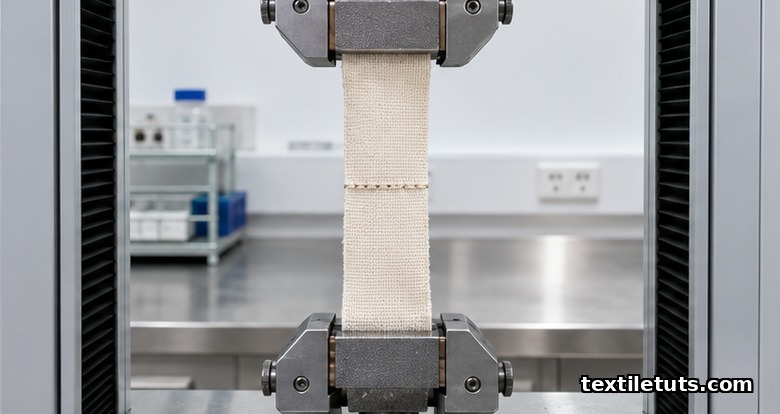
ISO 13935 specifies two methods for measuring the maximum tensile force a sewn seam can withstand when pulled transverse (perpendicular) to the seam line: Part 1 uses the grab method on a 100 mm wide specimen, while Part 2 uses the cut strip method on a 50 mm wide specimen, both extended at a constant rate of 50 mm/min until seam rupture occurs.
For most apparel applications, seam strength must exceed 100 N on lightweight woven shirts and 200 to 400 N on denim jeans, with seam efficiency (the ratio of seam strength to unsewn fabric strength) typically falling between 80% and 100% on well-constructed garments.
This guide explains what each part of ISO 13935 actually measures, how the grab and cut strip methods differ, the specimen dimensions and machine settings the standard requires, and how ISO 13935 sits alongside ASTM D1683 and ISO 13936 in a quality control workflow.
What ISO 13935 Measures and Why It Exists
Sewn seams are the structural weak points of most garments. A shirt can be cut from a fabric that resists 600 N of pull along its warp, but if the seam joining the shoulder falls apart at 80 N under normal wear, the garment fails in the field. ISO 13935 was developed to give textile laboratories a repeatable way to quantify that weak point so manufacturers, brands, and testing labs can compare seam performance across fabric types, stitch types, thread choices, and machine settings.
The standard, formally titled “Textiles, Seam tensile properties of fabrics and made-up textile articles”, was first published in 1999 and revised in 2002. It applies to woven and knitted fabrics and to seams sewn by any stitch type. ISO 13935 quantifies a single primary result: the maximum force, in newtons, recorded when a strip of fabric containing a seam perpendicular to the direction of pull is extended until rupture. From that single number, two secondary values are commonly calculated:
- Seam strength (N): the peak force the seam withstands.
- Seam efficiency (%): seam strength divided by the strength of the unsewn fabric, multiplied by 100.
Seam efficiency is the figure quality managers typically track, because it tells them whether the seam is the limiting factor in the garment or whether the fabric itself is the bottleneck. Values above 80% generally indicate a balanced construction. Values below 60% usually indicate that thread, stitch density, or seam type need adjustment before the garment reaches the consumer.
Part 1 vs Part 2: Grab Method vs Cut Strip Method
ISO 13935 is a two-part standard because no single test specimen geometry captures every seam type accurately. The two parts are not interchangeable. They give systematically different numbers on the same seam because the stress distribution at the seam line differs between the two clamp geometries.
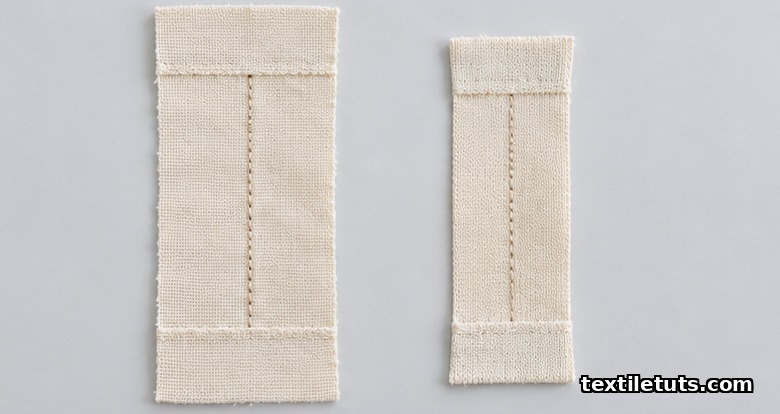
| Property | Part 1 (Grab) | Part 2 (Cut Strip) |
|---|---|---|
| Specimen width | 100 mm | 50 mm |
| Clamp width | 25 mm central grip | 50 mm full-width clamp |
| Best suited for | Woven fabrics, balanced seams | Knitted fabrics, stretch seams |
| Typical result magnitude | Higher (grip concentrates stress) | Lower (uniform stress distribution) |
| Method origin | Based on ISO 13934 grab principles | Based on ISO 13934 cut strip principles |
Choose Part 1 for tight, stable wovens where the seam line itself is the point of interest. Choose Part 2 for knitted fabrics, lace, or stretch seams where the fabric between the clamps must elongate uniformly to avoid premature jaw breaks. Most denim and shirting labs default to Part 1 because the historical denim seam strength data in their spec sheets is grab-method data.
Specimen Preparation and Machine Settings
Both parts of ISO 13935 share the same conditioning and machine setup. Specimens must be conditioned for 24 hours at 20 °C and 65% relative humidity per ISO 139 before testing, because seam strength is sensitive to moisture content. Cotton threads in particular lose measurable strength at low humidity. The testing machine must be a constant-rate-of-extension (CRE) tensile tester with a load cell accurate to within 1% of the expected seam force.
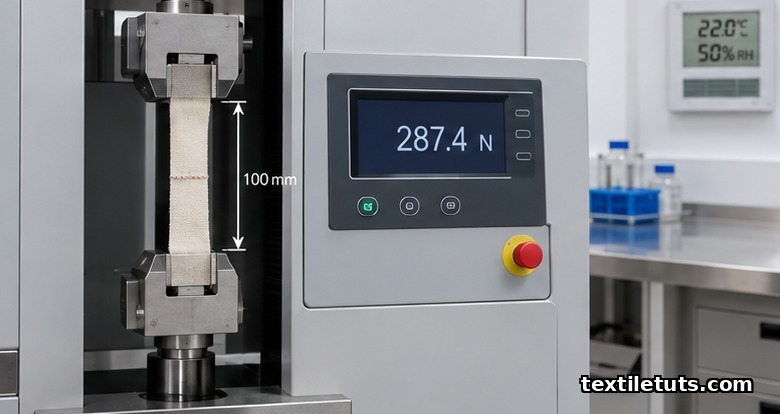
Required machine settings are fixed by the standard to remove operator variability:
- Crosshead speed: 50 mm/min for both parts.
- Gauge length (jaw separation): 100 mm for Part 1 and 200 mm for Part 2.
- Number of specimens: minimum 5 per direction (warp and weft, or course and wale for knits), giving a minimum of 10 specimens per fabric sample.
- Pre-load: typically 2 N, applied to remove slack without stretching the seam.
The seam must be positioned at the center of the gauge length so the rupture zone falls on the seam line, not on the fabric 20 mm away from it. If fabric rupture occurs before seam rupture, the test result is invalid for seam strength comparison and must be reported as “fabric rupture” rather than “seam rupture”. Specimens that fail at the clamps are recorded as “jaw breaks” and are excluded from the seam strength calculation.
How to Read ISO 13935 Results
Results are reported as the arithmetic mean of the maximum force (N) recorded for valid specimens, with the standard deviation alongside. A typical lab report entry reads: “Seam strength (grab): 287 N plus or minus 18 N, warp direction; 312 N plus or minus 22 N, weft direction.” Failure mode must also be noted, because the location of rupture changes the interpretation:
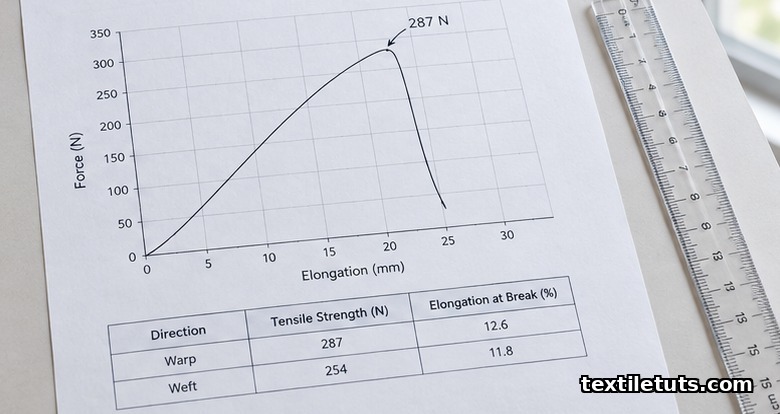
- Seam rupture (thread breaks): sewing thread snapped first. Suggests thread size or stitch density is too low for the fabric weight.
- Seam rupture (yarn slippage): warp or weft yarns pulled out of the seam before thread rupture. Suggests fabric structure is too open or stitch tension is too loose.
- Fabric rupture: fabric tore next to the seam, leaving the seam intact. The seam is stronger than the fabric, and this is the desired failure mode for high-quality garments.
- Jaw break: specimen slipped or broke at the clamps. Specimen geometry must be adjusted, and the test is invalid for seam comparison.
Most spec sheets for woven apparel require a minimum grab seam strength of 140 N at the seams and a minimum seam efficiency of 80%. Knitted apparel specs typically require 100 N minimum and 70% efficiency, reflecting the lower absolute strength of knit structures and the greater role of stretch in field performance.
ISO 13935 vs ASTM D1683 vs ISO 13936
ISO 13935 is one of three related seam test standards. Picking the right one depends on fabric type and on what aspect of seam performance you want to capture.
| Standard | What it measures | Best for |
|---|---|---|
| ISO 13935-1 / 13935-2 | Maximum seam force, transverse pull | Woven and knit apparel seams, quality control |
| ASTM D1683 / D1683M | Maximum seam force, transverse pull | U.S. spec sheets for woven garments, comparable to ISO 13935-1 |
| ISO 13936 | Bursting force at seam (ball-burst principle) | Knitted fabrics and lingerie, where transverse pull distorts the seam |
ASTM D1683 is technically equivalent to ISO 13935-1 for woven fabrics, with minor differences in specimen width and clamp geometry. Many global brands accept either result for compliance, and conversion factors between the two methods are well documented in the literature. ISO 13936 is preferred for knitted and stretch seams because transverse pull on a knit can give misleadingly low numbers. The multidirectional burst load in ISO 13936 better reflects how a T-shirt or pair of leggings actually fails in wear, where the stress is rarely a single axis.
Frequently Asked Questions
What is the difference between ISO 13935-1 and ISO 13935-2?
ISO 13935-1 specifies the grab method on a 100 mm wide specimen with 25 mm central clamps, suited to woven fabrics. ISO 13935-2 specifies the cut strip method on a 50 mm wide specimen with full-width clamps, better suited to knitted and stretch fabrics. The two methods give different absolute values, so results from Part 1 and Part 2 cannot be directly compared in a single spec sheet.
What seam strength is considered acceptable for a pair of jeans?
For denim jeans, a typical spec sheet requires a minimum grab seam strength (ISO 13935-1) of 250 N at the outseam and 200 N at the seat seam, with seam efficiency above 80%. Premium denim brands often spec 350 N or higher to survive repeated laundering stress over the life of the garment.
What is seam efficiency?
Seam efficiency is the ratio of seam strength to unsewn fabric tensile strength, expressed as a percentage. An efficiency of 100% means the seam is as strong as the surrounding fabric. Below 70%, the seam is the weak link and is likely to fail before the fabric does, which is the most common field failure mode for low-quality garments.
How many specimens does ISO 13935 require?
ISO 13935 requires a minimum of five specimens per direction (warp and weft for wovens, course and wale for knits), giving at least ten specimens per fabric sample. Each specimen must rupture at the seam line to count as a valid seam strength result. Specimens that rupture in the fabric body or at the clamps are reported separately and do not enter the seam strength mean.
Does ISO 13935 apply to knitted fabrics?
Yes, both parts of ISO 13935 apply to knitted fabrics, but Part 2 (cut strip method) is generally preferred for knits because transverse pull on a knit specimen can produce jaw breaks or fabric rupture rather than clean seam rupture. For highly elastic knits and lingerie, ISO 13936 (bursting method) is often a better fit, since the multidirectional load more closely matches how these garments fail in wear.
References
- International Organization for Standardization. ISO 13935-1:2002, Textiles, Seam tensile properties of fabrics and made-up textile articles, Part 1: Determination of maximum force on seam transverse to the seam using the grab method. https://www.iso.org/standard/34451.html, Specifies the 100 mm wide grab method for woven and knit fabrics.
- International Organization for Standardization. ISO 13935-2:2002, Textiles, Seam tensile properties of fabrics and made-up textile articles, Part 2: Determination of maximum force on seam transverse to the seam using the cut strip method. https://www.iso.org/standard/34452.html, Specifies the 50 mm wide cut strip method for woven and knit fabrics.
- ASTM International. ASTM D1683/D1683M-22, Standard Test Method for Failure in Sewn Seams of Woven Fabrics. https://www.astm.org/d1683_d1683m-22.html, U.S. equivalent method for woven apparel seams.
- International Organization for Standardization. ISO 13936-1:2004, Textiles, Determination of bursting strength of fabrics, Part 1: Hydraulic method. https://www.iso.org/standard/34453.html, Bursting method used as a complement for knitted and stretch seams.
- International Organization for Standardization. ISO 139:2005, Textiles, Standard atmospheres for conditioning and testing. https://www.iso.org/standard/34456.html, Specifies the 20 °C and 65% RH conditioning required before ISO 13935 testing.
- Mukhopadhyay, A., Sikka, M., and Karmakar, A. K. (2013). Impact of stitch density and seam type on seam strength and efficiency of cotton woven fabrics. Indian Journal of Fibre & Textile Research, 38, 56-61. Peer-reviewed study correlating stitch density and seam type with seam efficiency in cotton shirting and poplin.
This article is the working reference for ISO 13935 seam strength testing. Editorial by Iftay Khairul Alam, TextileTuts. Sources: ISO 13935-1, ISO 13935-2, ASTM D1683/D1683M, ISO 13936-1, ISO 139, and Mukhopadhyay et al. (2013) as cited.


