
Water Resistance: AATCC 127 (Hydrostatic Head)

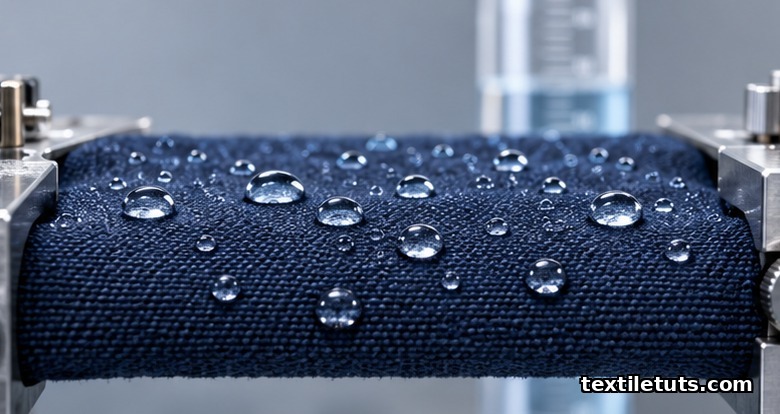
AATCC Test Method 127 (“Water Resistance: Hydrostatic Pressure Test”) measures fabric resistance to water penetration under steadily increasing water pressure, with the end point recorded as the pressure, in centimeters of water column or millibars, at which three droplets of water penetrate the specimen face.
For outdoor apparel, a hydrostatic head rating of 5,000 mm is widely accepted as the practical minimum for waterproof rainwear, while 10,000 mm or higher is recommended for sustained heavy-rain conditions and for activities that put body pressure on the fabric (kneeling, sitting on wet ground, or carrying a loaded backpack).
This article walks through what AATCC 127 actually measures, how the test is run, the apparatus and specimen conditions, how the result compares against ISO 811 and the related AATCC 42 spray test, and which hydrostatic head rating a buyer should look for in a given end use.
What AATCC 127 measures (and what it does not)
AATCC 127 is a hydrostatic pressure test. A fabric specimen is clamped face-down over a chamber filled with water, the water pressure on the face of the fabric is increased at a controlled rate, and the test ends when three droplets of water penetrate the visible face of the specimen. The pressure at that moment, expressed in centimeters of water column (cm H2O) or millibars (mbar; 1 mbar ≈ 1.0197 cm H2O), is the hydrostatic head of that fabric. Common industrial shorthand is “mm” (1 cm H2O = 10 mm H2O).
The test is a static pressure method. It does not simulate rain impact (that role is filled by AATCC 22, the spray test, and AATCC 42, the impact penetration test) and it does not measure the durability of a durable water repellent (DWR) finish after washing, although the test can be repeated after a specified number of wash cycles. AATCC 127 is best understood as one number that tells you how much continuous water pressure a fabric can hold back before it leaks.
Apparatus, specimen, and test conditions
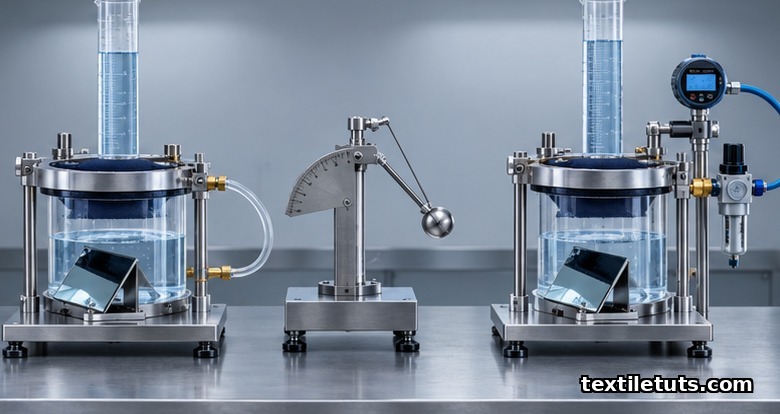
The test rig has three functional parts: a clamp that holds the specimen face-down over a chamber, a water column (typically a graduated cylinder that is mechanically raised, or a regulated pressure source feeding a manometer), and a viewing surface or mirror below the specimen so the technician can spot droplet penetration without lifting the clamp.
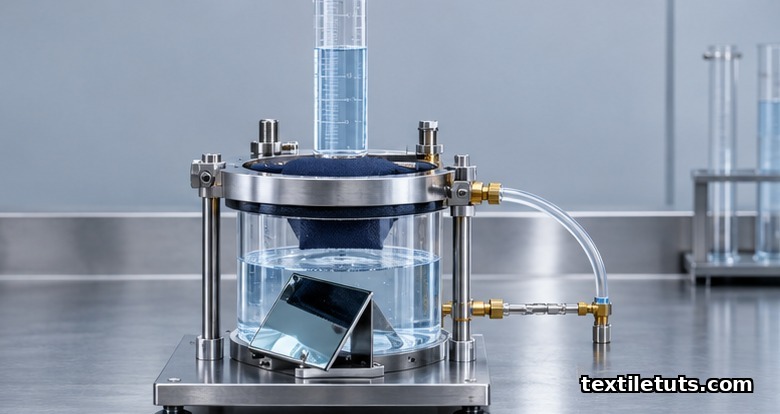
According to the AATCC Test Method 127 published procedure, the standard specimen is a 200 mm × 200 mm square (test area 100 cm²), conditioned at 21 ± 2 °C and 65 ± 2% relative humidity for at least 4 hours before testing. Distilled or deionized water at 21 ± 1 °C (or 27 ± 1 °C for tropical conditions) is used as the test liquid. Pressure is increased at 60 ± 3 cm H2O/min. (ISO 811, the international equivalent, also allows a slower 10 cm H2O/min rate, which suits fabrics whose performance may be rate-sensitive, such as some coated fabrics with viscoelastic polymer layers.)
Five specimens are tested per fabric sample. If the fabric is anisotropic (most wovens and many knits), five specimens are taken in each principal direction, for ten tests total. The reported result is the average pressure at penetration, reported to the nearest centimeter or millibar, with the direction noted when relevant.
Reading the result: hydrostatic head rating thresholds
Hydrostatic head ratings are commonly banded into performance tiers, although the banding is industry convention rather than a codified standard. The widely cited tiers, drawn from outdoor-industry guidance and from standards such as EN 343, are:

- Below 500 mm: not considered water-resistant; suitable only for dry conditions or as a decorative layer.
- 500–1,500 mm: resists light rain and snow for short periods; acceptable for everyday jackets, school bags, and pack covers.
- 1,500–5,000 mm: water-resistant to waterproof for most conditions; suitable for general outdoor wear and hiking.
- 5,000–10,000 mm: waterproof under sustained rain and body pressure (backpack straps, kneeling, sitting on wet ground).
- 10,000 mm and above: high-performance waterproofing for severe weather and mountaineering shells.
For comparison, a typical woven nylon with a polyurethane (PU) coating rates around 1,500–3,000 mm; a 3-layer waterproof breathable membrane such as those used in mountaineering jackets routinely tests above 20,000 mm. The hydrostatic head value scales with how the fabric is built: tighter weave, hydrophobic fiber finish, and a continuous coating or membrane each push the number higher.
AATCC 127 vs ISO 811 vs other hydrostatic tests
The international equivalent of AATCC 127 is ISO 811, “Textile fabrics: Determination of resistance to water penetration, Hydrostatic pressure test.” Both tests clamp the specimen, increase water pressure at a controlled rate, and use three droplets penetrating as the end point. ISO 811 specifies a test area of 100 cm² and a rate of pressure increase of either 6 kPa/min (about 60 cm H2O/min) or 1 kPa/min. AATCC 127 and ISO 811 results are directly comparable when run at the higher rate on the same fabric.
| Standard | Method | Rate | End point | Report unit |
|---|---|---|---|---|
| AATCC 127 | Hydrostatic pressure | 60 cm H2O/min | 3 droplets | cm H2O or mbar |
| ISO 811 | Hydrostatic pressure | 6 or 1 kPa/min | 3 droplets | cm H2O or kPa |
| AATCC 42 | Impact penetration | 500 mL spray, 27.6 kPa | Mass gain of blotter | grams |
| AATCC 22 | Spray test | 250 mL spray, 27.6 kPa | Visual rating 0–100 | ISO spray rating |
| ASTM D751 | Hydrostatic pressure (coated fabrics) | Procedure A or B | 3 droplets or visual leak | psi or cm H2O |
AATCC 42 and AATCC 22 measure a different property: how well the fabric sheds the kinetic energy of falling or impacted water. A fabric can score well on AATCC 127 (sustained pressure) and poorly on AATCC 42 (impact), or vice versa, so the two tests are complementary rather than interchangeable. Quality specifications for waterproof outerwear typically require passing both, plus a seam-strength test, before the garment is labeled waterproof.
Factors that change the hydrostatic head result
Several variables move the number up or down on the same fabric. The most important:
Coatings and membranes. A woven nylon with no coating might rate below 200 mm. The same fabric with a polyurethane (PU) coating typically pushes the value above 1,500 mm; with a thermoplastic polyurethane (TPU) or expanded PTFE (ePTFE) membrane, values of 10,000 mm and above are routine.
Seam and needle-hole effects. AATCC 127 can be run on a seam rather than a flat panel. Seams with no seam tape will leak at much lower pressures than the parent fabric, because stitch holes act as preferential pathways for water. Heat-welded or radio-frequency welded seams close those pathways and restore much of the parent fabric’s hydrostatic head.
Washing and abrasion. The durable water repellent (DWR) finish on the face of a waterproof breathable fabric degrades with wash cycles and field use. Repeating AATCC 127 after 5, 10, or 20 wash cycles is a standard QA check for outerwear factories; a typical specification requires the fabric to retain at least 80% of its original hydrostatic head after 20 wash cycles.
Specimen orientation. Woven fabrics often show higher hydrostatic head in the warp direction than the weft, especially if the warp is finer or more tightly set. Knits can be direction-dependent because of wales versus courses. This is why AATCC 127 reports results by direction when the fabric is anisotropic.
Temperature of the water. Warmer water is less viscous and penetrates some coatings more easily, lowering the hydrostatic head. The standard controls this at 21 ± 1 °C or 27 ± 1 °C, and deviations from the controlled temperature are a common source of inter-lab disagreement.
Practical guidance: what rating does the buyer actually need?
For most consumer rainwear (commuter jackets, school bags, light hiking gear), a hydrostatic head of 1,500–5,000 mm is appropriate when the garment is sold as “water-resistant,” and 5,000–10,000 mm when sold as “waterproof.” For high-exertion or pressure-loaded uses (mountaineering shells, sailing drysuits, motorcycle suits), 10,000 mm is the conventional minimum, with premium shells testing above 20,000 mm.
It is worth noting that “waterproof” in retail marketing is not regulated to a single hydrostatic head threshold. EN 343, the European standard for protective clothing against rain, sets the wet-penetration resistance bar at ≥ 8,000 Pa (about 80 cm H2O, roughly equivalent to 800 mm) for Class 1 protection and ≥ 13,000 Pa (about 130 cm H2O) for Class 3. Brand-level claims of “10K/10K waterproof” usually refer to 10,000 mm hydrostatic head paired with 10,000 g/m²/24h moisture vapor transmission, the latter measured by methods such as ASTM E96 (water method) or JIS L 1099. Hydrostatic head on its own does not describe breathability.
If you are sourcing fabrics for a finished product, the most defensible specification is to require the fabric to meet AATCC 127 (or ISO 811) at a stated minimum rating after a stated number of wash cycles, and to require the seams (taped or welded) to meet the same rating. Hydrostatic head on a swatch does not translate directly into garment performance if the seams leak at a third of the pressure.
Frequently Asked Questions
Is AATCC 127 the same as ISO 811?
Functionally yes, for routine testing. Both apply increasing hydrostatic pressure to the face of a fabric and use three droplets as the end point. The rate of pressure increase is specified in different units (cm H2O/min vs kPa/min), and minor differences exist in specimen preparation and reporting, but a fabric tested under either method produces comparable results when run at the equivalent rate. ISO 811 is the standard cited in EU regulations; AATCC 127 is the standard cited in US apparel specifications.
How many specimens do I need for AATCC 127?
Five specimens per fabric sample is standard, with each specimen tested once. If the fabric is anisotropic (most wovens and knits), five specimens are taken in each principal direction, for ten tests total. The reported result is the mean of the five specimens in each direction, to the nearest centimeter or millibar.
What hydrostatic head rating is considered “waterproof”?
There is no single international threshold, but industry convention treats 1,500 mm as the lower bound for general waterproofing and 10,000 mm as the lower bound for high-performance outerwear. EN 343 requires at least 8,000 Pa (≈ 80 cm H2O, or about 800 mm) for Class 1 protective rainwear and at least 13,000 Pa for Class 3.
Can AATCC 127 be run on a finished garment?
Indirectly. The test method calls for a flat specimen, so it is run on a fabric sample cut from the garment or on a swatch produced under the same lot and finishing conditions. For end-product testing, factories use seam and whole-garment shower tests (such as AATCC 35, the rain test for garments) rather than the hydrostatic pressure method.
Why does my fabric pass AATCC 42 but fail AATCC 127?
AATCC 42 measures water-shedding under impact (a 500 mL spray at 27.6 kPa). AATCC 127 measures sustained pressure. A tightly woven fabric with a good DWR finish can shed impact water and still leak under sustained pressure if it has no continuous coating or membrane. The two tests describe different failure modes; both are useful, and a fully waterproof specification typically requires passing both.
References
- AATCC. Test Method 127: Water Resistance: Hydrostatic Pressure Test. AATCC Technical Manual. Research Triangle Park, NC: American Association of Textile Chemists and Colorists. Official method document.
- ISO. ISO 811:2018 — Textile fabrics — Determination of resistance to water penetration — Hydrostatic pressure test. Geneva: International Organization for Standardization.
- AATCC. Test Method 42: Water Resistance: Impact Penetration Test. AATCC Technical Manual.
- ASTM International. ASTM D751 — Standard Test Methods for Coated Fabrics. West Conshohocken, PA.
- Holmes, D. A. (2000). Waterproof Breathable Fabrics. In: Textiles for Protection (ed. R. A. Scott), Woodhead Publishing, pp. 282–315. Peer-reviewed chapter on the relationship between coating, membrane, and hydrostatic head performance.
- Mukhopadhyay, A., and Midha, V. K. (2016). A Review on Designing the Waterproof Breathable Fabrics Part I: Fundamental Principles and Mathematical Modelling of Moisture Transport. Journal of the Textile Institute, 107(6), 701–710.
This article is the working reference for AATCC 127 hydrostatic head testing on textiles. Editorial by Iftay Khairul Alam, TextileTuts. Sources: AATCC Test Method 127, ISO 811, AATCC Test Method 42, ASTM D751, and peer-reviewed references as cited.


