
Fabric Thickness: ISO 5084

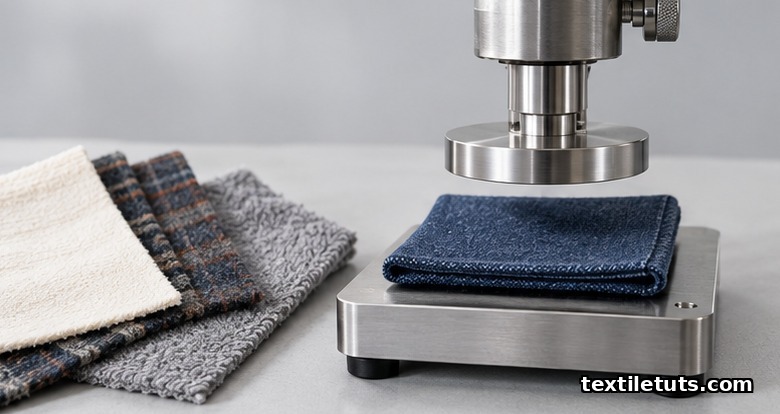
ISO 5084:1996 specifies that fabric thickness is the distance, in millimetres, between a reference plate and a circular presser foot of standard area (1,000 mm² for general fabrics, 2,000 mm² for bulky textiles) that exerts a defined pressure of 1 kPa (0.01 N/mm²) on the specimen, measured after 10 s under a standard atmosphere of 20 °C ± 2 °C and 65 % ± 4 % relative humidity. The same standard allows reduced pressures (0.2 kPa for pile fabrics and carpets) when the bulk or compressibility of the material would skew the reading, and the report must declare which pressure was used. Because thickness drives thermal resistance, hand feel, compressibility, and the accuracy of any later gravimetric test (such as GSM by area), an ISO 5084 reading is the first numeric property most labs record when a fabric arrives for quality control.
This article walks through the apparatus, the conditioning required by ISO 139, the step-by-step procedure, and the pressure-selection rules that govern ISO 5084, then contrasts the standard with ASTM D1777 and ISO 9073-2 so you can match the right method to woven, knitted, nonwoven, pile, or carpet samples.
What ISO 5084 Measures, and What It Does Not
ISO 5084:1996, Textiles — Determination of thickness of textiles and textile products, defines thickness as the perpendicular distance between two parallel plates that bound a fabric under a specified compressive load. The reading is a bulk property, not a fibre or yarn property: it captures the combined effect of yarn diameter, weave or knit density, crimp, finishing, and any loft imparted by raising, brushing, or chemical bulking.
The standard applies to woven, knitted, and felted fabrics, and it is also used on nonwovens when ISO 9073-2 is not invoked. It explicitly excludes textiles measured under loads outside its pressure table, geotextiles tested to ISO 9863, and pile carpets when an industry-specific test method (such as ISO 1765 for carpet thickness under a defined static load) is more appropriate.
Required Apparatus
An ISO 5084 thickness gauge has four mandatory components: a flat, rigid reference plate; a circular presser foot of known area; a means of applying a defined pressure; and a displacement sensor (dial indicator, LVDT, or digital encoder) readable to 0.01 mm or better. The presser foot must be parallel to the reference plate within 0.2 % across the contact area, and the gauge must be verified with calibrated thickness standards before each test session.
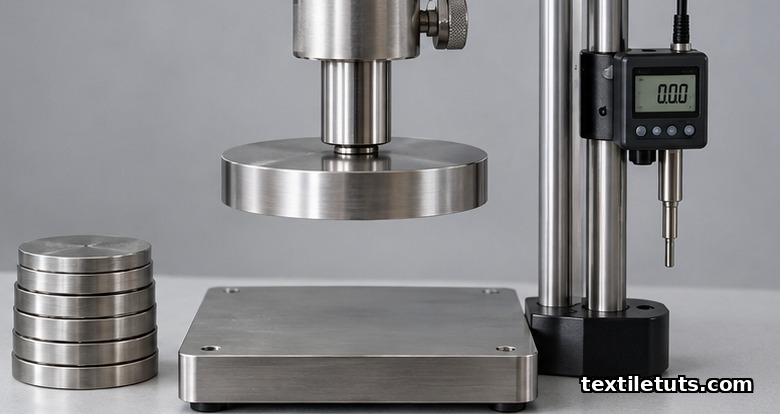
For general woven and knitted fabrics the presser foot area is 1,000 mm² (a circle of about 35.7 mm diameter). For bulky fabrics, knitted pile, and carpets the foot grows to 2,000 mm² to spread the load and reduce local compression. The foot is lowered onto the specimen gradually, not dropped, so dynamic impact does not add to the static pressure.
Test Atmosphere: ISO 139 Conditioning
Thickness is hygroscopic. Cotton, wool, viscose, and most protein and regenerated-cellulose fibres swell measurably as relative humidity rises, and thermoplastic fibres creep under load when temperature is uncontrolled. ISO 5084 therefore borrows the standard atmosphere defined in ISO 139: Textiles — Standard atmospheres for conditioning and testing, which fixes the laboratory at 20 °C ± 2 °C and 65 % ± 4 % RH.
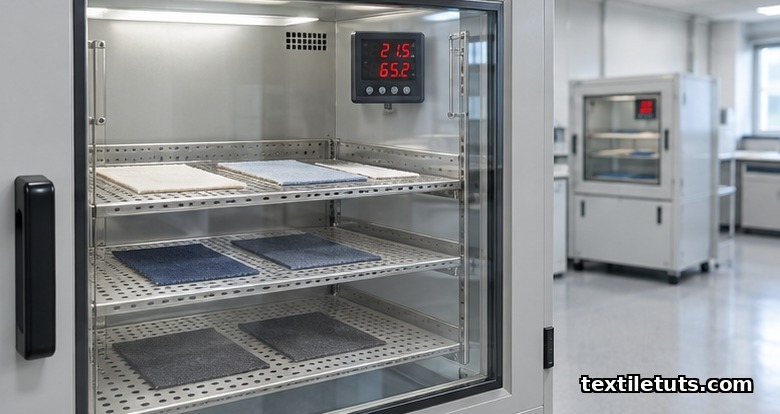
Specimens are preconditioned if they are wet or have been exposed to extremes, then conditioned flat, free of tension, for at least 24 hours until constant mass is reached. The same atmosphere is maintained during the test. Without this step, the same fabric can read 2 % to 4 % thicker at 90 % RH than at 40 % RH, a difference large enough to fail a tolerance band of ±0.05 mm.
Step-by-Step Procedure
Place the conditioned specimen on the reference plate without folds, creases, or tension, ensuring it lies flat across the full presser-foot area. Lower the foot gradually until the specified pressure is reached, start the 10-second timing interval, and record the displacement reading at the end of that interval. Move the foot to a fresh location, repeat for a total of five readings on five different specimens (or five locations on one specimen if the fabric is dimensionally uniform), and average the results.
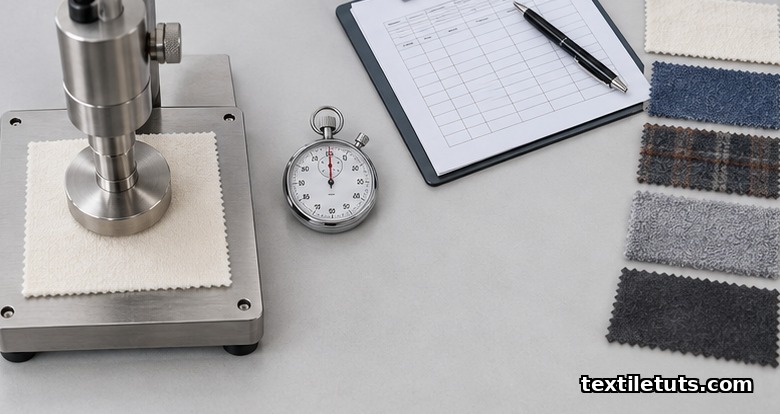
For pile fabrics and carpets, the standard lowers the pressure from 1 kPa to 0.2 kPa and shortens the reading interval because the bulk compresses slowly under load and the standard 10-second wait would shift the reading downward by 5 % to 10 % on loose constructions. The test report must state the pressure used, the presser-foot area, the number of readings, the mean, the standard deviation, and the conditioning atmosphere.
Pressure Selection by Fabric Type
The default 1 kPa load works for most woven shirting, suiting, denim, sheetings, and flat knit fabrics. Pile fabrics, terry towels, carpets, and lofty nonwovens need 0.2 kPa or even 0.02 kPa depending on the construction. Tightly woven technical fabrics, coated textiles, and laminated composites can tolerate higher pressures (often 5 kPa or 10 kPa in custom test plans) without crushing the structure, but those higher loads fall outside ISO 5084’s table and must be reported as deviations from the standard method.
The pressure choice is not a detail; it is a specification. A denim twill measured at 1 kPa typically reads 0.85 mm to 1.10 mm, while the same denim at 5 kPa can drop to 0.70 mm to 0.90 mm. Quoting thickness without naming the pressure is a common laboratory error that makes cross-mill comparisons meaningless.
Result Reporting and Precision
Report thickness to the nearest 0.01 mm. Express precision as the coefficient of variation across the five readings; a CV above 5 % usually indicates fabric variability rather than instrument noise and should prompt a larger specimen count. ISO 5084 itself does not publish a single interlaboratory reproducibility figure, but round-robin data reported in the textile metrology literature place the between-laboratory reproducibility (R) at roughly ±4 % to ±6 % for uniform woven fabrics when the same pressure and presser-foot area are used.
Always retain the conditioning log with the test report. If a buyer later disputes a thickness reading, the conditioning record (time in the standard atmosphere, RH and temperature trace) is the evidence that the lab followed the method.
ISO 5084 vs ASTM D1777 vs ISO 9073-2
| Feature | ISO 5084:1996 | ASTM D1777 | ISO 9073-2 (nonwovens) |
|---|---|---|---|
| Scope | Woven, knitted, felted fabrics; nonwovens (optional) | Woven, knitted, nonwoven, pile, coated textiles | Nonwovens only |
| Standard pressure | 1 kPa general, 0.2 kPa pile/carpet | Selectable; common 0.7 kPa, 4.7 kPa, 50 kPa | 0.5 kPa typical; 0.1, 1.0 kPa permitted |
| Presser-foot area | 1,000 mm² or 2,000 mm² | Variable by fabric type | 2,500 mm² (circular) |
| Reading interval | 10 s | 5 s or 10 s depending on method | 10 s |
| Conditioning | ISO 139 (20 °C, 65 % RH) | ASTM D1776 (21 °C, 65 % RH) | ISO 139 |
| Report unit | mm (0.01 mm resolution) | mm or in. | mm |
The three standards overlap heavily, but the difference in default pressure (ISO 5084’s 1 kPa versus ISO 9073-2’s 0.5 kPa versus ASTM D1777’s flexibility) means a single fabric can return three different numbers depending on which method the lab uses. Match the method to the buyer’s specification before sampling, not after.
Common Pitfalls in the ISO 5084 Workflow
Skipping conditioning is the single largest source of dispute. Stretching a specimen on the anvil to flatten it artificially lowers the reading by removing crimp. Reading the displacement before the 10-second interval elapses is common on automated rigs and biases the result upward on compressible fabrics. Finally, using a worn presser foot whose edge has been polished to a knife profile will under-record bulk and is the most frequent cause of between-lab drift in long-running production contracts.
Frequently Asked Questions
What pressure does ISO 5084 use by default?
ISO 5084 uses 1 kPa (0.01 N/mm²) for general woven, knitted, and felted fabrics, with a circular presser foot of 1,000 mm². Pile fabrics, carpets, and other bulky constructions are measured at 0.2 kPa with a 2,000 mm² foot. The selected pressure must be declared in the test report.
Is ISO 5084 the same as ASTM D1777?
No. Both measure thickness between parallel plates, but ISO 5084 fixes the pressure at 1 kPa for general fabrics and conditions specimens under ISO 139 (20 °C, 65 % RH), while ASTM D1777 allows a wider range of pressures (commonly 0.7 kPa, 4.7 kPa, and 50 kPa) and uses ASTM D1776 (21 °C, 65 % RH). A buyer specifying ISO 5084 cannot accept an ASTM D1777 report unless the conditions are documented as equivalent.
Can ISO 5084 be used on nonwoven fabrics?
Yes, but ISO 9073-2 is the dedicated method for nonwovens. ISO 9073-2 specifies a 2,500 mm² presser foot and typically a 0.5 kPa load, which better reflects the compressibility of dry-laid and spunlaid webs. When a buyer accepts either method, document which one was used, because the two pressures can produce different thickness values on the same nonwoven.
How long must a fabric be conditioned before an ISO 5084 test?
ISO 5084 inherits the conditioning rule from ISO 139: specimens reach constant mass in the standard atmosphere (20 °C, 65 % RH), typically requiring 24 hours for natural fibres and shorter for synthetic hydrophobic fibres. The conditioning time, temperature, and RH should be recorded in the test report so the result is traceable.
What is the reading interval for an ISO 5084 thickness measurement?
The presser foot is held at the specified pressure for 10 seconds before the reading is taken. Reading before the interval elapses biases the result on compressible fabrics because the bulk has not yet stabilised under the applied load.
References
- International Organization for Standardization. ISO 5084:1996 — Textiles — Determination of thickness of textiles and textile products. ISO. Standard method and pressure table for general woven, knitted, and felted fabrics.
- International Organization for Standardization. ISO 139:2005 — Textiles — Standard atmospheres for conditioning and testing. ISO. Defines the 20 °C and 65 % RH conditioning atmosphere used by ISO 5084.
- ASTM International. ASTM D1777 — Standard Test Method for Thickness of Textile Materials. ASTM. Comparable U.S. method with selectable pressure and presser-foot area.
- International Organization for Standardization. ISO 9073-2:2023 — Nonwovens — Determination of thickness. ISO. Dedicated thickness method for nonwoven fabrics with a 2,500 mm² presser foot.
- International Organization for Standardization. ISO 9863-1:2016 — Geosynthetics — Determination of thickness at specified pressures. ISO. Pressure-based thickness method for geotextiles outside the ISO 5084 scope.
- Hu, J. Fabric Testing. Woodhead Publishing (Textile Institute series). Independent reference on textile test methods including thickness measurement.
This article is the working reference for ISO 5084 fabric thickness testing. Editorial by Iftay Khairul Alam, TextileTuts. Sources: ISO 5084:1996, ISO 139:2005, ASTM D1777, ISO 9073-2:2023, ISO 9863-1:2016, and Hu (Woodhead) as cited.


