
Fabric Drape: ISO 9073-9

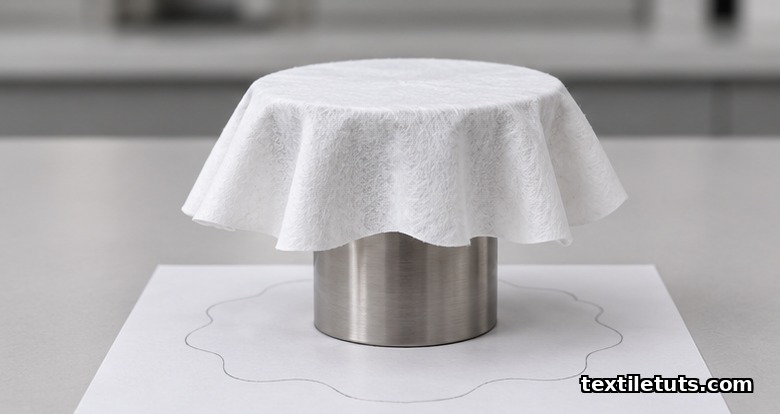
Fabric drape measured by ISO 9073-9:2008 yields a dimensionless drape coefficient between 0% (the fabric behaves as a rigid plate and projects no shadow) and 100% (the specimen folds fully back onto itself), calculated by draping a circular 240 mm specimen over a 100 mm supporting disc and comparing the area of its projected shadow to the unsupported annular ring of the original specimen.
This single number controls whether a surgical drape conforms to a patient’s body during a procedure, whether a hydroentangled wipe folds flat under a robotic cleaning head, and whether a spunbond hygiene top-sheet drapes softly against skin.
Below is what textile engineers need to know about the method: how the test runs, what the numbers mean, how ISO 9073-9 differs from the older Cusick fabric-drape work that fed into it, and where the standard breaks down on real production nonwovens.
What Drape Means for a Nonwoven
Drape is a fabric’s ability to bend under gravity and form folds. For a nonwoven, drape is governed by fiber orientation, fiber-to-fiber bond density, basis weight, and the bending stiffness those structural features produce. A high-drape (low-coefficient) nonwoven folds softly into gentle waves; a low-drape (high-coefficient) nonwoven stands up like cardboard.
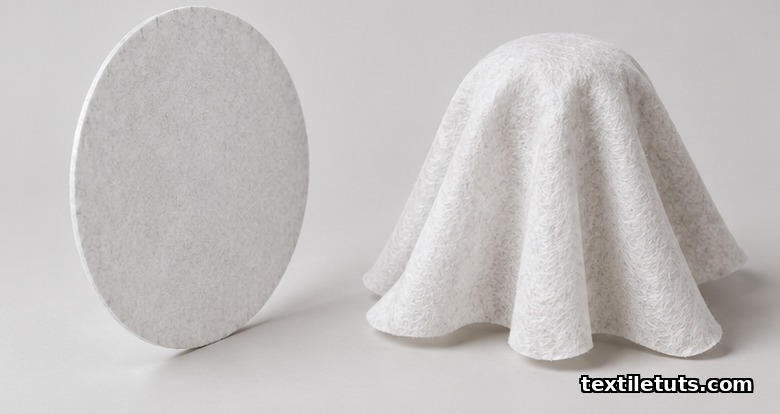
The drape coefficient is independent of fabric thickness and weight in absolute terms. A 30 g/m² spunbond polypropylene with bond points distributed evenly can show a similar drape coefficient to a 60 g/m² needle-punched polyester, depending on how the fibers are oriented and how much the web has been drafted during laydown.
For textile engineers working on medical drapes, hygiene products, automotive headliners, and filtration media, the drape coefficient is the laboratory number that predicts real-world handling behavior on the line and at the end user.
How the ISO 9073-9 Test Works
The test uses a circular fabric specimen, normally 240 mm in diameter, placed flat over a horizontal circular pedestal. The pedestal is smaller than the specimen, typically 100 mm across, leaving an annular ring of unsupported fabric that hangs freely under gravity.
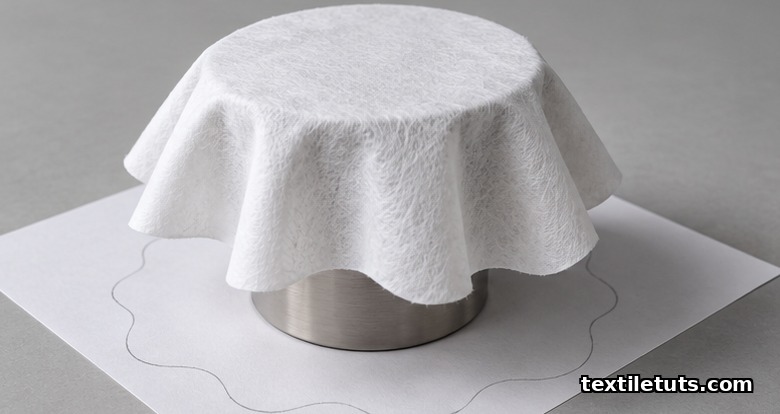
Once the specimen settles, typically within 30 seconds for a typical nonwoven and longer for stiff laminates, the test records the area of the fabric’s silhouette as projected onto a horizontal plane below the pedestal. The drape coefficient is then:
DC (%) = (AS − AD) / (AO − AD) × 100
where AS is the area of the shadow projected by the draped specimen, AD is the area of the supporting disc (which does not contribute to drape), and AO is the area of the original flat specimen.
When AS equals AO, every part of the original disc has dropped below the pedestal rim and DC = 100. When AS equals AD, no fabric has dropped below the pedestal rim at all and DC = 0.
The standard specifies two measurement paths: a paper-tracing method in which the operator traces the shadow onto concentric annular rings, cuts the traced zones, and weighs them on an analytical balance (the original Cusick paper-trace route); or an optical method in which a digital camera captures the silhouette and image-analysis software calculates the areas. ISO 9073-9 accepts either route.
For routine quality control, the optical method is preferred. Paper-tracing takes roughly 5 minutes per specimen and adds operator handling variance; a calibrated digital setup takes under 30 seconds and resolves sub-percent differences between production rolls.
Typical Drape Coefficient Ranges for Nonwovens
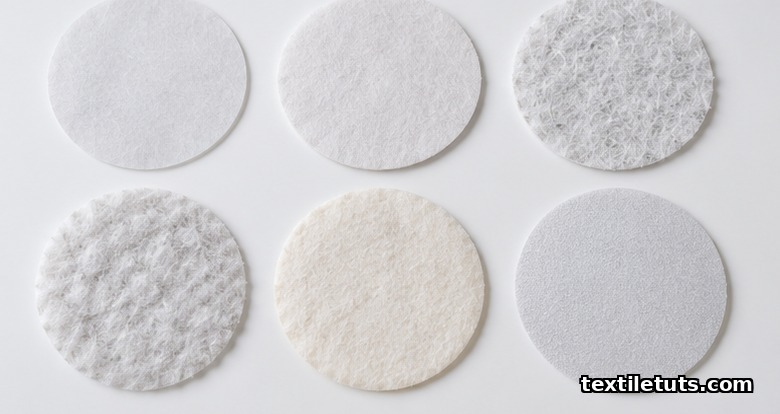
Drape coefficients vary widely across nonwoven families. Published values from peer-reviewed work and standards-body data sheets give engineers a working calibration band:
| Nonwoven type | Basis weight (g/m²) | Typical drape coefficient (%) |
|---|---|---|
| Spunbond polypropylene (light) | 15–30 | 55–70 |
| Spunbond-meltblown-spunbond (SMS) | 35–60 | 45–60 |
| Hydroentangled polyester / viscose (wipe) | 40–80 | 30–45 |
| Needle-punched polyester (high loft) | 100–400 | 60–80 |
| Spunlace cotton-rich (top-sheet, hygiene) | 25–50 | 25–40 |
| Meltblown filtration web | 20–100 | 70–90 |
Wider ranges reflect binder content, fiber orientation distribution, and post-treatment calendaring. A spunbond that has been cold-calendered at 30 N/mm will sit near the upper end of its range; the same web uncalendered will drop several points lower.
ISO 9073-9 vs. the Older Cusick Method
ISO 9073-9 grew out of a 1968 paper by G.E. Cusick at the then-University of Manchester Institute of Science and Technology, which introduced the supporting-disc and shadow-projection geometry now used in laboratories worldwide. Cusick’s “The measurement of fabric drape,” published in the Journal of the Textile Institute, focused on woven fabrics; ISO 9073-9 adapted the geometry to nonwovens in 1995 and revised it in 2008.
Key differences engineers notice when moving from a woven drape test to ISO 9073-9:
- Specimen size. ISO 9073-9 standardizes the 240 mm specimen and 100 mm pedestal combination. Woven-fabric labs often use a 300 mm specimen and a 200 mm pedestal variant derived directly from Cusick’s original work.
- Specimen orientation. ISO 9073-9 mandates separate cross-direction (CD) and machine-direction (MD) specimens when anisotropy matters; the older Cusick approach averaged across both.
- Fold counting. ISO 9073-9’s optical path does not require counting folds, which removes a major operator-variance factor for low-drape nonwovens that produce irregular creases.
When a supplier quotes a fabric at “drape coefficient 42” with no method reference, ask for the specimen size and the shadow-capture path. Numbers from a 300 / 200 setup do not interchange with a 240 / 100 setup on the same fabric.
What ISO 9073-9 Cannot Tell You
The drape coefficient is a single global number; it does not separate fiber-level bending from fabric-level shear, nor does it distinguish between cascade drape (fabric hangs in soft waves) and edge-curl drape (fabric rolls inward at the rim). For two fabrics that both report DC = 50, a side-by-side handling test can still show one folds neatly and the other hangs in rigid panels.
The test also assumes the fabric is symmetric and isotropic. A carded-and-crosslapped web with strong MD bias drapes asymmetrically; ISO 9073-9 averages the silhouette, so the resulting number hides the directionality. If anisotropy matters for the application (most apparel and most wipe uses it does), test MD and CD specimens separately and report both values.
For very stiff laminates, the standard’s specimen geometry becomes a problem. A 240 mm disc of a rigid foam-laminated structure cannot bend enough to wrap the pedestal rim in any direction, so the resulting drape coefficient becomes unreliable. ISO 9073-9 addresses this by recommending a smaller 160 mm specimen for high-bending-stiffness samples, and most engineers working with thick composites switch to a cantilever bending test such as ISO 9073-7 for primary screening before running ISO 9073-9.
Frequently Asked Questions
What is a “good” drape coefficient for a nonwoven?
There is no universal good value; the right drape coefficient depends on the application. A surgical drape fabric typically targets 35% to 55% so it conforms to a patient’s body without collapsing into folds that block the operative site, while a hydroentangled wipe tends to sit between 25% and 45% so it lays flat on a hard surface during robotic cleaning. The number is always benchmarked against a reference fabric that has been validated for the end use.
Can ISO 9073-9 be used on woven or knitted fabrics?
ISO 9073-9 is written for nonwovens, so its specimen geometry and tolerances assume a nonwoven’s particular structural behavior. Woven and knitted fabrics sit under different parts of the ISO 9073 family and under AATCC and ASTM woven-drape methods, which use larger specimens (typically 300 mm) and heavier pedestals. The Cusick paper that gave rise to ISO 9073-9 was originally run on woven fabrics, but the ISO standard has been tuned for nonwoven response.
Why does my fabric’s drape coefficient change between laboratories?
Two laboratories can disagree on the same fabric by 3 to 8 drape-coefficient points when one runs the paper-tracing path and the other runs the optical path, when the cut specimens are not held axis-aligned, or when the conditioning atmosphere (for example 65% vs 50% relative humidity at 20°C vs 23°C) shifts fiber modulus. Standardize conditioning per ISO 139 and lock the same measurement path before assigning any QC limits to the number.
Does basis weight predict drape?
No. Basis weight alone is a poor predictor of drape coefficient. A 25 g/m² spunbond with a dense point-bond pattern can drape more stiffly than a 60 g/m² hydroentangled web if the bonding pattern dominates the bending stiffness. Use basis weight as a first-pass check, then measure drape directly; the two values are not interchangeable.
How does ISO 9073-9 connect to other ISO 9073 parts?
ISO 9073 is a multi-part standard for nonwovens. Part 9 covers drape, while adjacent parts cover mass per unit area (part 1), thickness (part 2), tensile strength (parts 3 and 4), and bending stiffness (part 7). Engineers typically pair a part 9 drape result with a part 7 bending stiffness measurement, because the two numbers together characterize how the fabric flexes and folds under load.
References
- International Organization for Standardization. ISO 9073-9:2008 — Textiles — Test methods for nonwovens — Part 9: Determination of drapability including drape coefficient. Geneva: ISO. Official method that defines the 240 mm specimen / 100 mm pedestal geometry and the drape-coefficient formula.
- Cusick, G.E. (1968). “The measurement of fabric drape.” Journal of the Textile Institute, 59(6), 253–260. Foundational paper for the supporting-disc and shadow-projection method that later became ISO 9073-9.
- International Organization for Standardization. ISO 9073-1:1989 and ISO 9073-7:1995 — Textiles — Test methods for nonwovens — Part 1: Determination of mass per unit area, and Part 7: Determination of bending length. Geneva: ISO. Adjacent parts of the ISO 9073 family used alongside Part 9 to characterize nonwoven drape and stiffness.
- Mokhtar, S., and co-authors (peer-reviewed). “Review of fabric drapability and the methods for measuring it.” Journal of the Textile Institute. Independent academic review of drape-measurement methods and their application to nonwoven substrates.
- EDANA (European Disposables and Nonwovens Association). Nonwovens Test Methods Compendium. Brussels: EDANA. Industry-standard reference volume that includes the standardized drapability procedure adopted from ISO 9073-9.
- International Organization for Standardization. ISO 9073-3:2023 — Textiles — Test methods for nonwovens — Part 3: Determination of tensile strength and elongation. Geneva: ISO. Companion part cited to round out the structural picture alongside Part 9.
This article is the working reference for fabric drape and ISO 9073-9 testing of nonwovens. Editorial by Md. Asad Ullah (Meem), TextileTuts. Sources: ISO 9073-9:2008 (International Organization for Standardization), Cusick (1968) in the Journal of the Textile Institute, ISO 9073 adjacent parts 1, 3, and 7, peer-reviewed drape reviews in the Journal of the Textile Institute, and the EDANA Nonwovens Test Methods Compendium, all as cited.


