
Water Footprint of Textile Industry


The global textile industry consumes roughly 100 trillion liters of freshwater each year, and a single pair of conventional cotton jeans uses 7,500 to 10,000 liters from field to finished garment.
About 20 percent of that total flows through the dyehouse, which is also where the industry’s effluent load concentrates into the rivers of producing countries.
Below is a breakdown of where the water goes, how much each fiber type uses, and which ISO-aligned standards actually shift the number.
What “Water Footprint” Means in Textiles
The term “water footprint” was formalized by the Water Footprint Network and later codified in ISO 14046:2014, “Environmental management, Water footprint, Principles, requirements, and guidelines.” It splits every liter of water used by a product into three categories:
- Blue water: surface and groundwater withdrawn for irrigation or process use, for example river water pumped into a dyehouse.
- Green water: rainwater consumed by the crop or fiber plant, such as rainfall absorbed by cotton.
- Grey water: the volume of clean water needed to dilute pollutants from production to acceptable river-quality levels.
For a textile, the footprint is the sum of all three across the supply chain, from the field (for natural fibers) or the polymerization reactor (for synthetics), through spinning, weaving or knitting, wet processing, garment assembly, and end-of-life.
Where the Water Goes in a Cotton T-Shirt
The arithmetic behind the well-known “2,700 liters per cotton T-shirt” figure comes from a 2006 value-chain assessment by Chapagain and colleagues at UNESCO-IHE. The figure is dominated by agriculture, not by the factory:
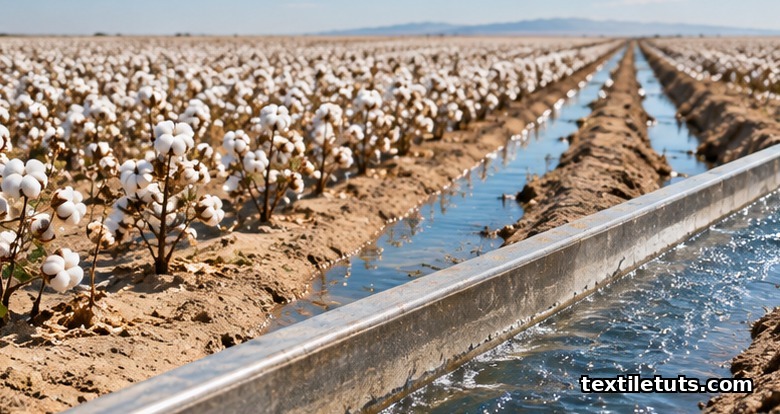
- About 2,300 liters, roughly 85 percent, goes to irrigate and feed the cotton plant.
- About 200 liters is consumed in wet processing, including desizing, scouring, bleaching, dyeing, printing, and finishing.
- About 200 liters covers spinning, knitting or weaving, cutting, sewing, and transport.
Conventional cotton grown under surface irrigation is the most water-intensive mainstream fiber in the apparel chain. The Water Footprint Network’s global assessment by Mekonnen and Hoekstra (2011) puts the world-average cotton footprint at roughly 9,800 liters of water per kilogram of fiber, of which about 4,300 liters is blue water drawn from rivers and aquifers.
Better Cotton Initiative (BCI) plots and rainfed smallholder plots in India, sub-Saharan Africa, and parts of China cut blue-water use sharply, but still consume green water from rainfall.
Fiber-by-Fiber: How Much Water Each Common Textile Uses
The figures below are drawn from peer-reviewed water-footprint assessments for raw fiber production. Wet-processing volumes are reported separately because they depend on the dye recipe, the number of wash-off baths, and the liquor ratio of the machine.
| Fiber | Total water footprint (L/kg fiber) | Blue water share (L/kg) | Notes |
|---|---|---|---|
| Cotton (global average) | ~9,800 | ~4,300 | Heavily affected by irrigation source |
| Cotton (rainfed) | ~3,000–5,000 | ~200–800 | Mostly green water |
| Polyester | ~30–60 | ~30–60 | Cooling water in polymerization |
| Viscose/rayon | ~300–700 | ~150–300 | Heavy chemical processing of pulp |
| Wool (merino) | ~17,000 | ~1,000 | Driven by sheep farming (green water) |
| Hemp (rainfed) | ~2,000–3,000 | ~200 | Low-input crop |
| Conventional silk | ~8,000 | ~500 | Mulberry cultivation dominant |
Two things stand out. First, polyester looks cheaper on water than cotton but carries a fossil-fuel input that the table does not show. Second, natural fibers vary by an order of magnitude depending on whether they are irrigated, rainfed, or grown on marginal land.
The Wet-Processing Stage: Where Most Pollution Is Made
Spinning and weaving are largely dry mechanical operations. The dyehouse is where both water consumption and pollution concentrate.
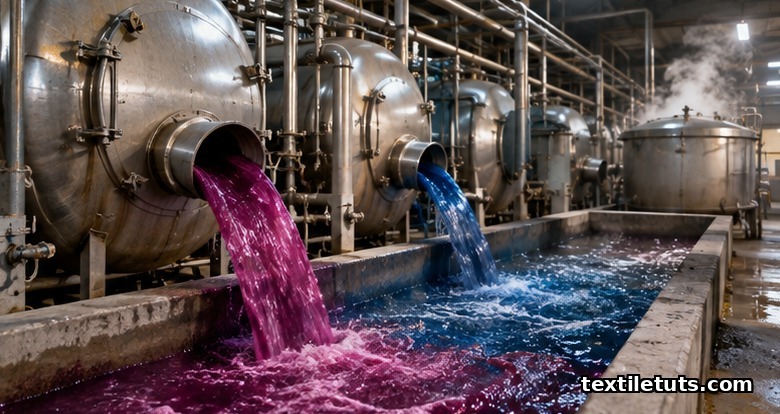
A typical polyester knit route uses 80 to 150 liters of water per kilogram of fabric just for scouring, disperse dyeing, reduction clearing, and finishing. A reactive-dyed cotton route can exceed 200 liters per kilogram because reactive dyes require multiple wash-off baths to remove unfixed hydrolyzed dye.
The European Commission’s Best Available Techniques (BAT) Reference Document for the Textiles Industry (2023 update) lists the following effluent streams as priority control points:
- High-salinity brine from reactive dyeing.
- Heavy-metal residues from certain acid and mordant dyes, including chrome, copper, and cobalt.
- Residual dyes that absorb visible light and prevent downstream photosynthesis.
- Finishing auxiliaries, including perfluorinated compounds (PFCs) used for water-repellent finishes, which are persistent and bioaccumulative.
Industry estimates attribute up to 20 percent of global industrial water pollution to textile dyeing and finishing, which is why the ZDHC (Zero Discharge of Hazardous Chemicals) Foundation publishes a restricted substances list covering dye classes, solvents, and auxiliaries that member brands commit to eliminating.
Microfibers: A New Category of Water Pollution
Synthetic textiles shed tiny plastic fibers during washing. A 2018 study by Carney Almroth and colleagues in Environmental Pollution found that a single acrylic fleece jacket can release more than 700,000 microfibers per wash cycle, and follow-up work has documented comparable shedding from polyester, nylon, and polyamide fabrics. The IUCN’s 2017 assessment “Primary Microplastics in the Oceans” estimates that synthetic textiles contribute on the order of 190,000 tonnes of fiber-shaped microplastic to the ocean each year.
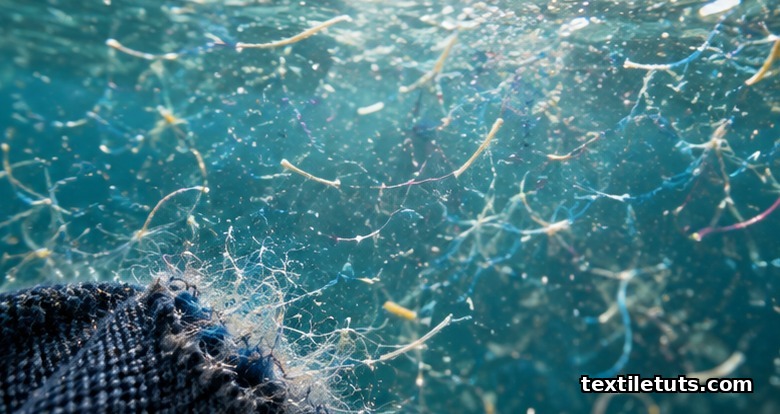
Microfibers are now under formal regulatory scrutiny. The EU’s revised Industrial Emissions Directive, in force from 2024, requires textile installations to apply BAT for microfiber capture, including filtration of process wastewater. The Microfibre Consortium, an industry working group, runs the Textile Data Exchange with standard test methods for fiber-shedding measurement.
How the Industry Reduces Its Water Footprint
Three engineering pathways reliably lower water intensity, and all are codified in ISO 14046 assessments or in industry BAT notes.
1. Liquor ratio reduction. Modern jet-dyeing machines operate at liquor ratios of 1:4 to 1:6 (kilograms of fabric per liter of water), versus 1:8 to 1:12 typical of older atmospheric machines. Cutting the bath volume in half cuts both steam and water roughly in half for the same dye uptake.
2. Right-first-time dyeing and color kitchen automation. Off-shade batches must be re-dyed, doubling water use. Inline spectrophotometry and automated dispensing reduce re-dye rates from a typical 8 to 12 percent to below 3 percent in well-run plants.
3. Effluent treatment and reuse. Reverse-osmosis and membrane-bioreactor systems can recover 70 to 90 percent of dyehouse wastewater for reuse in less-critical wash steps. ZDHC-aligned facilities report combined water-reuse rates above 50 percent at the plant level.
At the brand level, the Sustainable Apparel Coalition’s Higg FEM (Facility Environmental Module) benchmarks facility water use against a per-kilogram fabric baseline, allowing buyers to compare mill performance across regions.
What ISO 14046 Does and Does Not Cover
ISO 14046 is the only internationally agreed method for quantifying a product’s water footprint based on a life-cycle assessment. It defines blue, green, and grey water, sets requirements for the assessment boundary, and specifies how impact categories such as water scarcity and eutrophication should be reported separately from inventory totals.
ISO 14046 does not prescribe limits, define acceptable footprints, or certify products as sustainable. That is the role of certification schemes such as OEKO-TEX STeP (Sustainable Textile Production), the EU Ecolabel, and Bluesign, which combine water performance with chemical-management criteria.
Frequently Asked Questions
How many liters of water does it really take to make one cotton T-shirt?
About 2,700 liters in the global average, of which roughly 2,300 liters is green water, meaning rainfall the cotton plant would absorb whether the crop existed or not. The directly competing freshwater resource, called blue water, is closer to 500 to 800 liters per T-shirt, which is the number textile engineers use when comparing real water-stress impact.
Which fiber has the lowest water footprint?
Polyester uses far less water than any natural fiber at the polymerization stage (about 30 to 60 L/kg), but the comparison is not apples to apples because polyester also consumes fossil feedstock and sheds microfibers. Among natural fibers, rainfed hemp and rainfed linen have the smallest water footprints because they require little or no irrigation.
Is organic cotton always better for water?
No. Organic cotton typically uses less blue water than irrigated conventional cotton because it relies on rainfed systems and avoids synthetic agrochemicals, but its total water footprint can still be 7,000 to 9,000 liters per kilogram because green water from rainfall dominates. A BCI-equivalent rainfed conventional cotton can match organic on water while delivering higher yields per hectare.
Does recycled polyester save water?
Yes, substantially. Recycled polyester from PET bottles skips the polymerization step entirely and uses roughly 70 to 90 percent less water than virgin polyester, according to lifecycle assessments cited in the EU’s PET recycling BAT document. It also reduces energy demand by a similar margin.
What is the single biggest water-saving upgrade a mill can make?
Reducing the liquor ratio in dyeing, because every subsequent wash-off, drying, and heating step scales with bath volume. Replacing an atmospheric dye machine at 1:10 liquor ratio with a low-liquor jet or beam machine at 1:5 typically halves both water and steam per kilogram without changing chemistry.
References
- International Organization for Standardization. ISO 14046:2014 Environmental management, Water footprint, Principles, requirements, and guidelines. iso.org — defines blue, green, and grey water assessment.
- Chapagain, A.K., Hoekstra, A.Y., Savenije, H.H.G., and Gautam, R. (2006). The water footprint of cotton consumption. Value of Water Research Report Series No. 18, UNESCO-IHE — origin of the 2,700 L/T-shirt figure.
- Mekonnen, M.M. and Hoekstra, A.Y. (2011). The green, blue and grey water footprint of crops and derived crop products. Hydrology and Earth System Sciences — global per-kilogram fiber water footprints.
- Carney Almroth, B., et al. (2018). Quantifying shedding of synthetic fibers from textiles; a source of microplastics released into the environment. Environmental Pollution — source of the 700,000 microfibers per wash figure.
- Boucher, J. and Friot, D. (2017). Primary Microplastics in the Oceans: A Global Evaluation of Sources. IUCN, Gland, Switzerland — global synthetic microfiber emission estimate.
- European Commission Joint Research Centre. Best Available Techniques (BAT) Reference Document for the Textiles Industry. EU Publications — effluent control points and liquor ratio benchmarks.
- Zero Discharge of Hazardous Chemicals Foundation. ZDHC Wastewater Guidelines v2.1. zdhc.org — industry standard for textile mill effluent quality.
- Sustainable Apparel Coalition. Higg Facility Environmental Module (Higg FEM) 3.0. apparelcoalition.org — per-kilogram facility water benchmarks.
This article is the working reference for the water footprint of textile production. Editorial by Mohammad Yousuf (Anik), TextileTuts. Sources: ISO 14046:2014, UNESCO-IHE Water Footprint Reports, European Commission BAT Reference Document for Textiles, ZDHC Wastewater Guidelines, Sustainable Apparel Coalition Higg FEM, IUCN Primary Microplastics in the Oceans, and Environmental Pollution as cited.


