
Herringbone Weaving

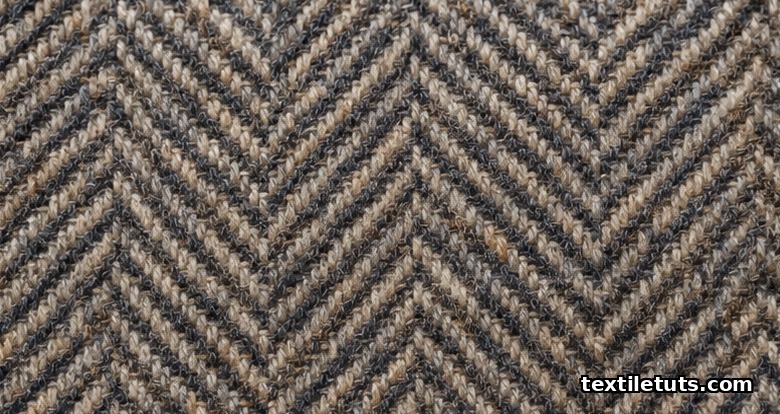
Herringbone is a broken twill weave that produces a V-shaped pattern by reversing the direction of the diagonal twill line every 4 to 12 warp threads, with each chevron typically measuring 5 to 20 mm across the fabric width. The repeating V forms a balanced zig-zag that resembles the skeleton of a herring fish, which is where the weave takes its name. The pattern is structurally a variant of the 2/2 twill where the diagonal direction is flipped at regular intervals rather than continuing in one direction across the cloth, and it has been used in wool suiting, tweed, blankets, and industrial textiles for over two centuries because the balanced diagonal construction gives both visual texture and mechanical stability.
This guide covers the structure of herringbone, how it is drafted on a loom, the yarns and finishes that change its drape and hand, the fabric properties that matter in tailoring and upholstery, and how it compares to plain twill, chevron, and houndstooth weaves.
What Is Herringbone Weave? The Structural Definition
Herringbone is classified under ISO 3572 as a derivative of the 2/2 twill family, in which the warp and weft floats are reversed in direction at a fixed repeat point along the warp. In a standard 2/2 twill, the diagonal line runs uninterrupted from one selvedge to the other. In a herringbone, that diagonal line breaks and re-forms on the opposite slant after a set number of warp threads, usually between 4 and 12. The break point creates the central spine of each V, and the next diagonal picks up the opposite direction on the other side of the spine. The repeat width is the sum of the threads in the rising diagonal, the break, and the falling diagonal.
Each complete herringbone repeat is symmetric across the central break, which is what gives the pattern its balanced look. The number of warp threads in one V is typically 8, 12, 16, or 20, depending on the yarn count and the desired scale of the chevron. A heavier worsted yarn spun to 30 tex (Nm 33) at a 30 ends/cm warp set will produce a chevron around 8 to 10 mm wide, while a 60 tex (Nm 17) wool at the same sett will give a chevron closer to 18 to 20 mm. The chevron scale does not change the weave class; it only changes the visual weight of the fabric.
How Herringbone Is Drafted on the Loom
The drafting plan for herringbone uses two mirrored twill segments on the same warp. Most mills start from a 2/2 twill draft and split the lifting plan into two halves: the first half lifts in the rising diagonal, and the second half lifts in the falling diagonal. If the rising segment uses 8 shafts with a 2/1/2/1 step, the falling segment reverses to 1/2/1/2 across the next 8 shafts. The tie-up is identical for both segments, which is why a 16-shaft loom (or a 16-end repeat on a dobby loom) is the standard minimum for a clean herringbone.
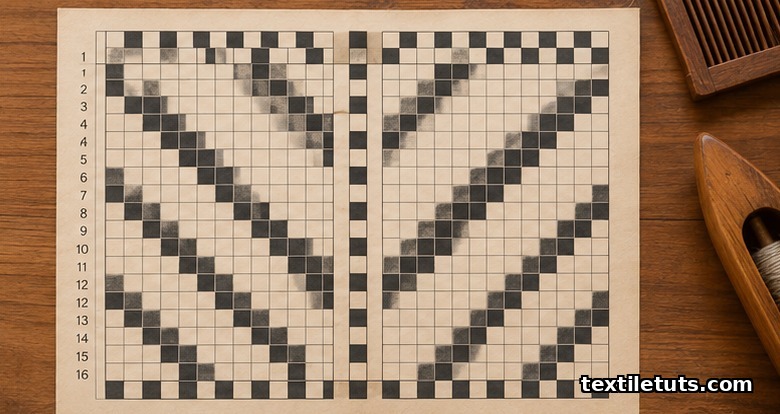
The point draft matters because the V has to meet cleanly at the spine. Weavers typically align the break at a 2-up, 2-down intersection on both sides, so the transition happens where two warp threads are up and two are down at the same pick. Misaligned breaks show as a visible step or hole at the spine, especially under tension, and this is one of the most common quality defects checked at the loom. AATCC 20A (fiber analysis) and ASTM D629 (quantitative analysis of textiles) are used downstream to confirm yarn count and construction on the finished cloth.
For weft-faced or warp-faced versions, the same drafting logic applies but the float length shifts. A 2/1 weft-faced herringbone (also called a swansdown or satinette herringbone) shows more weft on the face, while a 3/1 warp-faced version shows more warp. The 2/2 balanced version, with two warp up to two weft up on each pick, is the most common because it gives the cleanest V on both sides of the cloth and the most stable geometry under repeat laundering cycles.
Yarns Used in Herringbone Cloth
Wool is the classic herringbone fiber, particularly in the form of worsted yarns for suiting and woolen yarns for tweed and blankets. Harris Tweed, which has a protected designation under UK law, is almost always woven in herringbone or plain twill, with the herringbone variant typically using 2-ply worsted yarns of 30 to 50 tex (Nm 20 to Nm 33) at 12 to 16 ends/cm warp and 10 to 14 picks/cm weft. Cotton herringbone is widely used in shirting and outerwear, often as a 2/1 weft-faced variant that shows the V more strongly on the technical back. Linen and silk herringbone appear in higher-end shirting and decorative textiles, while industrial herringbone is often woven from nylon 6,6 or polyester multifilament yarns at much higher thread densities.
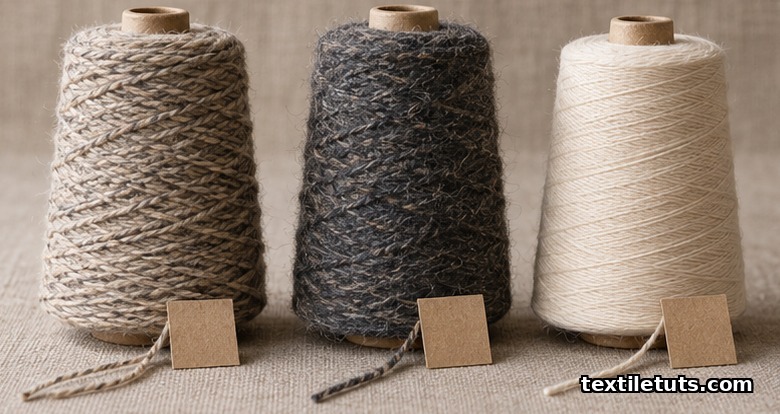
The yarn twist direction affects how the V reads. A Z-twist yarn used as warp against an S-twist weft (or vice versa) tends to make the chevrons appear sharper because the opposing twist angles catch light differently on the two diagonals. This is why some mills deliberately reverse twist across the spine of the V: the rising diagonal uses one twist direction, and the falling diagonal uses the opposite, exaggerating the contrast between the two halves of the chevron. This effect is most visible in wool and silk herringbones and barely noticeable in cotton.
Mechanical Properties of Herringbone Fabric
Herringbone inherits most of the mechanical performance of a 2/2 twill, with one important addition: the broken diagonal distributes stress more evenly along the warp. In a continuous twill, the bias stretch is concentrated along a single diagonal line, which can lead to seam slippage and skewed drape in garments. In a herringbone, the bias stretch alternates direction every few centimeters, so the cloth tends to hang more squarely from the body and resist skewing through repeated wear.
Tensile strength depends on yarn count and sett. A worsted wool herringbone at 14 ends/cm by 12 picks/cm, using 40 tex yarns, typically tests in the range of 40 to 60 daN warp direction and 30 to 45 daN weft direction when measured by the ISO 13934-1 strip method. Abrasion resistance, tested by ISO 12947 (Martindale) at 9 kPa pressure, runs 20,000 to 40,000 cycles before thread rupture for a 250 to 300 g/m² wool herringbone, and 50,000+ cycles for a heavier 400 g/m² variant. These ranges are typical for suiting-weight wool and explain why herringbone is favored for trousers, jackets, and uniforms that see heavy wear.
Yarn slippage at the seam is one of the standard failure points for any twill-based weave, and it is measured by ASTM D434. Herringbone generally performs better than a continuous twill of the same weight on this test because the V breaks do not allow a single slip line to propagate along the diagonal. Values of 1.5 to 2.5 mm slippage at 50 N seam load are typical for a well-settled wool herringbone.
Herringbone vs Chevron vs Houndstooth
Herringbone, chevron, and houndstooth are often confused because they all show V-shaped or angular patterns, but they are constructed differently. Chevron uses a true point twill where the diagonal reverses direction at a single warp thread, producing a sharp, continuous point at the center of each V. Herringbone uses a small block of 2 to 4 warp threads at the break, producing a softer, slightly squared-off spine. Houndstooth is a color-and-weave effect, not a weave structure: it uses a 2/2 twill base with a specific color pattern in warp and weft that creates the broken-check appearance.
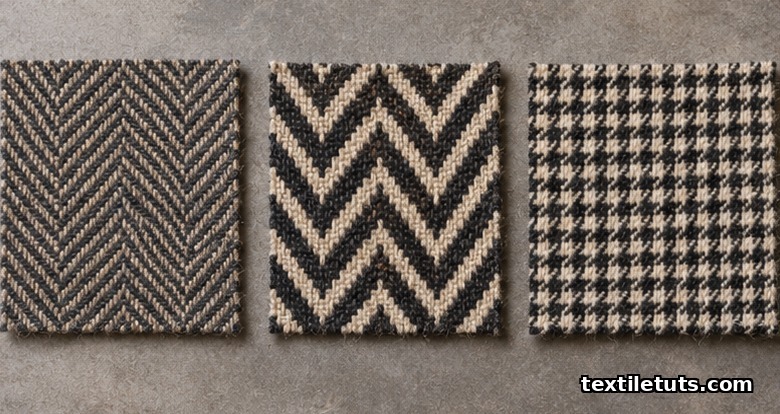
| Property | Herringbone | Chevron | Houndstooth |
|---|---|---|---|
| Weave structure | Broken 2/2 twill with multi-thread break | Point twill reversing at a single thread | 2/2 twill with planned color order |
| Spine sharpness | Soft, slightly squared | Sharp, pointed | Not applicable (color pattern, not weave) |
| Visual scale | 5 to 20 mm chevrons | 5 to 30 mm points | 3 to 8 mm checks |
| Common use | Wool suiting, tweed, blankets | Decorative fabrics, ribbons | Wool suiting, coatings |
| Drafting complexity | Medium (16-shaft minimum) | Medium-high (point draft required) | Low (standard 2/2 twill) |
The practical takeaway is that herringbone is the most stable of the three for tailoring because the soft spine avoids the visible wear line that can form on a true chevron point after repeated dry cleaning. Houndstooth, by contrast, is the easiest to weave but the hardest to scale in garment production because the color pattern must be matched at every seam.
Common Applications of Herringbone Weave
Wool herringbone is the standard cloth for men’s and women’s tailored suits, particularly in autumn/winter collections where the visual texture reads as more substantial than a plain twill. Cotton herringbone is widely used in workwear shirts and outer jackets, where the weft-faced variant produces a sturdy fabric with a visible weave structure. Industrial herringbone, often woven from nylon or polyester at 20+ ends/cm, is used in conveyor belts, hoses, and tire cord because the broken-twist geometry resists deformation under cyclic loading.
In home textiles, herringbone appears in wool blankets, tweed upholstery, and decorative throws. The weave’s high dimensional stability makes it a good choice for items that are washed or dry cleaned repeatedly. Linen herringbone is used in lighter suiting and in drapery, where the natural irregularities of linen yarn show through the weave and add a hand-crafted appearance.
How to Identify Herringbone in a Finished Fabric
To check whether a fabric is a true herringbone and not a printed imitation, examine the back of the cloth with a loupe or under a light source. In a real herringbone, the V continues across the back because the weave structure is the same on both sides (for balanced 2/2) or the back shows a clear mirror image of the chevrons (for weft-faced or warp-faced variants). A printed herringbone will show a flat back with no weave structure, and the pattern will be perfectly uniform at a scale the loom could not reproduce.
Count the threads in one V under magnification. If the chevron is built from 8 to 20 warp threads with a 4 to 8 thread break at the spine, it is consistent with a standard herringbone draft. A chevron with a 1 or 2 thread break is a true point twill, not a herringbone, even if it looks similar at first glance.
Care and Durability of Herringbone Cloth
Wool herringbone should be dry cleaned for tailored garments to preserve the loft and avoid felting shrinkage that can reach 40 to 60% in an aggressive machine wash. Cotton and linen herringbone can typically be machine washed at 30 to 40 °C with mild detergent, then line dried or tumble dried on low. Industrial nylon herringbone has high chemical resistance but can be damaged by prolonged UV exposure, so it is rarely used in outdoor applications without a UV-stabilized finish.
Pilling resistance depends on yarn quality. A worsted-spun wool herringbone at 30 tex or finer, woven at 14 ends/cm or higher, generally rates 4 to 5 on the ISO 12945-2 pilling scale after 2,000 cycles. Woolen-spun tweed herringbones pill faster, typically rating 2 to 3 on the same scale, because the shorter fibers in woolen yarn migrate to the surface more readily.
Frequently Asked Questions
Is herringbone a twill or a plain weave?
Herringbone is a broken twill, classified as a derivative of the 2/2 twill family under ISO 3572. It is not a plain weave, because plain weave has a simple 1-up, 1-down interlacing with no diagonal structure. The V-shape of herringbone comes directly from reversing the twill diagonal at regular intervals, which a plain weave cannot produce.
What is the difference between herringbone and chevron?
Herringbone reverses the twill direction over a small block of 2 to 4 warp threads at the center of each V, producing a softer, slightly squared spine. Chevron reverses at a single warp thread, producing a sharp, pointed spine. Visually they look related, but on the loom they require different drafting plans and the finished fabrics behave differently under stress.
Can herringbone be machine washed?
Wool herringbone should not be machine washed because agitation and heat cause felting shrinkage of 40 to 60% on untreated wool. Cotton, linen, and synthetic herringbones can typically be machine washed at 30 to 40 °C, but always check the care label, as finishes and dyes can shift the safe temperature range.
What yarn count is best for herringbone suiting?
For a 250 to 300 g/m² suiting-weight herringbone, worsted wool yarns in the range of 30 to 50 tex (Nm 20 to Nm 33) at 12 to 16 ends/cm warp and 10 to 14 picks/cm weft are the standard. Lighter 200 g/m² summer suiting uses finer 20 to 25 tex yarns, while heavier 400 g/m² coatings use 50 to 80 tex yarns.
Why is herringbone more stable than a continuous twill?
The repeated reversal of the twill direction distributes bias stretch across the warp rather than concentrating it along a single diagonal. This reduces seam skew, improves drape on the body, and limits yarn slippage along any one line, which is why herringbone is preferred for tailored trousers and jackets that see heavy wear.
References
- ISO 3572:1995. Textiles — Weaves — Definitions of general terms and basic weaves. International Organization for Standardization. Definition of twill derivatives including broken twills such as herringbone.
- ISO 13934-1:2013. Textiles — Tensile properties of fabrics — Part 1: Determination of maximum force using the strip method. International Organization for Standardization. Tensile testing protocol used for wool herringbone samples.
- ISO 12947-2:2016. Textiles — Determination of abrasion resistance of fabrics by the Martindale method — Part 2: Determination of specimen breakdown. International Organization for Standardization. Abrasion test method referenced for wool herringbone cycle counts.
- ISO 12945-2:2020. Textiles — Determination of fabric propensity to surface fuzzing and to pilling — Part 2: Modified Martindale method. International Organization for Standardization. Pilling resistance scoring for wool herringbone.
- ASTM D434-95. Standard Test Method for Resistance of Woven Fabrics to Slippage of Yarns. ASTM International. Seam slippage test method applied to herringbone and other twill derivatives.
- AATCC 20A-2021. Test Method for Fiber Analysis: Qualitative. American Association of Textile Chemists and Colorists. Fiber identification method used to confirm wool, cotton, and synthetic content in herringbone cloth.
- Adanur, S. (2001). Handbook of Weaving. CRC Press. Peer-reviewed textile engineering reference covering the drafting, structure, and mechanical behavior of broken twill weaves including herringbone.
This article is the working reference for herringbone weaving. Editorial by Mohammad Yousuf (Anik), TextileTuts. Sources: ISO 3572, ISO 13934-1, ISO 12947-2, ISO 12945-2, ASTM D434, AATCC 20A, and Adanur (2001) as cited.


