
Warp Knitting: Tricot, Raschel, and Milanese Structures

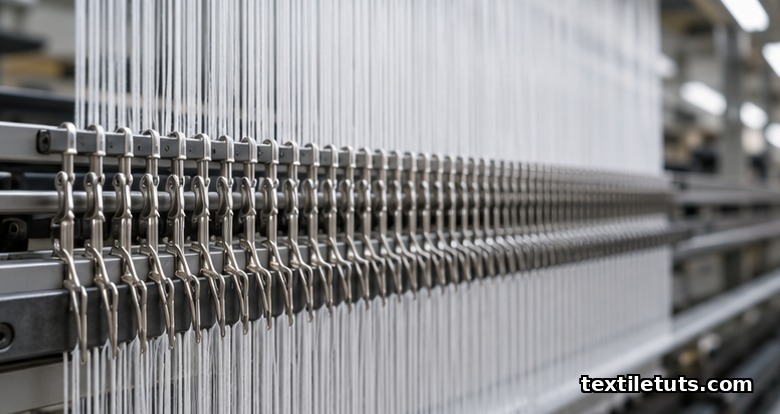
Warp knitting produces fabric at up to 2,500 courses per minute by interlooping parallel warp yarns vertically along the fabric length, with three principal structures, tricot, Raschel, and Milanese, accounting for most commercial output worldwide.
The three structures differ mainly in how many guide bars feed yarn into the needle loop and how those bars overlap, which is why a 2-bar tricot runs 28 to 40 gauge and weighs under 150 g/m² while a 78-bar Raschel can knit 3D spacer meshes for automotive cushioning.
Below is a working reference for warp-knitting fundamentals: how each structure is built, the machines that produce them, and the fabric properties that follow from the loop geometry.
What Warp Knitting Is and How It Differs From Weft Knitting
Warp knitting forms loops from a warp sheet, a parallel array of yarns running lengthwise on a beam, that feeds each needle as the fabric builds vertically. Every needle gets at least one yarn at every course, so the warp sheet must contain as many yarn ends as there are needles across the machine width, often 1,800 to 4,000 ends on a modern tricot machine (Spencer, 2001, Knitting Technology, Woodhead Publishing).
Weft knitting, by contrast, uses a single yarn that travels horizontally across one needle at a time. This is the structural reason warp knit is more dimensionally stable: cutting a tricot sample does not cause the laddering you see in a cut weft-knit jersey, and the fabric recovers faster from extension because each wale has its own dedicated yarn chain.
The classification of warp-knit structures is standardized in ISO 8388, which defines the three families covered in this article, tricot, Raschel, and Milanese, alongside other constructions such as stitch-bonded and weft-insertion fabrics.
Tricot: The 2-Bar Fine-Gauge Workhorse
Tricot is built on machines with two main guide bars plus, in many cases, a partial third bar for inlay. Each guide bar lays a lap, the diagonal yarn segment that crosses behind one needle and in front of the next, on every course. The standard 2-bar lap is the closed lap, written 1-0/1-2 on the front bar and 1-2/1-0 on the back bar, which produces the soft face and slightly rougher back that you can feel on a lingerie fabric (Spencer, 2001).
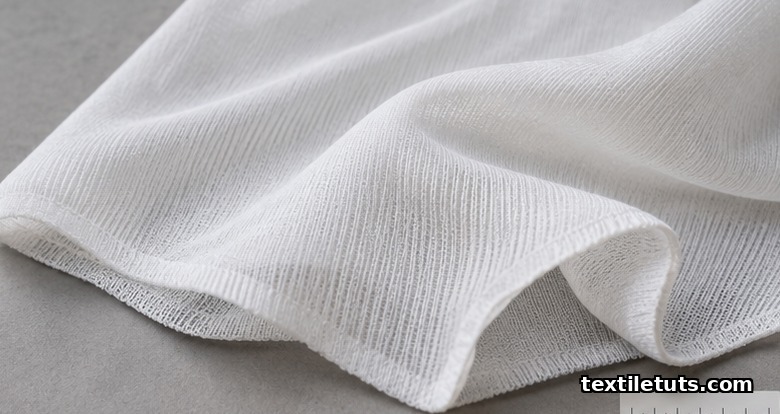
Gauge for tricot runs from 28 to 40 needles per inch, which is finer than most Raschel work. The result is fabric weights from 30 to 150 g/m² in polyester or polyamide filament, used as lining, intimate apparel, swimwear shell, automotive seat trim, and lightweight outerwear.
Production speed is the commercial reason tricot dominates fine warp knit: a modern Karl Mayer tricot machine runs at 2,000 to 2,500 courses per minute, with working widths up to 210 inches, and fabric leaving the machine is set by dry heat on a stenter rather than by chemical finishing (Karl Mayer Textilmaschinenfabrik technical documentation, Warp Knitting Technology).
Raschel: The Multi-Bar Generalist
Raschel machines accept between 4 and 78 guide bars, each carrying its own warp sheet, so the designer can stack features into one fabric. A 4-bar Raschel produces standard curtain net and laundry bag mesh; an 8 to 12-bar build knits spacer fabric, where two outer surfaces are tied together by monofilament pillars; a 30-bar build knits floral lace for bridal wear.
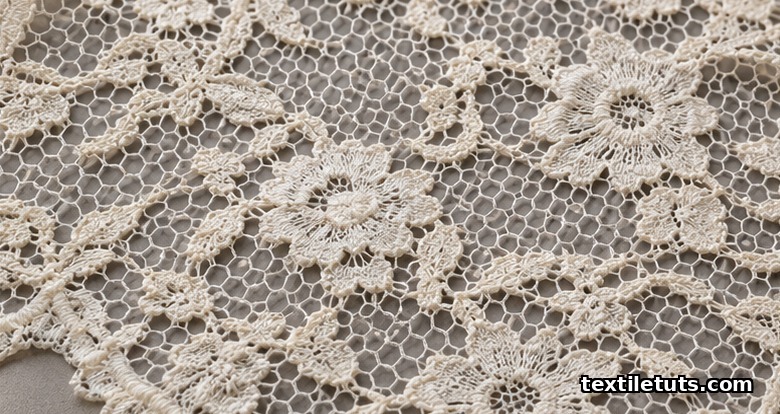
The lap on Raschel is more open than tricot, written 0-2/2-0 on the simplest net pattern, and the bars can be set to lay in long inlays between the loops, holding textured yarns in place without forming a loop on every needle. This is how Raschel achieves the stable, hole-rich net you see in fruit packaging, and also the high-tenacity geogrid used in road base reinforcement, where a polyester or polypropylene structure must hold 50 to 200 kN/m of tensile load (Raz, S., 1987, Warp Knitting Production, Heidelberger Verlagsanstalt).
Gauge runs coarse, 12 to 24 needles per inch, and the machine feeds spun yarn as readily as filament, which is why Raschel is the warp-knit structure that touches agricultural shade cloth, baler-twine netting, and the warp-knit backing used in bullet-resistant laminate stacks.
Milanese: The Smallest Production Family
Milanese is built from two full-set warp beams that feed needles from opposite directions, so each loop is held by two laps crossing at an angle. The fabric is characteristically fine, smooth on both sides, and run-resistant because no single yarn carries a column by itself.
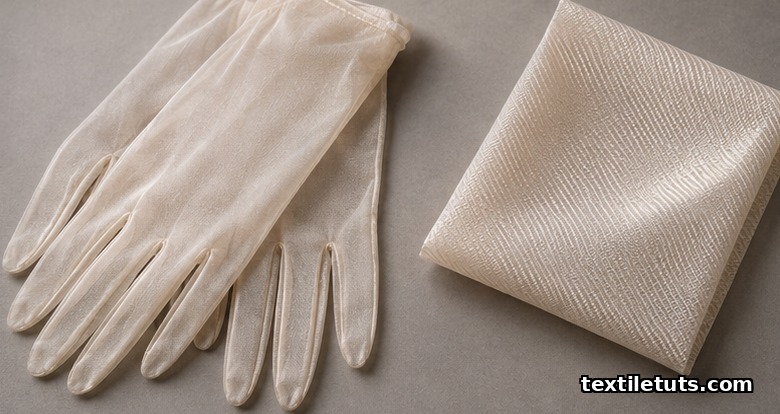
Commercial Milanese output is small. Most machines were converted to tricot in the second half of the 20th century, since tricot on 2 bars is faster and cheaper to run, and the few surviving Milanese lines concentrate on high-quality gloves, hosiery tops, and ceremonial textiles where the unique two-direction construction is still specified (Spencer, 2001).
Loop Geometry, Lapping Patterns, and Course Density
All three structures share the same primitive: a loop formed as the needle draws yarn down, the old loop knocks over, and a new loop is set. What changes between them is the lap length and overlap, expressed as shog, the sideways shift in needle spaces that a guide bar makes between courses.
Tricot shogs are typically 1 or 2 needle spaces. Raschel shogs can run from 0 inlays up to 6 needle spaces in open lace. The shog controls how much yarn sits between two loops in the same wale, which directly sets the fabric’s extensibility: a 0-shog pillar stitch is almost inextensible, and a 4-shog atlas lap extends by 80 to 120 percent before recovery (Raz, 1987).
Course density, courses per centimeter, is set by the take-up rate and machine speed. Standard tricot for apparel runs 18 to 24 courses per cm; Raschel net can run as low as 4 courses per cm with heavy inlay yarns. The relation is one of the variables ASTM D3887 specifies a tolerance on, alongside wale count and areal density.
Property Comparison Across the Three Structures
| Property | Tricot | Raschel | Milanese |
|---|---|---|---|
| Typical guide bars | 2 (plus optional inlay) | 4 to 78 | 2 full-set beams, opposing |
| Gauge (needles/inch) | 28 to 40 | 12 to 24 | 28 to 36 |
| Fabric weight | 30 to 150 g/m² | 40 to 600 g/m² | 50 to 120 g/m² |
| Production speed | 2,000 to 2,500 courses/min | 500 to 1,800 courses/min | 800 to 1,200 courses/min |
| Common yarns | Polyester, polyamide filament | Filament, spun, monofilament, tape | Fine silk, polyamide filament |
| Typical end uses | Lining, lingerie, swimwear, automotive trim | Lace, net, geogrid, spacer, baler netting | Fine hosiery tops, gloves, ceremonial cloth |
| Dimensional stability | High | Variable, depends on lap | Highest |
Standards That Apply to Warp-Knit Quality Control
Three ISO and ASTM documents cover the routine properties a knitting mill or buyer needs to verify. ISO 8388 defines the structures and vocabulary used throughout this article. ASTM D3887/D3887M specifies the tolerances for knitted fabrics, including course count, wale count, and unit weight. ISO 5077 paired with ISO 6330 covers dimensional change after domestic washing cycles on knitted fabrics.
For finished textile articles, AATCC TM135 covers dimensional change to home laundering, and ASTM D3786/D3786M covers bursting strength using the Mullen-type ball burst, which is the more meaningful strength test for warp knits because the loop structure resists strip tensile differently from a woven fabric (ASTM International, West Conshohocken, PA).
Frequently Asked Questions
What is the difference between warp knitting and weft knitting?
Warp knitting forms loops from many parallel warp yarns that each feed one needle vertically, while weft knitting uses one continuous yarn that loops horizontally across the needles. Warp knit is more dimensionally stable and does not ladder when cut, which is why tricot lingerie keeps its edge while a cut jersey curls.
Why is Raschel used for lace but tricot is not?
Raschel machines run up to 78 guide bars, and each bar can carry a different yarn so lace patterns can be built course by course with inlays, pillar stitches, and net grounds in the same fabric. Tricot is limited to 2 main bars plus an inlay bar, so the geometric complexity of bridal lace cannot be achieved on a tricot machine.
Is Milanese warp knitting still produced commercially?
Yes, but in very small volumes. Most Milanese machines were converted to tricot after the 1960s, and the few remaining lines supply high-end gloves, hosiery tops, and ceremonial textiles where the two-direction lap construction is specified for its smooth two-sided face.
What GSM range can warp knit cover?
Tricot runs 30 to 150 g/m², Raschel runs 40 to 600 g/m² depending on the construction, and Milanese runs 50 to 120 g/m². Spacer and 3D Raschel fabrics can exceed 1,000 g/m² when the structure includes thick monofilament pillars.
How do you tell the face from the back of a tricot fabric?
The face shows a fine vertical wale line from the front bar’s underlap, and the back shows the longer diagonal floats of the back bar’s lap. Under a magnifier the face wales appear straight, while the back wales lean consistently in one direction. This face/back difference is one reason tricot lining is always sewn with the technical back against the garment body.
References
- ISO 8388:2018. Knitted fabrics, Types, Vocabulary and definition. International Organization for Standardization, Geneva.
- ASTM D3887/D3887M. Standard Specification for Tolerances for Knitted Fabrics. ASTM International, West Conshohocken, PA.
- AATCC TM135. Dimensional Change of Fabrics After Home Laundering. American Association of Textile Chemists and Colorists, Research Triangle Park, NC.
- ASTM D3786/D3786M. Standard Test Method for Bursting Strength of Textile Fabrics, Diaphragm Bursting Strength Tester Method. ASTM International.
- ISO 5077 / ISO 6330. Textiles, Determination of dimensional change (paired domestic-wash / domestic-dry procedures). International Organization for Standardization.
- Spencer, D.J. (2001). Knitting Technology: A Comprehensive Handbook and Practical Guide. Woodhead Publishing, Cambridge.
- Raz, S. (1987). Warp Knitting Production. Heidelberger Verlagsanstalt, Heidelberg.
- Karl Mayer Textilmaschinenfabrik GmbH. Warp Knitting Technology: Technical Documentation. Obertshausen, Germany.
- Textile Research Journal, peer-reviewed papers on warp knit mechanics and spacer structures, SAGE Publications (journals.sagepub.com/home/trj).
This article is the working reference for warp knitting structures (tricot, Raschel, Milanese). Editorial by Iftay Khairul Alam, TextileTuts. Sources: ISO 8388, ASTM D3887, AATCC TM135, ISO 5077 / ISO 6330, Spencer (2001), Raz (1987), Karl Mayer technical documentation, Textile Research Journal as cited.


