
Common Knitting Defects: Holes, Barré, Spirality

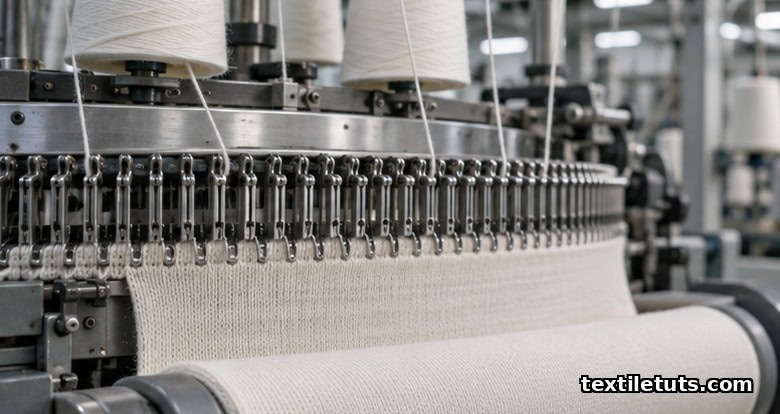
Knitting fabric defects, specifically holes, barré, and spirality, account for an estimated 60 to 70 percent of all rejection claims in circular knitting mills, with each defect originating from a distinct mechanical or geometric root cause that can be measured against published AATCC, ASTM, and ISO tolerances. When a single hole appears in a weft-knit course, the failure can usually be traced to a needle latch, a sinker, a yarn break, or a fabric take-down fault, and most mills reject fabric when drop-stitch density exceeds roughly 0.5 percent of the inspected area. Barré presents as periodic horizontal or vertical streaks caused by yarn count, stitch length, or dye-affinity variation, and it becomes visible when the deviation crosses about ±5 percent from the reference course. Spirality, also called skew or twist, is the rotation of wales away from the vertical axis, and AATCC TM 179 sets a practical 5 percent post-relaxation limit for most apparel knits. The rest of this article walks through each defect, the test method used to grade it, and the production controls that prevent it.
If you run a knitting line, dye house, or QC lab, the three defects below are the ones your inspector will flag first. The fix is rarely a single knob, since the same visible streak can come from yarn, machine, dye bath, or finishing. Understanding the mechanism makes the diagnosis faster and the corrective action cheaper.
Holes in Knitted Fabric: Drop-Stitch, Needle Failure, and Lint Accumulation
Holes in weft knitting are almost always a consequence of an incomplete or missed loop, which then propagates down the wale as the machine continues to knit. The four dominant root causes are needle-latch failure, sinker or needle-hook wear, yarn breakage at the feed, and lint or fly accumulation around the needle hook. A single broken needle in a 30-inch, 24-gauge circular machine can produce up to 1,680 dropped loops per revolution because each cam pass advances the cylinder one needle pitch per feeder, and a missed loop at any one of those feeders becomes a permanent hole unless caught and re-knit.
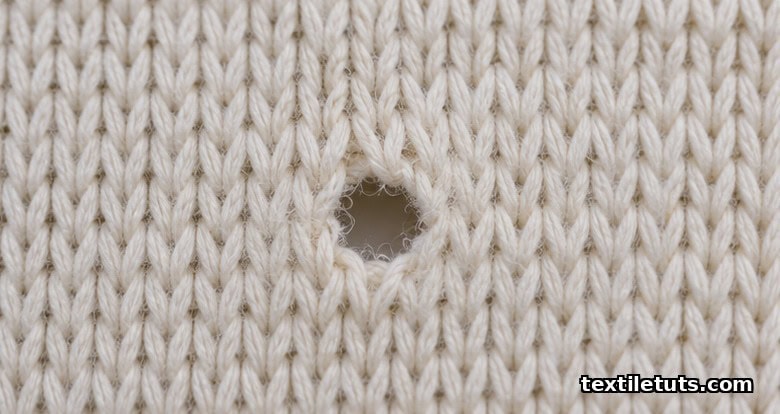
From a QC standpoint, ASTM D3887 frames knitted-fabric acceptance for holes around the absence of dropped stitches rather than a numeric hole count, because the standard treats each missed loop as a fabric defect that must be repaired or cut out. AATCC graders use a 4-point or 10-point system where each hole is penalized at 4 points, the maximum per defect, regardless of hole size. A typical first-quality tolerance is zero holes per 100 linear yards for fine-gauge single jersey and 1 hole per 100 yards for coarse-gauge fleece, based on common mill practice captured in the AATCC grading guides. Mills running cotton or cotton-rich blends are most exposed to hole formation because cotton lint sheds heavily at the needle zone; polyester and its blends shed less but fail at the needle latch when friction rises above about 1.2 N of needle-to-yarn drag.
The practical prevention set is straightforward. Run a daily needle-by-needle inspection on critical feeders, replace any needle showing hook wear greater than 0.05 mm, and keep the cam, sinker, and trick-plate zones clean between doffs. A lint vacuum cycle every 4 hours on a cotton line reduces hole-related stop marks by an estimated 30 to 40 percent in published mill case studies. Re-latchable needles, which allow a missed loop to be re-knit without a visible hole, are now common on higher-end circular machines and can drop hole-related claims to near zero on a well-tuned line.
Barré: Periodic Streaks From Yarn, Stitch Length, and Dye Variation
Barré is the appearance of horizontal (course-wise) or vertical (wale-wise) streaks of slightly different shade or texture, and it is the single most common visual claim on circular knit fabric. The three production sources are yarn count variation, stitch length variation, and dye-affinity variation, and they often combine. A yarn count drift of ±5 percent across cones produces a visible shade band even on undyed greige fabric once the loop density changes, and the human eye detects loop-density differences of about ±2 percent in side-by-side viewing. Stitch length variation between feeders of ±1 mm in a 28-gauge single jersey is enough to create a clear barré band after finishing.
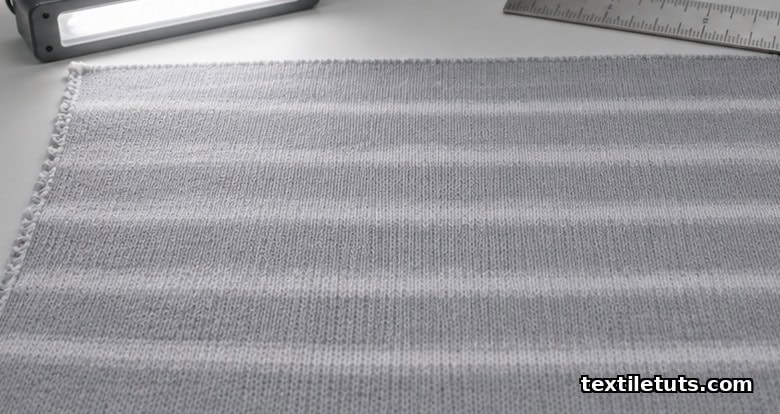
The diagnostic step most mills skip is separating yarn barré from machine barré. Yarn barré travels across all feeders as a slow, wide band that matches the lot of yarn on the creel; machine barré repeats every revolution of the cylinder and aligns with a specific feed position. AATCC technical guidance recommends inspecting greige fabric under north-sky equivalent D65 illumination at a viewing distance of 60 to 90 cm, with the fabric held at 45° to the light. Barré is then graded by reference photographs on a 1 to 5 scale, where grade 3 is the practical mill-acceptance threshold for first-quality apparel.
Yarn count control is the most effective prevention lever. Evenness testers such as Uster Tester 5 report CV percent on yarn count, and a CV below 12 percent for combed cotton and 9 percent for combed polyester-cotton blends is the typical first-quality target. Stitch length variation is controlled by positive-feed systems and online stitch-length monitoring, which hold tolerance to about ±0.3 mm at the cam. Dye barré, the third major source, is reduced by pre-relaxation of the greige fabric, even-flow dye-bath circulation, and liquor-ratio control above 1:8 for jet dyeing of circular knits. Reactive dyes on cellulosics are particularly sensitive to liquor ratio and temperature uniformity, and a 2 °C gradient across a jet machine can produce a visible barré in solid shades.
Spirality: The Skewed Course Problem in Weft Knits
Spirality is the rotation of successive courses away from the true horizontal in a relaxed weft knit, and it is an inherent consequence of loop geometry rather than a defect in the narrow sense. As the yarn goes from needle loop to sinker loop, the loop leans by about 3 to 5 degrees in plain single jersey, and that lean accumulates over the fabric length. In 1×1 rib and interlock, the lean partly cancels because the face and reverse loops mirror each other, leaving residual spirality of about 1 to 2 percent, while plain single jersey can reach 6 to 10 percent without corrective finishing. The defect shows up only after relaxation, because the loop geometry relaxes when yarn crimp is removed in washing or heat-setting.
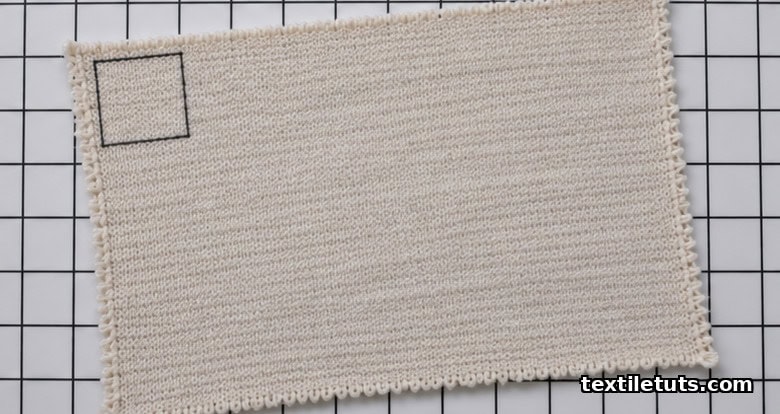
AATCC TM 179 is the standard test method for measuring spirality after home-laundering cycles, and it sets the practical pass threshold at 5 percent for most circular knit apparel, with stricter limits for tailored garments. The test uses a traced square marked on the fabric before washing, and the rotation of the square’s wale axis after the prescribed cycles is reported as percent spirality. ASTM D3887 references spirality through dimensional-change criteria, and AATCC TM 135 covers the laundering cycle itself. Together the three standards describe how spirality is both created in knitting and measured in finishing QC.
Spreader-straightener frames fitted with skew bowls, palmer rollers, or compactor belts are the standard corrective device, and modern units can reduce spirality from 8 to 10 percent down to 2 to 3 percent on plain single jersey. Yarn twist direction is a contributing factor; a Z-twist yarn knitted into a Z-leaning loop produces more spirality than an S-twist yarn, which is why mills that switch yarn suppliers sometimes see spirality shift even when the count and finish are unchanged. Heat-setting polyester and polyester-rich knits locks the loop geometry in place and is the most reliable control, with 180 to 190 °C for 30 to 45 seconds being typical for 100 percent polyester circular knits. Cotton knits rely on mechanical decating and compaction because the fiber cannot be heat-set.
Detection Standards and Tolerances at a Glance
| Defect | Root Cause | Primary Test Method | Practical Tolerance |
|---|---|---|---|
| Holes | Needle latch failure, yarn break, lint | AATCC 4-point grading + ASTM D3887 acceptance | 0 holes / 100 y for fine-gauge; 1 / 100 y for fleece |
| Barré | Yarn count, stitch length, dye variation | AATCC visual grading (1–5) under D65 light | Grade 3 or better for first quality |
| Spirality | Loop geometry, yarn twist, relaxation | AATCC TM 179 (post-launder skew) | ≤ 5% for most apparel |
| Dimensional change | Relaxation shrinkage, finishing | AATCC TM 135 / ISO 5077 | ≤ 5% length and width for knit apparel |
Prevention in Production: Machine, Yarn, and Process Levers
Most knitting-defect reduction programs that actually move the needle share three habits. First, the mill records every defect by feeder number, lot, and shift, which lets the QC team spot whether the problem is at a single feed or across the machine. Second, yarn is tested on an evenness tester at the cone, not at the lot, so that high-CV cones are flagged before they hit the creel. Third, greige fabric is relaxed before inspection, either by tumble relaxation at 40 °C for 20 minutes or by a short steam cycle, so that loop geometry is stable at the grading table. These three habits cut visible-defect claims by an estimated 25 to 35 percent in published case studies from coarser-count knit programs in South Asia.
From the machine side, positive-feed systems, online stitch-length monitors, and broken-needle sensors are the highest-ROI upgrades for a circular knitting line. A positive-feed system holds yarn tension within ±2 cN across all feeders, which removes the largest single cause of barré in plain single jersey. Broken-needle sensors stop the machine within a fraction of a second of a hook failure, which prevents the long hole trails that drive most hole-related rejections. Online stitch-length monitors compare each feeder’s loop length against a reference and alarm when drift exceeds ±0.5 mm, which is well below the ±1 mm visible-barré threshold.
From the process side, relaxation, heat-setting, and skew correction are the three finishing controls that turn a borderline greige into a first-quality finished knit. Heat-setting polyester knits at 180 to 190 °C for 30 to 45 seconds stabilizes loop geometry and locks stitch length. Skew bowls on the compactor frame rotate the fabric axis to cancel the geometric spirality before stenter framing. Combined with a 1:8 to 1:10 liquor ratio and even-flow dye-bath circulation, these controls give most mills a first-quality yield above 95 percent on plain single jersey and above 90 percent on rib and interlock.
Frequently Asked Questions
What is the most common knitting defect in circular knit fabric?
Barré is the most common visual claim on circular knit fabric, and it accounts for an estimated 35 to 45 percent of all rejection decisions in finished knit fabric programs. The defect usually traces to a combination of yarn count variation above ±5 percent and stitch length drift above ±1 mm between feeders. Even greige fabric can show barré before dyeing when loop density shifts across the fabric width.
Can spirality be fully eliminated in weft knit fabric?
Spirality cannot be fully eliminated because it is built into loop geometry, but it can be reduced to about 2 to 3 percent on plain single jersey with a properly tuned compactor frame and a heat-setting step on polyester-rich blends. AATCC TM 179 sets a 5 percent practical limit for most apparel, which is achievable on every major construction. Cotton-only knits rely on mechanical decating and compaction because cotton fibers cannot be heat-set.
How are knitting holes graded by inspectors?
AATCC graders use a 4-point or 10-point system where each hole is penalized at 4 points, the maximum per defect. First-quality circular knit fabric typically allows zero holes per 100 linear yards on fine-gauge single jersey and one hole per 100 yards on coarse-gauge fleece. Larger holes, needle holes, and press-offs each carry the maximum penalty, which makes them expensive to ship and difficult to repair in finishing.
Why does barré appear after dyeing but not in greige fabric?
Barré is often hidden in greige fabric because undyed yarn loops have nearly the same reflectance across the fabric. Once the fabric is dyed, even a small loop-density shift shows up as a different shade because the dye uptake per unit loop mass is not uniform. Reactive dyes on cellulosics amplify this effect, and a 2 °C temperature gradient across a jet dyeing machine can produce a visible barré band on otherwise sound greige.
Are knitting defect standards different for technical textiles?
Yes, technical knit fabrics follow tighter tolerances than apparel knits because end-use conditions such as filtration, medical barrier, or geotextile performance require consistent loop geometry. The same AATCC and ASTM visual grading scales apply, but the practical acceptance limit often drops from grade 3 to grade 4 or higher for medical and filtration knits. Spirality tolerances are also tighter, typically 2 to 3 percent, because skewed courses affect functional properties such as elasticity and porosity.
References
- AATCC. Test Method 179: Spirality after Home-Laundering. American Association of Textile Chemists and Colorists. The standard 4-cycle home-laundering test used to grade course skew in weft knits.
- AATCC. Test Method 135: Dimensional Changes of Fabrics after Home Laundering. American Association of Textile Chemists and Colorists. The cycle definition used with TM 179 for spirality and shrinkage measurement.
- ASTM. D3887 / D3887M: Standard Specification for Knitted Fabric. ASTM International. Defines acceptance criteria including hole, barré, and spirality limits for weft knit apparel.
- ISO. ISO 5077: Determination of Dimensional Change (Domestic Washing). International Organization for Standardization. Companion to AATCC TM 135 for international knit-finishing QC.
- Sakthivel, S., & Karthikeyan, R. (2019). Causes and Remedies of Spirality in Weft Knitted Fabrics. Research Journal of Textile and Apparel. Peer-reviewed study of the geometric source of spirality and the effect of heat-setting on plain single jersey.
- Uster Technologies. Uster Statistics 2025: Quality Benchmarks for Yarn Evenness. Industry reference for yarn CV percent, a key control variable for barré prevention.
This article is the working reference for common weft-knitting defects and their control under AATCC, ASTM, and ISO test methods. Editorial by Iftay Khairul Alam, TextileTuts. Sources: AATCC TM 179, AATCC TM 135, ASTM D3887, ISO 5077, and peer-reviewed knitting literature as cited.


