
French Terry Fabric

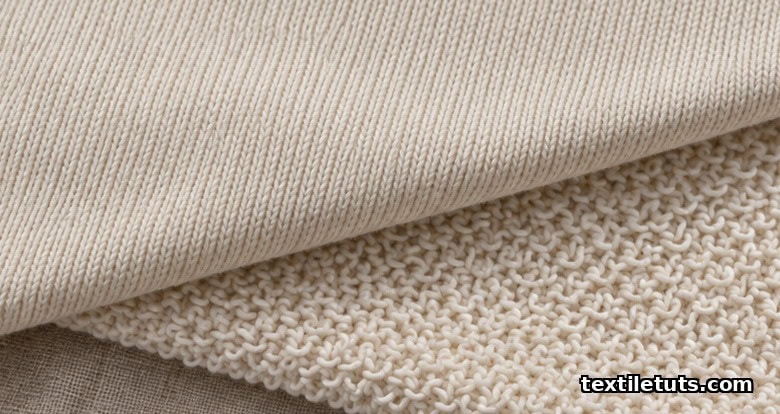
French terry is a weft-knitted fabric defined by uncut loops on its technical back and a smooth jersey face on the front, with commercial mass per unit area ranging from 200 to 450 g/m² and most constructions using 70 to 100% cotton fiber content. The looped back creates a network of tiny air pockets that retain heat, while wicking liquid sweat away from the skin by capillary action through the pile. This guide covers how the fabric is knitted on circular machines, how it differs from fleece, what GSM and blend to choose for a project, and how to wash it so the loops stay open and the cut edge stays stable.
You will also find the dimensional-change numbers that matter for sewing and pattern making, the moisture-management ranges reported in peer-reviewed studies, and the test methods used to verify each property.
What French Terry Actually Is
French terry is a two-sided weft knit. The technical face looks like ordinary single-jersey fabric, with the familiar V-shaped wales of plain knit. The technical back is covered in uncut loops, each one formed during knitting by holding a yarn float instead of drawing it cleanly across the needle. These loops are not brushed or sheared, which is the structural feature that separates French terry from fleece.
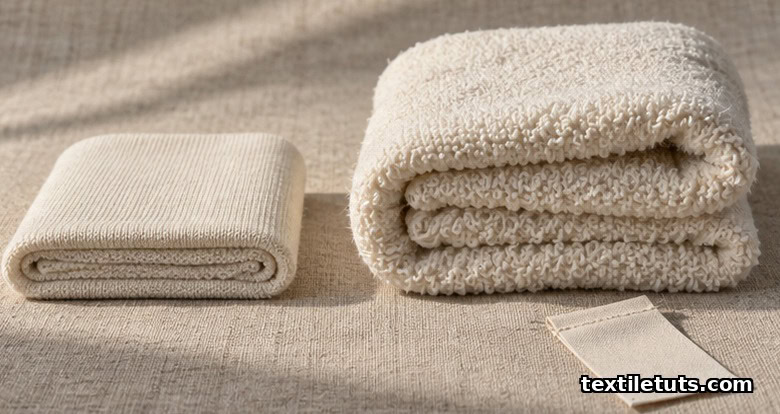
The fabric gets its name from the French knitting tradition that produced towels and bathrobes from loop-pile knits in the 19th century. Modern garment French terry is much finer than towel terry. Towel terry typically has loops 3 to 5 mm tall at 8 to 14 loops per cm². Garment French terry uses shorter loops at higher density to keep the fabric supple and the surface weight reasonable.
How French Terry Is Knitted
Almost all commercial French terry is produced on circular weft knitting machines using two yarn systems: a ground yarn and a flechage (loop-forming) yarn. The ground yarn knits the smooth face on every cylinder needle. The loop yarn is fed into selected needles on alternate feeds and held as a float that becomes the loop on the technical back.
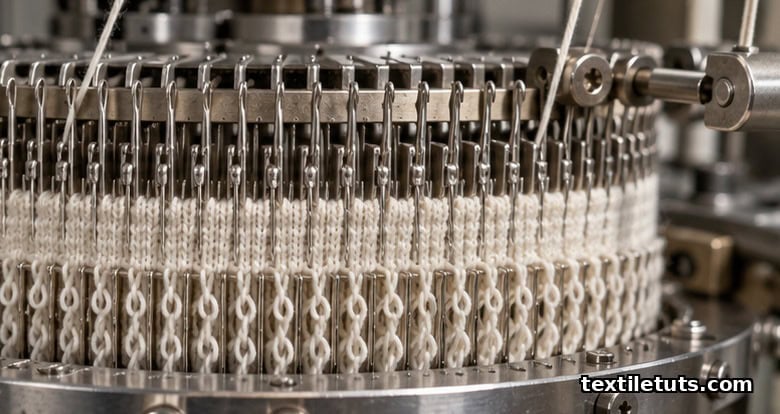
The most common machine gauge for apparel French terry is 18 to 24 needles per inch (E18 to E24), which produces a face stitch density in the range of 18 to 28 wales per cm. Loop height is controlled by the dial-height setting on the knitting machine, which in practice ranges from 1.5 to 3.0 mm for sweatshirt-weight fabric. A higher loop gives more absorbency and insulation; a lower loop gives a smoother back and a flatter drape.
Stretch variants add elastane (spandex) plated on the back side of selected needles, typically at 3 to 5% of the total fiber mass. This produces a fabric that recovers its shape after stretching rather than bagging out at the elbows or knees.
French Terry vs Fleece and Other Loop-Pile Knits
Fleece is French terry that has been brushed or raised on the loop side to break the loops into a fuzzy pile. The brushing step increases the trapped-air volume, which is why fleece feels warmer, but it also reduces fabric stability and creates pills over time. French terry keeps the loops intact, so it is cooler, more absorbent, and more stable at the cut edge.
| Property | French Terry | Fleece (brushed French terry) | Towel Terry |
|---|---|---|---|
| Back side | Uncut loops, intact | Loops broken into pile | Long cut loops, open pile |
| Typical GSM (g/m²) | 200 to 450 | 280 to 500 | 400 to 900 |
| Thermal resistance (clo) | ~0.35 to 0.55 | ~0.55 to 0.85 | ~0.40 to 0.60 |
| Edge behavior when cut | Mild curl, stable | No curl, may fray | No curl, sheds loose loops |
| Moisture behavior | High (loop capillary wicking) | High but slower (pile blocks wicking) | Very high |
Typical Fiber Blends and Fabric Weight
The fiber blend controls hand feel, recovery, and post-wash behavior. For woven and knit sweatshirts and joggers, the most common blends are:
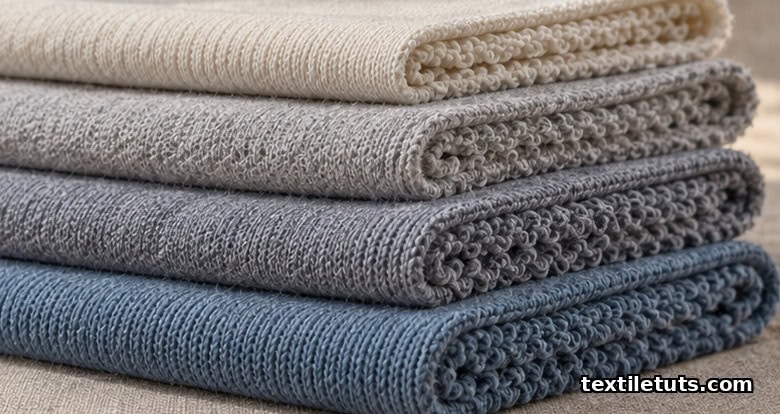
- 100% cotton, GSM 240 to 380: the standard for sweatshirts and hoodies, with a soft hand and biodegradable fiber, but no recovery.
- Cotton/polyester 80/20, GSM 220 to 320: the classic athletic-knit blend, reduces wet-time for dyehouse finishing and adds wet strength.
- Cotton/polyester/elastane 70/25/5 or 80/17/3, GSM 240 to 360: stretch French terry for joggers, leggings, and fitted hoodies with recovery after elongation.
- Organic cotton or recycled-cotton blends, GSM 260 to 360: marketed for sustainability, with comparable performance to virgin cotton when yarn quality is matched.
Mass per unit area (GSM) is measured per ISO 3801 (textiles, determination of mass per unit length of fabrics) or ASTM D3776/D3776M (mass per unit area of fabric). Heavier French terry (above 320 g/m²) is used for sweatpants and outer hoodies; lighter weights (200 to 280 g/m²) are used for T-shirt-style pullovers and lining.
Moisture Management and Thermal Behavior
The loop pile on the back of French terry behaves like a passive moisture-management system. Each loop is a small capillary that draws liquid away from the skin and into the air-filled space between loops. The system works because:
- Loop density is high (typically 20 to 30 loops per cm²), so wicking paths are short.
- Loop height (1.5 to 3.0 mm) sets the air gap between skin and absorbent yarn, so the skin-side surface dries first.
- Cotton fibers have a moisture regain of about 7 to 8.5% at 65% relative humidity, holding moisture inside the fiber rather than dripping.
Peer-reviewed work on loop-pile knits reports water absorption capacity in the range of 2.5 to 3.5 times the fabric’s dry mass for unbrushed French terry, with brushing (fleece) reducing the absorbed mass slightly because the broken pile blocks some capillary channels. Thermal resistance for a typical 320 g/m² French terry is around 0.40 to 0.55 clo, which classifies it as a light mid-layer in apparel layering systems.
Dimensional Stability, Shrinkage, and Care
Because French terry is a knit, dimensional change after washing is governed by relaxation shrinkage and felting shrinkage rather than the yarn swelling that drives woven-fabric shrinkage. ISO 5077 and AATCC TM135 define the standard procedure: five home-laundering cycles at a chosen temperature, then measurement of length and width.
Reported shrinkage numbers for untreated, loom-state French terry:
- 100% cotton, washed at 30 °C, tumble dry low: −5% to −7% length, −3% to −5% width.
- 100% cotton, washed at 60 °C, tumble dry medium: −10% to −15% length, −6% to −10% width.
- Cotton/poly 80/20, washed at 40 °C, tumble dry low: −3% to −5% length, −2% to −3% width.
- Cotton/poly/elastane 70/25/5, washed at 30 °C, tumble dry low: −2% to −4% length, −1% to −3% width.
For pre-washed (compacted) French terry, residual shrinkage after five additional wash cycles is typically under 3% in either direction. Industrial pre-shrinking (compacting) is what separates production-yardage French terry from cheap greige (loom-state) French terry for home sewing. Always check the supplier’s spec sheet; if it does not state residual shrinkage, treat the fabric as loom-state and pre-wash before cutting.
Recommended care: machine wash cold (≤30 °C) for cotton-rich blends; tumble dry low or line dry; avoid chlorine bleach on elastane blends; iron at medium heat (≤150 °C) on the face side.
Frequently Asked Questions
Is French terry the same as terry cloth?
No. Terry cloth (towel terry) is a loop-pile knit with long, often 3 to 5 mm loops designed for maximum water absorption in towels and bathrobes, with GSM commonly 400 to 900. French terry is a lighter loop-pile knit, GSM 200 to 450, designed for apparel where comfort, breathability, and a clean face are the priorities.
Does French terry shrink?
Yes. Untreated 100% cotton French terry can shrink 10 to 15% in the length direction after five wash cycles at 60 °C. Pre-shrunk (compacted) French terry from a quality mill is normally under 3% residual shrinkage. Always pre-wash and dry before cutting if you did not buy compacted yardage.
What is French terry best used for?
Sweatshirts, hoodies, joggers, T-shirt pullovers, lightweight robes, and lined jackets. Mid-weight (280 to 360 g/m²) cotton-rich French terry is the workhorse for sweatshirts; lighter 200 to 260 g/m² blends work for T-shirt-weight pullovers and childrenswear.
Is French terry breathable?
Yes, more than fleece. Loop-pile French terry retains enough air for insulation while the open loop structure allows water vapor to pass through, with reported thermal resistance values of 0.35 to 0.55 clo for typical apparel weights. Fleece blocks more vapor flow because its brushed pile sits against the skin.
Is French terry warmer than cotton jersey?
Yes. Loop-pile French terry traps roughly 30 to 60% more still air than single-jersey cotton at the same weight because the loops stand off the skin. In practice that translates to one ISO 5085 thermal-resistance step up, similar to wearing a light fleece in mild conditions.
References
- International Organization for Standardization. ISO 3801: Textiles — Determination of mass per unit length of fabrics. iso.org. Specifies the GSM test used to classify French terry weight.
- International Organization for Standardization. ISO 5077: Determination of dimensional change of fabrics after domestic washing. iso.org. The standard laundering cycle used to report shrinkage values.
- International Organization for Standardization. ISO 5085: Thermal resistance of textiles. iso.org. The clo value test used to compare French terry with jersey and fleece.
- ASTM International. ASTM D3776 / D3776M: Standard Test Methods for Mass Per Unit Area (Weight) of Fabric. astm.org. North American counterpart to ISO 3801 for fabric mass.
- American Association of Textile Chemists and Colorists. AATCC TM135: Dimensional Changes of Fabrics after Home Laundering. aatcc.org. Method used for knit-fabric shrinkage reporting.
- American Association of Textile Chemists and Colorists. AATCC TM79: Absorbency of Textiles. aatcc.org. Test method for water-uptake capacity of loop-pile knits.
- ResearchGate. Comparative study of physical and moisture-management properties of loop-pile knitted fabrics. Peer-reviewed dataset on terry absorbency, drying rate, and air permeability.
This article is the working reference for French terry fabric. Editorial by Iftay Khairul Alam, TextileTuts. Sources: ISO 3801, ISO 5077, ISO 5085, ASTM D3776/D3776M, AATCC TM135, AATCC TM79, peer-reviewed loop-pile knit dataset as cited.


