
Air-Jet Spinning: Process, Properties, and Applications

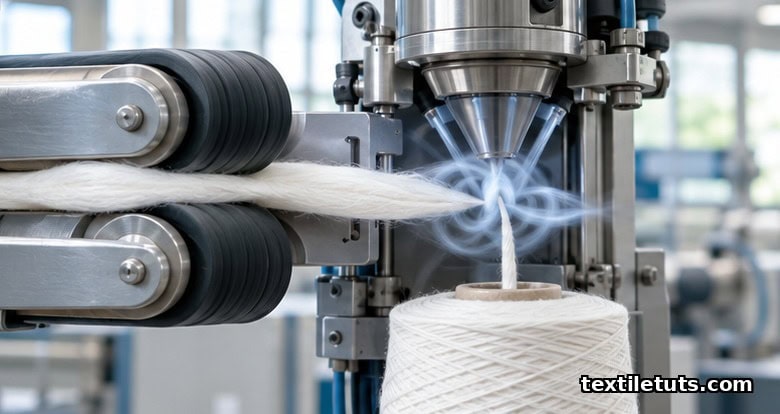
Air-jet spinning twists staple fibers into yarn at delivery speeds of 200–450 m/min using high-velocity air vortices, with the Murata Jet Spinner (MJS, introduced 1981) and the Murata Vortex Spinner (MVS, commercialized 1997) being the two commercially dominant systems for producing 100% cotton, synthetic, and cotton-blend yarns.
The process packages each fiber as it forms, replacing the rotating spindle of ring spinning with a column of compressed air that consolidates and binds the fibers in fractions of a second. This guide explains how an air-jet spinning frame works, what the resulting yarn looks like under the microscope, how its properties stack up against ring-spun and rotor-spun yarn, and where the technology fits in modern knitwear, woven apparel, and home textiles.
What Is Air-Jet Spinning?
Air-jet spinning is a non-ring, non-rotor method of converting drawn sliver into a packaged yarn in a single pass. Instead of relying on mechanical twist from a rotating spindle or on the slip groove of a rotor, the machine uses paired jets of compressed air that create a swirling vortex to insert false twist into the drafted fiber ribbon. The action happens inside nozzles mounted on each spindle position, so the productivity per operator position is several times higher than on a ring frame.
The principle was commercialized first in 1981 by Murata Machinery as the MJS (Murata Jet Spinner). A second design was released in 1997 as the MVS (Murata Vortex Spinner) and later refined in the VORTEX III air-jet platform. Together these two systems account for the majority of installed air-jet positions worldwide. Earlier or specialty designs such as the Platt Jet Spinner and the ZN air-jet series from Japan use the same core physics of air-imposed twist, although on much smaller populations of machines.
How the Process Works, Step by Step
Air-jet spinning collapses four classical spinning steps (roving, ring spinning, doffing, and winding) into three. Sliver drawn on a drafting frame is fed directly into the spinning nozzle. The fibers exit as a packaged yarn on a cross-wound cheese ready for knitting, weaving, or dyeing, with no roving stage and no manual handling between drafting and package.
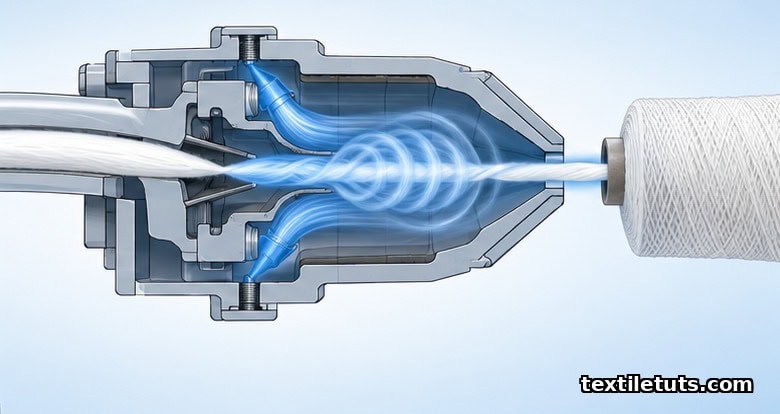
Inside the spinning nozzle, two adjacent air-jet orifices generate a swirling vortex that travels along the fiber axis. The vortex inserts a high level of false twist into the trailing fiber ribbon, then collapses and binds the fiber ends into the yarn core when the twist runs off the leading end. Wrapper fibers, the trailing ends that the air stream catches at the nozzle exit, lock the core in place without the tight cylinder of true twist that a ring spindle would apply.
Because the nozzle acts on a short length of fiber at any moment, the machine keeps yarn tension within a tight band regardless of how the package builds. This consistency translates into cleaner knitting performance downstream, because the tension variation from full to empty package is much smaller than on a ring-spun cone.
Yarn Structure and Properties
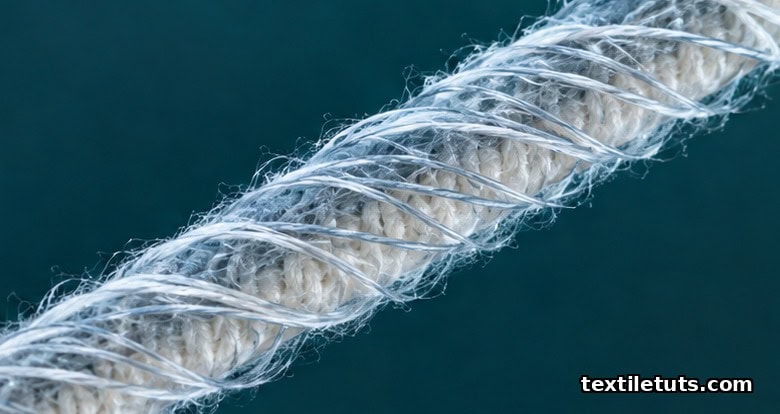
The signature feature of air-jet yarn is its wrapper-fiber outer layer. The vortex catches trailing fibers at the drafting exit and wraps them around the core at a high helix angle, typically representing 15–30% of surface fiber ends. The result is a yarn that is less hairy than rotor-spun yarn, more uniformly twisted than ring-spun yarn of the same count, and slightly weaker in tensile strength than a ring-spun control of equal count and fiber blend.
Single-strand tensile strength is the standard industry metric for comparing yarn strength. ASTM D2256 is the standard test method for tensile properties of yarns by the single-strand method, and it is the reference cited in most air-jet performance studies. Loss of strength against ring-spun yarn is typically 10–20%, but the gap narrows with finer counts and with synthetic blends where the fiber surface is uniform. Twist in the finished yarn is measured by ISO 2061:2015 (Textiles: Determination of twist in yarns: Direct counting method), the second reference standard that usually appears alongside any air-jet performance paper.
Yarn evenness improves by roughly 10–25% compared with ring spinning, which is why air-jet yarn is favored where surface cleanness matters: yarn-dyed knit fabrics, pique knits, fine-gauge jersey, and lightweight shirting. Twist liveliness (the residual torque that makes knitted fabrics skew off-grain) is lower because the false-twist mechanism does not store torsional energy the way a wound-on ring-spun package does.
Pilling behavior is a notable trade-off. Fewer protruding fiber ends mean less pilling on first wear, but once a pill forms, the wrapper structure can hold it on the surface. Air-jet yarn also tends to be slightly stiffer at the same count, which reads as a crisper fabric hand in woven constructions.
Operating Speeds and Productivity
Delivery speed is the headline production metric. A modern ring frame runs at 20–30 m/min and a rotor spinner at 100–200 m/min, while an air-jet frame delivers packaged yarn at 200–450 m/min depending on count and fiber blend. A single operator can tend 12–24 positions on an air-jet frame, versus the single-spindle attention required on a ring frame, which is why the technology is widely chosen for fine and medium counts in cost-sensitive markets.
Power consumption per kilogram of yarn is comparable to ring spinning, since compressed-air generation offsets the savings in spindle motors, but labor cost per kilogram drops sharply because handling is concentrated at the package doffing and creel loading steps rather than at every spindle. Floor-space productivity per square meter is also higher than rotor spinning at fine counts.
Comparison With Ring and Rotor Spinning
| Parameter | Ring Spinning | Rotor Spinning | Air-Jet Spinning |
|---|---|---|---|
| Delivery speed (m/min) | 20–30 | 100–200 | 200–450 |
| Twist method | Mechanical spindle (true twist) | Rotor groove (true twist) | Compressed-air vortex (false twist) |
| Yarn surface | Smooth, helical twist | Hairy, wrapper-rich | Less hairy than rotor, less smooth than ring |
| Tensile strength vs ring (baseline 100%) | 100 | 70–85 | 80–90 |
| Evenness CV% | 12–18 | 11–15 | 9–14 |
| Hairiness (H value index) | Lowest | Highest | Intermediate |
| Best-fit count range (Ne) | Fine to coarse | Medium to coarse | Fine to medium |
| Typical end uses | Apparel, suiting, technical | Denim weft, knit, towels | Knit jersey, shirting, home textiles |
These ranges are typical industry values reported in the spinning literature; precise figures depend on fiber blend, count, machine settings, and ambient conditions, and they should be verified against current mill benchmarks before being adopted for any specific product specification.
Where Air-Jet Yarn Is Used
The yarn is well matched to knit fabrics that demand a clean surface and modest hairiness: jersey for T-shirts and underwear, pique polo knits, single-jersey and rib for casualwear, fine-gauge sweater yarns, hosiery, and tubular knit panels. Woven applications include yarn-dyed shirting, lightweight dress fabrics, home-textile sheeting, and certain grades of denim where the slight stiffness of the yarn contributes to a stable, less-stretchy fabric hand.

End uses where ring-spun or compact-spun yarn is generally preferred over air-jet include high-strength industrial fabrics, hard-twist crepe yarns, and weft yarns for worsted suiting where high fiber alignment is critical. Air-jet is rarely used for very coarse counts (below roughly Ne 6) because the air-jet hardware becomes physically large relative to the fiber mass being handled.
For textile students, the practical takeaway is that air-jet spinning is a productivity play at the fine and medium count range: it produces a yarn that knits cleanly, dyes evenly, and runs well on modern looms and knitting machines, but it trades some tensile performance for that cleanness and surface evenness.
Frequently Asked Questions
What is the difference between MJS and MVS air-jet spinning?
Both systems use compressed-air vortices to insert false twist into the drafted fiber ribbon. The MJS (Murata Jet Spinner, 1981) uses two short nozzles arranged in series along the yarn path, while the MVS / VORTEX (Murata Vortex Spinner, 1997) uses a single longer nozzle with a more controlled air-flow path that exposes fewer wrapper fibers and gives a smoother, stronger yarn at comparable delivery speeds.
Is air-jet yarn stronger than ring-spun yarn?
No. Air-jet yarn typically measures 10–20% lower in single-strand tensile strength than a ring-spun control of the same count and fiber blend when tested by ASTM D2256 on the same lot. Its advantages are productivity, evenness, lower hairiness, and reduced residual torque, rather than raw tensile strength.
Can air-jet spinning handle 100% cotton?
Yes. Cotton, cotton-polyester blends, viscose, modal, and several microfibers are routine feedstocks for MJS and MVS frames, with counts from roughly Ne 20 to Ne 80 covering most knit and yarn-dyed applications. Spinning 100% long-staple cotton at very fine counts requires careful humidity control and more frequent nozzle cleaning than synthetic blends.
How much does it cost to run an air-jet frame?
Operating cost depends on local electricity and labor rates, but compressed-air energy and the capital cost of the nozzle block dominate. As a planning figure, most mills report a 15–30% lower conversion cost per kilogram of yarn than ring spinning at matched count, driven mainly by labor and floor-space savings rather than by raw energy use.
Does air-jet yarn pill more than ring-spun yarn?
It depends on the fabric and end use. Air-jet yarn has fewer loose surface fibers, so it tends to pill less in the early wear cycle, but once pills do form, the wrapper-fiber structure can hold them on the surface longer. For low-pill critical applications such as hosiery and fine-gauge knitwear, ring-spun compact yarn is usually the safer choice.
References
- ASTM International. ASTM D2256/D2256M – Standard Test Method for Tensile Properties of Yarns by the Single-Strand Method (ASTM, West Conshohocken, PA).
- International Organization for Standardization. ISO 2061:2015 – Textiles: Determination of twist in yarns – Direct counting method (ISO, Geneva).
- International Organization for Standardization. ISO 2060 – Textiles: Yarn from packages – Determination of linear density (mass per unit length) by the skein method (ISO, Geneva).
- Lawrence, C. A. (2003). Fundamentals of Spun Yarn Technology (CRC Press, Taylor & Francis) – cited via the Taylor & Francis eBook platform and ResearchGate listing, ISBN 9780849326972.
- ResearchGate open-access listing: “A comparative study of air-jet, ring, and rotor spun cotton yarn properties” – published in a peer-reviewed textile journal, indexed on researchgate.net.
- Textile Institute (UK). “Air-jet spinning” review article in The Journal of The Textile Institute (Wiley/Taylor & Francis) – accessed via textileinstitute.org resource pages.
This article is the working reference for air-jet spinning within TextileTuts’ Spinning cluster. Editorial by Iftay Khairul Alam, TextileTuts. Sources: ASTM D2256, ISO 2061:2015, and Lawrence (2003) as cited.


