
Viscose Staple Fiber Spinning

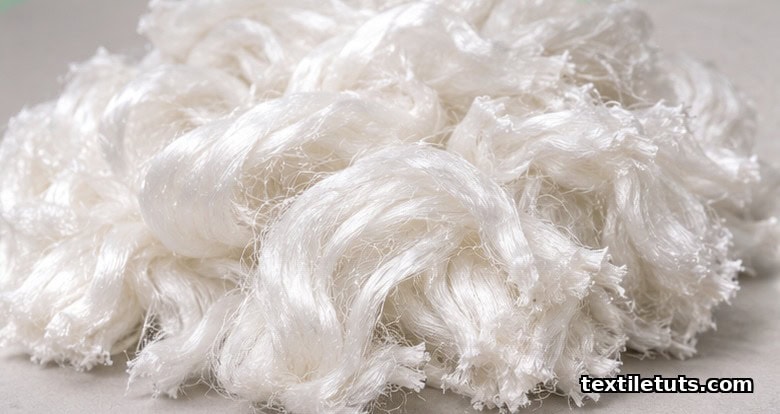
Viscose staple fiber is a regenerated cellulose filament of 1.2 to 1.7 dtex produced by wet-spinning cellulose xanthate into a sulfuric acid bath, then cut to 38 to 51 mm so it can be processed on the cotton spinning system into Ne 20s to Ne 60s ring yarn. The fiber carries a moisture regain of about 13 percent, a dry tenacity of 20 to 25 cN/tex, and a wet tenacity roughly 50 to 60 percent of its dry value, which is why processors size it on cotton machinery rather than on worsted or filament equipment. This article walks through the fiber production route, the parameters that control its spinnability on a cotton line, the yarn properties it delivers, and the standards used to test the finished yarn.
Viscose staple spinning matters because viscose is the second-most-produced cellulosic fiber after cotton, accounting for an estimated 2.4 million tonnes of the global cellulosic staple output in 2023, and because its behavior on a cotton line is the reference case for blending with polyester, modal, and lyocell.
What Viscose Staple Fiber Is and How It Differs from Filament Viscose
Viscose is a regenerated cellulose fiber that begins as dissolving-grade wood pulp with an alpha-cellulose content above 90 percent and ends as a continuous filament tow that is mechanically crimped and cut into staple lengths matched to cotton or wool processing. The chemical path is the viscose process: cellulose pulp is steeped in 17 to 20 percent sodium hydroxide at 20 to 25 °C, pressed to a press ratio of about 2.8 to 3.2, shredded into alkali cellulose crumbs, aged at 22 to 28 °C for 18 to 30 hours, and reacted with carbon disulfide at 30 to 40 percent of the cellulose weight to form sodium cellulose xanthate. The xanthate dissolves in 4 to 6 percent sodium hydroxide to give the spinning dope, which is then ripened for 18 to 30 hours at 18 to 22 °C before extrusion.
Staple viscose differs from filament viscose in two ways. First, the spinning bath exits through thousands of holes in a spinneret, the resulting tow is drawn, crimped, and cut to length, rather than being wound onto a package as continuous filament. Second, the fiber is engineered for cohesion on cotton cards, which is why linear density and cut length are tightly controlled. The cut length is normally 38 mm for coarse yarn counts and 51 mm for finer counts, while linear density is held to 1.2 to 1.7 dtex for cotton-system spinning and 2.2 to 5.6 dtex for woolen or carpet systems.
The Viscose Wet-Spinning Process and Its Process Parameters
Wet spinning is what defines viscose as a fiber. The ripened dope, at a cellulose content of 8 to 10 percent and a viscosity of 30 to 50 seconds by the falling-ball method, is extruded through a multi-hole spinneret into an acid bath containing 8 to 12 percent sulfuric acid, 12 to 18 percent sodium sulfate, and 1 to 2 percent zinc sulfate, held at 45 to 55 °C. Inside the bath the cellulose xanthate decomposes and regenerates as cellulose, releasing carbon disulfide and hydrogen sulfide gases.
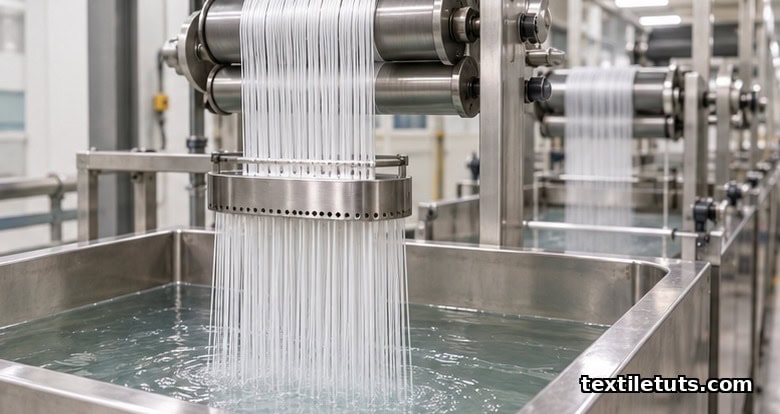
The fiber’s structure and its downstream spinning behavior are set inside this bath. The key parameters and their typical ranges are:
- Jet stretch (first godet to second godet): 20 to 80 percent, controlling molecular orientation.
- Spin bath temperature: 45 to 55 °C. Lower temperatures yield a more skin-oriented fiber with lower wet tenacity; higher temperatures yield a more porous, skinless fiber with higher absorbency.
- Acid concentration: 8 to 12 percent H2SO4. Higher acid speeds regeneration but can cause shell formation.
- Zinc sulfate: 1 to 2 percent. Zinc ions suppress shell formation and raise wet tenacity by 30 to 50 percent.
- Spinneret hole diameter: 50 to 80 µm for 1.2 to 1.7 dtex fiber.
- Tow linear density at the cutter: 80 to 160 ktex, then cut into staple.
After the bath, the tow passes through a stretch bath at 90 to 95 °C (plasticizing hot stretch of 50 to 120 percent), is washed to remove residual acid, desulfurized with sodium sulfide or sodium hydroxide to remove free sulfur, bleached with sodium hypochlorite or hydrogen peroxide, finished with a softener for fiber-to-fiber lubrication, dried on a perforated drum or through-air dryer, and baled at 200 to 250 kg/bale.
Spinning Viscose Staple on a Cotton System
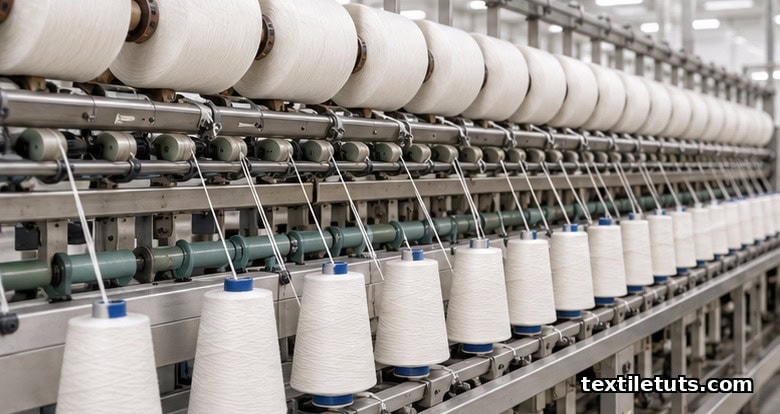
Once baled, viscose staple goes through the same stages as cotton: blowroom, carding, drawing (breaker and finisher), roving, and ring, rotor, or air-jet spinning. The differences from cotton are operational, not architectural.
Blowroom and Carding
Viscose is cleaner than cotton at the bale, so blowroom opening is light. Carding is where viscose behaves differently from cotton. Its fiber-to-fiber friction is low because the surface is smooth and the moisture regain is high, so the card needs finer wire (36 to 40 points per inch worker and stripper wire for 1.2 dtex fiber), a slower flat speed of 150 to 200 mm/min, and a reduced licker-in speed to keep fiber breakage low. Production rates of 25 to 40 kg/hour per card are typical for 1.4 dtex, 38 mm viscose, compared to 60 to 80 kg/hour for cotton at the same count.
The card sliver should be drawn at 4.0 to 5.0 ktex with a uniformity CV below 4 percent. Higher CV indicates fiber breakage in the card, which feeds directly into yarn unevenness.
Drawing and Roving
Drawing uses three or four passages with a total draft of 6 to 8 times. The break draft at the breaker drawing is held to 1.3 to 1.5 to keep the sliver stable. The finisher drawing sliver runs at 3.0 to 4.0 ktex. Roving frames run with a roving twist multiplier of 1.1 to 1.3 (indirect system) to give roving strength sufficient to survive the ring-spinning frame, since viscose roving is weaker than cotton roving of the same count by 15 to 25 percent.
Ring, Rotor, and Air-Jet Spinning
Ring spinning remains the reference route for viscose staple. Traveler speeds of 35 to 40 m/s and spindle speeds of 12,000 to 18,000 rpm are common, with twist multipliers between 3.8 and 4.4 (indirect, α-text of 110 to 130). Viscose ring yarn has a clean surface, low hairiness index (H below 4 by the Zweigle method for Ne 30s), and tenacity of 14 to 18 cN/tex.
Rotor spinning suits coarser viscose yarn counts. Rotor speeds of 60,000 to 100,000 rpm with a 33 to 46 mm rotor groove diameter produce Ne 10s to Ne 30s at rotor speeds that viscose tolerates because the fiber is ductile. Rotor viscose yarn shows a tenacity of 10 to 14 cN/tex but better evenness than equivalent ring yarn at the same count.
Air-jet (MVS or Murata-type) spinning is used for fine-count viscose blends. The fiber must be dry (moisture regain below 12 percent) and antistatic-finished, since humidity inside the nozzle changes the false-twist zone. Air-jet viscose yarn reaches Ne 50s to Ne 60s with a tenacity of 11 to 15 cN/tex.
Comparison of Viscose Staple with Other Cellulosic and Synthetic Staples
| Property | Viscose staple | Cotton | Modal | Polyester staple |
|---|---|---|---|---|
| Linear density (dtex) | 1.2 to 1.7 | 1.5 to 2.5 (mic) | 1.0 to 1.3 | 1.2 to 1.7 |
| Cut length (mm) | 38 to 51 | 25 to 35 (staple) | 38 to 51 | 32 to 38 |
| Tenacity, dry (cN/tex) | 20 to 25 | 20 to 35 | 32 to 38 | 40 to 60 |
| Tenacity, wet (% of dry) | 50 to 60 | 110 to 130 | 80 to 90 | 100 |
| Elongation at break (%) | 18 to 25 | 6 to 9 | 13 to 15 | 15 to 25 |
| Moisture regain (%) | 13 | 8.5 | 12.5 | 0.4 |
| Wet modulus (cN/tex at 5% strain) | 3 to 5 | 10 to 12 | 10 | n/a |
The wet tenacity line is the key contrast. Cotton is the only common staple fiber that is stronger when wet than dry, which is why cotton can be mercerized and viscose cannot be treated in the same way without fiber damage. Modal is a high-wet-modulus viscose variant and roughly doubles the dry tenacity of regular viscose by raising the spin-bath temperature above 60 °C and adding a slow secondary stretch, as described in ISO 2076:2021‘s generic name table.
Yarn Properties and Quality Control Parameters
Viscose ring yarn quality is tested against the same parameters as cotton yarn, with adjusted expectation ranges. Standard test methods from AATCC and ASTM are used as published, while ISO methods govern export markets. The most common parameters and their acceptance ranges for a Ne 30s ring-spun viscose yarn are:
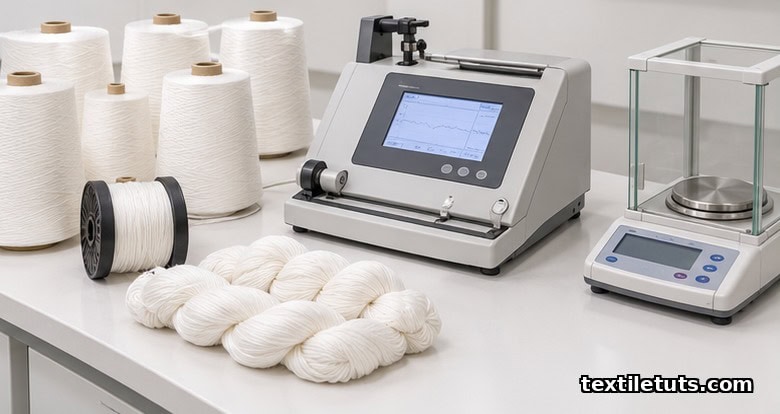
- Yarn count CV: below 3.0 percent on a 100 m sample (ASTM D1907).
- Yarn evenness CVm: 11.0 to 13.5 percent at 400 m/min on a Uster Tester 5.
- Imperfections per 1,000 m: thin places below 25, thick places below 35, neps below 40.
- Single-end tenacity: 14 to 18 cN/tex, with an elongation of 14 to 18 percent.
- Hairiness index (H): below 4 by Zweigle.
- Twist: 4.0 to 4.4 TM (indirect), ±0.2 verified against design.
Two viscose-specific defects deserve attention. First, ring-spun viscose yarn can develop “shiners,” bright spots caused by loose, parallel fibers on the yarn surface that flatten under roller pressure; the fix is to raise traveler weight or lower the front drafting roller pressure. Second, bleached viscose yarn yellows on storage under heat and UV because of residual carbonyl groups; the fix is a final rinse with a reducing agent such as sodium hydrosulfite after bleaching.
Applications and Blending Routes
Pure viscose yarn goes into lining fabrics, ladies’ dress materials, and light shirting where drape and moisture absorption are prized. Viscose is rarely used alone for knit outerwear because wet-fabric distortion is severe; instead it is blended. The common blends, run on cotton-system machinery, are:
- Viscose 50 / polyester 50: suiting and trouser fabric; adds drape to polyester.
- Viscose 70 / cotton 30: shirting with better hand than pure cotton.
- Viscose 60 / modal 40: fine jersey with high wet strength.
- Viscose 50 / linen 50: summer suiting; reduces linen’s crease recovery loss.
Each blend is carded and drafted on the cotton line. The key parameter to watch is the fiber-length differential: viscose at 38 mm blended with cotton at 28 to 32 mm causes the longer viscose to dominate the roving surface and float in the yarn, lowering pilling resistance. The fix is to cut viscose to the cotton length or buy viscose at the same length as the cotton in the blend.
Frequently Asked Questions
What Is the Difference Between Viscose Staple Fiber and Viscose Filament Yarn?
Viscose filament yarn is wet-spun as a continuous filament, twisted, and wound onto a package for use in satin, lining, and other smooth-surface fabrics. Viscose staple fiber is the same filament cut to 38 to 51 mm lengths, crimped, and baled so it can be processed on cotton spinning machinery into spun yarn. Staple gives softer hand and better moisture management; filament gives higher luster and lower cost per square meter of fabric.
Why Is Viscose Staple Spun on Cotton Machinery Rather Than Worsted?
Cotton machinery uses short-staple drafting systems sized for fibers up to about 60 mm with a high draft and a single-apron pressure bar. Worsted machinery is sized for longer, coarser fibers above 60 mm and uses a double-apron system. Viscose is produced at cotton-system lengths (38 to 51 mm) and cotton-system linear densities (1.2 to 1.7 dtex) on purpose, so it can use the higher-throughput cotton card and ring frame. Processing viscose on worsted machinery is technically possible for the 80 mm wool-system variant but produces a yarn with weaker cohesion because the worsted drafting zone is longer than the fiber.
Can Viscose Staple Yarn Be Mercerized Like Cotton?
No. Mercerization uses concentrated sodium hydroxide (around 25 percent) at low temperature to swell cotton and lock in a higher tenacity and luster. Viscose dissolves in sodium hydroxide above about 9 percent, so the mercerizing bath destroys the fiber. The viscose analogue is “high-wet-modulus” production at the fiber plant, which raises wet tenacity to 30 to 35 cN/tex without an after-spinning chemical bath.
Does Viscose Staple Shrink in Wet Processing?
Yes. Woven viscose fabric relaxed in water at 50 °C for 30 minutes shows warp and weft shrinkage of 5 to 8 percent, higher than cotton’s 2 to 4 percent. The shrinkage is largely relaxation shrinkage, not felting, because viscose has no scales. To control shrinkage, finishers compact the fabric at the stenter or use a 5 percent kier-boiling bleach with controlled overfeed.
What Tests Verify Viscose Staple Yarn Quality?
The base set is ASTM D1907 (yarn count by skein), ASTM D2256 (single-end tensile), ASTM D1425 (yarn evenness), and ASTM D3888 (yarn terminology). For chemical identification of the fiber itself, AATCC TM20 is the qualitative microscopic method, while ISO 1833 dissolves the cellulose with formic acid/zinc chloride to confirm the viscose content in a blend.
References
- ISO 2076:2021 — Man-made fibres: generic names and definitions, including viscose, modal, and lyocell classification.
- ISO 1833-4:2017 — Quantitative chemical analysis of fibre mixtures: protein / viscose mixtures.
- ASTM D1907 / D1907M-13 — Standard test method for linear density of yarn by the skein method.
- ASTM D2256 / D2256M-21 — Standard test method for tensile properties of yarns by the single-strand method.
- ASTM D1425 / D1425M-21 — Standard test method for unevenness of textile strands using capacitance testing.
- AATCC TM20-2018 — Fiber analysis: qualitative identification of man-made and natural fibers by microscopy.
- MDPI Polymers (2020), “Regenerated Cellulose by the Viscose Process: A Structural and Property Review” — peer-reviewed summary of spin-bath chemistry, process parameters, and resulting fiber properties.
- ResearchGate (2021), “Viscose Staple Fibre: Process Optimization and Yarn Quality” — process-engineering review covering draw ratios, crimp, and cotton-system spinning performance.
This article is the working reference for viscose staple fiber spinning. Editorial by Iftay Khairul Alam, TextileTuts. Sources: ISO 2076:2021, ISO 1833-4:2017, ASTM D1907, ASTM D2256, ASTM D1425, AATCC TM20-2018, MDPI Polymers (2020), and ResearchGate (2021) as cited.


