
Flax Spinning: Wet vs Dry Systems

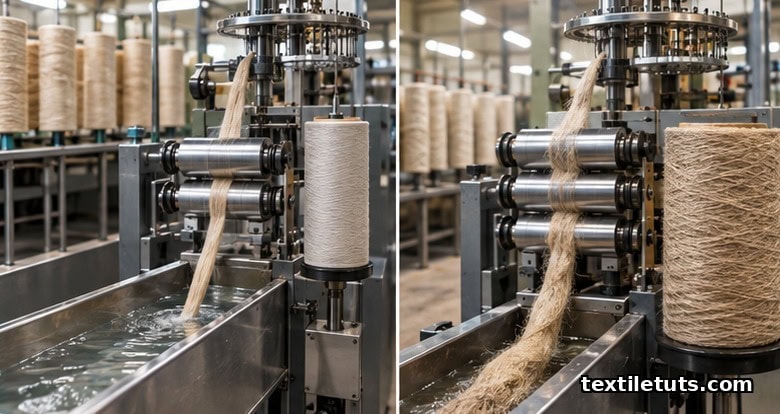
Wet spinning of flax produces yarns in the linear density range of Nm 24 to Nm 80 (about 12.5 to 41.7 tex) at twist multipliers roughly 30 to 50 percent higher than dry spinning, with single-end breaking tenacity typically 25 to 50 percent above dry-spun yarn at the same count.
Wet spinning is the route to fine, smooth, apparel-grade linen yarn; dry spinning is the route to coarse, hairier yarn for technical and industrial fabrics. The choice between them controls yarn count, surface hairiness, tensile behavior, and ultimately what the yarn can be woven or knitted into.
This article walks through both systems side by side: the chemistry that lets wet spinning dissolve the pectin binder, the mechanics that make dry spinning faster and cheaper, the resulting yarn properties measured against ISO and ASTM standards, and the end uses each system serves.
Why Flax Spinning Splits into Two Systems
Flax (Linum usitatissimum) is a bast fiber. The bast arrives at the spinning frame as a sliver of long, multi-cellular technical fibers cemented together by a pectin matrix. Each technical fiber is roughly 10 to 80 cm long and 10 to 40 micrometers in diameter, but it contains 10 to 40 individual ultimate fibers held in place by middle lamella pectin.
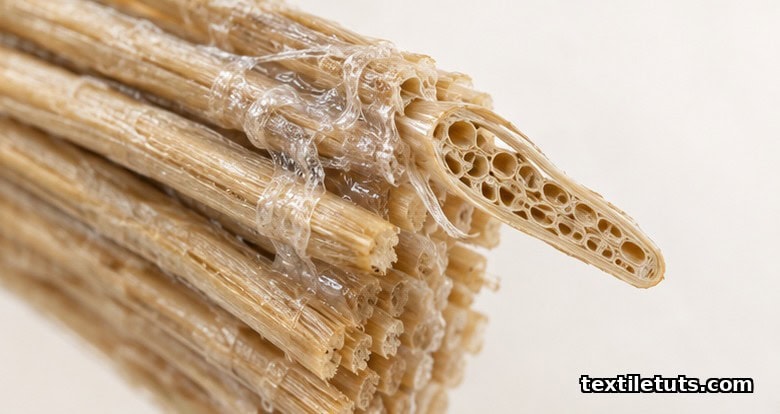
Cotton spinning starts with single-cell fibers already separated; flax spinning does not. The spinner has to choose how much to break the technical fibers apart before twist is inserted. That choice defines the two systems.
In wet spinning, the roving passes through a trough of water heated to 50 to 70 degrees Celsius just before the drafting rollers. The hot water softens and partly dissolves the middle lamella pectin, letting adjacent ultimate fibers slip and form a finer, more compact strand. In dry spinning, no trough is used; the roving is drafted dry and the technical fibers are spun largely intact, producing a coarser, hairier yarn.
How Wet Spinning Works
The wet spinning line begins where the long-line roving has been combed and doubled to a count typically between Nm 1.5 and Nm 6. Roving bobbins are creeled on a frame and the ends are fed through a water bath set 60 to 70 degrees Celsius for fine counts and 40 to 50 degrees Celsius for medium counts. The immersion length is short, usually 15 to 25 cm, just enough to plasticize the pectin without rewetting the fiber backbone.
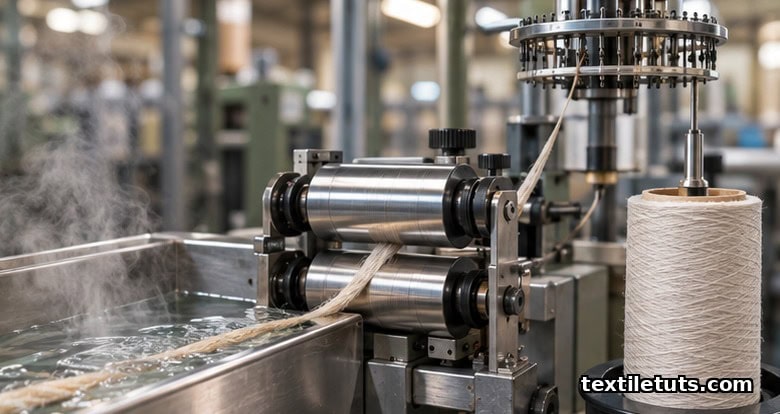
After the bath, the wet strand passes through the front drafting rollers and then to a ring, cap, or flyer twisting element. Twist multiplier (alpha) for wet-spun flax typically runs between 130 and 180 in the metric alpha system, versus 80 to 130 for dry-spun flax. The higher twist is needed because wet-spun fibers are finer and need more cohesive force to lock the structure.
Production speed for ring wet spinning sits between 8 and 25 m/min, much slower than dry spinning. The water bath, the need to dry the yarn afterward, and the high twist all constrain throughput. Wet-spun yarn is dried on heated cylinders or in a hot-air chamber immediately after winding to prevent mildew and set the twist.
How Dry Spinning Works
Dry spinning uses the same drafting-and-twisting principle as wet spinning but skips the trough. Roving moisture is controlled at 10 to 14 percent (the natural regain-equilibrium level) and passed straight to the drafting zone. No hot water is applied, so the middle lamella pectin stays in place and the technical fibers remain bundled.
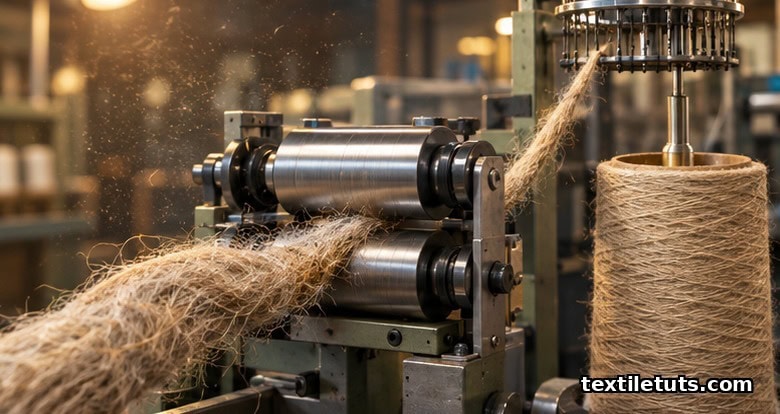
Because the fiber bundle is coarser, lower twist is required to lock it. Dry-spun twist multipliers run from 80 to 130 (metric alpha). Lower twist means lower twist insertion per minute, which lets the machine run faster. Production speeds of 250 to 400 m/min are standard on modern dry spinning frames, with flyer frames reaching 30 to 60 m/min on coarse counts.
Dry-spun yarn is hairier because the un-dissolved pectin and the intact technical fiber bundles create surface fibrils. This hairiness is a feature in some products (it gives a rustic, slubby look in heavy linens) and a defect in others (it sheds lint in weaving).
Yarn Count and Twist Range
The two systems split the count range cleanly. Dry spinning covers the coarse end, Nm 1.25 to Nm 24, used for canvas, sacks, industrial webbing, and heavy furnishing fabrics. Wet spinning covers the fine end, Nm 24 to Nm 80, used for apparel, sheeting, table linen, and fine household textiles. The overlap at Nm 24 to Nm 30 is where both systems can run, and the choice there is set by fabric hairiness and hand rather than count alone.
Twist follows the count split. A wet-spun Nm 50 yarn typically runs at a twist multiplier of 145 to 160, giving a twist per meter of about 1020 to 1130 turns per meter. A dry-spun Nm 10 yarn at the same twist multiplier of 110 gives about 350 turns per meter. Twist per meter must rise with finer counts because thinner strands need more twist energy per unit length to remain stable.
Tensile Properties Compared
Wet-spun yarn beats dry-spun yarn on breaking tenacity by a wide margin. Independent mill data and published test results using ISO 6939 and ASTM D2256 methods show wet-spun Nm 50 flax yarn at 25 to 35 cN/tex breaking tenacity versus 15 to 25 cN/tex for dry-spun Nm 50 yarn (where dry spinning can run that fine). Elongation at break also tends to run higher for wet-spun yarn, typically 2.5 to 4.0 percent versus 1.5 to 2.5 percent for dry-spun.
Two reasons drive this gap. First, wet-spun yarn contains more fully separated ultimate fibers, so the load is distributed over more individual fiber cross sections. Second, the smooth, compact wet-spun structure has fewer stress concentrations than the hairier, bundle-based dry-spun structure.
Coefficient of variation (CV) of breaking force is also lower for wet-spun yarn, typically 12 to 18 percent versus 18 to 25 percent for dry-spun. This matters in weaving: more even yarn breaks less at the loom and produces more even fabric.
Surface Properties and Hairiness
Hairiness is the most visible difference. Dry-spun yarn shows 80 to 200 protruding fibers per meter of yarn length, measured by the Zweigle hairiness method, against 20 to 60 for wet-spun yarn. The hair comes from the unbroken technical fiber ends that escape the twist.
Wet-spun yarn has a smoother, slightly lustrous surface because dissolved pectin and the redistributed fibers form a closed, even surface. This luster is one reason wet-spun yarn is the standard for apparel linen; it dyes more evenly and prints more sharply.
Comparison Table
| Property | Wet Spinning | Dry Spinning |
|---|---|---|
| Yarn count range (Nm) | 24 to 80 | 1.25 to 24 |
| Linear density range (tex) | 12.5 to 41.7 | 41.7 to 800 |
| Twist multiplier (metric alpha) | 130 to 180 | 80 to 130 |
| Production speed (m/min) | 8 to 25 | 250 to 400 |
| Breaking tenacity (cN/tex) at Nm 50 | 25 to 35 | 15 to 25 |
| Elongation at break (%) | 2.5 to 4.0 | 1.5 to 2.5 |
| CV of breaking force (%) | 12 to 18 | 18 to 25 |
| Hairiness (fibers/m) | 20 to 60 | 80 to 200 |
| Bath temperature (degrees C) | 40 to 70 | Not applicable |
| Main end use | Apparel linen, fine household textile | Canvas, industrial webbing, furnishing |
End Uses by System
Wet-spun flax yarn is the standard input for shirting, sheeting, table linen, handkerchief linen, fine dress fabric, and coated industrial fabrics where surface smoothness matters. Damask and jacquard tablecloths rely on the luster of wet-spun yarn to throw the woven pattern into relief.
Dry-spun flax yarn is used for canvas, painter’s drop cloths, fire hose, luggage fabric, casual slub apparel, decorative furnishing, sandbags, and industrial webbing. The hairiness is acceptable or even desirable in these products.
Blends also follow the system. When flax is blended with cotton, wool, or synthetic fibers, the system choice is set by the flax component’s share and the desired count. Flax-rich blends above 50 percent flax usually run on the wet system; flax-poor blends below 30 percent can usually be dry spun.
Process Economics
Wet spinning costs more per kilogram of yarn because of the slower speed, the energy used to heat and dry the bath, and the lower output per spindle. Industry estimates put the wet spinning conversion cost (spinning only) at roughly 1.8 to 2.5 times the dry spinning cost for comparable count ranges.
Dry spinning wins on volume. A modern dry spinning frame running at 300 m/min produces roughly 10 to 15 times more yarn per spindle-hour than a wet spinning frame at 15 m/min. For commodity canvas and industrial fabric, that gap is decisive.
Frequently Asked Questions
What is the difference between wet-spun and dry-spun linen yarn?
Wet-spun linen is produced by passing the flax roving through a hot water bath (40 to 70 degrees C) just before twisting, which softens the pectin and separates the ultimate fibers to give a smooth, fine, strong yarn in the Nm 24 to Nm 80 range. Dry-spun linen is twisted without a bath, keeps the technical fibers in their bundles, and produces a coarser, hairier yarn in the Nm 1.25 to Nm 24 range used for canvas and industrial fabrics.
Why is wet-spun linen more expensive?
Wet spinning runs at 8 to 25 m/min versus 250 to 400 m/min for dry spinning, so output per spindle is much lower. Energy for heating the bath, drying the yarn afterward, and the higher twist multiplier all add to the conversion cost. Wet-spun yarn typically costs 1.8 to 2.5 times more per kilogram to produce than dry-spun yarn at overlapping counts.
Can you spin fine counts on a dry spinning frame?
Technically you can, but the yarn will be hairier and weaker than wet-spun yarn at the same count. Below about Nm 24, dry-spun yarn quality drops fast: hairiness exceeds 100 fibers per meter and CV of breaking force rises above 25 percent. Most mills switch to wet spinning for any count finer than Nm 24.
Which system produces stronger yarn?
Wet spinning. Wet-spun Nm 50 flax yarn typically tests at 25 to 35 cN/tex breaking tenacity against 15 to 25 cN/tex for dry-spun yarn at the same count, measured under ISO 6939 or ASTM D2256. The strength gain comes from better separation of ultimate fibers and a more compact, even structure.
Does wet-spun linen shrink more than dry-spun linen?
Wet-spun yarn has slightly higher residual shrinkage potential (around 4 to 6 percent after wet finishing) compared to dry-spun yarn (around 2 to 4 percent), because the wet spinning process itself uses hot water that sets internal stresses. Commercial wet finishing stabilizes both yarn types to under 2 percent residual shrinkage in finished fabric.
References
- International Organization for Standardization. ISO 2061:2015 Textiles – Determination of twist in yarns – Direct counting method. iso.org – method for measuring yarn twist on flax yarn from both wet and dry systems.
- International Organization for Standardization. ISO 6939:1988 Textiles – Yarns from packages – Determination of single-end breaking force and elongation using constant rate of extension (CRE). iso.org – test method used to compare wet-spun and dry-spun tenacity values.
- ASTM International. ASTM D2256/D2256M-21 Standard Test Method for Tensile Properties of Yarns by the Single-Strand Method. astm.org – reference tensile test method cited alongside ISO 6939 in mill quality reports.
- International Organization for Standardization. ISO 1144:2016 Textiles – Universal system for designating linear density (Tex system). iso.org – conversion basis between Nm and tex values used in the comparison table.
- Kozlowski, R., & Mackiewicz-Talarczyk, M. (2020). Handbook of Natural Fibres: Volume 1: Types, Properties and Factors Affecting Breeding and Cultivation. Woodhead Publishing (Elsevier), sciencedirect.com – peer-reviewed reference chapter on flax fiber structure and spinning behavior.
- European Flax and Hemp Confederation. European Flax Standard: Technical Specifications for Flax Fibres and Yarns. euroflax2020.eu – industry technical specification for flax yarn count, twist, and tenacity classes.
This article is the working reference for the flax wet-spun vs dry-spun comparison. Editorial by Iftay Khairul Alam, TextileTuts. Sources: ISO 2061, ISO 6939, ISO 1144, ASTM D2256, sciencedirect.com, European Flax as cited.


