
Modal and Tencel Spinning

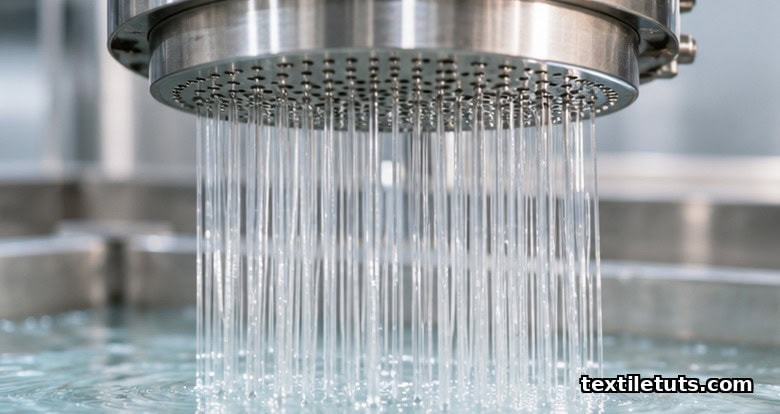
Modal and Tencel are regenerated cellulosic fibers spun from dissolving wood pulp, with Tencel lyocell produced in a closed-loop N-methylmorpholine N-oxide (NMMO) solvent route that recovers more than 99% of the solvent, while Modal uses a modified viscose process delivering about 50% higher wet tenacity than standard rayon at comparable linear density.
Both fibers fall under the ISO 2076 generic family of regenerated cellulose, but they differ sharply in spinning chemistry, supramolecular structure, and yarn-processing behavior, so a spinner choosing between them has to plan wet-modulus, fibrillation tendency, and blend ratios before the machine is set.
This article walks through how each fiber is made, what the resulting molecular and morphological structure means at the drafting zone, and how to spin them into ring, rotor, and air-jet yarns that hold up in weaving and knitting.
What Modal and Tencel Actually Are
Modal and Tencel are not natural fibers in the botanical sense; they are man-made cellulosics, classified by ISO 2076 as regenerated cellulose. The cellulose comes from sustainably managed hardwood (beech for Modal, eucalyptus and other fast-growing species for Tencel), and the polymer chains are dissolved, extruded through a spinneret, and re-precipitated as continuous filament.
The word “Tencel” is a brand owned by the Austrian company Lenzing AG and covers two generic fiber types: Tencel Lyocell (the NMMO-spun fiber originally commercialized in 1992 as “Tencel”) and Tencel Modal (a high-wet-modulus viscose-type fiber). “Modal” itself is a generic name defined in ISO 2076 as a regenerated cellulose fiber with a higher wet modulus and a defined wet-and-dry tenacity ratio, originally developed as a successor to regular viscose.
For the yarn spinner, the practical takeaway is that both fibers carry the comfort, moisture regain, and dye affinity of cotton, with extra luster, finer achievable linear density, and a wet-tenacity profile that resists the breakage that plagues ordinary viscose on modern high-speed machines.
Wood Pulp to Spinning Dope: Raw Material and Pre-Treatment
Both routes begin with dissolving-grade wood pulp, typically in sheet form with alpha-cellulose content above 90%, hemicellulose below 5%, and a controlled degree of polymerization in the 600 to 1100 range. The sheets are slit, milled, and conditioned in a humidity-controlled room before they enter the dissolution step.
For Modal, the pulp is treated with a sodium hydroxide solution (around 18% w/w) to form alkali cellulose, pressed to a target press-weight ratio, and aged under controlled temperature to reduce the degree of polymerization to the desired window. The aged alkali cellulose is then converted to sodium cellulose xanthate by reaction with carbon disulfide (CS2), and the xanthate is dissolved in dilute sodium hydroxide to form the viscose spinning dope at around 7 to 9% cellulose.
For Tencel lyocell, the pulp is suspended directly in a mixture of N-methylmorpholine N-oxide (typically around 78% w/w NMMO in water) at elevated temperature (90 to 120 °C), with the water content reduced under vacuum to produce a clear solution at about 10 to 15% cellulose. The NMMO route skips the derivatization step entirely; the cellulose dissolves by physical disruption of hydrogen bonds rather than chemical substitution.
The Tencel (Lyocell) Spinning Process
Lyocell spinning uses a dry-jet wet extrusion line. The hot dope is filtered through fine metal filters, then pushed through a spinneret with hole diameters typically between 50 and 120 µm, into an air gap of about 1 to 10 cm, and finally into a coagulation bath of dilute aqueous NMMO at room temperature or below.
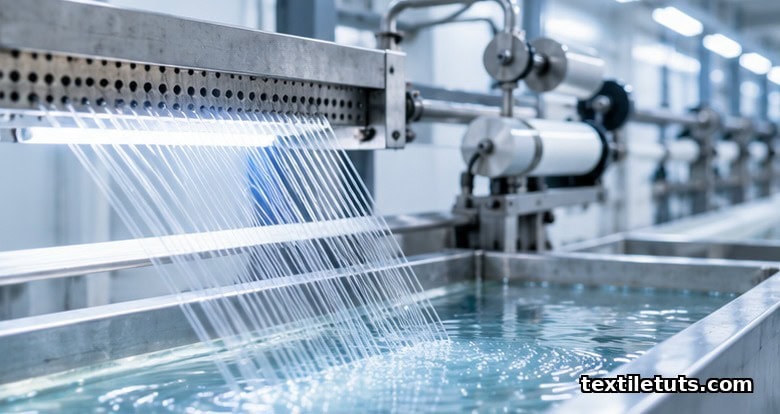
As the filament travels through the air gap, draw-down and evaporative cooling align the polymer chains, producing a high crystalline orientation that survives coagulation. This orientation, measured as a birefringence in the 0.030 to 0.045 range, gives lyocell its high dry and wet tenacity (around 38 to 42 cN/tex dry and 32 to 36 cN/tex wet for standard staple fiber, per typical Lenzing technical data sheets for Tencel lyocell).
The coagulation bath strips NMMO from the filament, and the dilute NMMO/water mixture is recovered, purified, and reconcentrated for reuse. Lenzing reports solvent recovery above 99% in its commercial lyocell lines, with the recovered NMMO re-cycled back into the dissolution stage. The washed tow is finished with a soft finish oil, dried on heated rolls, and crimped mechanically before being baled as staple fiber.
The Modal Spinning Process
Modal uses a modified viscose route with two defining adjustments. First, the spinning bath contains a higher proportion of zinc sulfate (typically 40 to 80 g/L ZnSO4 compared with less than 20 g/L for standard viscose), which slows regeneration and produces a denser skin on the filament.
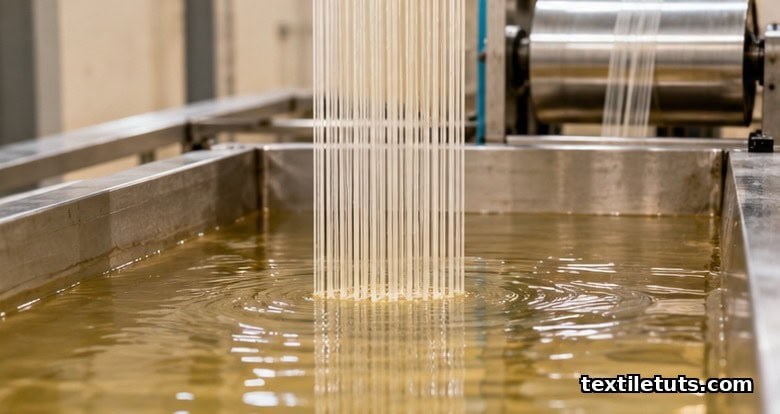
Second, the stretch in the spinning bath is higher (often 80 to 120% compared with 40 to 60% in standard rayon), and a hot second bath or hot tube after the primary coagulation bath applies further plasticizing stretch. The combined effect is a cross-section with a thicker outer skin and a more oriented core, giving Modal its characteristic high wet modulus, around 5 to 6 cN/tex per dtex when wet (in the same order as cotton, around 4 to 5 cN/tex per dtex, but achieved at higher tenacity retention under load).
After regeneration, the tow is cut, washed, finished with a lubricating spin finish, dried, and crimped. Filament yarns can be taken up directly from the spinning machine on cylindrical packages for downstream draw-twisting.
Why Fibrillation Matters for the Spinner
The most distinctive structural feature of lyocell is its long, highly aligned crystalline microfibrils that are weakly bound laterally. When the fiber is exposed to wet mechanical action, especially on machines with steel components, surface fibrils peel off as tiny hairy structures, producing the so-called “peach skin” or “lyocell fuzz” look.
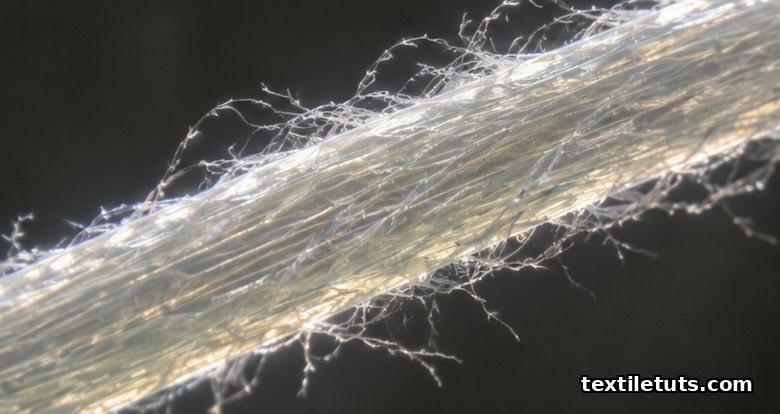
This fibrillation is not a defect for some end uses (sueded knits, peach-skin weaves, knitted fleece substitutes), but in a worsted ring-spun yarn it can show up as pilling and a hazy, dull appearance after only a few wash cycles. Spinners who want a clean, smooth yarn therefore choose Tencel Modal or select lyocell variants that have been crosslinked or enzyme-treated to suppress fibrillation, or they blend lyocell with cotton or synthetic fibers in a 30/70 to 50/50 ratio to anchor the fibrils.
Modal, by contrast, has a more isotropic structure with shorter crystalline domains and a thicker skin, so it fibrillates only under aggressive wet-abrasion conditions and is generally considered low-fibrillation for apparel yarns.
Spinning Preparation: Carding, Drawing, and Roving
Modal and Tencel staple fibers arrive from the producer at a cut length of 38 mm for cotton-system processing or 50 to 80 mm for worsted and compact-ring systems, and at a linear density between 1.0 and 1.7 dtex for fine yarns (up to about 3.3 dtex for carpet and terry applications). The fibers carry a spin finish of 0.2 to 0.4% on weight, designed to control static and fiber-metal friction at speeds of 200 m/min on modern cards.
On the card, revolving flats and a high-production licker-in are preferred over aggressive settings; the goal is to keep fiber breakage under 4% and nep count below 30 per gram. Tencel in particular wants reduced cylinder load to limit surface damage that would seed fibrillation later in the yarn’s life.
Drawing passages are run at a total draft of 6 to 8 with a light ratch (around 4 to 6% overfeed at the breaker draw) to keep the sliver uniform. Roving twist is set conservatively, around 1.0 to 1.3 twist factor (in TM units) for 1.0 to 1.5 dtex fibers, because excessive roving twist locks in false-twist effects that become visible in the finished ring yarn.
Ring, Rotor, and Air-Jet Spinning Choices
For ring spinning, the recommended spindle speed is in the 14,000 to 18,000 rpm range for fine counts (Ne 40 to Ne 60) using a small traveler (size 16/0 to 22/0). Traveler weight has to be matched to yarn count to keep balloon tension low; an over-weighted traveler on Tencel raises fiber breakage at the front drafting zone.
Rotor spinning works well for both Modal and Tencel at counts up to about Ne 30, with rotor speeds of 80,000 to 110,000 rpm on a 33 mm rotor. Below Ne 30, the wrapper fibers at the rotor groove start to dominate the structure and the yarn loses the smooth appearance that is one of Modal’s selling points.
Air-jet spinning (Murata-type Vortex or Rieter Air-Com-Tex) handles Modal cleanly up to Ne 60 and produces a yarn with a tight core-and-wrapper structure that resists pilling, but the air-jet process relies on the fiber friction at the drafting nip, and Tencel’s smooth, low-friction surface requires a higher draft (around 1.3 to 1.5× the ring-spin draft) and a slightly higher feed ratio of false-twist inserts to anchor the wrapper fibers.
Twist, Ply, and Blend Recommendations
Twist factor for 100% Modal ring yarn in the Ne 30 to Ne 50 range should sit between 3.6 and 4.2 (α in TM, where α = TPC × √Ne); for Tencel, a slightly lower 3.4 to 3.9 α avoids harsh hand while keeping single-end strength above 18 cN/tex for Ne 40. Below α 3.4 the yarn loses hairiness control; above α 4.2 the fabric loses the soft drape that is the reason the fiber was chosen in the first place.
For 50/50 Modal/cotton blends, the twist can stay in the same 3.8 to 4.0 α window because the cotton provides the surface friction that Modals low-friction finish reduces. For 100% Tencel woven warp, sizing on a slasher with a PVA or modified starch recipe at 8 to 10% size pickup is recommended to control loom fly and weft breaks.
Two-ply construction at a plying twist of α 3.0 to 3.4 is common for both fibers in knit applications where the surface smoothness has to survive repeated laundering without pilling.
Comparison: Modal, Tencel Lyocell, Cotton, and Regular Viscose
| Property | Modal | Tencel Lyocell | Cotton | Regular Viscose |
|---|---|---|---|---|
| Dry tenacity (cN/tex) | 34 to 38 | 38 to 42 | 25 to 35 | 20 to 25 |
| Wet tenacity (cN/tex) | 20 to 24 | 32 to 36 | 30 to 40 | 10 to 15 |
| Wet modulus (cN/tex per % strain) | High (≈5 to 6) | High (≈6 to 7) | Medium (≈4 to 5) | Low (≈1 to 2) |
| Moisture regain (%) | 12 to 13 | 11 to 12 | 7 to 8.5 | 12 to 14 |
| Fibrillation tendency | Low | High (if not treated) | None | Low |
| Spinning route | Modified viscose | NMMO solvent | Natural | Standard viscose |
| Solvent recovery | n/a (chemical regeneration) | >99% NMMO recycled | n/a | n/a |
Frequently Asked Questions
Is Tencel more sustainable than Modal?
Tencel lyocell scores higher on solvent-loop recovery (more than 99% of NMMO reused in commercial production) and on the EU Ecolabel criteria for closed-loop chemical processes, while Modal uses a modified viscose route that still depends on carbon disulfide recovery and emissions control. Both fibers come from FSC-certified or equivalent wood pulp, so the forestry footprint is similar; the difference is mostly in the spinning chemistry and the chemical load at the spinning mill.
Why does Tencel fibrillate, and how do I stop it?
Tencel fibrillates because its crystalline microfibrils are long, well-aligned, and weakly bound laterally; wet mechanical action lifts them off as tiny surface hairs. To stop it, choose a fibrillation-resistant Tencel grade (enzyme-treated or cross-linked), blend with at least 30% cotton or synthetic fiber to anchor the fibrils, or finish the woven fabric with a peach-skin emerizing process that intentionally creates a controlled, even nap rather than random fuzz.
Can you blend Modal or Tencel with cotton?
Yes, and it is common. A 50/50 Modal/cotton or Tencel/cotton blend combines the moisture management and luster of the regenerated cellulose with the surface friction of cotton for spinning stability. The cotton component also reduces fibrillation in the Tencel blend and adds a drier hand to the finished fabric. Twist settings on the ring frame stay close to those used for 100% cotton of the same count, with only minor finish adjustments.
Is Modal the same as rayon?
Modal is a sub-type of regenerated cellulose, the same ISO 2076 family as rayon (viscose), but it differs from generic viscose in having a higher wet modulus, higher wet tenacity (about double at comparable linear density), and a defined minimum tenacity ratio between wet and dry states. The practical difference is that Modal yarns and fabrics resist shrinkage and distortion in wet processing much better than standard rayon, and they tolerate modern high-speed knitting and weaving without the breaks that plague regular viscose.
What’s the difference between Tencel Lyocell and Tencel Modal?
Both are sold under the Lenzing Tencel brand family. Tencel Lyocell is spun from dissolved pulp in NMMO with the dry-jet wet route and the high crystallinity that drives fibrillation; Tencel Modal is a high-wet-modulus regenerated cellulose spun from a modified viscose chemistry that is smoother and lower-fibrillation. For apparel yarns that need a clean, pill-resistant surface, Tencel Modal is usually the first choice; for fabrics that intentionally use fibrillation (peach-skin knits, sueded shirtings), Tencel Lyocell is the right starting fiber.
References
- International Organization for Standardization. ISO 2076:2021, Man-made fibres — Generic names. ISO, Geneva. Generic classification and definitions for regenerated cellulose fibers including Modal and Lyocell.
- American Association of Textile Chemists and Colorists. AATCC TM 135-2018, Dimensional Changes of Fabrics after Home Laundering. AATCC, Research Triangle Park. Standard test method for shrinkage of cellulosic fabrics including Modal and Tencel.
- ASTM International. ASTM D629-2015, Standard Test Methods for Quantitative Analysis of Textiles. ASTM, West Conshohocken. Method for fiber blend quantification, applicable to Modal/cotton and Tencel/cotton blends.
- Persson, J., et al. (2019). Textile properties of lyocell and modal fibers: A review. Cellulose, 26(3), 1433–1454. Springer. Peer-reviewed comparative study of fiber mechanical properties and spinning behavior.
- Bredereck, K., & Hermanutz, F. (2018). Man-made cellulosics: Production, properties, and applications. Springer Series in Textile Engineering. Springer, Cham. Reference text covering spinning routes and structure-property relationships.
- Lenzing AG. Tencel and Modal technical data sheets. Lenzing, Lenzing, Austria. Producer-published fiber specifications, including linear density, cut length, and recommended processing parameters.
This article is the working reference for Modal and Tencel spinning. Editorial by Iftay Khairul Alam, TextileTuts. Sources: ISO 2076, AATCC TM 135, ASTM D629, Persson et al. 2019, Bredereck & Hermanutz 2018, and Lenzing technical data, as cited.


