
Velvet and Velour Weaving

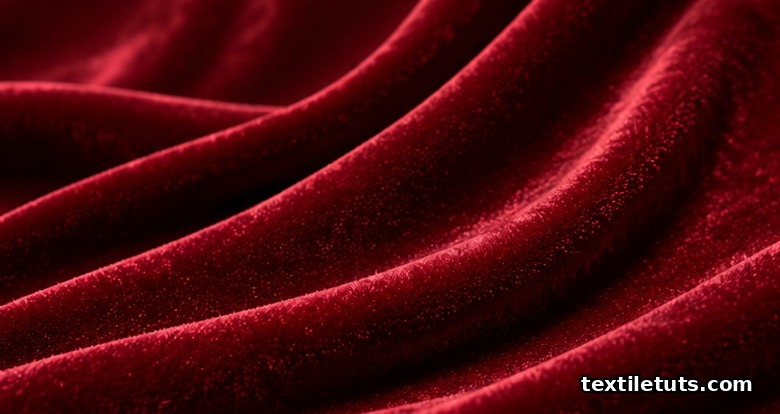
Velvet is a warp-pile woven fabric produced on a double-loom or wire-loom system that yields 100–400 g/m² face weights with pile heights of 0.5–3.0 mm and surface densities of 200–600 pile loops per cm², whereas velour is most commonly a weft-knitted cut-pile fabric (single jersey or warp-knit) with pile heights of 1.0–4.0 mm that imitates velvet’s hand but offers 15–25% greater stretch along the knitting direction.
The distinction matters in every step of the supply chain, from loom setup and yarn selection to finishing, cutting, and end-use performance. Velvet and velour share a soft, light-scattering surface, but they get there through different yarn paths, different machine categories, and different test methods. The article below walks through the weaving (and knitting) sequence, the structural differences that engineers measure, the standards used to grade them, and the practical implications for sewing, care, and end use.
What Velvet Is: Warp-Pile Woven Construction
Velvet is a warp-pile fabric woven on a special loom that lifts selected warp yarns over a cutting wire (or rod) to create loops, which are then cut to form an erect pile. Modern velvet production uses one of three systems: the double-cloth method (two fabrics woven face-to-face with pile warps connecting them, then split apart by a traversing knife), the wire method (a weft insertion places a metal wire across every pile row, the wire is withdrawn leaving loops that are then sliced), or the modern CAD-controlled single-piece system where pile height is set by the wire gauge. Pile density for apparel-grade silk velvet typically runs 250–400 pile ends per cm²; for cotton velvet used in upholstery, 150–250 ends per cm² is more common, producing the heavier “ciselé” or “cisalfa” effects [1].
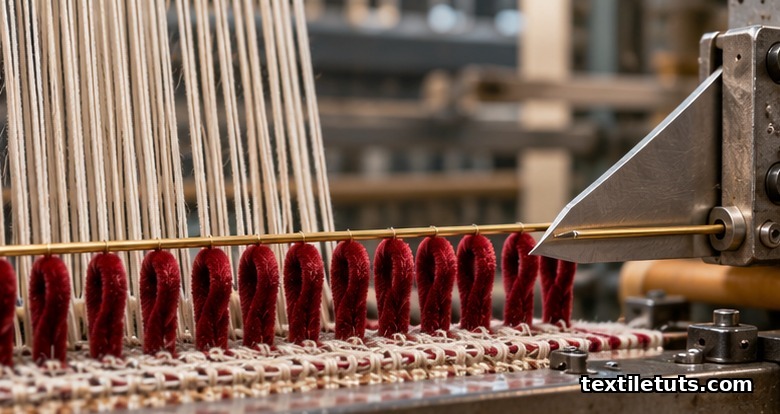
The warp that creates the pile (the “pile warp”) is almost always made from fine, lustrous fibers: silk historically (mulberry silk, 1.0–1.5 denier filaments), now commonly viscose/rayon, modal, or fine cotton for lower cost. The ground warp and weft can be the same fiber or a different one, which is why “silk/rayon velvet,” “cotton velvet,” and “viscose/acetate velvet” are all valid commercial designations. After weaving, the pile goes through a finishing sequence called “brushing and shearing” (using card-wire-covered rollers and a helical shearing blade) that evens the surface and sets the final pile height.
What Velour Is: Knitted Cut-Pile Construction
Velour is the knit counterpart of velvet. Most apparel velour is a weft-knit single-jersey base plated with a separate set of filament yarns that are raised into a pile by napping rollers on the finishing line. A second category, “warp-knit velour,” uses a Raschel machine to lay two yarn sets simultaneously, after which the connecting yarns are cut to produce a stable, lengthwise-stable pile surface that doesn’t ladder when snipped. Warp-knit velour is the dominant substrate for upholstery, automotive interiors (car seats), and theatrical curtains because it pills less and recovers better after compression.
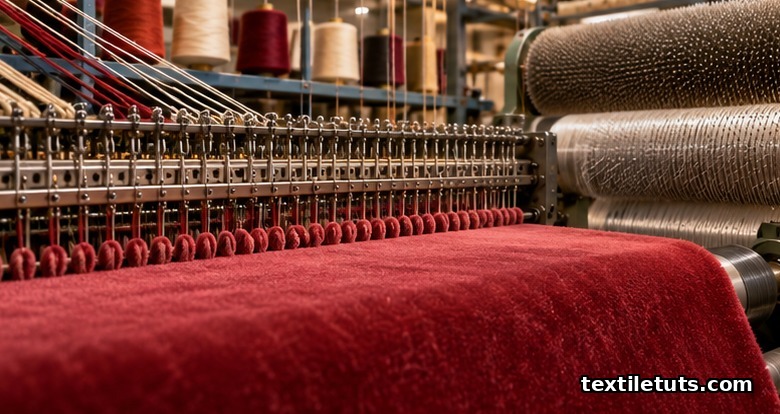
The pile fibers in velour are nearly always polyester (textured or flat filament, 75–150 denier) or a polyester/cotton blend; the knit base uses finer yarns (20–40 denier for polyester tricot bases, Ne 30–40 for cotton-rich bases). Typical weight runs 200–350 g/m² for apparel velour and 280–500 g/m² for upholstery and automotive velour. Compared to velvet, velour has measurably higher elongation at break along the knitting direction (often 40–80% for weft-knit velour versus 12–25% for woven velvet) and lower recovery from compression, which is why car seats use warp-knit variants [2].
The Manufacturing Sequence, Step by Step
Both fabrics share a general sequence (yarn prep, ground formation, pile formation, pile cutting/raising, dyeing, finishing, inspection), but the steps differ sharply. Velvet starts on a beam loom with two warp beams: a ground beam at standard tension and a pile beam at controlled overfeed (typically 2.5–5.0 times the ground beam tension) so the pile warp delivers extra length per pick and forms upright loops. Velour starts on a circular knitting machine or a Raschel warp-knit machine, and the pile layer is built into the knit rather than woven.
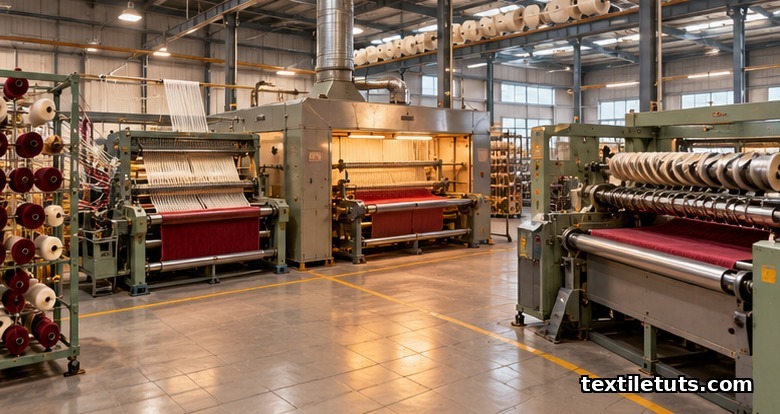
For wire-pile velvet, the loom inserts a brass or stainless-steel wire at every pile row; after the wire is withdrawn, a knife travels along its tip and slices every loop, converting loops to a cut pile in one pass. For double-cloth velvet, the knife is mounted on the loom itself and runs continuously, splitting the two cloths as they form. After cutting, both fabrics pass through a tenter frame for heat-setting (190–210 °C for polyester velour, 130–160 °C for silk/viscose velvet) and a brushing/shearing station that controls final pile height to ±0.1 mm tolerance on production looms.
Standards and Test Methods Used to Grade Velvet and Velour
The international standards that govern pile fabric quality cover weight, pile height, pile retention, abrasion, lightfastness, and stretch. The five most commonly applied are ISO 3801 (mass per unit length), ISO 7211-2 (woven fabric construction analysis, including pile density), ASTM D3776 (mass per unit area, the imperial equivalent), AATCC Test Method 8 (colorfastness to crocking, critical for any pile fabric whose surface rubs), and AATCC TM 16.3 (lightfastness under xenon arc). For upholstery and automotive velour, Martindale abrasion per ISO 12947 (typically required at 30,000–100,000 cycles) and Taber abrasion per ASTM D3884 are the load-bearing tests [3][5].
Pile retention, the property that determines whether a velvet chair keeps its surface after years of use, is measured by ISO 12945 (pilling resistance, against a standard photograph scale of 1–5) and the Martindale method, often combined with the pile-pull test in ASTM D3939 to measure how much force is needed to extract a single pile fiber. Industry targets for apparel velvet are a pile-pull of 1.5 cN minimum per fiber; for upholstery velvet and warp-knit velour, 2.5–4.0 cN is more typical, reflecting the heavier denier used in pile yarns [4].
Pile Density, Height, and Weight: How Engineers Read a Spec Sheet
The three numbers that drive most engineering decisions on pile fabrics are pile height, pile density, and total fabric mass (GSM). Pile height is measured by cross-section microscopy or a calibrated pile-height gauge; pile density by counting pile ends on a calibrated reticle under a 10× stereo microscope; GSM by ISO 3801 using a fabric swatch of 100 cm² on a calibrated balance. Apparel silk velvet typically reports 1.0–1.5 mm pile height at 110–160 g/m², while upholstery cotton velvet reports 2.0–3.0 mm pile at 280–400 g/m². Knit velour runs heavier for a given pile height because the knit base adds mass without contributing to the pile.
Velvet vs. Velour: A Side-by-Side Comparison
| Property | Velvet (woven warp-pile) | Velour (knit cut-pile, mostly weft-knit or warp-knit) |
|---|---|---|
| Formation method | Loom: double-cloth or wire-pile system | Circular knit (weft) or Raschel (warp-knit) |
| Pile height (typical) | 0.5–3.0 mm | 1.0–4.0 mm |
| Pile fiber | Silk, viscose, modal, cotton, fine polyester | Mostly polyester, some cotton/PET blends |
| Face weight (GSM) | 100–400 g/m² | 200–500 g/m² |
| Stretch at break (length) | 12–25% | 40–80% (weft-knit), 15–30% (warp-knit) |
| Pile retention | Higher (1.5–4.0 cN per fiber) | Lower (1.0–2.5 cN per fiber for weft-knit) |
| Drape behavior | Smooth, fluid, less recovery from creasing | Higher stretch, recovers better from compression |
| Common uses | Evening wear, drapery, upholstery, religious vestments | Athleisure, loungewear, automotive seats, theater curtains |
| Key standard for grading | ISO 7211-2, ISO 12947, AATCC TM 8 | ISO 3801, ISO 12945, ASTM D4966 |
Cutting, Sewing, and Care: Practical Implications
Pile fabrics punish poor cutting and pressing technique. Cutting must be done with the pile direction in mind, because velvet and velour reflect light differently when brushed one way versus the other (“up the pile” versus “down the pile”). Garment sections must be cut with consistent pile direction or the seam will look two-toned. For velvet, use a fresh rotary blade or sharp fabric scissors and cut on a low-pile cutting mat; for velour, a fresh blade on a long-arm mat works best because the knit base is stretchier. Pressing should be done with a velvet board (a thick needle-punched board that the pile sinks into, preventing crush) or by hovering a steam iron without contact; direct iron contact will flatten the pile permanently.
Care-wise, both fabrics benefit from dry cleaning or gentle hand-washing in cold water (≤30 °C) with a pH-neutral detergent. Hot water (≥40 °C) can cause pile distortion and, for viscose velvet, irreversible shrinkage of 8–15%. Velour’s knit base makes it more tolerant of gentle machine washing in a mesh bag at 30 °C, but it is also more prone to snagging, which is why warp-knit variants are specified for upholstery rather than weft-knit ones. For lightfastness, AATCC TM 16.3 ratings of 4 or higher (out of 5) are the practical minimum for curtains and any application with direct sun exposure [3].
Frequently Asked Questions
What is the main difference between velvet and velour?
Velvet is a woven warp-pile fabric made on a loom with a cutting wire or double-cloth system; velour is a knitted cut-pile fabric made on a circular knitting or Raschel warp-knit machine. Velvet has lower stretch (12–25%) and a stiffer drape; velour has higher stretch (40–80% in weft-knit variants) and a more compressible hand.
Is velvet always made from silk?
No. Modern velvet is made from silk, viscose/rayon, modal, cotton, polyester, or a blend. Silk velvet remains the premium standard for drape and luster, but viscose and modal velvets dominate the apparel market because they cost 40–70% less than silk at comparable luster, and cotton velvet is the standard for upholstery where abrasion resistance is the priority [1].
How is velvet woven on a loom?
Velvet is woven using two warp beams: a ground warp under standard tension and a pile warp overfed (2.5–5.0×) so that loops rise above the fabric surface. A brass or stainless wire is inserted at every pile row; once withdrawn, a knife cuts the loops into a pile. In double-cloth velvet, two ground fabrics are woven simultaneously and split apart by a knife that runs continuously, leaving both cloths with a cut pile face.
Why does velvet crush easily, and can crushed velvet be fixed?
Velvet crushes because the pile is a dense field of fine, unsupported fibers; any sustained pressure flattens them. Light crush recovers with steam from a steamer held 10–15 cm away; heavy crush can be reversed by brushing gently with a velvet brush (fine brass bristles) and then steaming, but deep-set crush in viscose velvet may be permanent because the fibers have taken a plastic set.
What GSM is suitable for upholstery velvet versus apparel velvet?
Upholstery velvet typically runs 280–400 g/m² with pile heights of 2.0–3.0 mm to survive 30,000+ Martindale cycles; apparel velvet runs 110–160 g/m² with pile heights of 1.0–1.5 mm, optimized for drape rather than abrasion. Velour for automotive seats runs 320–500 g/m² because it must meet higher abrasion specs (often 50,000–100,000 Martindale cycles).
References
- ISO. ISO 7211-2:2024 — Textiles — Woven fabrics — Construction — Part 2: Determination of number of threads per unit length. ISO — the international standard method for counting pile and ground threads per cm in woven pile fabrics.
- ISO. ISO 3801:1977 — Textiles — Woven fabrics — Determination of mass per unit length and mass per unit area. ISO — the baseline test for GSM reporting on pile fabrics.
- AATCC. AATCC Test Method 8 — Colorfastness to Crocking: AATCC Crockmeter Method. AATCC — the standard crocking test used to grade color transfer on pile surfaces.
- ASTM. ASTM D3939 — Standard Test Method for Snagging Resistance of Fabrics (Mace Test). ASTM — used together with pile-pull force to evaluate pile retention.
- ISO. ISO 12947-2:2016 — Textiles — Determination of abrasion resistance of fabrics by the Martindale method — Part 2: Determination of specimen breakdown. ISO — the dominant abrasion test for upholstery and automotive pile fabrics.
- Springer Nature. Textile Science and Technology series: Pile Fabric Construction (Chapter in Woven Fabric Engineering). Springer — peer-reviewed textbook treatment of double-cloth and wire-pile weaving mathematics.
This article is the working reference for velvet and velour weaving. Editorial by Mohammad Yousuf (Anik), TextileTuts. Sources: ISO 3801, ISO 7211-2, ISO 12947-2, AATCC TM 8, ASTM D3939, and Springer Nature’s textile engineering series as cited.


