
Towel Weaving: Terry Looms

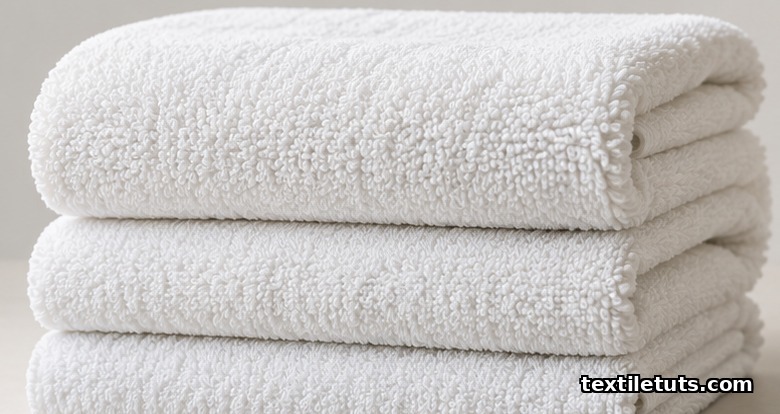
Terry looms weave terry towels by holding the pile warp under lower tension than the ground warp, then releasing it across three to seven ground picks to form uncut loops on one or both fabric faces, producing loop densities of 90 to 220 loops per square inch (≈14 to 34 loops/cm²) and towel weights of 300 to 800 g/m².
That pile-versus-ground tension differential is the single mechanical feature that separates a terry loom from any other shuttle, rapier, projectile, or air-jet weaving machine, and every parameter a mill tunes, from reed count to pick sequence to let-off ratio, flows from that one design choice. This article walks through how a terry loom actually forms loops, the differences between three-pick, four-pick, five-pick, six-pick, and seven-pick constructions, the loom settings that determine loop height and density, and the standards mills use to grade the finished towel.
What Makes a Loom a “Terry” Loom
A terry loom is a standard weaving machine fitted with a second warp beam, called the pile beam, that runs parallel to the ground warp beam. The ground beam supplies warp yarns at the tension needed to drive the fell of the cloth forward at a stable rate. The pile beam supplies the warp that will become the loops, and it is held at a much lower tension, typically 30 to 60 percent of the ground warp tension, so that when the loom releases it the extra yarn can be pushed forward into loops instead of being beaten flat into the fabric body.
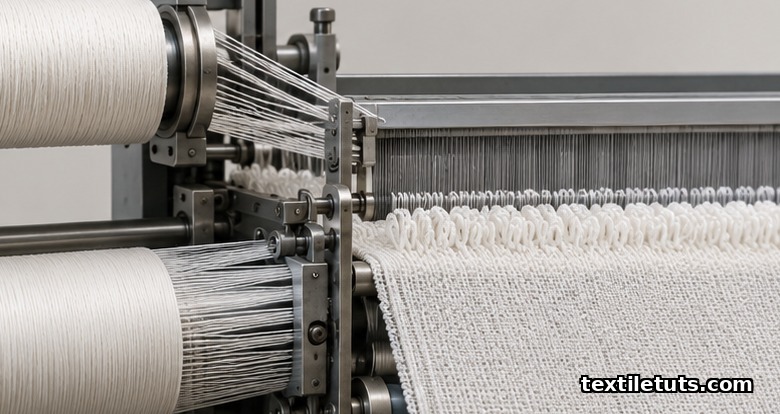
Loops are formed by a relative reed motion. In a “loose-reed” terry loom, the reed sits in a swing frame rather than being rigidly fixed to the sley, so the reed can move forward a few millimetres toward the fell at the pile pick. In a “rigid-reed” or rapier terry loom, an electronic cam or servo profile drives the same forward reed stroke without the loose-reed swing, which lets the loom run at higher speeds (up to 700 to 900 rpm on modern rapier terry machines) without distorting the loop shape. Both approaches produce the same fabric structure: an uncut pile on one or both faces of a plain-weave or twill ground.
Three elements distinguish a terry loom at a glance:
- A pile warp beam mounted above or behind the ground beam, with its own let-off control.
- A pile dwell mechanism (loose reed, cam, or servo) that holds the reed forward while the pile pick is inserted.
- A pile-cutter or “scissors” device (optional) that converts terry into velour by cutting alternate loop rows.
Two-Beam Warping and Let-Off Ratios
Because the pile loops must contain more yarn length than the ground weave, the pile beam is warper-creeled from a separate warp beam that unwinds faster than the ground beam. The ratio of pile let-off to ground let-off is the primary dial a weaver uses to control loop height: a 1:2.0 ratio gives short, dense loops of about 2.0 to 2.5 mm; a 1:2.6 to 1:2.8 ratio gives plush loops of 4.0 to 5.0 mm; a 1:3.0 ratio pushes loop heights past 6.0 mm and is common for bath-sheet luxury towels.
Typical warp composition by weight or yarn count in a 100 percent cotton bath towel is 60 to 65 percent ground warp and 35 to 40 percent pile warp. In institutional or sports towels the share can shift to 70:30 because shorter loops dry faster and survive harsher laundering. A 100 percent combed cotton face towel of 30/1 Ne warp and weft at 18 ends/cm and 20 picks/cm with a 1:2.5 pile ratio lands at roughly 380 to 420 g/m² finished weight, well inside the comfort range for hotel and spa use.
Pick Patterns: 3-Pick, 4-Pick, 5-Pick, 6-Pick, and 7-Pick Terry
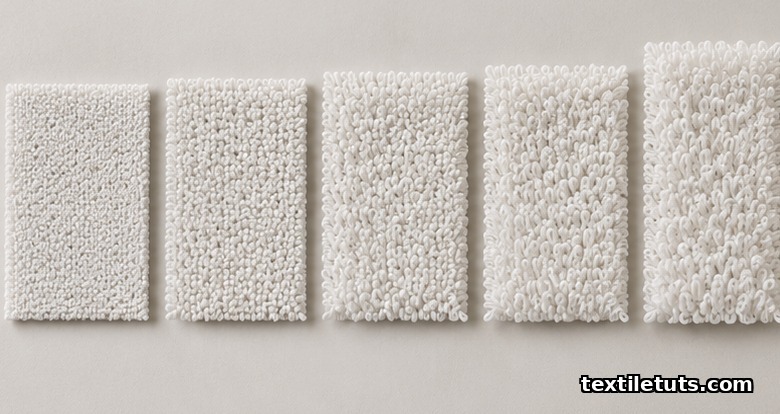
The number of ground picks between pile picks defines the construction. Each pile pick crosses one weft needle of pile warp over the fell and forms one row of loops.
| Construction | Picks per repeat | Loop stability | Typical end use |
|---|---|---|---|
| 3-pick terry | 1 pile + 2 ground | Lowest; loops pull under abrasion | Rough hand towels, low-cost utility cloths |
| 4-pick terry | 1 pile + 3 ground | Moderate | Hand towels, gym towels, dish cloths |
| 5-pick terry | 1 pile + 4 ground | Good; most common bath-towel construction | Bath towels, bath sheets, hotel linen |
| 6-pick terry | 1 pile + 5 ground | High | Premium spa towels, robes |
| 7-pick terry | 1 pile + 6 ground | Highest loop anchoring | Industrial laundering, healthcare towels |
A 5-pick terry places one pile pick for every four ground picks, giving the ground weave enough cross-yarn to lock the loops against pull-out during washing. Each extra ground pick adds about 4 to 7 percent to the fabric weight and improves loop anchoring under AATCC TM 79 absorbency and abrasion testing, which is why institutional buyers tend to specify 6-pick or 7-pick constructions even though the loom runs slower and the towel feels slightly less plush.
Reed, Pick Density, and Loop Density Targets
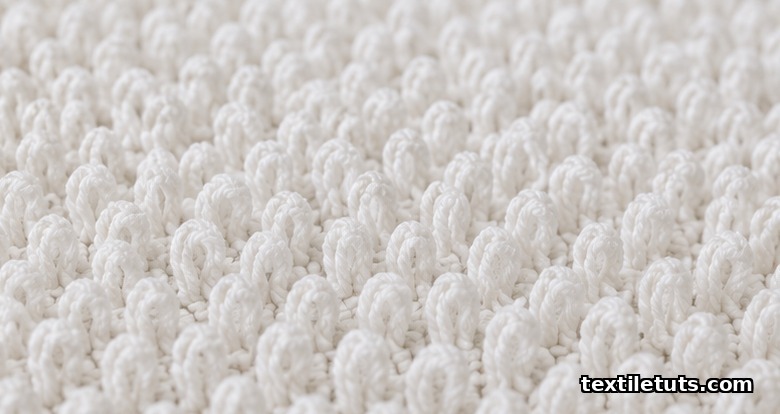
Loop density, measured in loops per square inch or loops per cm², is the single best predictor of perceived softness and absorbency. The arithmetic is straightforward:
Loop density (loops/cm²) = (pile warp ends per cm) × (pile picks per cm)
A typical 5-pick terry bath towel has 20 to 24 pile ends/cm and 5 pile picks/cm (one fifth of a 25 pick/cm weft), giving 100 to 120 pile insertions/cm², or 640 to 770 loops/in². Premium spa towels push pile ends to 26 to 30/cm and weft to 28/cm, which lifts loop density past 800/in². Beyond about 900 loops/in² the diminishing-returns problem appears: the ground weave starts to bind, loop height drops, and absorbency per gram of fabric begins to fall.
The reed has to be chosen for the combined ground and pile warp, not for the pile alone. A reed of 40 dents per 10 cm (≈10 dents/in) doubles up with 2 ends per dent is a common bath-towel setup; a 60 dents/10 cm reed (≈15 dents/in) is used when the mill wants higher ends without dropping to a finer yarn count.
Modern Terry Loom Hardware
Terry weaving used to require mechanical cam-loom technology with the loose reed, which limited running speeds to 250 to 350 rpm. Today, most new terry mills are rapier machines with electronic terry packages:
- Picanol TerryPlus on the Optimax platform, running up to 700 rpm with electronically profiled reed dwell.
- Toyota JAT 810 air-jet terry with on-loom loop-height measurement.
- Itema R9500 rapier, available with a terry kit and servo-controlled let-off on both beams.
- Tsudakoma water-jet terry variants for high-density polyester-cotton blends.
All four platforms share the same essential controls: separate let-off motors for the ground and pile beams, electronic pick sequencing (so the operator can change from 3-pick to 5-pick without re-camming), and a closed-loop take-up that synchronises fabric advance with the pile dwell. Loop-height closed-loop control, where a sensor reads the formed pile and trims let-off ratio on the fly, is now standard on premium machines and is what makes today’s loop-height tolerances of ±0.3 mm achievable.
Process Parameters That Move the Outcome
Beyond the let-off ratio and pick pattern, four process parameters dominate the final towel:
- Pile warp tension. Set at 8 to 14 cN/tex for cotton pile; too tight and the loops flatten, too slack and the loops collapse into the ground weave.
- Ground warp tension. Set at 22 to 28 cN/tex; tighter than the pile by 50 to 100 percent.
- Reed dwell. The forward stroke of the reed at the pile pick, usually 4 to 8 mm, controls loop height directly.
- Weft insertion tension. Lower than in plain weaving, because the reed dwell must push the fell forward against the weft without bowing it.
GSM is then a function of all four parameters plus warp and weft count. A mill running 30/1 Ne warp, 18/1 Ne weft, 22 pile ends/cm, 25 picks/cm, 5-pick construction, and 1:2.5 let-off ratio will land within roughly 380 to 430 g/m² finished, depending on finishing shrinkage (woven terry shrinks 8 to 12 percent in width and 12 to 18 percent in length during the first wet process).
Testing Terry Towels Against Standards
Three standards cover most of what a mill or a buyer needs to verify:
- ISO 9056 defines how to count the stitch and loop density of a woven terry fabric, the reference test behind almost every “loops per cm²” claim on a towel spec sheet.
- ASTM D3823 covers dimensional stability of terry products after repeated laundering, the test that justifies the “tumble-dry safe” claim.
- AATCC TM 79 measures absorbency, the time it takes a defined water column to wick into a hanging strip of towel fabric; values under 5 seconds are typical of a 5-pick combed-cotton bath towel.
For colour fastness to institutional laundering, mills run ISO 6330 domestic-wash cycles and grade against ISO 105 C06 for staining and ISO 105 B02 for light. A 4 to 5 grey-scale rating on staining after 20 wash cycles is the typical spec for a hotel-grade towel.
Frequently Asked Questions
What is a terry loom?
A terry loom is a standard weaving machine fitted with a second, low-tension pile warp beam plus a reed-dwell mechanism. The pile beam feeds extra yarn length that the reed pushes forward at the pile pick, forming uncut loops on one or both fabric faces.
How many picks per repeat does a terry towel use?
Most terry towels use a 3-pick, 4-pick, 5-pick, 6-pick, or 7-pick repeat, meaning one pile pick interleaved with two to six ground picks. Five-pick is the global default for bath towels because it balances loop anchoring, hand feel, and loom productivity.
What determines loop height on a terry loom?
Loop height is set by the let-off ratio between the pile beam and the ground beam, and by the reed dwell distance. A 1:2.5 pile-to-ground let-off with 4 to 6 mm reed dwell gives plush 4 to 5 mm loops suitable for bath towels; a 1:2.0 ratio gives the short, dense loops found on hand towels.
What GSM range is normal for terry towels?
Bath towels typically finish at 400 to 600 g/m², bath sheets at 500 to 800 g/m², and institutional or gym towels at 300 to 450 g/m². GSM is set by warp and weft count, ends and picks per cm, and the let-off ratio during weaving.
Why do my towels lose loops after a few washes?
Loop pull-out under laundering is almost always a construction problem, not a yarn problem. A 3-pick or 4-pick terry with low pile-anchor ground picks is the usual culprit; switching to a 5-pick to 7-pick construction and verifying that pile warp tension stays below 14 cN/tex fixes it in most cases.
References
- International Organization for Standardization. ISO 9056:1988 Textiles — Determination of Stitch Density. iso.org — Reference test behind loop-density claims on terry fabric.
- ASTM International. ASTM D3823 — Standard Practice for Determining Terry Fabric Stability After Repeated Laundering. astm.org — Dimensional change protocol for terry towels.
- American Association of Textile Chemists and Colorists. AATCC TM 79 — Absorbency of Terry Towels. aatcc.org — Water-column absorbency method for towel fabrics.
- International Organization for Standardization. ISO 6330:2021 — Domestic Washing and Drying Procedures for Textile Testing. iso.org — Wash-cycle protocol referenced by most terry buyers.
- Buhler, G. and Weder, M. Terry fabric: construction and performance. ResearchGate / peer-reviewed textile journal article on loop geometry and absorbency, accessible via researchgate.net.
- Picanol. TerryPlus Technical Bulletin. picanol.com — Manufacturer’s description of electronically profiled reed-dwell control on rapier terry machines.
This article is the working reference for towel weaving on terry looms. Editorial by Mohammad Yousuf (Anik), TextileTuts. Sources: ISO 9056, ASTM D3823, AATCC TM 79, ISO 6330, Buhler and Weder (ResearchGate), and Picanol TerryPlus technical bulletin as cited.


