
Gauze Weaving

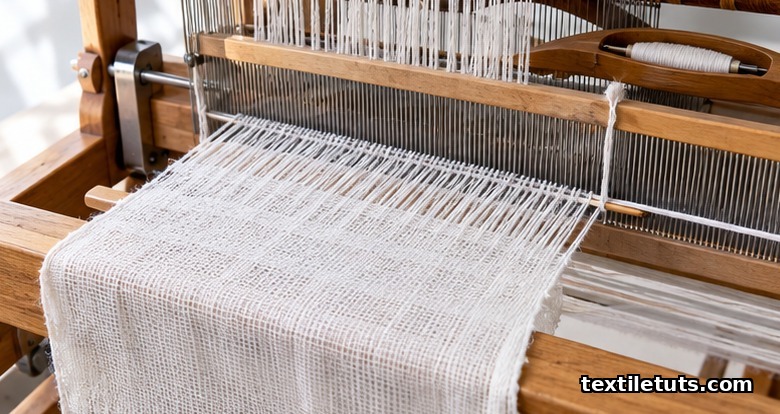
Gauze weave is an open, leno-based woven structure made on a doup loom, in which pairs of warp ends cross between picks to lock each weft yarn in place, producing fabrics at 20–80 GSM with 8–20 picks per cm; typical surgical gauze is woven at 24 ends × 20 picks per cm using 40s Ne cotton for an areal density of 35–50 GSM.
The crossing action stabilizes the weft without the dense interlacing of a plain weave, which is why gauze fabrics are light, porous, and resistant to yarn slippage at the same time.
This guide walks through what gauze weave actually is, how it differs from plain weave and leno, what a loom needs to weave it, and where the construction shows up in medical, agricultural, filtration, and apparel products.
What Is Gauze Weaving?
Gauze weaving is the process of interlacing warp and weft yarns in a way that produces an open, porous, dimensionally stable fabric, most commonly by crossing two warp ends around each weft pick. The crossing is what separates gauze from a plain weave of similar thread count: in a plain weave, the warp simply goes over-one-under-one; in gauze weave, two warp ends twist around the weft pick, mechanically locking it in place.
Because the warp ends are doing the locking, gauze can be woven at surprisingly low thread densities and still resist yarn slippage. A medical gauze at 14 ends × 10 picks per cm will hold its shape in the wash; a plain weave at the same count would distort and fray.
The term “gauze” in English originally referred to silk fabrics imported through the port of Gaza in the 16th century. Modern gauze weaving covers cotton surgical dressings, polyester agricultural shading nets, fiberglass filtration scrims, and the cotton lawn, muslin, and “double gauze” fabrics used in apparel and bedding.
Gauze vs Leno vs Mock Leno: How They Differ
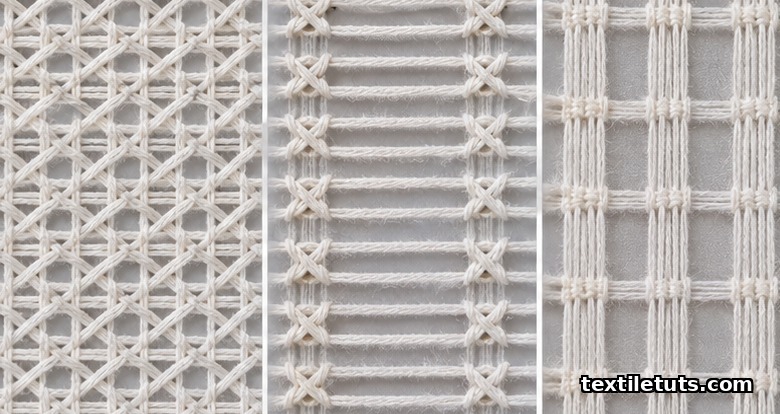
“Gauze,” “leno,” and “mock leno” are often used interchangeably, but they are three distinct constructions woven on three different loom setups with three different yarn behaviors. Getting this right matters when sourcing fabric or specifying a construction in a technical data sheet.
| Property | Gauze (true) | Leno | Mock Leno |
|---|---|---|---|
| Loom required | Doup loom with crossing heddles | Doup loom with crossing heddles | Plain loom, no doup |
| Warp behavior | Pairs of ends cross around every pick | Pairs of ends cross around selected picks | Some ends grouped, no crossing |
| Typical ends × picks per cm | 10–24 × 10–20 | 6–14 × 6–12 | 10–18 × 10–18 |
| GSM range | 20–80 | 30–120 | 40–150 |
| Locking mechanism | Warp cross-locks weft on every pick | Warp cross-locks weft intermittently | Yarn grouping and float stability |
| Common end uses | Surgical gauze, mosquito netting, lightweight apparel | Industrial filtration, bagging, fiberglass scrim | Towels, blankets, decorative open weaves |
The defining test is whether the warp ends physically cross over each other between picks. If yes, the fabric is gauze (every pick) or leno (intermittent picks). If no, the open structure is created by yarn grouping or float patterns, and the fabric is mock leno, woven on a standard loom without a doup attachment.
Loom Mechanics: How the Doup Heddle Crosses the Warp
Gauze weaving requires a doup (or “gauze”) heddle in addition to the standard ground heddles. Each pair of warp ends, one “ground end” and one “doup end,” is threaded through a heald on one of the standard shafts, and the doup end is also looped through a second heald held by the doup shaft. When the doup shaft lifts, the doup end is pulled across the ground end, twisting around the inserted weft pick before the standard beat-up.
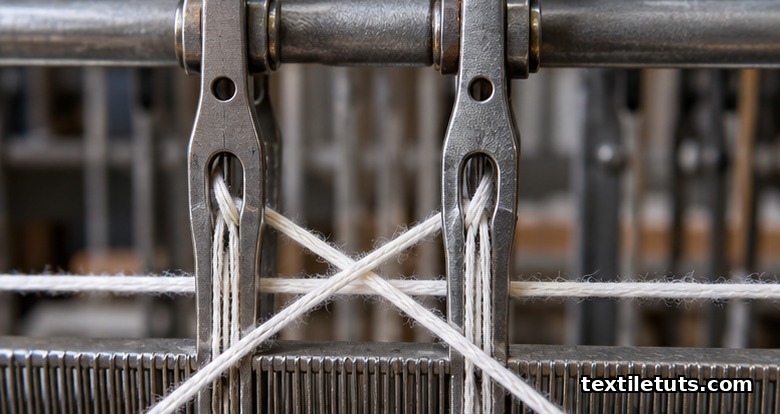
Standard drafting notation for gauze is 1-and-1: one ground end, one doup end, repeating across the warp. A 2-and-1 draft uses two ground ends to one doup end and gives a more open fabric with the doup ends spaced further apart; a 1-and-2 draft uses two doup ends to one ground end and produces a denser, more stable gauze used in technical filtration scrims.
Modern high-speed gauze looms run at 400–600 picks per minute. The doup shaft motion is mechanically tied to the weft insertion cycle; without it, the fabric collapses into plain weave. Most modern air-jet and rapier looms can be fitted with gauze attachments, but the take-up tension must be 15–25% lower than for plain weave to prevent warp breaks during crossing.
Yarn Selection, Count, and Twist
Gauze constructions use finer yarns than most apparel weaves because the structure provides dimensional stability without dense interlacing. The most common choices are combed cotton in the 30s–60s Ne range (roughly 20–10 tex) for medical and apparel gauze, polyester filament 50–100 denier for industrial shading, and fiberglass 75–150 tex for filtration scrims.
Warp twist must be 8–15% higher than for plain weave at the same count. The extra twist gives the doup end the rigidity to cross without buckling and survive the friction of repeated doup shaft lifts. A 40s Ne cotton yarn at 4.5 TM (twist multiplier) is a typical starting point; dropping below 3.8 TM causes the doup end to jam and produces uneven crossings.
Weft twist can be standard apparel twist (3.8–4.2 TM for cotton) because the weft is not crossed. Higher weft twist reduces fabric stiffness but lowers the fabric’s air permeability, which matters for medical gauze where the spec usually calls for 70–85% open area to preserve absorbency and breathability.
Density, GSM, and Open Area
Three numbers define a gauze fabric: warp density (ends per cm), weft density (picks per cm), and yarn linear density (tex). From those three, GSM and percent open area fall out. The standard textile-engineering calculation for woven GSM is:
GSM = (ends/cm × warp tex + picks/cm × weft tex) ÷ 10
For surgical cotton gauze at 14 ends × 10 picks per cm, both in 40s Ne (14.8 tex): GSM = (14 × 14.8 + 10 × 14.8) ÷ 10 = 35.5. That matches the 35–50 GSM range cited in pharmacopeial monographs for non-sterile cotton gauze. For 24 ends × 20 picks per cm at the same count, GSM climbs to about 62–63, which is the upper limit for surgical dressings.
Open area is what makes gauze breathable and absorbent. A 24 × 20 gauze at 40s Ne has roughly 40–50% open area; a 14 × 10 gauze at the same count has 55–65% open area. ISO 7211-5 sets the method for thread-density counting under a dissecting microscope, which is what mills use to verify the construction before shipment.
Industrial and End-Use Applications
Gauze weave is everywhere once you know to look for it. The four biggest end-use families are:
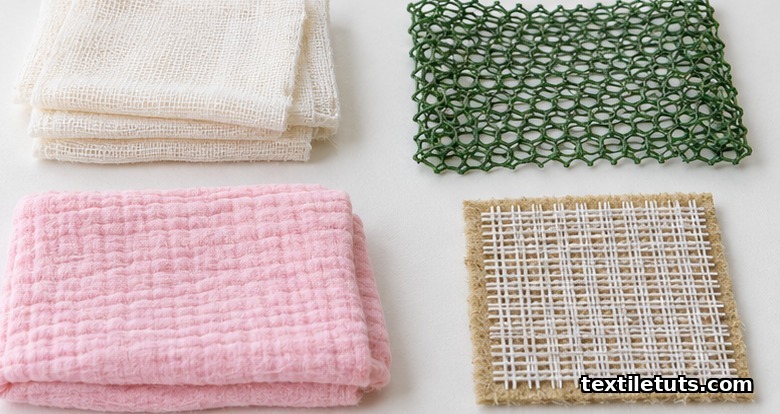
Medical and hygiene. Sterile and non-sterile surgical dressings, X-ray detectable swabs, and face mask inner layers are woven on gauze looms. The crossed warp keeps loose cotton fibers from shedding into wounds, which is why monographs such as the United States Pharmacopeia specify leno/gauze construction for Class I cotton sponges.
Agriculture. Greenhouse shading nets, hail protection screens, and windbreak fabrics are polyester or HDPE leno weaves at 6–14 ends × 6–12 picks per cm. The crossed structure lets the fabric flex in wind without distorting under load.
Filtration. Fiberglass leno scrims are the carrier fabric in nearly every industrial filter bag. The crossed warp holds the needle-punched felt in place during high-temperature pulse-jet cleaning, where temperatures can reach 200 °C continuously and the filter is cycled every 60–120 seconds.
Apparel and home textiles. Cotton gauze is woven into crinkle-textured scarves, baby swaddles, blankets, and the “double gauze” fabrics used in summer dresses and bedding. Mock leno at 10–18 ends × 10–18 picks gives the open, breathable structure of leno without the doup-loom cost.
Testing Standards for Gauze Fabrics
Three standard families cover gauze testing. ASTM D5034 governs grab tensile strength, which matters for filtration scrims that have to survive pulse-jet cleaning. ASTM D3776 covers mass per unit area (GSM verification), with the woven-fabric method using a 100 cm² cutter die. ISO 7211-5 is the construction method, counting ends and picks per cm under magnification to verify the woven architecture.
For absorbent medical gauze, additional methods apply: ISO 9073 parts cover liquid strikethrough and absorbency for nonwovens, but woven gauze follows pharmacopeial methods (USP, EP) for absorbency and fiber content, with AATCC TM 20 used to verify fiber identity. AATCC TM 20 microscopy is the standard fiber-identification method in cotton gauze acceptance testing.
Colorfastness testing on dyed gauze uses AATCC TM 8 (crocking) and AATCC TM 16 for lightfastness on apparel gauze that will be exposed to sunlight. Dimensional stability after repeated laundering is tested per AATCC TM 135 for cotton gauze apparel and home textiles.
Frequently Asked Questions
Is gauze weave the same as leno weave?
Gauze is a sub-type of leno. In strict textile-engineering use, “leno” refers to any weave where two warp ends cross around the weft, while “gauze” is reserved for the densest leno construction in which the warp crosses on every pick. Most mills and pharmacopeial monographs treat the two as equivalent, but a true gauze always has continuous cross-warp locking on every pick.
Can gauze be woven on a normal loom without a doup?
No. True gauze, with crossed warp ends on every pick, requires a doup heddle and a doup shaft on the loom. What you can weave on a plain loom is mock leno, which mimics the open structure of gauze using grouped warp ends and float patterns but does not actually cross the warp. The two fabrics are visually similar at low thread counts but behave differently in tension and abrasion.
What GSM is surgical gauze?
Non-sterile surgical cotton gauze, per the United States Pharmacopeia monograph for Class I cotton sponges, is woven at 14–24 ends × 10–20 picks per cm in 30s–50s Ne combed cotton, giving an areal density of 35–50 GSM. Sterile gauze for surgical packs is the same construction, packaged and sterilized after weaving.
Why does gauze not fall apart even though it is so open?
The crossed warp locks each weft pick mechanically. In a plain weave of the same low thread count, the weft would slide back and forth; in gauze, the warp twist around the pick physically prevents the pick from migrating. This is why gauze can be cut without significant fraying; loosening is limited to a few millimeters around the cut edge.
Is double gauze the same as a doup weave?
No. “Double gauze” in apparel refers to two layers of plain-woven cotton fabric lightly tacked together at intervals during weaving, which makes it a layered plain weave, not a leno construction. The two layers are joined by stitching warp ends that pass between them. The fabric looks open and crinkled but does not use a doup heddle.
References
- ASTM International. ASTM D5034-21: Standard Test Method for Breaking Strength and Elongation of Textile Fabrics (Grab Test). ASTM International, West Conshohocken, PA.
- ASTM International. ASTM D3776/D3776M-20: Standard Test Methods for Mass Per Unit Area (Weight) of Fabric. ASTM International, West Conshohocken, PA.
- International Organization for Standardization. ISO 7211-5:2020 — Textiles — Methods for the Analysis of Woven Fabric Construction — Part 5: Determination of Linear Density of Yarn Removed from Fabric. ISO, Geneva.
- American Association of Textile Chemists and Colorists. AATCC Test Method 8-2016: Colorfastness to Crocking: Crockmeter Method. AATCC, Research Triangle Park, NC.
- American Association of Textile Chemists and Colorists. AATCC Test Method 20-2021: Fiber Analysis: Qualitative. AATCC, Research Triangle Park, NC.
- Lord, P. R., & Mohammed, M. H. (1982). Weaving: Conversion of Yarn to Fabric (2nd ed.). Woodhead Publishing (Elsevier), Cambridge, UK.
- Adanur, S. (2001). Handbook of Weaving. CRC Press / Taylor & Francis, Boca Raton, FL.
- Gandhi, K. L. (2012). Woven Textiles: Principles, Technologies and Applications. Woodhead Publishing (Elsevier), Cambridge, UK.
Editorial by Mohammad Yousuf (Anik), TextileTuts. Sources: ASTM D5034-21, ASTM D3776/D3776M-20, ISO 7211-5:2020, AATCC TM 8-2016, AATCC TM 20-2021, Lord and Mohammed (Woodhead/Elsevier, 1982), Adanur (CRC Press, 2001), and Gandhi (Woodhead/Elsevier, 2012) as cited.


