
Velour Knit Fabric

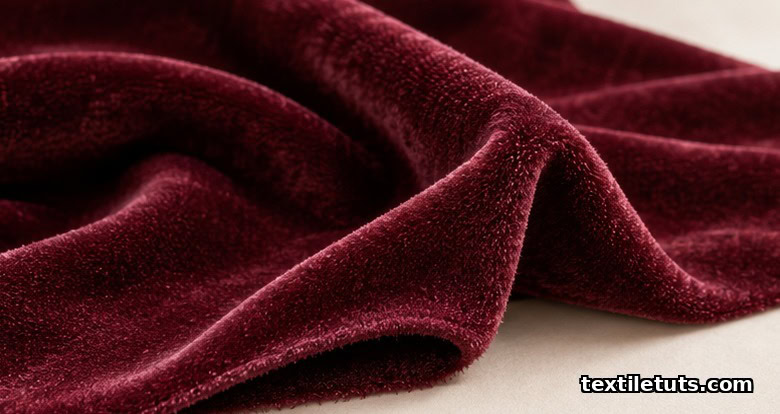
Velour knit fabric is a plush, pile-knit textile that typically weighs 220 to 340 GSM (grams per square meter) with a cut pile height of 1 to 3 mm, produced on circular weft knitting machines and finished by shearing, brushing, and heat-setting to create a velvet-like surface with 15 to 30 percent stretch in the width direction. The knit construction is what separates velour from woven velvet, and that single structural difference explains why velour drapes softer, recovers from compression faster, and tolerates body movement better than its woven counterpart.
This article walks through what velour knit actually is, how it is manufactured, the fiber blends used commercially, the standards that govern its mass and dimensional stability, the grades sold for different end uses, and practical guidance for sewing and caring for it.
What Velour Knit Fabric Actually Is
Velour is a French-derived word meaning velvet, and in textile usage it describes any fabric finished to imitate velvet’s dense, soft pile. When the word “velour” is used alone in modern apparel and upholstery catalogs, it almost always refers to the knitted version, because the woven version is simply called velvet. The knit version is built by floating longer yarns across the face of a base fabric, then cutting and brushing those floats to stand upright as a short pile.
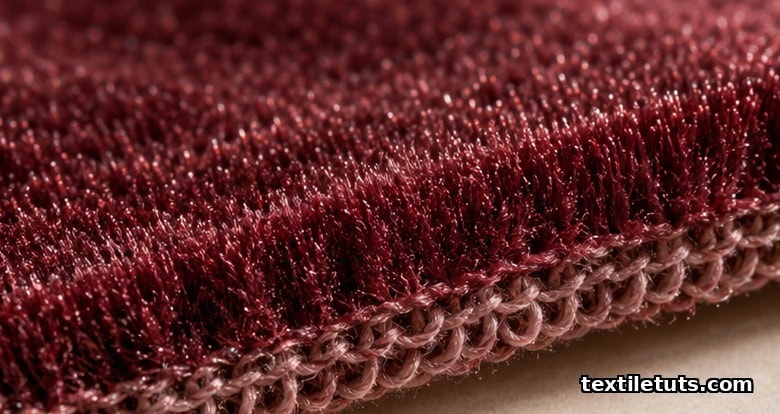
The base structure is a weft knit, most often produced on a circular knitting machine using a single jersey or fine 1×1 rib ground. The pile is created by knitting additional yarns (called pile yarn or plush yarn) that are tucked into the ground at defined intervals and floated across the face between tucks. After knitting, the fabric is stabilized, dyed, and then run through a shearing cylinder that cuts the floats to a uniform height and a brushing roller that raises the cut ends into a dense, upright pile.
How Velour Knit Differs from Velvet
The single biggest difference is stretch. Woven velvet is built on a loom with two warps and one weft, which produces a fabric that is essentially stable in both directions. Velour knit uses looped yarns that can spread and contract, so a typical velour knit stretches 15 to 30 percent in the width and 5 to 10 percent in the length before it begins to resist. That is why velour knit became the default fabric for 1970s tracksuits and is still used today in leotards, loungewear, and stretch-upholstery applications.
The second difference is recovery. Because the knit loops spring back to their original shape after being compressed, velour knit recovers from sitting, leaning, and bending better than woven velvet, which crushes permanently at high pressure points. The third difference is effective density. A woven velvet at 300 GSM feels denser than a velour knit at 300 GSM, because the knit’s trapped air pockets reduce the actual mass per unit volume and give the fabric a softer drape.
Standard Mass Ranges for Knit Velour
Commercial knit velour falls into three mass ranges that map directly to end use. Lightweight apparel velour runs 180 to 240 GSM and is used for tops, dresses, and garment linings. Medium-weight apparel and light upholstery velour runs 240 to 320 GSM and is the most common grade sold for tracksuits, sweatpants, and loungewear sets. Heavy upholstery velour runs 320 to 420 GSM and is used for furniture, headboards, and acoustic panels where the pile depth can be extended to 3 mm without distortion.
Mass per unit area is tested under ISO 3801 (Determination of mass per unit area of woven and knitted fabrics) or ASTM D3776/D3776M for US-market reporting. Both methods require the fabric to be conditioned at 20 degrees Celsius and 65 percent relative humidity before weighing, a procedure defined in ISO 139:2005 (Textiles: Standard atmospheres for conditioning and testing). Skipping the conditioning step gives readings that can drift by 3 to 5 percent, which is enough to push a borderline shipment out of specification and trigger a rejection.
Fiber Composition Used in Velour Knit
Velour knit is produced in three principal fiber families. The first is 100 percent cotton, valued for its soft hand, matte appearance, and breathable comfort, and is the grade most often used for high-end upholstery and baby garments. The second is 100 percent polyester, which delivers higher abrasion resistance, better pile recovery, and lower cost, and serves as the workhorse grade for furniture and apparel. The third is a cotton-polyester blend, typically 80/20 or 70/30, which balances comfort against durability and is the most common mass-market grade.
Spandex (elastane) is regularly plated into the ground yarns at 3 to 8 percent of total fabric weight to add recovery, especially in apparel grades. Stretch velours used in dancewear and athletic apparel often push elastane to 10 to 15 percent. A smaller share of velour knit is also produced from solution-dyed polyester for contract upholstery, where the dye is built into the polymer before extrusion and gives very high lightfastness under direct sun exposure.
Manufacturing Stages of Velour Knit
The first stage is knitting on a circular plush machine. The machine knits a ground structure (usually single jersey or 1×1 rib) and a separate set of plush yarns that are floated across the face. The plush yarns are held in place by tuck stitches that bind them to the ground at every few courses. The second stage is relaxation, where the greige fabric is allowed to relax on a tenter or in a relaxed loop to recover its full width and length before any wet processing.
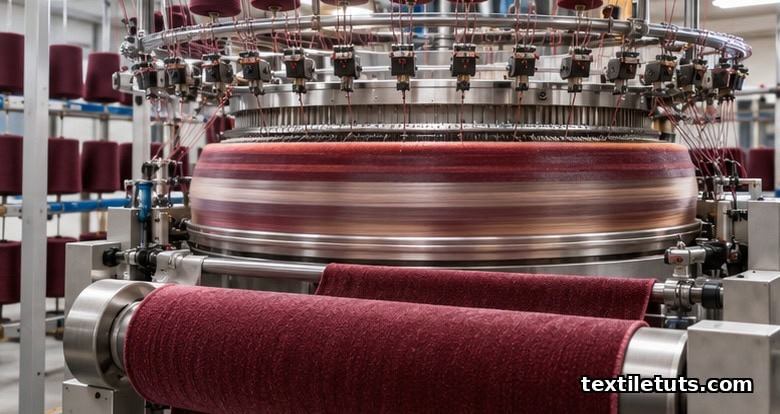
The third stage is dyeing, which is almost always piece dyeing in a jet or beck because the pile must be dyed evenly across its full depth. The fourth stage is finishing: the fabric is first heat-set on a stenter at 180 to 200 degrees Celsius to lock the dimensions, then passed through a shearing cylinder that trims the floats to a uniform 1 to 3 mm height, then through a brushing roller that raises the cut ends into a vertical pile. A final decating step presses the pile flat for visual inspection before rolling and packing.
Testing Standards That Apply to Velour Knit
Beyond mass per unit area, four other ISO and AATCC methods are routinely run on velour knit shipments. ISO 5077:2007 (Determination of dimensional change) is used to quantify how the fabric shrinks or grows after a defined number of wash cycles, which matters because the cut pile relaxes into the ground structure during washing and the visible dimensions can change by 3 to 7 percent. AATCC TM 135 is the US-market equivalent for home-laundering dimensional change. ISO 13934-1 (Tensile properties, strip method) is used to verify that the knit ground retains adequate strength after the pile-raising process, which can shave 10 to 15 percent off the original yarn tenacity. ISO 12945-2 (Pilling resistance, Martindale method) is used to check that the pile resists forming pills under abrasion, with a target rating of 4 to 5 on a 5-point scale after 5,000 cycles for upholstery-grade velour knit.
Common Applications of Velour Knit
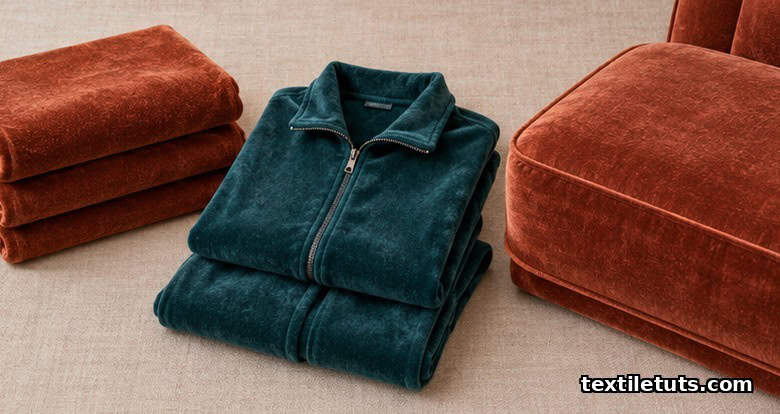
Apparel remains the largest end use. Tracksuits, hoodies, sweatpants, loungewear sets, and baby blankets all use the medium-weight grade because the pile traps air for warmth without the weight of a woven velvet. Upholstery is the second major end use, where the heavy grade provides a soft seating surface that recovers from body impressions and resists the visible wear patterns that flatten woven velvet over time. Costume and theatrical fabrics use a high-stretch grade with 10 to 15 percent elastane for fitted garments. A smaller volume goes into automotive interiors (seat covers, headliners) and acoustic panels where the open pile absorbs sound.
Sewing and Care Guidance for Velour Knit
Velour knit should be cut with a sharp rotary cutter rather than scissors, because the pile pulls into scissor blades and produces ragged edges. Use a ballpoint or stretch needle (size 80/12 or 90/14) to avoid snagging the knit loops during seam construction. Sew with a slight zigzag (width 1.0 to 1.5 mm, length 2.5 to 3.0 mm) or a coverstitch, which lets the seam stretch with the fabric without popped stitches. Pressing should be done from the back with a low-heat iron (max 110 degrees Celsius for polyester grades, 150 degrees Celsius for cotton grades) and a pressing cloth, because direct heat on the pile flattens it permanently.
Washing should be done in cold water (30 degrees Celsius maximum) on a gentle cycle, then tumble dried on low or laid flat to dry. Hot water and high-heat drying are the two factors most likely to cause irreversible pile matting and shrinkage, particularly in cotton-rich blends. Pill management is straightforward: a fabric shaver run lightly across the surface every few wears keeps the pile standing upright and the surface looking fresh.
Velour Knit Property Summary
| Property | Light apparel grade | Medium apparel grade | Heavy upholstery grade |
|---|---|---|---|
| Mass (GSM) | 180 to 240 | 240 to 320 | 320 to 420 |
| Pile height (mm) | 1.0 to 1.5 | 1.5 to 2.5 | 2.5 to 3.0 |
| Width stretch (%) | 15 to 25 | 10 to 20 | 5 to 15 |
| Common fiber | Cotton or cotton-poly | Cotton-poly blend | Polyester or solution-dyed polyester |
| Typical elastane (%) | 3 to 8 | 0 to 5 | 0 |
| Primary end use | Tops, linings, baby items | Tracksuits, loungewear | Furniture, headboards, acoustic panels |
Frequently Asked Questions
Is velour knit the same as velvet?
No. Velvet is woven on a loom with two warps and one weft, while velour knit is built on a circular knitting machine with looped yarns. The knit construction gives velour stretch and pile recovery that woven velvet does not have, which is why the two fabrics are sold for different end uses despite looking similar.
Does velour knit shrink in the wash?
Yes, typically 3 to 7 percent in length and 1 to 3 percent in width after five home-laundering cycles, per AATCC TM 135 testing. Cotton-rich grades shrink more than polyester-rich grades, and hot water increases the shrinkage significantly. Pre-washing a cut length before sewing is recommended for fitted garments.
Can velour knit be ironed?
Yes, but only from the back with a pressing cloth and low heat. Maximum iron temperature is 110 degrees Celsius for polyester grades and 150 degrees Celsius for cotton grades. Direct heat on the face flattens the pile permanently and creates shiny patches that cannot be restored.
Is velour knit breathable?
Cotton-rich velour knits are breathable and comfortable against skin, while 100 percent polyester grades are noticeably less breathable. For warm-weather apparel, an 80/20 cotton-polyester blend is the practical compromise between comfort and durability, and matches the hand of 100 percent cotton closely enough for most wearers.
How does velour knit hold up on furniture?
A 320 to 420 GSM polyester velour knit, properly finished and abrasion-tested to ISO 12945-2 grade 4 or higher, is suitable for residential and light contract upholstery. Heavy-use commercial settings should specify a solution-dyed grade for stain and lightfastness, because the dye is built into the polymer and resists fading under direct sunlight far better than piece-dyed grades.
References
- International Organization for Standardization. ISO 139:2005, Textiles: Standard atmospheres for conditioning and testing. iso.org. Defines the 20 degrees Celsius, 65 percent relative humidity conditions used in all subsequent textile tests.
- International Organization for Standardization. ISO 3801:1977, Determination of mass per unit area of woven and knitted fabrics. iso.org. The reference method for GSM reporting on knit velour shipments.
- International Organization for Standardization. ISO 5077:2007, Determination of dimensional change. iso.org. Used to quantify wash shrinkage in knit velour.
- ASTM International. ASTM D3776/D3776M, Standard Test Methods for Mass Per Unit Area. astm.org. US-market mass reporting method for woven and knit fabrics.
- AATCC. AATCC TM 135, Dimensional Changes of Fabrics after Home Laundering. aatcc.org. US-market wash-shrinkage test referenced for knit velour apparel.
- International Organization for Standardization. ISO 12945-2, Determination of fabric propensity to surface fuzzing and pilling, Martindale method. iso.org. The standard abrasion test for velour knit upholstery grades.
- Wikipedia contributors. Velour. en.wikipedia.org. Background on the etymology and use history of velour as a textile.
This article is the working reference for velour knit fabric. Editorial by Iftay Khairul Alam, TextileTuts. Sources: ISO 139, ISO 3801, ISO 5077, ISO 12945-2, ASTM D3776/D3776M, AATCC TM 135, and Wikipedia Velour as cited.


