
Sweater Knit Fabric

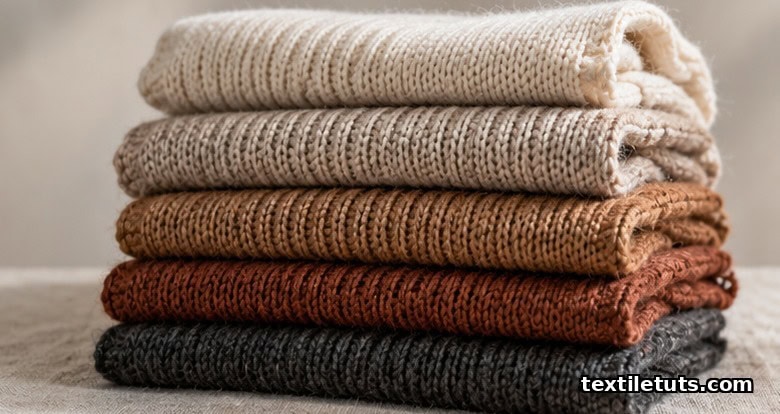
Sweater knit fabric is a cut-and-sewn weft-knitted textile produced on flat (V-bed) or circular knitting machines at gauges of 3 to 18 needles per inch from yarn counts of 1/16 to 1/48 Nm, delivering areal densities of 200 to 600 g/m² with widthwise stretch of 30 to 100 percent at 30 N/cm load as measured under ISO 3801, ISO 7211-5, and ASTM D2594.
The fabric earns its place in every winter wardrobe because the looped structure traps still air, lowering thermal conductivity to roughly 0.04 W/(m·K) for wool and yielding a warmth-to-weight ratio no flat woven cloth can match.
What follows explains how gauge, yarn count, stitch geometry, and finishing interact to produce the wide range of sweater knits on the market, and how to read the numbers a knit mill actually quotes on a technical sheet.
How Gauge and Machine Type Define the Fabric
Gauge (abbreviated GG, from the German Gauge) is the number of needles per inch on the knitting machine and is the single most important variable defining a sweater knit. Coarse-gauge machines run at 3 to 7 GG and produce bulky fabrics for fisherman sweaters, Icelandic pullovers, and chunky cardigans; middle-gauge machines at 8 to 12 GG deliver classic midweight pullovers and crew necks; fine-gauge machines at 14 to 18 GG turn out the smooth, dress-weight knits used in fine-gauge sweaters and sweater-knit shirts. Beyond 18 GG the fabrics are usually classified as hosiery rather than sweater knit, because the loop length drops below about 2.5 mm and the fabric loses body.
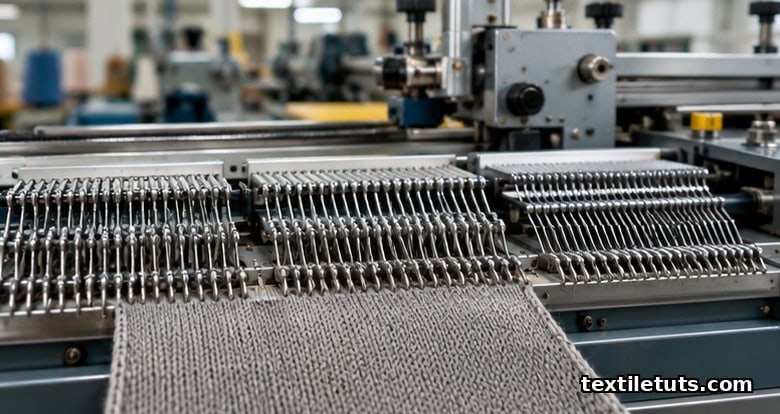
Two machine families dominate. Flat knitting (V-bed) machines knit shaped panels (fronts, backs, sleeves, collars) directly to shape, allowing integral knit trims, full-fashioned side seams, and engineered stitch patterns such as cable or Aran. Circular knitting machines knit an open-width tube that is later cut and sewn, which is faster but cannot shape panels to body curve. Gauge, needle bed width, and machine diameter together determine panel dimensions and knitting time; a typical 12 GG flat knitting machine produces a sweater body panel in 20 to 35 minutes at about 1.2 m/min carriage speed.
Yarn Count and Fiber Choice
Sweater knit yarn is reported in the metric Nm system (1/16 Nm to 1/48 Nm), in English cotton count (Ne 1/4.5 to Ne 1/30), or directly in tex. A 1/28 Nm yarn weighs 35.7 tex and is a typical mid-gauge choice; a 1/48 Nm yarn weighs 20.8 tex and feeds 16 to 18 GG machinery. The yarn count must match the gauge: a yarn thicker than the machine gauge cannot be knitted because the loop cannot pass between adjacent needles, while a yarn far thinner than gauge produces a sheer, unstable fabric with poor cover.
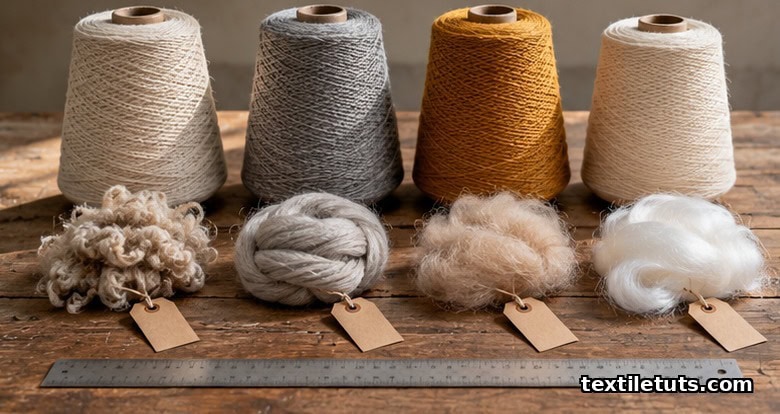
Fiber choice drives hand-feel and performance. Wool at 19 to 25 µm Merino and 30 to 37 µm crossbred gives warmth, recovery, and odor resistance; acrylic at 2.2 to 4.5 dtex is hypoallergenic, machine-washable, and inexpensive; cotton at 3.5 to 5.0 dtex is cool, smooth, and weaker in elasticity; cashmere at 14 to 19 µm gives the softest hand but at a price roughly six to eight times merino wool. Blends such as 70/30 acrylic/wool or 50/50 wool/cotton dominate mass-market cut-and-sewn knitwear.
Twist level matters as much as count. Weft-knitted sweater yarn is typically ring-spun or mule-spun with a twist multiplier of 2.8 to 3.4 (alpha) in the Z-direction for woolen-spun yarn and 3.5 to 4.0 for combed worsted yarn, verified under ISO 2061. Too low a twist produces a hairy, pilling-prone surface; too high a twist produces a stiff, boardy hand and reduces loop formation efficiency on the needles.
Loop Geometry, Stitch Density, and Areal Density
A weft-knitted fabric is built from loops, and the loop length (ℓ, in mm) is the master variable. Loop length is measured under ASTM D3887 or ISO 7211-5 and typically sits between 2.5 and 6.0 mm for sweater knit at 8 to 14 GG. Areal density M (g/m²) is the product of yarn linear density T (tex), loop length ℓ (mm), and stitch density (wales per cm W times courses per cm C), divided by 1000:
M = (T × ℓ × W × C) / 1000
For a typical 12 GG fabric knitted at ℓ = 4.0 mm from 1/28 Nm yarn (35.7 tex), with W = 8 wales/cm and C = 10 courses/cm, this gives M = (35.7 × 4.0 × 8 × 10) / 1000, or about 285 g/m² total in a single jersey. Halving ℓ drops areal density to roughly 140 g/m²; doubling yarn tex doubles it.
Areal density is measured directly under ISO 3801 (mass per unit area) and is the single number mills quote on a technical sheet. Lightweight sweater knits for layering sit at 150 to 250 g/m², standard pullovers at 250 to 400 g/m², and chunky sweaters at 400 to 600 g/m². Above 600 g/m² the fabric is usually classed as fleece or blanket.
Stitch Types and Surface Appearance
Sweater knit fabric is not one stitch. The four base structures are:
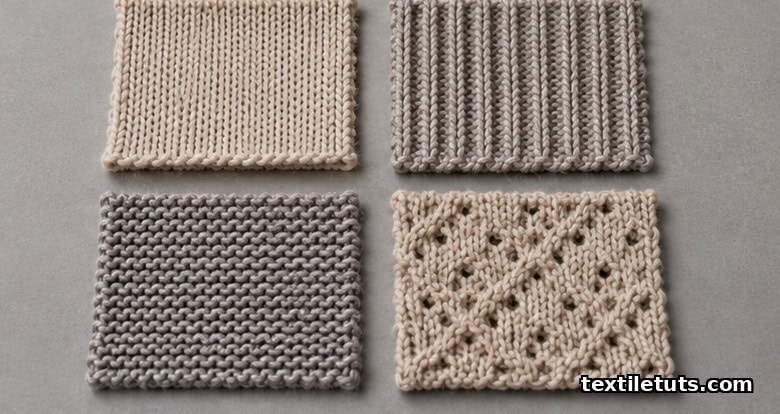
- Plain (jersey) knit: all loops drawn to the face; visible wales on the face and courses on the back; curls at the cut edges; the most common structure for sweater bodies.
- Rib knit: alternating wales of face and reverse loops in 1×1, 2×2, or 3×3 layouts; balanced, recovers well, used for cuffs, collars, hems, and rib bodies.
- Purl knit: alternating face and reverse loops within a single wale; reversible and slower to knit, used for textured designs and babywear.
- Tuck and miss stitches: loops held on previous courses for color, lace, or relief patterns; common in jacquard and pointelle sweater knits.
Cable, Aran, and fisher knit structures are not separate stitches but combinations of plain knit, rib, and transfers that create relief patterns. A full-fashioning mark, which is a small half-hole at the seam edge, indicates shaped panels knitted on flat machines; a true cut-and-sewn sweater knit has no such marks because panels are cut from circular knit yardage.
Dimensional Stability and Shrinkage
Cut-and-sewn sweater knit relaxes and shrinks more than woven fabric, especially in the first wash. AATCC TM135 dimensional-change testing on home-laundered knit fabric typically shows 5 to 10 percent lengthwise shrinkage and 3 to 7 percent widthwise for relaxed wool, with synthetic blends shrinking 1 to 3 percent. Pre-relaxation by mill finishing (crabbing, decating, steam finishing) reduces but does not remove this; finished garments are still expected to lose 1 to 3 percent on first wash.
Stitch length and yarn twist are the strongest levers. Increasing yarn twist from 3.0 to 4.0 alpha reduces lengthwise shrinkage by 1 to 2 percentage points but stiffens hand. Compressive shrink-resist finishing, such as chlorine-Hercosett on wool, holds machine-washable shrinkage below 3 percent in both directions and is the basis for the total easy care wool label.
Stretch, Drape, and Handle
Sweater knit fabric stretches further in the width (course) direction than in the length (wale) direction. ASTM D2594 stretch testing of plain jersey at 12 GG typically reports 60 to 100 percent stretch across and 15 to 30 percent stretch along at 30 N/cm load; rib knit reaches 100 to 200 percent across the same load.
Hand-feel is judged subjectively by KES-F or objectively by a Fabric Touch Tester, with surface friction coefficient MIU of 0.20 to 0.35 for soft wool and 0.45 to 0.60 for hard acrylic. Drape coefficient, measured by a Cusick drape tester, ranges from 30 percent (soft drape, lightweight knit) to 70 percent (stiff, chunky knit). These numbers let a designer predict whether a 14 GG, 250 g/m² sweater knit will work for a structured blazer or a slouchy pullover before any sample is knitted.
Sweater Knit Compared With Other Knits
| Property | Sweater knit | Single jersey | Rib (1×1) |
|---|---|---|---|
| Typical gauge | 3 to 18 GG | 18 to 32 GG | 8 to 18 GG |
| Areal density | 200 to 600 g/m² | 100 to 220 g/m² | 180 to 400 g/m² |
| Yarn count | 1/16 to 1/48 Nm | 1/40 to 1/80 Nm | 1/20 to 1/48 Nm |
| Stretch across | 60 to 100 percent | 80 to 150 percent | 100 to 200 percent |
| Widthwise shrinkage after wash | 3 to 7 percent | 5 to 10 percent | 2 to 5 percent |
| End use | Pullover, cardigan | T-shirt, top | Cuff, collar, hem |
Finishing and Care
Mills finish sweater knit to set stitch geometry and stabilize dimensions. Wool is crabbed (hot-water pressing) and decated (steam pressing against a cylinder) to flatten loops and pre-relax shrinkage; acrylic is heat-set at 120 to 140 °C for 30 to 60 seconds to fix the loop shape; cotton is singed and mercerized for luster. Fulling (controlled felting) on wool produces the classic boiled-wool sweater at 600 to 800 g/m², with area shrinkage up to 40 percent.
Consumer care follows the fiber. Wool sweater knits prefer hand wash at 30 °C or a machine wool cycle with neutral detergent, then flat drying; acrylic tolerates 40 °C machine wash; cotton blends tolerate 60 °C. AATCC TM135 dimensional-change and AATCC TM61 colorfastness to laundering are the two tests every quality sweater knit fabric should clear before it is shipped.
Frequently Asked Questions
What gauge is best for a sweater knit fabric?
There is no single best gauge. Choose by end use: 3 to 7 GG for chunky fisherman sweaters, 8 to 12 GG for standard pullovers and cardigans, 14 to 18 GG for fine-gauge dress-weight sweaters. Within a given gauge, finer yarn reduces weight and improves drape; coarser yarn increases warmth and bulk.
Is sweater knit the same as jersey?
No. Jersey is one stitch structure (plain knit, all loops drawn to the face); sweater knit is a category of weft-knitted fabrics used for pullovers, made on coarse- to mid-gauge machinery. Most sweater knit is jersey, rib, or purl, but the term refers to the fabric’s end use and gauge range, not to a single stitch.
Why does my sweater knit grow when I wear it?
Weft-knitted fabric elongates under sustained body weight and recovers only partially. Wool and wool blends recover best because of the fiber’s natural crimp and elastic recovery; acrylic grows more because thermoplastic fibers stress-relax under body heat and humidity. Reshape the garment after washing and flat dry it to recover original dimensions.
How much will a sweater knit shrink on the first wash?
Unfinished (loom-state) sweater knit can shrink 10 to 15 percent in length and 5 to 8 percent in width. Mill-relaxed and finished knit shrinks 3 to 7 percent lengthwise and 1 to 3 percent widthwise on first wash, measured under AATCC TM135. Pre-washed or pre-shrunk fabric is engineered to hold shrinkage below 3 percent.
What is the warmest sweater knit fabric?
Wool is the warmest common sweater knit fiber at thermal conductivity of about 0.04 W/(m·K), and brushed or fulled wool adds trapped air that pushes insulation higher. Acrylic reaches 0.05 to 0.06 W/(m·K); cotton 0.06 to 0.07; polyester 0.07 to 0.09. Higher GSM and a looser knit structure trap more still air and improve warmth at any fiber.
References
- ISO 3801:1977. Textiles — Woven fabrics — Determination of mass per unit length and mass per unit area. International Organization for Standardization. — Reference method for fabric weight per square meter widely applied to knit fabric.
- ISO 7211-5:1984. Textiles — Determination of number of yarns per unit length — Part 5: Woven and knitted fabrics. International Organization for Standardization. — Standard procedure for counting wales and courses per cm on knit fabric.
- ISO 2061:2010. Textiles — Determination of twist in yarns — Direct counting method. International Organization for Standardization. — Standard method for measuring yarn twist direction and turns per meter on sweater knit yarn.
- ASTM D3887/D3887M-21. Standard Specification for Tolerances for Knitted Fabrics. ASTM International. — Industry-wide tolerance table for wales, courses, loop length, and mass on weft-knitted cloth.
- ASTM D2594-21. Standard Test Method for Stretch Properties of Knitted Fabrics. ASTM International. — Stretch and recovery test method for weft knit at specified loads.
- AATCC TM135-2018. Dimensional Changes of Fabrics After Home Laundering. American Association of Textile Chemists and Colorists. — Procedure for measuring shrinkage of knit fabric after repeated washing cycles.
- Spencer, D. J. (2001). Knitting Technology: A Comprehensive Handbook and Practical Guide. Woodhead Publishing. — Standard textbook reference for weft-knit fabric structure, gauge, and yarn interaction.
This article is the working reference for sweater knit fabric. Editorial by Iftay Khairul Alam, TextileTuts. Sources: ISO 3801:1977, ISO 7211-5:1984, ISO 2061:2010, ASTM D3887, ASTM D2594, AATCC TM135, Spencer (2001) as cited.


