
Mesh Knit Fabric: Athletic and Casual Use

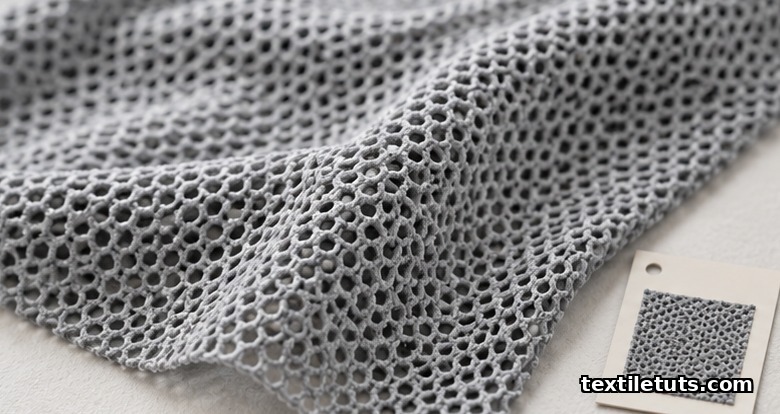
Mesh knit fabric is an open, porous textile with air-permeability values typically between 800 and 2,500 mm/s at 100 Pa (tested under ISO 9237), most often knit from polyester or nylon filaments in warp-knit or weft-knit constructions that yield 40 to 65 percent open area across the fabric surface.
That open architecture is the reason mesh dominates two otherwise unrelated categories: high-intensity athletic apparel, where the fabric must move sweat vapor away from the skin, and casual streetwear, where the same perforations give a garment its breathability and visual texture.
This article explains how mesh is constructed, which test methods and standards govern its performance, and how the same knit structure serves a marathon singlet and a layering T-shirt.
What Mesh Knit Fabric Actually Is
Mesh is a knit fabric in which the needle selection and stitch pattern intentionally leave regularly spaced openings, or holes, distributed across the fabric surface. The openings are not defects; they are engineered features. A peer-reviewed overview published in MDPI’s Textiles journal classifies mesh structures for apparel by hole size, hole distribution, and the yarn count used to bind the openings.
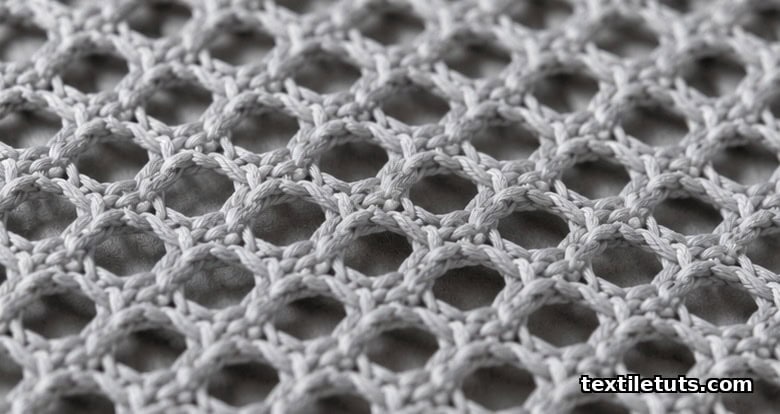
Two construction families dominate:
- Warp-knit mesh: produced on tricot or raschel machines using polyester or nylon filament yarns. Tricot mesh has fine, evenly spaced holes and is the typical lining and athletic-base-layer fabric. Raschel mesh with larger holes, often 1 to 4 mm, is used for sports jerseys, bags, and spacer constructions.
- Weft-knit mesh: produced on circular knitting machines, typically in single-jersey or pique constructions, with tuck stitches or miss stitches creating the open effect. Weft-knit mesh is the basis for most casual mesh T-shirts and fashion panels.
Mesh fabric weight typically ranges from 60 to 220 g/m² (grams per square meter). Athletic mesh used in jerseys and training tops sits between 80 and 140 g/m², fashion mesh for layering tees can fall as low as 60 g/m², and heavy spacer mesh for shoe uppers can exceed 200 g/m².
Why Mesh Works for Athletic Apparel
The athletic case for mesh is straightforward: a runner producing roughly 1.0 to 1.5 L of sweat per hour in moderate conditions needs a fabric that allows both evaporative cooling and vapor transmission. Mesh solves both problems by adding a high-volume air channel to the garment.
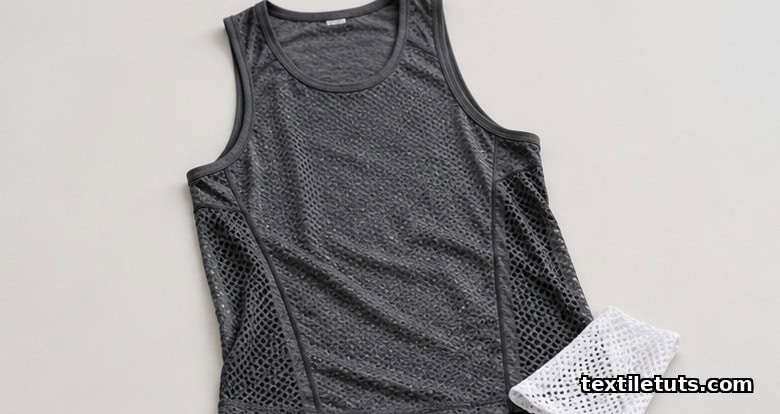
Three measurable properties explain the athletic fit:
Air permeability. Measured under ISO 9237 (Textiles, Determination of the permeability of fabrics to air) or ASTM D737, mesh fabrics typically fall between 800 and 2,500 mm/s at a 100 Pa pressure drop. A standard single-jersey cotton T-shirt measures around 200 to 500 mm/s at the same pressure, an order of magnitude less open. The higher the air permeability, the faster convective heat loss occurs through the fabric.
Moisture management. Polyester and nylon filaments are hydrophobic, so they do not absorb water into the fiber. Instead, moisture wicks along the filament surface and through the mesh holes. AATCC TM 79 (Absorbency of Textiles) measures the time a droplet takes to wick into a fabric; quality athletic mesh scores under 5 seconds for vertical wicking on the fabric face.
Cooling effect. Peer-reviewed work in sports-science journals has measured skin temperature under mesh versus solid fabric during cycling at moderate workload. Mesh conditions produced skin temperatures roughly 0.8 to 1.4 °C lower at constant workload. The mechanism is a combination of dry heat transfer (convection) and accelerated sweat evaporation.
Why Mesh Works for Casual Wear
Casual use of mesh leans on the same physics but markets the visual texture rather than the lab measurement. Casual mesh is typically a polyester or poly-blend weft-knit, sometimes with spandex (elastane) at 3 to 8 percent for stretch recovery.
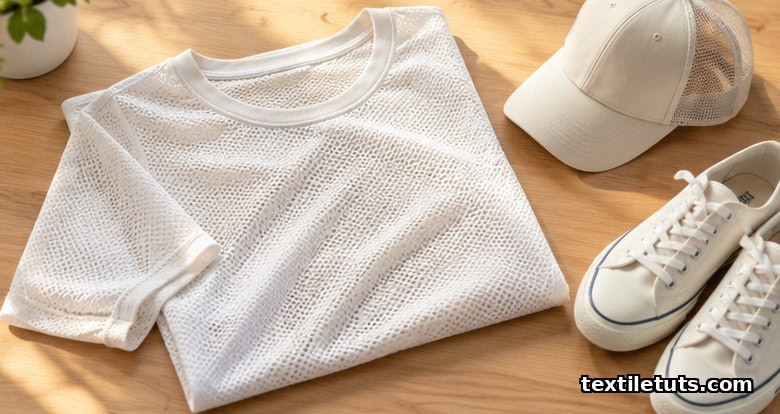
The shift from athletic to casual use accelerated in the 2010s when fashion brands adopted athletic mesh layering pieces. Mesh’s appeal in casual wear rests on three factors: low fabric weight (which produces a draped, almost transparent silhouette), high breathability in warm weather, and a sport-coded aesthetic that fits contemporary athleisure.
Typical casual mesh applications include:
- Mesh-back baseball caps with rear panels in 100 percent polyester warp-knit mesh
- Layering T-shirts with mesh panels at the chest, back, or sleeves
- Mesh pocket bags in shorts and trousers, used widely in casual athletic shorts
- Mesh sneakers and slip-on shoes with knit uppers and engineered open zones
Fiber and Yarn Choices
Almost all commercial mesh is made from filament polyester (PET) or polyamide (nylon 6 or nylon 6,6). Filament yarns give a smoother, more regular surface than staple yarns, which is necessary for consistent hole geometry.
Common yarn specifications:
- Polyester 50D/24F to 150D/48F for athletic warp-knit mesh
- Nylon 40D/12F to 70D/24F for lightweight mesh used in linings and casual tops
- Polyester/spandex blends (92/8 or 95/5) for stretch mesh in compression and fitted casual wear
Cotton mesh exists but is less common in athletic applications because cotton absorbs water (up to 25 percent of its weight) and dries slowly, defeating the wicking function. Recycled polyester (rPET) mesh, made from post-consumer bottle flake, now accounts for a measurable share of athletic mesh production, driven by brand commitments to recycled content.
Key Standards That Define Mesh Performance
Mesh quality is rarely subjective. Five standards govern most of the measurable properties buyers and designers rely on:
| Property | Standard | Typical Athletic Mesh Value |
|---|---|---|
| Air permeability | ISO 9237 / ASTM D737 | 800 to 2,500 mm/s at 100 Pa |
| Mass per unit area | ISO 3801 / ASTM D3776 | 80 to 140 g/m² |
| Dimensional stability after washing | AATCC TM 135 / ISO 6330 | ±3 to ±5 percent |
| Bursting strength | ISO 13938-1 | 200 to 500 kPa |
| Vertical wicking | AATCC TM 79 (absorbency) | Less than 5 seconds for 5 cm |
AATCC TM 135 and ISO 6330 use slightly different agitation protocols, but both quantify how a fabric shrinks or stretches after repeated home laundering. For mesh, dimensional stability matters more than for solid knits because distortion of the holes changes the visual pattern. A mesh T-shirt whose holes elongate into ovals after five washes signals poor yarn stabilization, not normal wear.
Knitting Parameters That Define Mesh Behavior
Two knitting parameters do most of the work in defining a mesh fabric’s end use:
Stitch density, measured in courses and wales per centimeter, controls the hole size. A typical athletic warp-knit mesh has 18 to 24 courses per cm and 14 to 18 wales per cm; casual mesh tends toward 14 to 18 courses per cm and 10 to 14 wales per cm.
Yarn linear density, measured in denier (D) or decitex (dtex), sets the yarn thickness and, with stitch density, defines the open-area percentage. Open area is the ratio of hole area to total fabric area; quality athletic mesh sits between 40 and 65 percent open, while fashion mesh can exceed 70 percent.
Care and Durability Considerations
Mesh is mechanically delicate compared with solid knits. The same holes that make it breathable also concentrate stress at the narrow yarn segments that bound them. Three care practices extend mesh garment life:
- Wash in cold water at or below 30 °C with mild detergent; hot water relaxes polyester filaments and can permanently enlarge mesh holes by 5 to 10 percent
- Avoid fabric softener; softener coats filaments and reduces wicking performance, which is one of the reasons mesh was selected for the garment
- Tumble dry low or line dry; high dryer heat can shrink polyester mesh panels in blended garments
Frequently Asked Questions
Q1: Is mesh knit fabric only for sportswear?
No. Mesh knit fabric is used in athletic apparel, casual T-shirts, sneakers, caps, linings, and bags. The defining feature is the engineered open structure, not the application. Any garment that benefits from breathability or visible texture can use mesh.
Q2: What is the difference between warp-knit and weft-knit mesh?
Warp-knit mesh is produced on tricot or raschel machines and resists runs because each yarn is locked into multiple stitches. It is the typical choice for athletic jerseys and linings. Weft-knit mesh is produced on circular machines and stretches more in both directions; it is the typical choice for casual mesh T-shirts and fashion panels.
Q3: Does mesh shrink when washed?
Polyester and nylon mesh typically shrink less than 3 percent when washed under AATCC TM 135 conditions at 40 °C with normal agitation, because the fibers are thermoplastic and heat-set during finishing. Cotton mesh can shrink 5 to 10 percent under the same conditions because cotton fibers relax when wet.
Q4: Does mesh keep you cooler than a regular T-shirt?
Yes. Sports-science studies on cycling and running in moderate conditions show skin temperatures roughly 0.8 to 1.4 °C lower under mesh versus solid fabric at the same workload, because higher air permeability accelerates convective heat loss and sweat evaporation.
Q5: Is recycled polyester mesh as durable as virgin polyester mesh?
Recycled polyester (rPET) mesh matches virgin polyester on bursting strength and dimensional stability when yarn linear density is held constant. Modern rPET filament and staple quality has closed most of the gap that existed in early rPET production.
References
- International Organization for Standardization. ISO 9237:1995 Textiles, Determination of the permeability of fabrics to air. iso.org. Test method for air permeability, the primary standard used to compare athletic and casual mesh.
- ASTM International. ASTM D737-18 Standard Test Method for Air Permeability of Textile Fabrics. astm.org. Companion method to ISO 9237 used in North American laboratories.
- American Association of Textile Chemists and Colorists. AATCC TM 135-2018 Dimensional Changes of Fabrics after Home Laundering. aatcc.org. Wash-shrinkage protocol for knit fabrics including mesh.
- American Association of Textile Chemists and Colorists. AATCC TM 79-2014 Absorbency of Textiles. aatcc.org. Drop test for vertical wicking used on athletic mesh.
- International Organization for Standardization. ISO 6330:2021 Domestic washing and drying procedures for textile testing. iso.org. Domestic washing procedure paired with AATCC TM 135.
- International Organization for Standardization. ISO 3801:1977 Textiles, Determination of mass per unit length and mass per unit area. iso.org. Method for fabric GSM used on mesh samples.
- International Organization for Standardization. ISO 13938-1:2019 Textiles, Bursting properties of fabrics, Part 1: Hydraulic method. iso.org. Bursting-strength method relevant for knitted mesh.
Editorial by Iftay Khairul Alam, TextileTuts. Sources: ISO 9237, ISO 6330, ISO 3801, ISO 13938-1, ASTM D737, AATCC TM 135, and AATCC TM 79 as cited above.


