
Vat Printing Process

Vat printing is a textile printing method that uses water-insoluble vat dyes reduced to a soluble leuco form in an alkaline sodium hydrosulfite vat, printed onto cellulosic fibers, then re-oxidized in air or with an oxidizing agent and soaped at the boil to lock in wash-fastness ratings of 4 to 5 (ISO 105-C06) and light-fastness ratings of 6 to 8 (ISO 105-B02).
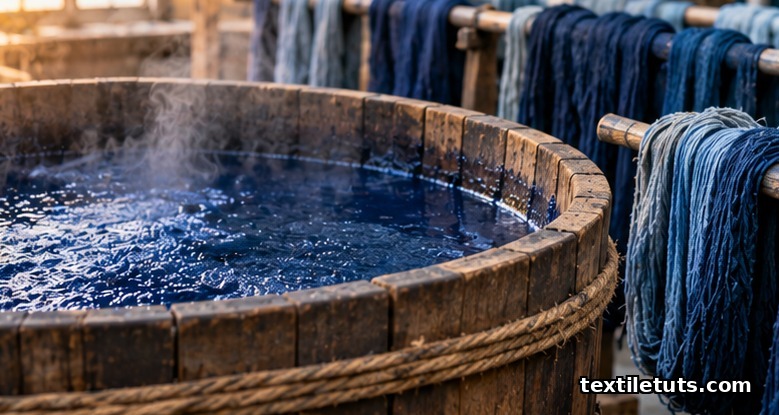
The dye class takes its name from the wooden fermentation vats where indigo leaves were historically steeped, and today spans synthetic anthraquinone derivatives (CI Vat Blue 1, CI Vat Green 1, CI Vat Yellow 2) that all share the same insoluble-to-soluble redox cycle. Vat prints are the standard for workwear, denim, military uniforms, and premium shirting where crocking, hot washing, and sunlight would destroy a reactive print within months.
This article walks through the chemistry of reduction, the print-paste recipe, the steaming and oxidation sequence, the soaping finish, the test methods that define a good vat print, and the common mill defects that show up when the redox cycle drifts out of balance.
How Vat Dyes Work: The Chemistry in Plain English
Vat dyes are a class of colorants that carry carbonyl groups locked inside a polycyclic aromatic structure (anthraquinone, indigoid, or perylene). In that oxidized state, the chromophore is electrically neutral and hydrophobic, which makes it insoluble in water and therefore useless as a print paste. To apply it, the dye must be reduced to a leuco form, an enolate or phenolate that carries two negative charges per dye molecule and dissolves in alkali.
The reaction in its simplest form:
Vat dye (insoluble, oxidized) + 2 e⁻ + 2 H⁺ → Leuco dye (soluble, reduced)
Sodium hydrosulfite (Na₂S₂O₄, also called sodium dithionite) is the standard reducing agent because it has a reduction potential of roughly -1.12 V under alkaline conditions, more negative than any commercial vat dye. Sodium hydroxide (NaOH, 2 to 4% on paste weight) keeps the leuco form ionized. Once the printed fabric leaves the steamer, oxygen in the air re-oxidizes the leuco dye back to the insoluble pigment form, and the color is permanently locked inside the fiber.
Because the re-formed pigment sits as a solid dispersion inside the cotton lumen and forms hydrogen bonds with the cellulose, vat prints are remarkably resistant to washing, light, and oxidizing bleach. This is why a pair of indigo-dyed denim jeans can survive 200 home launderings and still hold color, and why military uniforms, firefighter turnout gear, and industrial workwear specify vat prints as a baseline.
The Vat Printing Process: Step-by-Step
Vat printing is normally run as a screen or roller print on 100% cotton or cotton-rich blends. Polyester/cotton is printable but the light fastness on the polyester portion drops. The sequence has six stages.
1. Pre-treatment and fabric preparation
The greige fabric is desized, scoured, bleached, and mercerized so the cotton is fully absorbent and free of wax and pectin. A wet pickup of 70 to 80% is typical before printing. Mercerization under tension swells the cotton fiber, opens the lumen, and gives the print a deeper shade and better wash fastness because the leuco dye has more internal volume to diffuse into.
2. Print-paste formulation
A vat print paste is a concentrated water-based system with five essential components:
- Vat dye pigment (5 to 15% on paste weight), pre-milled with a dispersing agent so particle size sits below 2 μm.
- Reducing agent, sodium hydrosulfite at 2 to 5% on paste weight, sometimes paired with thiourea dioxide for paste stability.
- Alkali, sodium hydroxide at 2 to 4% on paste weight, plus potassium carbonate as a buffer to hold pH above 12.
- Thickener, a high-viscosity natural or modified starch ether (sodium alginate is preferred because it does not react with NaOH) at 4 to 6% on paste weight.
- Wetting agent and glycerin (1 to 2%) to keep the paste from skinning over on the screen.
The paste is mixed under nitrogen or in a closed vessel and used within 4 to 8 hours, because hydrosulfite slowly oxidizes in air and the leuco dye re-precipitates as inactive pigment.
3. Printing
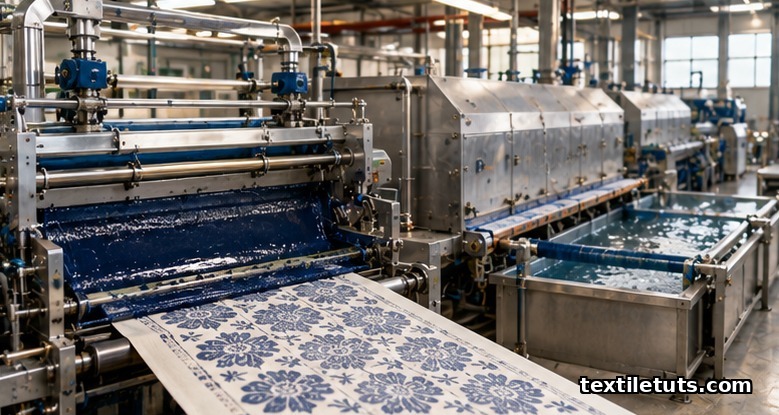
The paste is applied through a flat-screen or rotary-screen printer at a print-paste add-on of 80 to 120 g/m² depending on fabric weight. The pattern is dried at 100 to 110 °C in a hot-air stenter immediately after printing, but only enough to remove surface moisture. The print must stay moist enough for the next stage, so most mills aim for residual moisture of 15 to 25% on the printed area.
4. Steaming (the reduction-and-fixation step)
The dried print passes through a steam chamber at 100 to 102 °C for 8 to 15 minutes in a continuous ager. Inside the steamer, residual hydrosulfite completes the reduction of the dye pigment to the soluble leuco form, the leuco dye diffuses into the cotton fiber, and the cellulose absorbs it the way it would absorb any dissolved anion. Relative humidity in the steamer must stay above 80% so the paste does not skin over before diffusion finishes.
5. Oxidation
After steaming, the fabric enters an oxidation zone. Air passage at 25 to 40 °C for 30 to 90 seconds is enough for most anthraquinone vat dyes. Indigo is slower and often needs a chemical oxidant: 0.5 to 1.5 g/L potassium dichromate, or, in modern mills, hydrogen peroxide (1 to 2 g/L) at pH 9 to 10. The leuco dye re-oxidizes to the insoluble pigment, which is now mechanically trapped inside the fiber lumen and bound by hydrogen bonds.
6. Soaping
Finally, the fabric passes through a soap bath at 95 to 100 °C with 2 to 5 g/L non-ionic detergent for 5 to 10 minutes. Soaping removes unfixed dye from the fiber surface, develops the true shade, and improves crocking fastness. A second rinse in warm water (50 °C) and a final cold rinse complete the sequence.
Vat Dyes vs Reactive Dyes: When to Choose Vat
| Property | Vat dyes | Reactive dyes |
|---|---|---|
| Wet-fastness rating (ISO 105-C06, shade change after 5 washes at 60 °C) | 4 to 5 | 3 to 5 (depends on shade depth) |
| Light-fastness rating (ISO 105-B02, blue scale after 20 hr xenon) | 6 to 8 | 4 to 6 |
| Process chemistry | Redox cycle (Na₂S₂O₄ + NaOH) | Covalent bond with cellulose (NaOH + salt) |
| Process water use | Moderate (oxidation + soaping rinses) | High (wash-off of unfixed hydrolyzed dye) |
| Effluent load (COD) | High (residual hydrosulfite and sulfate) | High (residual salt and hydrolyzed dye) |
| Shade range | Narrow (deep blues, greens, blacks, browns; bright reds limited) | Very wide (full gamut including bright shades) |
| Print paste stability | Short (4 to 8 hours under inert cover) | Long (24 to 72 hours) |
| Cost per kg of printed fabric | Higher | Lower |
Vat printing is the right choice when the printed garment will face UV light, repeated hot washes, or hypochlorite bleach. Reactive printing wins on shade range, brightness, and cost for fashion apparel where extreme wash-fastness is not required.
Common Defects in Vat Printing and How to Prevent Them
Bleeding and flushing
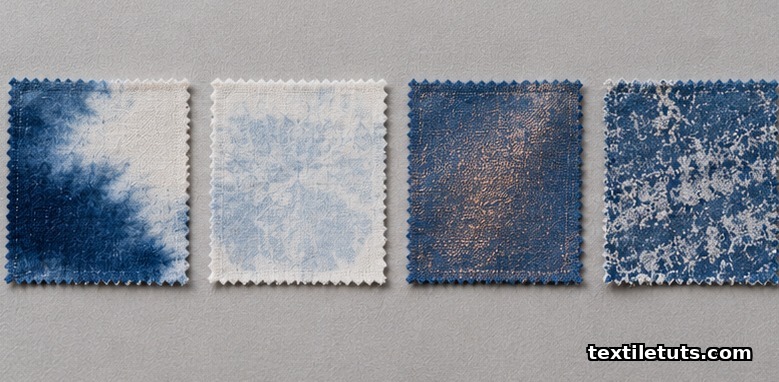
Bleeding at print edges happens when the print paste is over-reduced, when steaming humidity drops, or when oxidation runs at too high a temperature. The fix is to keep hydrosulfite at the stoichiometric minimum and to add 1 to 2% sodium m-nitrobenzene sulfonate (Ludigol) as an oxidizing buffer in the print paste.
Weak or pale shade
Pale prints usually come from under-reduction (steam temperature below 100 °C or dwell time below 6 minutes), or from dye particle size above 5 μm that resists dissolution. A finer pigment grind and longer steamer dwell time resolve it.
Poor crocking fastness
Crocking means color transfers to a white cloth under rubbing (AATCC 8 / ISO 105-X12). Crocking failures after a vat print almost always trace back to incomplete soaping. The surface pigment layer is what rubs off; a proper 95 to 100 °C soap at 5 g/L non-ionic detergent for 8 minutes removes it.
Bronzing
Bronzing is a metallic sheen on the surface of deep indigo prints. It is caused by dye particles too large to enter the fiber lumen, so they sit on the surface and reflect light. Reducing pigment particle size to under 2 μm with a sand or bead mill is the standard fix.
Industrial Uses of Vat Printing
Three product categories still depend on vat prints as a baseline specification.
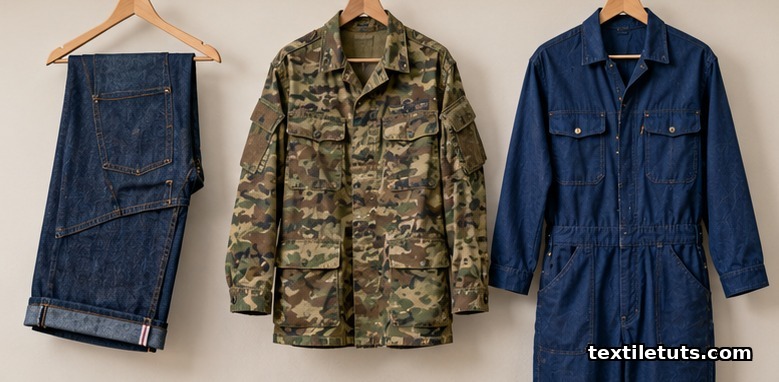
- Military and tactical uniforms. Camouflage patterns for several NATO forces specify vat dyes because combat uniforms are washed in hot water with bleach and dried in direct UV. Reactive prints lose 40 to 60% of their shade depth under those conditions.
- Industrial workwear and high-visibility backing fabrics. Petrochemical, electrical utility, and rail-worker uniforms use vat-dyed base fabrics because the standard industrial laundry protocol (75 °C, hypochlorite bleach) destroys reactive prints within 10 cycles.
- Premium denim and shirting. Indigo (CI Vat Blue 1) and sulfur-dyed blacks for selvedge denim are part of the same redox chemistry family. The same soaping step that finishes a vat print develops the contrast on a denim warp.
Vat prints also appear in home furnishings (curtain lining, upholstery), school uniforms in tropical markets, and licensed character prints on children’s wear where parents expect a 100-wash life at minimum.
Frequently Asked Questions
What is vat printing in textiles?
Vat printing is a textile printing method that uses water-insoluble vat dyes, reduces them to a soluble leuco form in an alkaline sodium hydrosulfite vat, prints the leuco dye onto cotton, then re-oxidizes it inside the fiber. The final color is a solid pigment trapped inside the cotton lumen, which gives wash fastness of 4 to 5 (ISO 105-C06) and light fastness of 6 to 8 (ISO 105-B02).
Why are vat dyes called vat dyes?
The name comes from the wooden fermentation vats where indigo leaves were steeped in water and a reducing bacteria converted the insoluble indigo pigment into soluble white indigo (leuco indigo). Modern vat printing uses sodium hydrosulfite instead of bacteria, but the name has stuck across the entire dye class, including the synthetic anthraquinone derivatives that have nothing to do with indigo botanically.
Can vat dyes be printed on polyester?
Vat printing is rarely used on 100% polyester because the ionic leuco form has no affinity for hydrophobic PET fibers. On polyester/cotton blends, the cotton portion takes the color and the polyester stays white, producing a frosted or washed-out look. Disperse dyes are the standard for printing 100% polyester, and sublimation transfer prints are the standard for polyester-rich blends.
What is the difference between vat dyes and indigo?
Indigo is one specific dye molecule (CI Vat Blue 1) inside the larger vat dye class. Indigo behaves slightly differently from anthraquinone vat dyes: it is harder to oxidize back to pigment from the leuco form, and it tends to crock and bleed more on cotton. Most mill recipes add a final oxidation step with hydrogen peroxide or potassium dichromate for indigo, where anthraquinone vats only need air.
Are vat dyes sustainable?
Vat printing has a mixed sustainability profile. On the positive side, vat prints outlast reactive prints by 2 to 3 times, which lowers the replacement rate of workwear and uniforms. On the negative side, sodium hydrosulfite generates sulfate-laden effluent, and oxidation baths can carry chromate or peroxide residues. Modern mills are switching to electrochemical reduction (where current re-reduces the dye bath in a closed loop) and to hydrogen peroxide for oxidation to remove chromate from the wastewater stream.
References
- ISO 105-C06:2010. Textiles — Tests for colour fastness — Part C06: Colour fastness to domestic and commercial laundering. iso.org — wash-fastness rating method used to grade vat prints.
- ISO 105-B02:2014. Textiles — Tests for colour fastness — Part B02: Colour fastness to artificial light (xenon arc fading lamp test). iso.org — light-fastness rating method used to grade vat prints.
- ISO 105-X12:2016. Textiles — Tests for colour fastness — Part X12: Colour fastness to rubbing (crocking). iso.org — crocking rating method for printed textiles.
- AATCC Test Method 8:2016. Colorfastness to Crocking: Crockmeter Method. aatcc.org — AATCC crocking method used in US dyehouses.
- Buhler, A. and Etters, J.N. (2000). “Indigo Dyeing of Cotton Denim Yarn: A Review of Process Chemistry and Dyehouse Practice.” Textile Chemist and Colorist and American Dyestuff Reporter, 32(2), 33 to 36. ResearchGate mirror — indigo reduction chemistry and mill practice.
- Shenai, V.A. (1997). Chemistry of Dyes and Principles of Dyeing. Sevak Publications, Mumbai — textbook reference for vat dye chemistry and reduction equilibria.
- Broadbent, A.D. (2001). Basic Principles of Textile Coloration. Society of Dyers and Colourists, Bradford — Chapter 9 on vat dyes and reduction chemistry.
Editorial by Shahrukh Islam, TextileTuts. Sources: ISO 105-C06, ISO 105-B02, ISO 105-X12, AATCC Test Method 8, and Buhler and Etters (2000) as cited.


