
Acid Printing Process

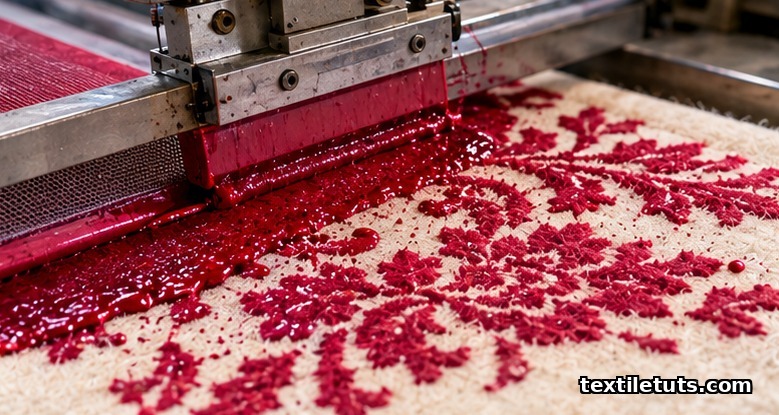
Acid printing deposits anionic acid dyes on wool, silk, and polyamide fibers from a weakly acidic print paste buffered to pH 4.0-5.0 with acetic or formic acid, fixes the printed fabric in saturated steam at 100-102 °C for 30-45 minutes, and finishes with a hot soap wash-off that delivers wash-fastness ratings of 4-5 on the ISO 105-A05 grey scale.
It is the standard printing route for protein fibers and nylon because the protonated amino groups on wool keratin and silk fibroin, and the terminal amine ends on nylon 6 and nylon 6,6, form ionic bonds with the sulfonate groups on the dye anion under acid conditions. Reactive and disperse prints cannot do this cleanly on protein substrates, which is why a woollen-scarf printer, a silk-sari converter, and a nylon-tights finisher all reach for the same chemistry. This guide walks through the chemistry, the print-paste recipe, the machine settings, the wash-off, and the fastness numbers an acid print must hit before it leaves the mill.
1. How Acid Printing Works: The Chemistry
Acid dyes are sodium salts of aromatic sulfonic acids. The chromophore is usually an azo, anthraquinone, or triphenylmethane system; the water solubility comes from one or more sulfonate (-SO₃⁻ Na⁺) groups attached to the aromatic rings. In the dyebath or print paste, the dye exists as a negatively charged ion. Wool, silk, and nylon carry protonated amine groups (-NH₃⁺) in acid conditions, so the dye is pulled onto the fiber by an ion-ion attraction.
Once on the fiber, the dye is locked in three ways at once: electrostatic (the ion-ion bond between -NH₃⁺ on the fiber and -SO₃⁻ on the dye), van der Waals (the planar aromatic rings lie flat against the polymer backbone), and in some classes a covalent link through a reactive group such as a chloro-triazinyl or vinyl-sulfone anchor. The combined effect is the bright, level shade acid dyes are known for, with a wet-fastness on wool that reactive dyes on cotton cannot match.
Acetic acid (CH₃COOH) is the workhorse acidulant for acid printing; formic acid (HCOOH) is added when a slightly lower pH is needed for hard-dyeing shades such as blacks and navy blues. Citric acid is sometimes used as a buffer so the pH does not swing during drying. The target pH window is narrow: above 5.5 the dye does not bond, below 3.0 the wool hydrolyses and yellows.
2. Fibers That Accept Acid Printing
Acid printing works on any fiber that carries protonatable amine groups under acidic conditions:
- Wool (keratin, isoelectric point around pH 4.5-5.0): the classic acid-print substrate. Used for shawls, scarves, ties, premium suiting, and carpet.
- Silk (fibroin, lower amine content than wool): bright shades but lower exhaustion, so the print paste typically runs slightly more acid.
- Nylon 6 and nylon 6,6 (terminal -NH₂ groups on the polymer chain): widely used for hosiery, swimwear, lingerie elastics, and carpet printing.
- Modified acrylics (cationic-dyeable variants with anionic dye sites): a smaller-volume specialty niche.
Cotton, linen, viscose, polyester, and regular acrylic cannot be acid-printed in any practical way. Cotton has no cationic sites, polyester has no protonatable amines, and regular acrylic carries sulfonate (anionic) sites that repel the negatively charged acid dye. Reactive printing is the answer for cellulosics; disperse printing is the answer for polyester.
3. Print Paste Recipe (a Working Formulation)
A standard acid print paste for wool or nylon looks like the table below. The figures are working values used in commercial print rooms and cross-checked against published dye-house manuals.
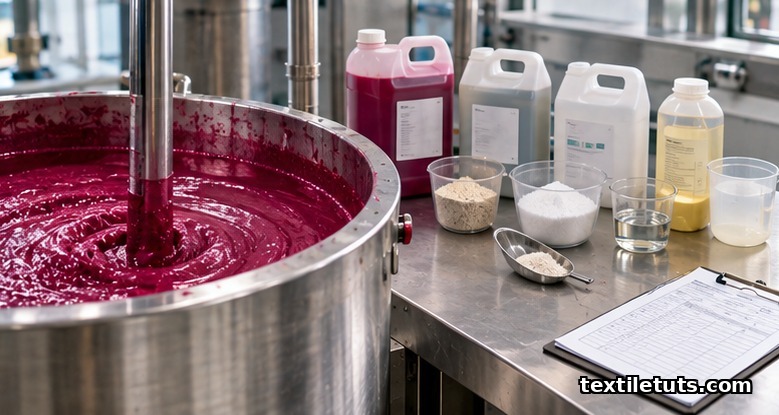
| Ingredient | Function | Typical level (per kg paste) |
|---|---|---|
| Acid dye | Color | 20-60 g (shade depth dependent) |
| Guar gum thickener (or sodium alginate) | Rheology, prevents bleed | 40-60 g (paste viscosity ~3000-5000 mPa·s) |
| Acetic acid (80%) | pH control to 4.0-5.0 | 30-50 g |
| Formic acid (85%) | Lower pH for hard shades | 0-15 g (optional) |
| Urea | Hygroscopic agent, prevents dye aggregation in drying | 50-100 g |
| Non-ionic wetting agent | Penetration into the fiber | 2-5 g |
| Anti-foam (silicone or fatty alcohol) | Foam control at the screen | 1-2 g |
| Water | Vehicle | Balance to 1 kg |
Guar gum is preferred over sodium alginate on wool because alginate can leave a harsher hand. On silk and nylon, sodium alginate is often the better choice because it washes off cleanly without dulling the shade. Urea is hygroscopic, so during drying it holds enough moisture in the print film to let dye molecules migrate into the fiber before fixation.
4. Printing, Drying, and Steaming
The prepared fabric is printed on a rotary-screen or flat-bed screen printer. Mesh counts from 60 to 120 are typical for silk, and from 40 to 80 for heavier woollen cloth. After printing, the fabric is dried in a stenter at 100-120 °C so the paste forms a tack-free film without overheating the fiber.
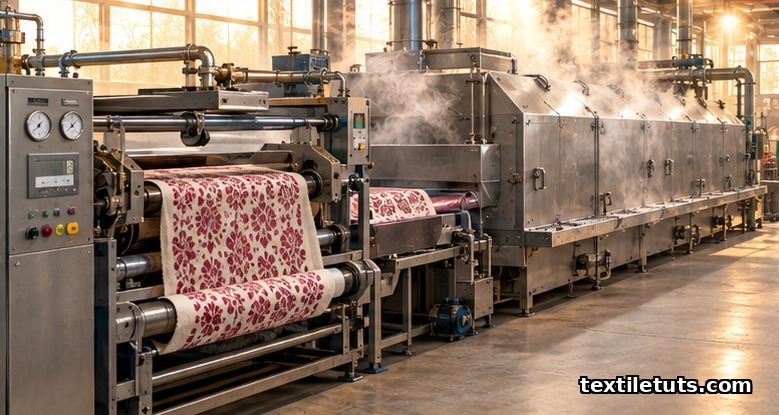
Fixation is the heart of the process. The dried print is conditioned in saturated steam at 100-102 °C for 30-45 minutes. In the steamer, condensed water swells the fiber, the acid paste re-liquefies, urea keeps moisture in the print film, and the dye molecules diffuse into the fiber. At the end of the steaming cycle, the dye is held by ion-ion and van der Waals forces inside the polymer matrix.
For wool, superheated steam at 102-105 °C can shorten the cycle to 20-30 minutes, but the wool yellows if the temperature runs higher or the time runs longer. For nylon, continuous steamers running at 100-103 °C for 15-25 minutes are typical in carpet and hosiery printing. Pressure steaming at 1.5 bar and 130 °C is sometimes used to push darker shades on wool, with a steaming time cut to 8-12 minutes.
5. Wash-off and After-treatment
After steaming, the print contains unfixed dye, thickener, urea, and acid residues on the fiber surface. Wash-off is critical: any dye left on the surface bleeds in the first home wash and ruins the fastness rating.
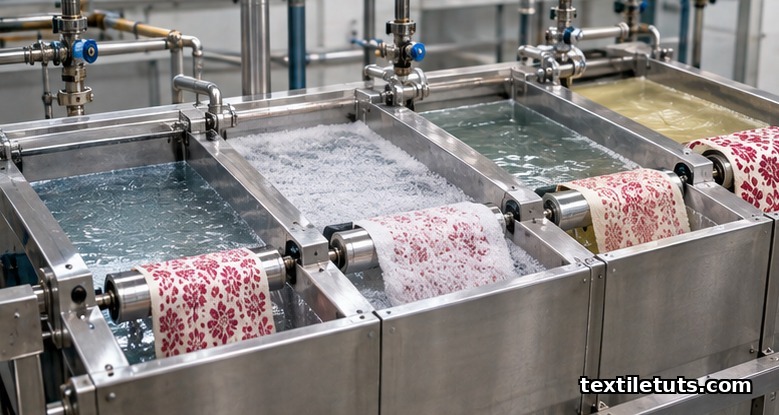
A standard wash-off sequence looks like this:
- Cold rinse to drop surface acid.
- Hot soap wash at 80-90 °C for 10-15 minutes with a non-ionic detergent (1-2 g/L).
- Warm rinse at 50 °C.
- Cold rinse to finish.
- Acid finish with 1-2 g/L acetic acid to bring the fiber back to its isoionic pH, which sharpens the shade.
On wool, the wash-off bath is sometimes adjusted to pH 4.5-5.0 with formic acid to prevent any alkali-induced yellowing. On silk, a milder soap at 60 °C is used to protect the fiber’s luster. The acid finish at the end is what textile engineers call “acid souring,” and it restores the dye to its fully protonated form so the true shade comes through.
6. Color Fastness: How Good Is Acid Printing?
Acid prints on wool, silk, and nylon typically hit these fastness numbers, tested against the standard methods listed in the References section:
| Test | Standard | Typical rating (wool) | Typical rating (nylon) |
|---|---|---|---|
| Wash fastness (40 °C, change) | ISO 105-C06 | 4-5 | 4 |
| Rub fastness, dry | ISO 105-X12 | 4-5 | 4-5 |
| Rub fastness, wet | ISO 105-X12 | 4 | 3-4 |
| Light fastness (Xenon, 20 h) | ISO 105-B02 | 4-6 (shade-dependent) | 4-5 |
| Perspiration, acid | ISO 105-E04 | 4-5 | 4 |
| Perspiration, alkali | ISO 105-E04 | 4 | 3-4 |
Numbers are typical mill results and vary with shade depth, fiber quality, and after-treatment. Light fastness is the weak point on bright reds and oranges; a UV-absorber in the finishing bath can lift these by about half a point on the ISO 105-B02 blue-wool scale. Wet rub on nylon is the other recurring weak spot, fixable with a cationic after-treatment that complexes residual anionic dye on the fiber surface.
7. Frequently Asked Questions
What fibers can be printed with acid dyes?
Acid dyes print cleanly on wool, silk, nylon 6, nylon 6,6, and cationic-dyeable acrylic. Cotton, viscose, polyester, and regular acrylic do not carry the protonatable amine groups needed to bond with acid dyes. Reactive printing is the route for cellulosics, and disperse printing is the route for polyester.
Why is the print paste acidic?
An acid pH of 4.0-5.0 keeps the amino groups on wool keratin, silk fibroin, and nylon terminals protonated (-NH₃⁺). Without that positive charge, the negatively charged dye anion has nothing to bind to, and the print washes out in the first rinse. Above pH 5.5 the dye barely exhausts; below pH 3.0 the wool fiber hydrolyses and yellows.
How long does acid printing take from paste to finished fabric?
A standard cycle is 15-30 minutes for printing, 2-5 minutes in a stenter dryer at 100-120 °C, 30-45 minutes in a saturated-steam fixer at 100-102 °C, and 20-30 minutes for the four-step wash-off and acid finish. End-to-end, expect 90-120 minutes from fabric-on-machine to fabric-ready-to-pack on a continuous line, plus 30-60 minutes for batch printing.
Can acid-printed fabrics be machine-washed at home?
Yes, with care. A wool or silk garment printed with acid dyes and rated 4 or better on the ISO 105-C06 wash test can be machine-washed on a delicate cycle at 30 °C with a pH-neutral detergent. Higher temperatures and alkaline detergents will strip shade and felting-shrink wool, so a care label reading “cold wash, pH-neutral detergent, flat dry” is standard for the retail market.
Is acid printing sustainable compared with reactive printing on cotton?
Acid printing generates less wastewater volume per kilogram of fabric because the wash-off cycle is shorter, and dye exhaustion on wool and nylon is typically above 90 percent. The trade-off is that the dyestuff itself is synthetic, and the acidic effluent must be neutralized before discharge to hit the pH 6-9 limit in most municipal effluent rules. Closed-loop acid recovery and reactive-acid auxiliaries are reducing this load in modern mills, and wool’s natural biodegradability at end-of-life is a downstream advantage over synthetic polyamide substrates.
References
- International Organization for Standardization. ISO 105-C06:2010, Textiles, Tests for colour fastness. Part C06: Colour fastness to domestic and commercial laundering. iso.org. Reference test method for the wash-fastness ratings cited in this article.
- International Organization for Standardization. ISO 105-X12:2016, Textiles, Tests for colour fastness. Part X12: Colour fastness to rubbing. iso.org. Crock-meter method for dry and wet rub-fastness ratings.
- International Organization for Standardization. ISO 105-B02:2014, Textiles, Tests for colour fastness. Part B02: Colour fastness to artificial light (Xenon arc fading lamp test). iso.org. Standard xenon-arc exposure protocol for light-fastness grading.
- International Organization for Standardization. ISO 105-E04:2013, Textiles, Tests for colour fastness. Part E04: Colour fastness to perspiration. iso.org. Acid and alkaline perspiration fastness protocol.
- International Organization for Standardization. ISO 105-A05:1996, Textiles, Tests for colour fastness. Part A05: Instrumental assessment of change in colour for determination of grey scale rating. iso.org. Grey-scale rating method used throughout this article.
- American Association of Textile Chemists and Colorists. AATCC Test Method 61-2013, Colorfastness to Laundering: Accelerated. aatcc.org. Accelerated laundering test commonly used alongside ISO 105-C06.
- Broadbent, A. S. (2001). Basic Principles of Textile Coloration. Society of Dyers and Colourists, Bradford. Reference textbook on acid-dye chemistry, fiber-dye interactions, and print paste formulation.
- Lewis, D. M. (2011). The Chemistry of Reactive Dyes and Their Application on Protein Fibers. In: Handbook of Textile and Industrial Dyeing, Vol. 1 (M. Clark, ed.), Woodhead Publishing, Cambridge. Peer-reviewed chapter covering acid-dye fixation mechanisms on wool and silk.
- Burkinshaw, S. M. (2016). Physico-Chemical Aspects of Textile Coloration. John Wiley & Sons, Chichester. Peer-reviewed textbook covering ionic dyeing of nylon and the role of acid pH in print fixation.
This article is the working reference for acid printing on wool, silk, and polyamide fibers. Editorial by Shahrukh Islam, TextileTuts. Sources: ISO 105-C06, ISO 105-X12, ISO 105-B02, ISO 105-E04, ISO 105-A05, AATCC TM 61, and the textile-coloration textbooks by Broadbent (2001), Lewis (2011), and Burkinshaw (2016) as cited.


