
Disperse Printing Process

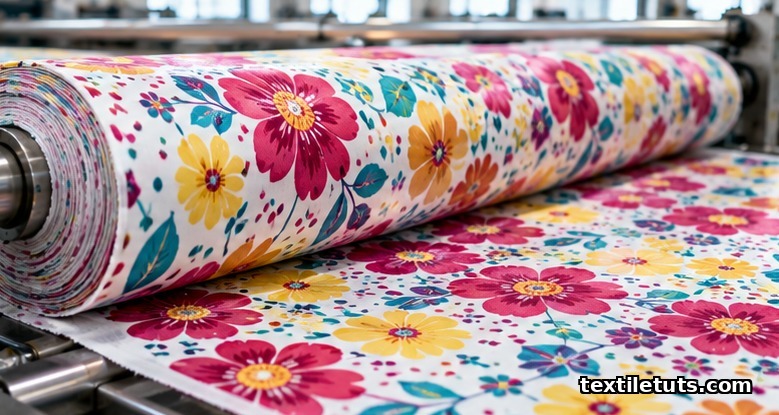
Disperse printing applies non-ionic disperse dyes to hydrophobic synthetic fibers, primarily polyester, from an aqueous print paste and fixes the color at 180 to 220 degrees Celsius in dry thermofixation for 60 to 90 seconds, or at 170 to 180 degrees Celsius in high-temperature steaming for 6 to 8 minutes.
This method accounts for an estimated 70 to 80 percent of all printed polyester fabric worldwide, because disperse dyes are the only dye class with measurable affinity for polyethylene terephthalate below its glass-transition range of about 67 to 81 degrees Celsius in water (1).
This article walks through the chemistry of disperse dyes, the step-by-step printing workflow, the four main fixation routes, the after-treatment that lifts color fastness to ISO and AATCC test standards, and the quality parameters that separate a commercially acceptable lot from a rejected one.
What Is Disperse Printing?
Disperse printing is the application of disperse dyes to textile substrates through patterned screens, engraved rollers, or digital inkjet heads. The dye molecule itself is non-ionic and only sparingly soluble in water, with solubility typically 0.1 to 30 milligrams per liter at 25 degrees Celsius, which is why the dye must be milled to a particle size below 1 micrometer and stabilized with anionic or non-ionic dispersing agents in the print paste (2).
The substrate is almost always a hydrophobic fiber such as polyester, nylon, or cellulose triacetate, where the dye diffuses into the amorphous regions of the polymer above its glass-transition temperature. On cellulosic fibers such as cotton and viscose, disperse dyes have no measurable wash fastness, which is why they are never used alone on natural substrates.
Disperse Dye Chemistry
Disperse dyes are small molecules, with molecular weights generally in the 300 to 700 grams-per-mole range, built around azo, anthraquinone, methine, or nitroarylamine chromophores. They contain polar groups such as -NO2, -CN, -OH, -NH2, and -SO2CH3 that tune the color, the light fastness, and the diffusion rate into the fiber (3).
Two structural features make a disperse dye work on polyester:
- Planar aromatic backbone: enables pi-pi stacking inside the rigid polymer matrix.
- Moderate polarity: gives the molecule enough water dispersibility for paste preparation without making it too soluble to hold onto the fiber during washing.
For deep shades, combination dyes (binary or ternary mixtures) are commonly used to compensate for the differing rates of uptake, since polyester’s dense crystalline structure slows dye diffusion. Azo dyes dominate the yellow-to-red range, while anthraquinone dyes cover the bright blue and turquoise shades that azo chemistry cannot reach.
Step-by-Step Printing Process
Although machine configurations vary, every disperse print line runs through the same five stages.
1. Fabric Preparation
The greige fabric is scoured at 80 to 90 degrees Celsius in a mildly alkaline bath at pH 8 to 10 with a non-ionic surfactant to remove spinning finishes, sizes, and lubricants. Heat-setting on a stenter at 190 to 220 degrees Celsius for 30 to 60 seconds stabilizes the dimensions and crystallinity of the polyester so the print registers accurately in later finishing.
2. Print Paste Preparation
A typical print paste contains the following components in approximate proportions for a medium shade:
- Disperse dye at 10 to 50 grams per liter, depending on shade depth.
- Anionic dispersing agent such as lignosulfonate or a naphthalene sulfonate-formaldehyde condensate at 5 to 15 grams per liter.
- Thickener: sodium alginate at 1 to 2 percent w/w for screen printing, or a synthetic polyacrylate for digital inkjet inks.
- Carrier (optional, see fixation table) at 10 to 30 grams per liter.
- Acid donor such as ammonium sulfate at 5 grams per liter to hold pH at 4.5 to 5.5 and prevent dye hydrolysis.
- Water to balance to 100 percent.
3. Printing
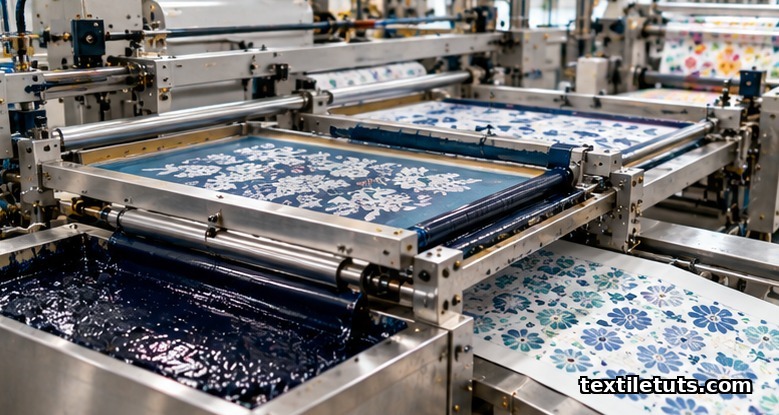
Flat-bed screen printing, rotary screen printing, or digital inkjet printing deposits the paste on the fabric surface. For digital inkjet, dyes are pre-dispersed at 0.1 to 1 micrometer particle size in low-viscosity ink (typically 3 to 10 millipascal-seconds) and jetted through piezoelectric print heads at resolutions of 600 to 1200 dots per inch (4). Rotary screen printing remains the workhorse for production runs above 5000 meters, where its throughput of 30 to 70 meters per minute cannot be matched by inkjet.
4. Fixation
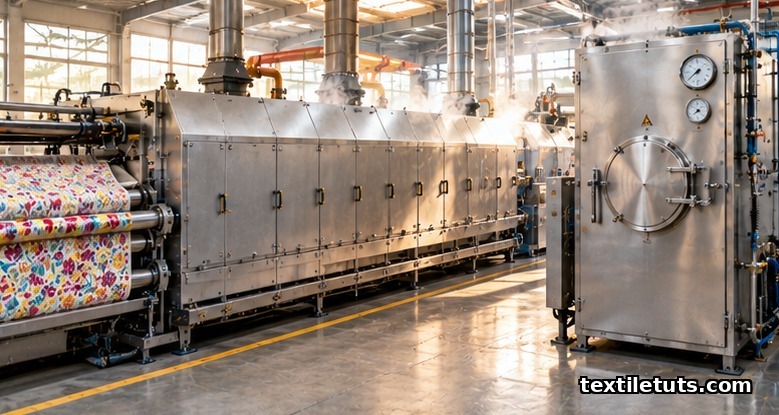
After printing, the fabric is dried at 100 to 120 degrees Celsius to remove water, then fixed. The four principal fixation routes are compared in the table below.
5. After-Treatment
Unfixed dye on the fiber surface is removed in two steps. First, reduction clearing: a hot alkaline bath with sodium hydrosulfite (Na2S2O4) at 2 to 4 grams per liter and sodium hydroxide at 5 to 10 grams per liter, held at 70 to 80 degrees Celsius for 15 to 20 minutes, reduces surface dye to a colorless leuco form. Second, soaping: a final wash with non-ionic surfactant at 90 to 95 degrees Celsius lifts loose color and improves wash fastness (5).
Fixation Methods Compared
| Method | Temperature | Time | Best for | Key trade-off |
|---|---|---|---|---|
| Thermofixation (dry heat) | 180 to 220 degrees Celsius | 60 to 90 seconds | Continuous runs, polyester knits | High energy; fabric-yellowing risk above 200 degrees Celsius |
| High-temperature steaming (HTS) | 170 to 180 degrees Celsius | 6 to 8 minutes | Fine patterns, deep shades | Steamers cost more than stenter frames |
| Carrier steaming | 100 to 105 degrees Celsius | 20 to 30 minutes | Polyester-cellulose blends, delicate fabrics | Many carriers are toxic, odorous, or regulated |
| Heat transfer (sublimation) | 180 to 210 degrees Celsius | 30 to 60 seconds | Flags, sportswear, short-run prints | Limited to disperse dyes with sublimation fastness of grade 4 or better |
Each route trades temperature, time, capital cost, and effluent load differently. For example, AATCC 8-2016 colorfastness to rubbing requires dry crock ratings of grade 4 or better, which is generally achievable only after reduction clearing, regardless of the fixation route (6).
Fabric-Specific Considerations
Polyester is the dominant substrate because polyethylene terephthalate absorbs disperse dye predictably in the temperature window of 120 to 140 degrees Celsius, where polymer segmental mobility is high. Nylon 6 and nylon 6,6 are also printable with selected low-energy disperse dyes, but the build-up is lower and wash fastness drops by roughly one grade compared with polyester.
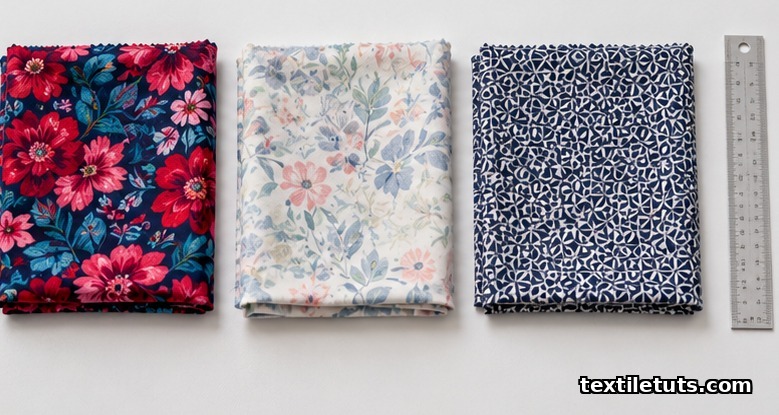
Microfiber polyester (filament linear density below 1 denier) prints more deeply than regular polyester because of the higher surface area, but it is also more prone to surface mark-off, so a milder reduction-clearing step at 60 to 65 degrees Celsius is often preferred to protect the hand-feel. Acrylic fibers can be printed with selected cationic disperse dyes, but the process requires careful pH control below 4.5 to avoid dye hydrolysis.
Process Parameters and Common Defects
The five most common print defects and their root causes:
- Poor wash fastness: insufficient reduction clearing, or dye hydrolysis from a pH below 4 during fixation. Verify with ISO 105-C06 wash testing (1).
- Migration or bleeding: incomplete drying before fixation, or excess humectant in the print paste. Hold fabric moisture below 8 percent before thermofixation.
- Color shade variation: inconsistent dye dispersion particle size. The dispersion should be checked below 1 micrometer by laser diffraction per ISO 13320-1.
- Stiff hand-feel: too much thickener, or thickener not washed out properly. Switch to a low-solids synthetic thickener.
- Light fading: selection of a low-lightfastness dye for outdoor end-uses. AATCC 16 lightfastness ratings of grade 5 or better are recommended for outdoor polyester (7).
Process control relies on the standard test methods summarized below.
Quality Standards for Disperse Prints
| Property | Method | Typical target |
|---|---|---|
| Wash fastness | ISO 105-C06 (or AATCC 61) | Shade change grade 4 or better; staining grade 3 to 4 |
| Rubbing fastness | ISO 105-X12 (or AATCC 8) | Dry grade 4 or better; wet grade 3 or better |
| Light fastness | ISO 105-B02 (or AATCC 16) | Grade 4 or better for apparel; grade 5 or better for outdoor |
| Sublimation fastness | ISO 105-P01 | Grade 4 or better at 180 degrees Celsius |
| pH of aqueous extract | ISO 3071 | 4.0 to 7.5 |
Targets vary by end-use: a fashion blouse printed at home typically accepts wash fastness of grade 3 to 4, while a hospital uniform specification often demands grade 4 to 5 plus a separate ISO 105-E04 test for perspiration fastness.
Environmental Notes
Disperse printing is generally lower-water than reactive printing on cotton because there is no salt-loading in the bath, and the reduction-clearing effluent, though it must be oxidized before discharge, is a smaller total volume. However, the discharge still contains residual disperse dye at 50 to 200 milligrams per liter, which is not removed by standard biological treatment and is usually handled by adsorption onto activated carbon or by membrane filtration (5).
Many mills are now moving toward digital inkjet disperse printing because the print paste is replaced by an ink with less than 2 percent solids, fixing the same dye at lower energy and zero screen waste. The trade-off is print-head cost: a single industrial piezoelectric head runs 2000 to 8000 dollars, and machine throughput is still lower than rotary screen printing for long runs.
Frequently Asked Questions
What fabrics work with disperse printing?
Disperse printing works on hydrophobic synthetic fibers, mainly polyester (including microfiber), polyamide (nylon 6 and nylon 6,6), cellulose triacetate, and selected acrylic blends. It does not work on 100 percent cotton, viscose, or wool because those fibers lack the amorphous hydrophobic regions that hold disperse dye molecules in place.
What is the difference between disperse printing and pigment printing?
Disperse dyes diffuse into the fiber during heat fixation and become part of the substrate, while pigments sit on the fiber surface bound by a resin binder. Pigments work on any fiber but feel stiffer and have lower wet-rubbing fastness, while disperse prints on polyester are softer, deeper in shade, and significantly more wash-fast.
Why is reduction clearing necessary after disperse printing?
Without reduction clearing, loose dye remaining on the fiber surface migrates into wash water and stains adjacent fabrics, dropping the wash-fastness grade by 1 to 2 points. A sodium hydrosulfite and sodium hydroxide bath at 70 to 80 degrees Celsius reduces that surface dye to a colorless form that washes away cleanly.
Can you disperse-print polyester-cotton blends?
Yes, with a modified workflow. The cotton portion does not retain disperse dye, so a disperse-reactive two-step print or a two-bath process is used to color both fibers to comparable depth. Two-stage fixation (first high-temperature steaming for disperse, then pad-steam for reactive) is the most common industrial route for 65/35 and 50/50 blends.
What causes dye migration during fixation?
Migration is most often traced to incomplete drying before the fabric enters the fixation zone, or to too much humectant (urea or glycerin) in the print paste. Holding fabric moisture below 8 percent before thermofixation prevents visible bleeding into adjacent white areas of the design.
References
- ISO. ISO 105-C06:2010 Textiles — Tests for colour fastness — Part C06: Colour fastness to domestic and commercial laundering. International Organization for Standardization. Standard wash test for disperse prints.
- ISO. ISO 105-X12:2016 Textiles — Tests for colour fastness — Part X12: Colour fastness to rubbing. International Organization for Standardization. Crock fastness method used after reduction clearing.
- ISO. ISO 105-P01:1993 Textiles — Tests for colour fastness — Part P01: Colour fastness to dry heat (excluding pressing). International Organization for Standardization. Sublimation fastness reference for disperse dyes.
- Burkinshaw, S. M. Chemical Principles of Synthetic Fibre Dyeing. Springer, 1995. Academic reference for disperse dye chemistry and diffusion into polyester.
- AATCC. AATCC Test Method 8-2016: Colorfastness to Crocking: AATCC Crockmeter Method. American Association of Textile Chemists and Colorists. Standard rubbing test.
- AATCC. AATCC Test Method 16-2014: Colorfastness to Light. American Association of Textile Chemists and Colorists. Lightfastness reference for outdoor polyester prints.
- Khatri, A. et al. A review on dyeing of polyester fiber with disperse dyes. ResearchGate (peer-reviewed), 2015. Process parameters and reduction-clearing chemistry.
- Aspland, J. R. Chapter 8: Disperse Dyes and Their Application. In Textile Dyeing and Coloration. ResearchGate, 2017. Academic treatment of disperse dye classification and application routes.
This article is the working reference for the disperse printing process on polyester and other synthetic fibers. Editorial by Shahrukh Islam, TextileTuts. Sources: ISO 105-C06, ISO 105-X12, ISO 105-P01, AATCC Test Method 8, AATCC Test Method 16, Burkinshaw (Springer, 1995), Khatri et al. (ResearchGate, 2015), Aspland (ResearchGate, 2017) as cited.


