
UV Protection Finishes

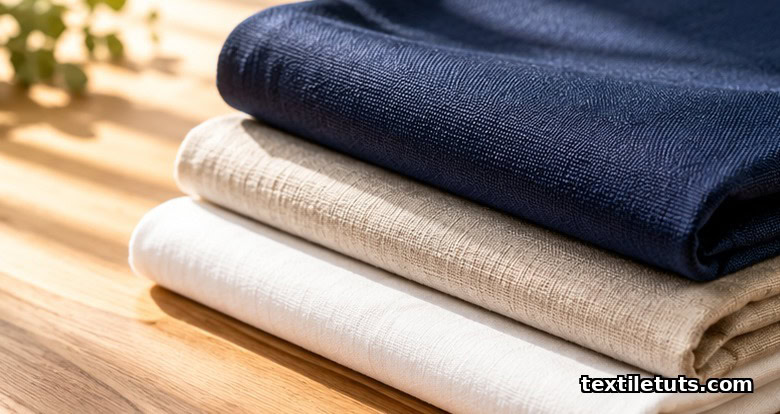
UV protection finishes raise the UPF (Ultraviolet Protection Factor) rating of a textile from UPF 5-10 for untreated cotton to UPF 50+ (blocking at least 98% of erythema-weighted UV radiation between 280 and 400 nm) by depositing 0.5-3% weight-gain of organic UV absorbers or inorganic oxide nanoparticles onto or within the fiber.
Most conventional apparel blocks only 30-50% of solar UV at typical summer noon irradiance, and the unprotected remainder contributes to skin erythema, photoaging, and long-term DNA damage. UV protection finishes close that gap with chemistry that selectively absorbs or scatters UVB (280-315 nm) and UVA (315-400 nm) photons before they reach the skin.
This article explains how UV-protective finishes work, which standards govern their rating, and how mills apply them on cotton, polyester, and blended fabrics.
What a UV Protection Finish Is (and What It Is Not)
A UV protection finish is a chemical treatment applied to a textile that selectively absorbs or scatters ultraviolet radiation while remaining transparent to visible light. The active ingredients are either organic UV-absorbing compounds (often called UV absorbers or UVAs) or inorganic semiconductor metal-oxide nanoparticles, both chosen because their electronic band gap sits in the UV range rather than the visible range.
The finish is distinct from a textile’s inherent UV protection. Polyester has a natural UPF of roughly 20-30 because the aromatic ring system of poly(ethylene terephthalate) absorbs strongly in the UVB band. Cotton, by contrast, has an inherent UPF that ranges from UPF 5 (a pale, loosely knitted T-shirt) to UPF 15 or so for a heavier denim. UV protection finishes are designed to lift that baseline.
Three things set a UV finish apart from related chemistries:
- Selectivity: the compound absorbs in the UVB/UVA band but is colorless in daylight.
- Durability: the finish must survive at least 20 home launderings without losing more than 20% of its UPF if the garment is sold as “sun-protective.”
- Photostability: the absorber itself must not yellow, lose potency, or generate radicals when exposed to UV (this is why benzotriazoles and phenyl triazines dominate over earlier benzophenones).
How UV Protection Is Measured: UPF and the AATCC TM 183 Test
The unit used for textiles is UPF, not SPF. UPF is defined in AATCC TM 183 as the ratio of erythema-weighted UV irradiance transmitted through air to the erythema-weighted UV irradiance transmitted through the fabric, measured in vitro over the 280-400 nm band. A fabric rated UPF 50 transmits only 1/50 (2%) of effective UV radiation.
UPF is graded as follows (from AS/NZS 4399 and ASTM D6603):
| UPF Rating | UV Transmission Blocked | Classification |
|---|---|---|
| UPF 15-24 | 93.3-95.9% | Good |
| UPF 25-39 | 96.0-97.4% | Very Good |
| UPF 40-50+ | ≥ 97.5% | Excellent |
The standard test procedure combines AATCC TM 183 (UV transmittance), ASTM D6544 (sample conditioning to simulate outdoor wear: 40 hours of simulated sunlight followed by 100 wash cycles before measurement), and ASTM D6603 (labeling). The conditioning step is what catches finishes that look good on the bench but fail after a season of wear.
Chemistry: Organic UV Absorbers and Inorganic Nanoparticles
Commercial UV protection finishes fall into two chemistry families, often used together.
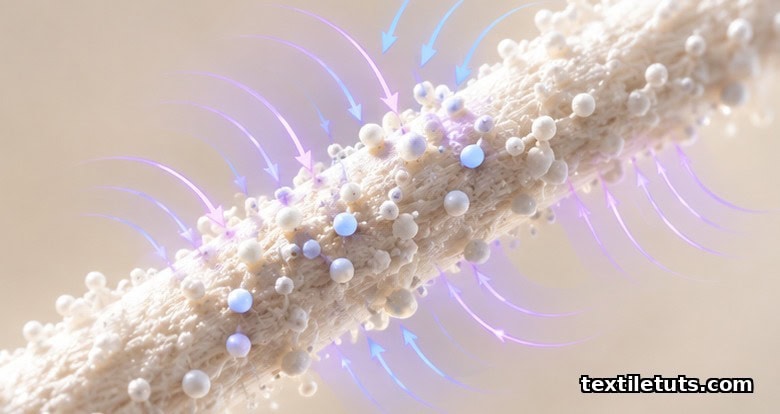
Organic UV absorbers are conjugated aromatic molecules that absorb photons and convert the energy to harmless heat. The main classes are:
- Benzophenones (e.g. 2-hydroxy-4-methoxybenzophenone, “UV-9”): an older class, mostly used as cosmetic additives. They yellow with extended UV exposure and are now rarely chosen for textiles.
- Benzotriazoles (e.g. 2-(2H-benzotriazol-2-yl)-4-methylphenol, “Tinuvin P”): excellent photostability, moderate UV coverage. Common in polypropylene and polyester fiber-spin additives.
- Phenyl triazines (e.g. Tinosorb S): a newer class with broad UVB + UVA absorption and exceptional photostability. Dominant in high-end sunscreen-grade textile finishes.
- Phthalocyanines and indolinones: specialty absorbers with specific spectral peaks.
Organic absorbers are typically applied at 0.5-2.0% on weight of fabric (owf) by padding or exhaustion. They can be combined with a hindered amine light stabilizer (HALS) to prevent photo-oxidative degradation of the polymer itself.
Inorganic oxide nanoparticles scatter and absorb UV because their band gap lies in the UVB range. The two workhorses are:
- Anatase TiO2 (band gap ~3.2 eV, absorbing below ~388 nm): particle size 15-50 nm is the sweet spot, small enough to scatter minimally in visible light, large enough to retain UV absorption. Anatase is preferred over rutile for finishing because it has a higher photocatalytic activity and a sharper UV cutoff.
- ZnO (band gap ~3.4 eV, absorbing below ~365 nm): particularly effective for UVA. Often the choice for skin-adjacent textiles because ZnO is widely accepted in topical sunscreens.
Nanoparticles are applied at 0.5-3.0% owf, often bound to the fiber with a sol-gel matrix based on tetraethyl orthosilicate (TEOS) or 3-glycidyloxypropyl trimethoxysilane (GPTMS). The sol-gel route is now standard because it survives 30+ home launderings, where simple pad-dry-cure application of nanoparticles without a binder can lose 50-70% of its UPF after just ten washes.
Application Methods for UV Protection Finishes
Four application routes dominate the industry, and the choice depends on fabric form (woven, knit, nonwoven), fiber content, and the durability target.
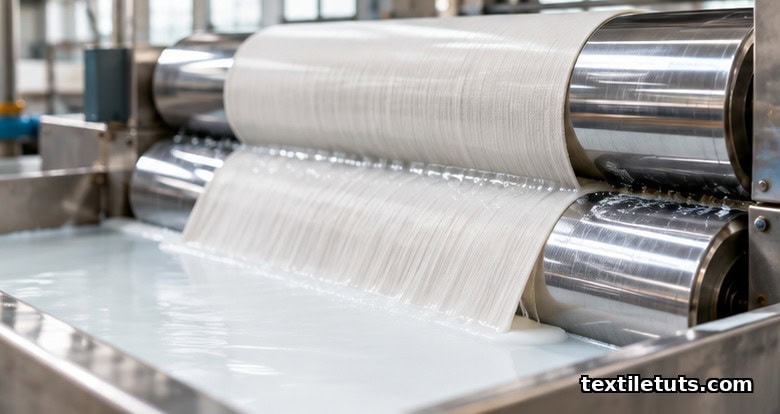
1. Padding (pad-dry-cure): the most common route for woven cotton and polyester/cotton blends. The fabric passes through a trough of finish liquor, is squeezed between two rollers to a wet pickup of 70-85%, then dried at 110 °C and cured at 150-160 °C for 3-5 minutes. Typical recipe: 2-5 g/L of organic UV absorber, 5-15 g/L of TiO2 or ZnO dispersion, 5-10 g/L of a binder (acrylic or silicone-based).
2. Exhaustion: used for knit fabrics and loose fibers. The textile is immersed in a circulating liquor at 60-80 °C for 20-45 minutes, with the finish exhausting onto the fiber like a reactive dye. Pickup is lower (3-8% owf), but the finish penetrates more deeply than padding.
3. Sol-gel: the binder is formed in situ on the fiber. A silane precursor (TEOS or GPTMS) is hydrolyzed in the padding bath with an acid catalyst, applied by padding, and cured at 150 °C. The resulting silica network traps the TiO2 or ZnO nanoparticles in a covalent matrix. This is the method that achieves the highest wash durability, with some finishes surviving 50+ home launderings.
4. Spin finishing: for synthetic fibers, UV absorbers are injected into the polymer melt before extrusion, locking the protection into the filament itself. This is how most commercial polyester and polyamide base fabrics are made inherently UV-resistant.
How Fabric Construction Affects UV Protection (Even Without a Finish)
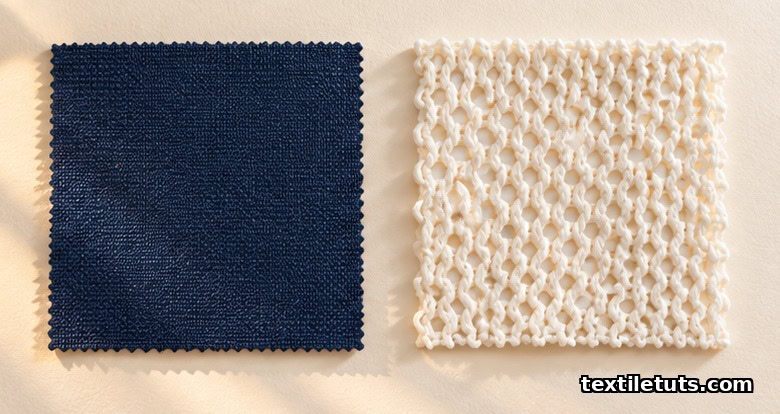
UV protection is not a chemistry problem alone. Four construction parameters shift the inherent UPF of a fabric before any finishing step:
- Fiber chemistry: polyester and wool have an inherent UPF advantage over cotton and viscose because of aromatic or conjugated structures in the polymer.
- Yarn count and twist: finer, lower-twist yarns spread flatter, leaving less inter-yarn gap for UV to pass through.
- Weave density: a tightly woven fabric has less open area (the fractional geometric opening measured by image analysis). UPF rises sharply when the open area drops below 8-10%.
- Color: deeper shades and fluorescent dyes absorb UV more strongly. A black cotton T-shirt typically scores UPF 15-20 where a white one of the same construction scores UPF 5-8.
A finish lifts a fabric further, but a well-constructed, dark polyester can already meet a UPF 50+ rating without any chemical treatment. Designers and finishers often work backward from the required rating to choose the lowest-cost finish load.
Standards Governing UV-Protective Textiles
| Standard | Scope | Region |
|---|---|---|
| AATCC TM 183 | UV transmittance test (UPF) | USA / global |
| ASTM D6544 | Pre-conditioning before UPF test | USA |
| ASTM D6603 | Labeling and marking UV-protective textiles | USA |
| AS/NZS 4399:2020 | Sun-protective clothing evaluation and classification | Australia / New Zealand |
| EN 13758-1:2002 | Solar UV protective properties, apparel fabrics | EU |
| ISO 12311:2013 | Personal protective equipment – test methods for sun-protective garments | Global |
For export to the EU, EN 13758-1 is the binding standard; for Australia, AS/NZS 4399 dominates the market. Manufacturers targeting both regions typically test once under each standard and label with the lower rating.
Frequently Asked Questions
What is the difference between UPF and SPF?
UPF measures protection provided by a fabric (measured in vitro by a spectrophotometer over the 280-400 nm band), while SPF measures the protection factor of a topical sunscreen applied to human skin. Both use the same erythema-weighted action spectrum. The fundamental difference is geometry: a fabric blocks UV by absorbing and scattering before it reaches the skin, while sunscreen absorbs at the skin surface.
Does the UV protection wash out over time?
It depends on the finish. Padding-only treatments of benzophenones or benzotriazoles lose 30-50% of their UPF after 10 home launderings because the molecules are physically adsorbed and partially desorb. Sol-gel-treated TiO2 or ZnO finishes retain over 80% of their UPF after 30 wash cycles because the silica network immobilizes the particles. AATCC TM 183 with ASTM D6544 pre-conditioning exposes the fabric to 100 simulated wash cycles before testing, so a passing garment is rated for that use.
Are UV protection finishes safe for skin contact?
Yes. The two main chemistries, organic benzotriazoles and inorganic TiO2/ZnO, are the same compounds used in topical sunscreens and have been reviewed by the FDA and the EU Scientific Committee on Consumer Safety. The finish is fixed to the fiber, so skin exposure is to the bound compound, not a free molecule. Wash-water release of nanoparticles from a properly cured finish is below the OECD detection limit of 0.01 mg/L.
Can a white T-shirt be made UPF 50+?
Yes, but it takes more finish than a colored one. White cotton has an inherent UPF of 5-8 because it scatters rather than absorbs UV. A combination of 2% owf phenyl triazine absorber plus 1.5% owf TiO2 nanoparticles in a sol-gel binder, padded to 80% wet pickup and cured at 150 °C, will reliably lift a white cotton knit above UPF 50. The trade-off is a 5-15% increase in production cost versus an untreated dark cotton.
Which fabrics have the highest inherent UV protection without a finish?
Polyester is the strongest, with an inherent UPF of 20-30 in a standard plain weave. Wool scores UPF 15-25 due to UV absorption by keratin aromatic residues. Cotton is the weakest, with UPF 5-15 depending on weave and color. Nylon and acrylic sit between polyester and cotton. A tightly woven, dark polyester may already meet UPF 50+ with no chemical finish at all.
References
- AATCC. Test Method 183-2022: Transmittance or Blocking of Erythema-Weighted UV Radiation through Fabric. https://www.aatcc.org , the canonical UPF test method for textiles.
- ASTM International. D6544-21: Standard Practice for Preparation of Textiles Prior to UV Testing. https://www.astm.org , defines the pre-conditioning cycle used before UPF measurement.
- ASTM International. D6603-19: Standard Guide for Labeling of UV-Protective Textiles. https://www.astm.org , covers label claims and minimum UPF thresholds.
- Standards Australia / Standards New Zealand. AS/NZS 4399:2020 Sun Protective Clothing – Evaluation and Classification. https://www.standards.org.au , the dominant sun-protection standard for the Australian market.
- European Committee for Standardization. EN 13758-1:2002 Textiles – Solar UV Protective Properties – Part 1: Method of Test for Apparel Fabrics. https://www.cen.eu , the binding standard for UV-protective apparel in the EU.
- ISO. ISO 12311:2013 Personal Protective Equipment – Test Methods for Sun Protective Garments. https://www.iso.org , the international test method for UPF-rated garments.
This article is the working reference for UV protection finishes on textile substrates. Editorial by Shahrukh Islam, TextileTuts. Sources: AATCC TM 183, ASTM D6544, ASTM D6603, AS/NZS 4399:2020, EN 13758-1:2002, ISO 12311:2013 as cited.


