
Anti-Microbial Finishes

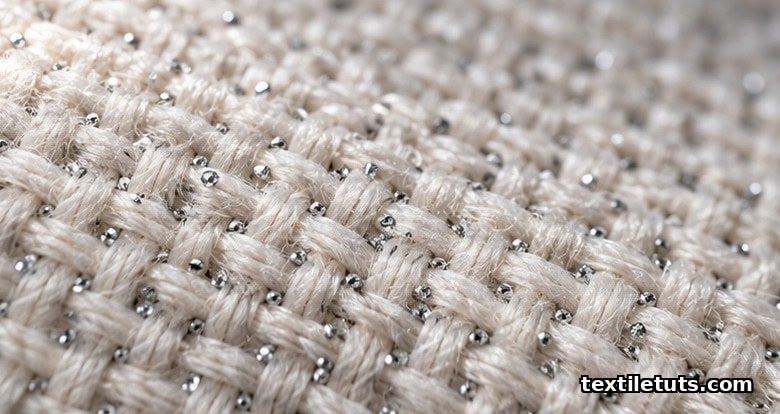
Antimicrobial textile finishes reduce bacterial colonies on fabric by ≥99.0% within 24 hours under ISO 20743 and AATCC TM 100 test conditions, using silver-ion releasing agents, quaternary ammonium salts, or chitosan-based chemistries that disrupt bacterial cell walls or block their metabolic enzymes.
These finishes matter because a single Staphylococcus aureus cell doubling every 30 minutes reaches a population of more than 1 million cells in 8 hours on an untreated textile, producing the odor, discoloration, and cross-contamination risks that hospital linens, athletic wear, and undergarments are designed to prevent.
This guide covers the chemistries used, the test methods that certify them, the typical performance numbers, and the application routes mills use to put each finish on a fabric.
What Antimicrobial Textile Finishes Do
An antimicrobial finish is a chemical treatment applied during finishing that inhibits the growth of bacteria, fungi, or viruses on the textile surface. The treatment works through one of three mechanisms: leaching a biocidal ion (silver, copper, or zinc) that denatures microbial proteins, adsorbing onto the microbial cell wall and rupturing its membrane (quaternary ammonium compounds), or generating reactive oxygen species inside the cell (triclosan and photocatalytic TiO2).
Finishes differ from coatings. A finish is chemically bonded to the fiber or polymer matrix, while a coating sits on top of the yarn as a film. Bonded finishes survive 30 to 50 home launderings under AATCC TM 135 conditions, while loosely applied coatings typically lose 80% of their activity after 10 washes.
The Main Antimicrobial Agents
Silver and Silver Nanoparticles
Silver is the most widely used antimicrobial in technical textiles. Silver ions (Ag+) bind to thiol groups in microbial enzymes and disrupt DNA replication. The active form is typically silver chloride or silver nitrate deposited onto TiO2 or zeolite carriers, with particle sizes of 10 to 100 nm producing the highest release rate.
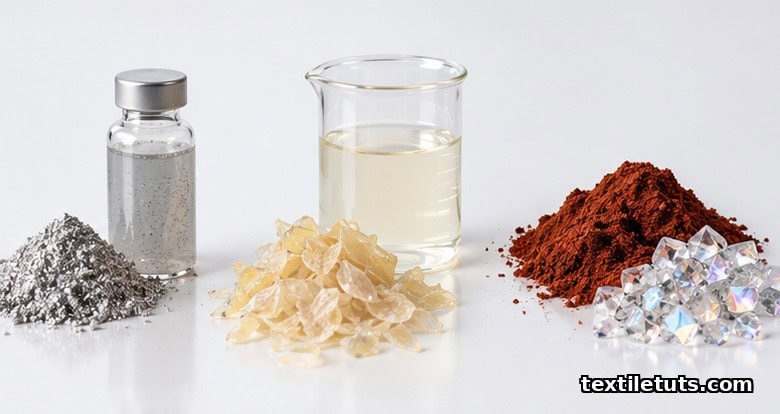
Peer-reviewed work in MDPI’s International Journal of Molecular Sciences reports that silver-loaded cotton reduces Escherichia coli and S. aureus populations by 99.9% at loadings of 0.5 to 2.0% on weight of fabric (owf), with activity retained after 20 wash cycles when the silver is ion-exchanged into a glass-ceramic carrier rather than surface-coated.
Quaternary Ammonium Compounds (QACs)
QACs such as 3-(trimethoxysilyl)propyldimethyloctadecyl ammonium chloride bond covalently to hydroxyl groups on cotton and create a positively charged surface that ruptures the negatively charged bacterial cell membrane on contact. Because the action is contact-based, QAC-treated fabrics kill microbes without releasing chemistry into the skin, which makes them the preferred finish for infant clothing and medical patient gowns.
Chitosan
Chitosan is a polysaccharide derived from chitin in crustacean shells. Its protonated amine groups (NH3+) bind to the bacterial cell wall and cause leakage of intracellular components. It is the only antimicrobial agent approved for direct food contact under US FDA 21 CFR regulations, and it dominates the finish on wound dressings and hygiene nonwovens.
Copper and Zinc Pyrithione
Copper oxide particles (Cu2O, CuO) and zinc pyrithione are used in socks, hosiery, and shoe linings. Copper releases Cu2+ ions that catalyze the formation of hydroxyl radicals inside bacterial cells. Zinc pyrithione disrupts membrane transport proteins and is primarily an antifungal, with published activity against Trichophyton mentagrophytes, the fungus responsible for athlete’s foot, at concentrations as low as 50 ppm on fabric.
How Mills Apply Antimicrobial Finishes
The four common application routes, in order of durability, are:
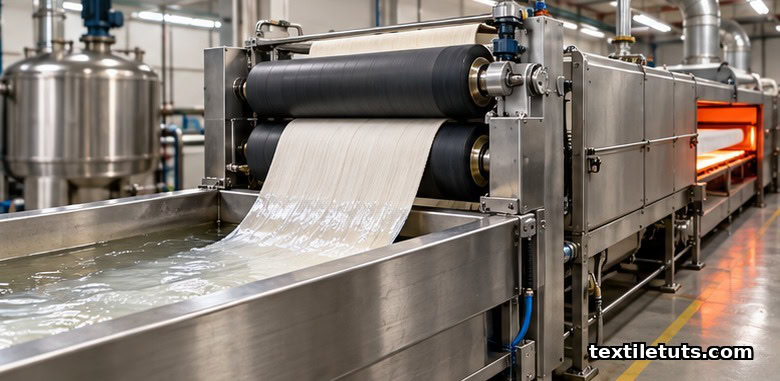
- Padding and curing – fabric passes through a finish bath, is squeezed to 70 to 90% wet pickup on a padder, then cures at 150 to 170 °C for 1 to 3 minutes. Used for silver and QAC finishes on cotton.
- Exhaustion – the finish is added to the dye bath and migrates onto the fiber during the dye cycle at 60 to 95 °C for 30 to 60 minutes. Used for cationic agents on polyester.
- Spray and foam – finish applied to one face of the fabric to leave the back untreated for breathability. Used on shoe linings and bra cups.
- Plasma grafting – low-pressure plasma activates the fiber surface, then a gaseous monomer is polymerized onto it. Plasma-grafted QAC finishes retain full activity after 50 industrial launderies under ISO 15797.
Test Methods That Define the Industry
Five standards govern antimicrobial performance claims. Mills and brand owners must agree on the same test before any commercial claim is made.
| Standard | Method Type | Typical Organisms | Reported Metric |
|---|---|---|---|
| ISO 20743:2021 | Absorption (quantitative) | S. aureus, K. pneumoniae | % reduction vs. untreated control |
| AATCC TM 100 | Absorption (quantitative) | S. aureus, E. coli | log reduction after 24 h contact |
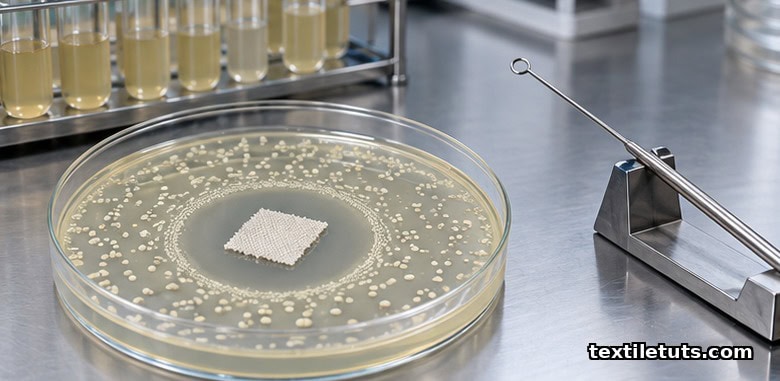
| AATCC TM 147 | Parallel streak (qualitative) | S. aureus, S. epidermidis | Width of inhibition zone (mm) |
| ASTM E2149 | Dynamic contact (shaking) | E. coli | % reduction at 1 h contact |
| JIS L 1902 | Absorption (quantitative) | S. aureus, K. pneumoniae | Antibacterial activity value (A) |
AATCC TM 100 is the most cited US method. A treated fabric is inoculated with 1 to 2 × 10^5 colony-forming units (CFU) of bacteria in a nutrient broth, incubated at 37 °C for 18 to 24 hours, then plated and counted. A 99.0% reduction equals a 2-log kill and is the typical threshold for “antibacterial” claims. A 99.9% reduction (3-log kill) is the threshold most medical-textile buyers require.
Typical Performance Numbers
Well-formulated commercial finishes deliver the following bacterial reductions on cotton and polyester under AATCC TM 100 with S. aureus:
- Silver-ion loaded (2% owf, ion-exchanged carrier): 99.9% reduction, durable to 50 washes
- QAC silane finish (3% owf, padded and cured): 99.5% reduction, durable to 30 washes
- Chitosan (1% owf, exhaust applied): 95 to 98% reduction, durable to 20 washes
- Copper oxide coating (1.5% owf, padding): 99.0% reduction, durable to 40 washes
Antifungal performance is reported separately. For Trichophyton mentagrophytes on sock fabric, zinc pyrithione at 200 ppm delivers an AATCC TM 30 grade 1 result (no growth), while untreated cotton typically shows grade 3 (visible growth covering more than 25% of the sample).
Where Antimicrobial Finishes Are Used
Medical textiles account for the highest-value applications: surgical gowns (ASTM F1671 barrier plus antimicrobial finish), wound dressings (chitosan or PHMB), and hospital bed linens (quaternary ammonium, bleachable). Athletic apparel is the largest volume segment, with polyester knits finished with silver-ion agents to suppress body odor between washes. Undergarments, socks, and home textiles (towels, mattress ticking) round out the consumer side.
Outside clothing, antimicrobial finishes are used on air filtration media (H13 and H14 HEPA filters), conveyor belts in food processing, and automotive interior fabrics.
Frequently Asked Questions
Are antimicrobial finishes safe to wear against the skin?
Yes, when applied within the dose ranges specified in OEKO-TEX Standard 100 and REACH. Silver-ion finishes on underwear and socks have been in consumer use for more than 25 years with no documented cases of dermal sensitization at the typical 0.5 to 2.0% on weight of fabric loading. Chitosan-based finishes are the safest option for sensitive skin and are the only antimicrobial finish approved for direct food contact.
How many wash cycles do antimicrobial finishes last?
Durability depends on the chemistry. Plasma-grafted QAC finishes retain more than 95% of their initial activity after 50 industrial wash cycles under ISO 15797 (75 °C). Padding-applied silver finishes typically last 30 to 50 home launderings under AATCC TM 135 conditions. Surface-coated finishes without binder lose most of their activity within 10 home washes.
Do antimicrobial finishes kill viruses on fabric?
Some do, but textile antiviral claims require a separate test, ISO 18184. Copper-oxide finishes have published results of 99.9% reduction of human coronavirus 229E within 2 hours. Most silver and QAC finishes show meaningful but smaller reductions (70 to 90%) against enveloped viruses.
Why does my treated shirt stop working after a few months?
The most common cause is body oils and detergent residue that coat the finish and block the active sites. A wash in warm water (40 °C) with a non-ionic detergent restores most of the activity. Avoid fabric softeners: cationic softeners react with anionic silver carriers and permanently deactivate them.
Can antimicrobial finishes cause resistant bacteria?
Resistance to silver has been documented in clinical isolates, primarily at the plasmid level, but the concentrations needed to select for resistance are higher than those released from textile finishes. Quaternary ammonium compounds carry a higher selection-pressure risk because sub-lethal exposure on contact-active surfaces has been linked to qac resistance genes in Staphylococcus. The textile industry is responding with multi-agent finishes (silver plus QAC) that require simultaneous resistance mutations.
References
- International Organization for Standardization. ISO 20743:2021 – Textiles – Determination of antibacterial activity of textile products. iso.org – Quantitative absorption and transfer methods for S. aureus and K. pneumoniae.
- American Association of Textile Chemists and Colorists. AATCC TM 100 – Antibacterial Finishes on Textile Materials: Assessment of. aatcc.org – 24-hour contact test; bacterial reduction expressed as percent or log.
- American Association of Textile Chemists and Colorists. AATCC TM 147 – Antibacterial Activity Assessment of Textile Materials: Parallel Streak Method. aatcc.org – Qualitative agar diffusion method.
- ASTM International. ASTM E2149 – Standard Test Method for Determining the Antimicrobial Activity of Antimicrobial Agents Under Dynamic Contact Conditions. astm.org – Dynamic shaking contact protocol for non-leaching finishes.
- Japanese Industrial Standards Committee. JIS L 1902 – Testing for antibacterial activity and efficacy on textile products. ISO-equivalent method used in Japanese and Korean markets.
- Dastjerdi, R., and Montazer, M. A review on the application of inorganic nano-structured materials in the modification of textiles: focus on anti-microbial properties. Colloids and Surfaces B: Biointerfaces, Elsevier, 2010. Peer-reviewed summary of silver, copper, and TiO2 finishing on cotton, polyester, and polyamide.
- International Organization for Standardization. ISO 18184:2019 – Textiles – Determination of antiviral activity of textile products. iso.org – Required for antiviral claims on textile articles.
This article is the working reference for antimicrobial textile finishes. Editorial by Shahrukh Islam, TextileTuts. Sources: ISO 20743, AATCC TM 100, AATCC TM 147, ASTM E2149, JIS L 1902, and ISO 18184, with peer-reviewed support from Colloids and Surfaces B: Biointerfaces (Elsevier), as cited.


