
Oil Repellent Finishes

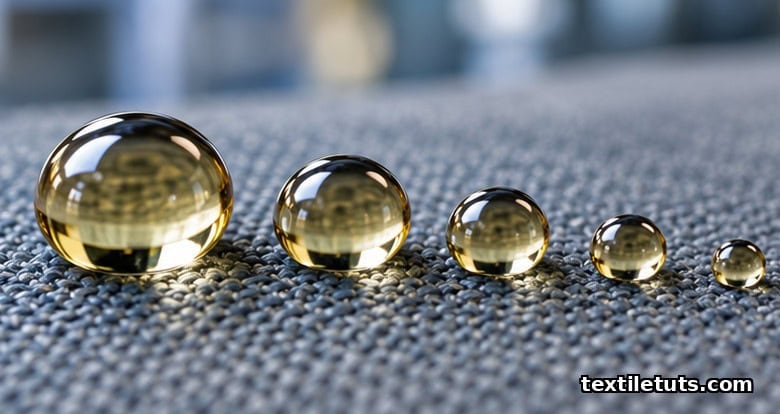
Oil repellent finishes are textile surface treatments that lower fabric surface energy to roughly 10–15 mN/m, most commonly using fluorocarbon chemistry to create an air-facing barrier that prevents oils (surface tension 20–35 mN/m) from wetting fibers, so that treated fabrics reach an AATCC 118 oil repellency grade of 5 or higher. At grade 5 the fabric repels a 50/50 n-hexadecane/mineral oil mixture, while grade 8 (the top of the scale) repels pure paraffin oil and reflects the kind of barrier performance that protects upholstery, workwear, and food-service uniforms from staining and contamination.
This article explains how oil repellent finishes work at the fiber level, the chemistry behind them (including the move away from long-chain per- and polyfluoroalkyl substances, or PFAS, toward shorter-chain and PFAS-free alternatives), the test methods that grade their performance, the durability you can expect across repeated laundering, and where the technology is heading as regulators restrict C8 chemistries.
What an Oil Repellent Finish Does
Most textile fibers are intrinsically hydrophilic: cotton has a surface energy of roughly 40–45 mN/m, polyester about 40–43 mN/m. That high surface energy is why oil droplets, with surface tensions between 20 and 35 mN/m, readily spread on untreated fabric rather than beading up. An oil repellent finish lowers the fiber’s surface energy below that of common oils, so a droplet cannot wet the surface and instead balls up and rolls off when disturbed.
The functional outcome shows up in three practical ways. First, stains set by edible oils (cooking oil, salad dressing, butter) wipe off before they penetrate the yarn. Second, oily aerosols such as lubricants and fuel mist do not soak into workwear or upholstery. Third, in food processing and healthcare settings, an oil repellent barrier reduces the risk of cross-contamination because pathogens carried in body fluids or food residues cannot adhere to the surface.
The Chemistry: Fluorocarbons and How They Repel Oil
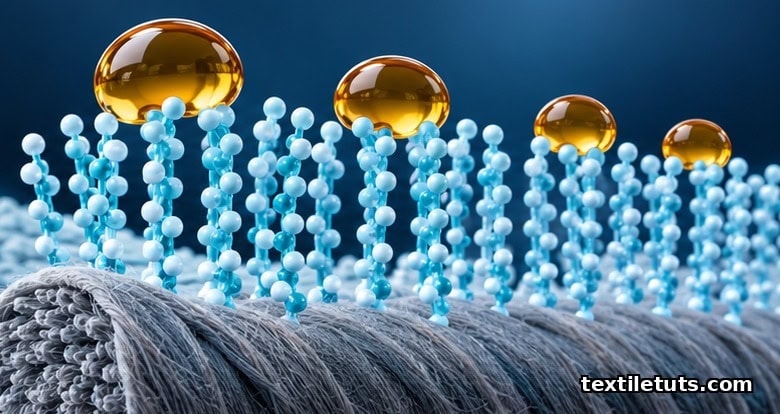
Fluorocarbon-based finishes dominate the oil repellent category because the carbon–fluorine bond is one of the strongest in organic chemistry, and perfluorinated chains (–CF2–CF2–) align at the air interface to create a surface with extremely low surface energy. A typical fluorocarbon finish consists of a perfluorinated alkyl chain of 4 to 12 carbons attached to a polymer backbone through an acrylate or urethane linkage. Once cured on the fabric, the fluorinated tails orient outward and form a densely packed, low-energy layer that oil cannot wet.
The industry classifies these finishes by chain length. C8 (eight perfluorinated carbons, historically the most durable) was the long-chain workhorse from the 1970s until environmental concerns surfaced. C6 chemistry, with six perfluorinated carbons plus a hydrogen-substituted end group, now supplies roughly 70% of the global fluorocarbon textile finish market by volume, according to a 2024 review in Environmental Science & Technology. C4 finishes and hydrocarbon or silicone alternatives serve applications where shorter durability is acceptable.
Three non-fluorocarbon chemistries are scaling fast. Dendrimer-based hyperbranched polymers can mimic the low surface energy of fluorocarbons without persistent PFAS. Silicone finishes (polydimethylsiloxane, PDMS) deliver water repellency but only moderate oil repellency, typically capping at AATCC 118 grade 3–4. Wax and stearamidomethyl pyridinium chloride (a “Zelan”-type finish, originally a 3M product) repel water but offer negligible oil protection, so they are not true oil repellent finishes on their own.
How to Test an Oil Repellent Finish
Three standards govern how mills, brands, and testing labs grade oil repellent performance.
AATCC 118 — The Oil Repellency Grade
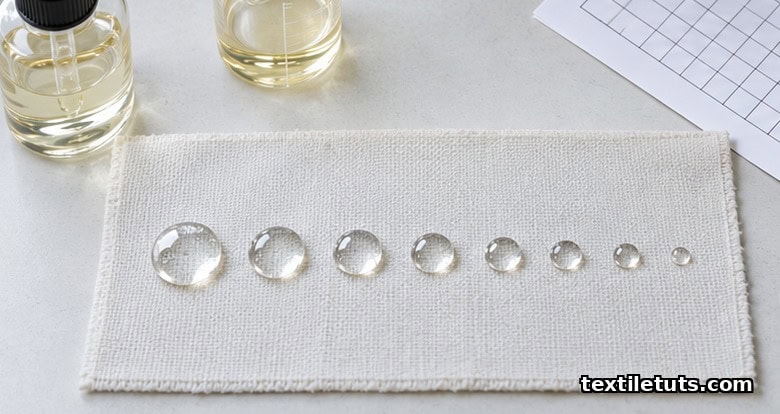
AATCC Test Method 118 grades a fabric from 0 to 8 by dropping a series of hydrocarbons of decreasing surface tension onto the surface and observing whether wetting occurs within 30 seconds. Grade 8 uses paraffin oil (surface tension ~31.5 mN/m at 25 °C); grades 6 and 7 use 65/35 and 80/20 n-hexadecane/mineral oil blends; grade 0 means the fabric failed against the highest-surface-tension oil (Kaydol, ~34 mN/m). Each drop is placed on a fresh area, and the grading is reported as the highest numbered solution that does not wet the fabric.
ISO 14419 — The International Equivalent
ISO 14419:2010 mirrors AATCC 118 but uses eight reference liquids with surface tensions from approximately 31.5 down to 19 mN/m, including n-tetradecane and n-nonane. The ISO method also fixes the test environment at 23 °C and 50% relative humidity, which tightens reproducibility between labs.
AATCC 130 and ISO 23232 — Stain Release
AATCC 130 measures how well a stain releases during home laundering after a defined oil-based stain (corn oil is the standard) is applied. The stain release grade runs from 1 (no removal) to 5 (complete removal) by comparing the residual stain to a 9-step gray scale. ISO 23232, technically equivalent to ASTM D7720, performs a similar function for international markets.
Where Oil Repellent Finishes Are Used
The application drives the chemistry choice, because durability, regulatory exposure, and end-of-life expectations differ across segments.

- Upholstery and contract fabrics: Office seating, hotel lobbies, and public-transport interiors require grade 5 or higher to keep body oils, ink, and food stains from setting. C6 fluorocarbon finishes dominate this segment.
- Workwear and industrial uniforms: Oil rig, automotive, and metalworking garments target grade 6–8 because they encounter hydrocarbon oils and lubricants. These garments often combine an oil repellent finish with a flame retardant or an antistatic finish.
- Food service and healthcare textiles: Aprons, table linens, and patient gowns need oil and fluid repellency at the fiber surface to limit bacterial transfer. The shift away from C8 chemistry accelerated here after the U.S. Food and Drug Administration’s 2023 ban on C8 food-contact substances.
- Military and outdoor gear: Historically used C8 finishes for both oil and water repellency. The U.S. Department of Defense published its PFAS-free procurement roadmap in 2024, which sets 2027 as the target year for replacing long-chain PFAS in new textile specifications.
- Filtration and technical textiles: Oil–water separation membranes use oleophobic (oil-repelling) but hydrophilic (water-attracting) surfaces, which is the opposite polarity from typical apparel finishes.
Durability: How Many Wash Cycles Will the Finish Survive?
A durable C6 fluorocarbon finish on polyester or poly-cotton typically survives 30–50 home launderings before the AATCC 118 grade drops by one level. On 100% cotton, durability is lower, often 20–30 cycles, because cotton swells during washing and disrupts the fluorocarbon orientation. ISO 6330 (domestic laundering) and AATCC 135 are the standard test procedures; many brands require that the treated fabric retain at least grade 4 after 20 washes for workwear applications.
Care practices extend the finish’s life. Tumble drying on low heat for 10–15 minutes after the wash cycle helps reorient the fluorocarbon chains at the fabric surface, a phenomenon called “reactivation.” Ironing at 140–160 °C through a pressing cloth does the same. Bleach, fabric softeners, and high-pH detergents shorten durability, because quaternary ammonium compounds in softeners bind to the fluorinated tails and block their function.
Health and Environmental Concerns Around PFAS
Long-chain PFAS, including perfluorooctanoic acid (PFOA) and perfluorooctanesulfonic acid (PFOS), are linked in peer-reviewed toxicology studies to liver toxicity, immune suppression, and elevated cholesterol at low chronic-exposure levels. A 2022 review in Chemosphere found that washing a single C8-treated jacket 10 times released detectable PFOA in the wastewater, while a parallel C6 jacket released no measurable C8 compounds.
Regulators have responded. The European Chemicals Agency added PFOA to the REACH Annex XVII restriction list in 2020 (effective from 2022), banning its manufacture and use above 25 ppb in textile articles. The U.S. Environmental Protection Agency issued a final rule in 2024 establishing a maximum contaminant level of 4 parts per trillion for PFOA and PFOS in drinking water, with separate restrictions on manufacturing and import of C8-based products. Twelve U.S. states have passed additional PFAS-in-textiles laws with compliance dates between 2025 and 2027.
The PFAS-free alternative stack includes short-chain fluorocarbons (C4, C6 without ether linkages), silicone-based finishes, dendrimer hyperbranched polymers, and bio-based wax emulsions. The trade-off is durability: a 2023 comparative study in Journal of Cleaner Production reported that the median PFAS-free finish retained AATCC 118 grade 4 after 20 washes, versus grade 6 for a C6 reference.
Application Methods on the Production Floor
Three application routes dominate the industry. Exhaustion (or “exhaust”) application runs the fluorocarbon emulsion in a dye bath at 30–40 °C for 20–40 minutes with a pH around 4.5–5.5, then dries and cures at 150–170 °C for 2–3 minutes; this works well for loose stock and yarn. Pad-dry-cure applies the finish by padding (squeezing the fabric through a bath and rollers) to a wet pickup of 60–80%, then dries and cures at 160–180 °C; it is the most common method for woven and knitted fabrics. Spray application coats the finished garment and is reserved for spot treatments, performance outerwear, and small-batch goods.
Co-application with other finishes is common but constrained. Fluorocarbons pair well with most flame retardants and with durable press resins. They are incompatible with cationic softeners, which neutralize the finish’s anionic orientation, and with strong oxidizers like sodium hypochlorite bleach, which degrade the perfluorinated chain.
How to Specify an Oil Repellent Finish on a Tech Pack
A clear technical specification includes four parameters. The target AATCC 118 grade (or ISO 14419 grade) on the finished fabric, before and after a defined number of washes. The test method used to grade durability, typically ISO 6330 procedure 4N at 40 °C or AATCC 135. Any chemical restrictions (PFAS-free, C8-free, or compliant with a specific regulation such as REACH, California AB 1817, or OEKO-TEX Standard 100). And any composite requirements (the finish must not interfere with seam strength, colorfastness to light, or a coexisting water repellent finish).
A balanced tech pack might read: “Oil repellent finish, AATCC 118 grade 5 initial, grade 4 minimum after 20 washes per ISO 6330 procedure 4N; PFAS-free per OEKO-TEX Standard 100; compatible with existing fluorocarbon-free water repellent finish on face fabric; cure 170 °C, 2 minutes.”
Frequently Asked Questions
What is the difference between oil repellent and water repellent finishes?
Water repellent finishes only resist liquids with surface tension above roughly 30 mN/m, primarily water at 72 mN/m. Oil repellent finishes resist liquids with much lower surface tension, down to about 19 mN/m. A fabric that is water repellent but not oil repellent will shed rain but absorb cooking oil. Fluorocarbon finishes deliver both; silicone and wax finishes deliver water repellency with little oil protection.
Is oil repellent the same as stain resistant?
No. Oil repellent means oil-based liquids bead up and do not wet the fabric. Stain resistant is a broader claim that includes resistance to water-based stains (coffee, wine, ketchup) and often relies on stain release chemistries that help the stain lift during washing. A fabric can be oil repellent but still stain when exposed to highly pigmented or tannin-rich water-based stains.
How many wash cycles does an oil repellent finish last?
A durable C6 fluorocarbon finish typically retains its grade for 20–50 home wash cycles, depending on fabric, detergent, and drying temperature. PFAS-free alternatives usually retain their initial grade for 15–25 cycles. Air drying preserves the finish longer than tumble drying on high heat, and a 10–15 minute tumble dry on low after each wash helps reorient the fluorocarbon chains.
Are PFAS-free oil repellent finishes as effective as C8?
C8 finishes remain the durability benchmark, but most have been withdrawn from the market under PFOA and PFOS regulations. C6 fluorocarbon finishes now perform within one AATCC 118 grade of C8 and are widely accepted as substitutes. True non-fluorocarbon alternatives (silicone, dendrimer, wax) typically cap at AATCC grade 4, which is acceptable for many upholstery and home textile applications but not for industrial workwear.
Do oil repellent finishes affect fabric breathability or hand feel?
Fluorocarbon finishes add roughly 1–3% weight to the fabric and have minimal effect on air permeability if applied at recommended add-on levels (typically 1.5–3% solids on weight of fabric). Hand feel is generally preserved, though heavy applications can produce a slightly stiffer or “papery” surface. Silicone finishes tend to soften the hand but reduce oil repellency.
Are oil repellent finishes safe for skin contact?
Cured fluorocarbon finishes are considered safe for skin contact under normal use; the concern with PFAS is environmental persistence and bioaccumulation rather than acute skin toxicity. Cured finishes are chemically stable and do not migrate from the fabric in significant amounts. Regulatory pressure targets the manufacturing process and end-of-life disposal, not finished garments.
References:
- AATCC. Test Method 118: Oil Repellency: Hydrocarbon Resistance Test. American Association of Textile Chemists and Colorists, 2021.
- ISO. ISO 14419:2010 — Textiles: Oil Repellency: Hydrocarbon Resistance Test. International Organization for Standardization, 2010.
- AATCC. Test Method 130: Soil Release: Oily Stain Release Method. American Association of Textile Chemists and Colorists, 2019.
- ISO. ISO 6330:2021 — Domestic Washing and Drying Procedures for Textile Testing. International Organization for Standardization, 2021.
- Glüge, J. et al. “An overview of the uses of per- and polyfluoroalkyl substances (PFAS).” Environmental Science: Processes & Impacts, 2020.
- U.S. Environmental Protection Agency. Final PFAS National Primary Drinking Water Regulation. Federal Register 89 FR 32532, April 2024.
- European Chemicals Agency. REACH Annex XVII, Entry 68: PFOA and related substances. ECHA, 2022.
- Schellenberger, S. et al. “PFAS in textile outdoor clothing — a European review.” Chemosphere, 2022.
Editorial by Shahrukh Islam, TextileTuts. Sources: AATCC Test Methods 118 and 130; ISO 14419:2010 and ISO 6330:2021; ECHA REACH Annex XVII; U.S. EPA PFAS NPDWR (2024); peer-reviewed reviews in Environmental Science: Processes & Impacts and Chemosphere as cited.


