
Types of Denim: Raw, Selvedge, Stretch, Distressed

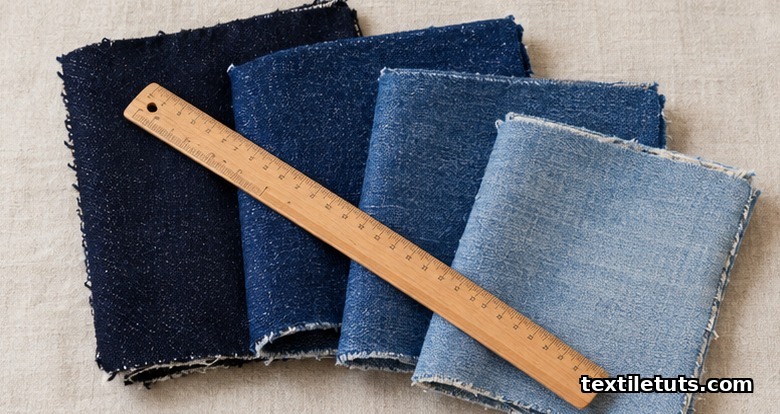
Denim is a 3/1 warp-faced twill fabric classified under ASTM D6779, woven with indigo-dyed warp yarns (typically 60–80% of the fabric mass) and undyed or lightly tinted weft yarns, with apparel-grade denim ranging from 4.5 oz/yd² (≈152 g/m²) for lightweight blends to 16 oz/yd² (≈542 g/m²) for heavy raw variants.
The four terms most often used to describe denim, raw, selvedge, stretch, and distressed, actually classify the fabric along three independent axes: weave method, finishing chemistry, and fiber blend. Raw and distressed describe what was done after weaving; selvedge describes how the fabric was woven; stretch describes what was added to the yarn. A single pair of jeans can be selvedge, raw, and stretch at the same time, so the words are not mutually exclusive. What follows is the engineering behind each label, the standards that govern them, and what those choices mean for fit, durability, and care.
Anatomy of Denim: The Indigo Warp, White Weft, 3/1 Twill
Almost every denim sold as “denim” uses the same basic architecture, and that architecture is what makes it a single category of fabric rather than several different ones. The warp (lengthwise) yarns are dyed with indigo, a vat dye that sits on the fiber surface rather than penetrating it, and the weft (crosswise) yarns are left undyed or tinted ecru. The yarns interlace in a 3/1 twill, meaning each weft passes under three warp threads and over one, producing the diagonal “twill line” that runs down the right side of the fabric. Because the warp covers most of the visible surface, the indigo color dominates the look and the dye chemistry of indigo controls most of the fabric’s long-term behavior.
Under ASTM D6779, the classification system for denim, warp-faced cotton and cotton-blend fabrics in this twill construction are sorted by mass per unit area (typically reported with ISO 3801) into light (under 8 oz/yd²), medium (8–12 oz/yd²), and heavy (above 12 oz/yd²) categories. The indigo dye itself is graded for colorfastness to crocking by AATCC Test Method 8, which scores dry and wet rubbing on a 1–5 scale; well-finished indigo denim typically rates 4 or higher when new, and well-worn raw denim drifts toward 3 over time as surface dye is abraded away. Those three ingredients, indigo warp, white weft, and 3/1 twill, are what make denim denim. Everything in the rest of this article modifies that baseline.
Raw Denim: Unwashed, Untreated, and Aging with the Wearer
Raw denim, also called “dry” or “loomstate” denim, refers to fabric that has been woven and indigo-dyed but never washed, singed, sanforized, or chemically finished before being cut into a garment. In practice this means a stiffer hand feel, a darker surface, and a fabric that still contains the full sizing and dye residue applied at the mill. When raw denim is finally washed, AATCC Test Method 135 records dimensional changes of roughly 5–10% in the warp direction for unsanforized cloth; sanforized raw denim shrinks closer to 1–3% because the fabric has been pre-shrunk mechanically at the mill, compressing the yarns before they ever reach a consumer washing machine.
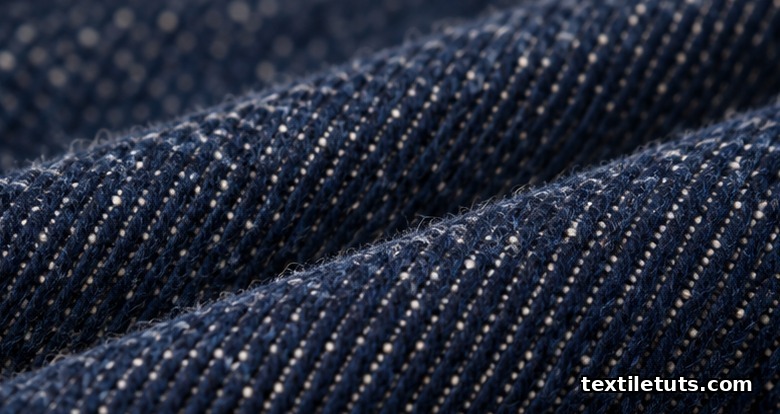
The reason raw denim fades in the wearer’s pattern, rather than at random, is that indigo only bonds superficially to cotton. Each abrasion lifts a microscopic layer of dye, and because the dye sits on the outside of the fiber rather than inside it, the fabric cannot return to a uniform color on its own. After 6–12 months of regular wear, raw denim shows honeycomb creases behind the knees, whiskers at the hips, and stack lines below the knees, all driven by the geometry of the body. The fabric itself does not get weaker from this process. Tensile strength tested per ASTM D5034 stays within roughly 10% of the as-made value as long as the warp yarns are not abraded through.
The trade-off is comfort in the first 2–4 weeks. A typical 14 oz/yd² (≈474 g/m²) raw denim jean has a stiffness that home sewists and mill technicians describe as “cardboard” until the fibers break in, which is why most raw-denim sellers recommend cold-water hand washing only and air drying flat. Hot water and machine agitation set creases permanently and accelerate indigo loss from crocking.
Selvedge Denim: Shuttle-Loom Woven with a Self-Finished Edge
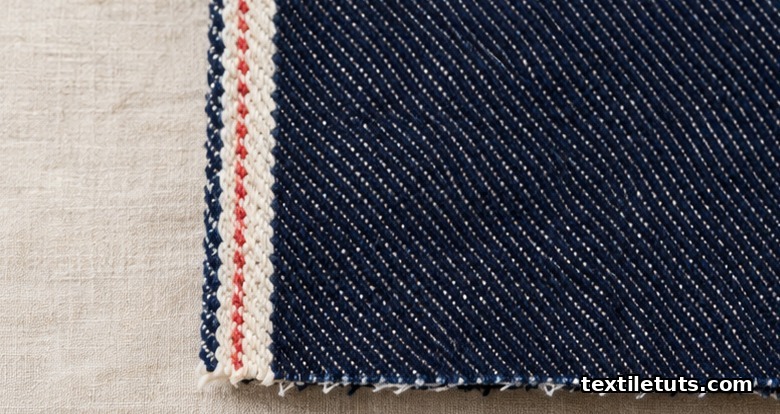
Selvedge denim is identified by the clean, tightly woven “self-edge” running down each side of the fabric, a band of diagonal lines in contrasting yarn color. That edge exists because selvedge denim is woven on a shuttle loom, a slow, narrow loom that produces fabric about 28–34 inches (≈71–86 cm) wide, compared with 60 inches (≈152 cm) or wider for modern projectile or air-jet looms. The shuttle carries the weft across the full width in one pass, so the weft yarn turns back at the edge and locks the warp into a clean, fray-free selvage without any added stitching or heat-cutting.
The narrow loom width has practical consequences for garment construction. Selvedge denim is typically cut along the warp for leg panels, which orients the tighter selvedge-bound edge along the outseam and keeps the center of the bolt on the most abrasion-prone parts of the jean. Jeans made this way cost more because the loom produces about 1–2 meters of fabric per hour versus 200+ meters per hour on a modern projectile loom, and because the tighter weave generally gives a denser fabric at the same nominal weight, often 10–15% more warp threads per square centimeter than a comparable non-selvedge denim measured under ISO 3801 conditioning.
The selvedge band itself is mostly cosmetic for the wearer, but the slower weaving process tends to produce fewer yarn breaks and less yarn-on-yarn abrasion, which long-time denim shops cite as the reason selvedge garments often outlast mass-market denim at the same weight. The colored tick mark you see on the outseam, sometimes red, sometimes a mill-specific pattern, is the literal edge of the loom, not a decorative tape sewn on after the fact.
Stretch Denim: When Elastane Joins the Yarn Mix
Stretch denim is cotton (or cotton-polyester) denim with elastane, also called Spandex or Lycra, spun into the weft, and in higher-stretch versions into the warp as well. The most common retail blends are 98% cotton / 2% elastane or 95% cotton / 5% elastane, with 1–5% elastane being the normal range. Above about 5% the fabric starts behaving more like a legging than a jean, and recovery, meaning the ability to snap back to its original shape after stretching, degrades at higher percentages.
The standard test for stretch performance is a cyclic tensile method in the same family as ASTM D5034: a stretch denim specimen is stretched a defined amount, released, and the residual elongation measured. Most quality stretch denim, with 2–4% elastane, recovers 90% or better after 5–10 stretch cycles, and 80% or better after a hundred cycles, which is what keeps the knees and seat from bagging out over a day of wear. The downside of elastane is heat. Under hot washing or tumble drying, polyurethane fibers degrade, lose recovery, and eventually break, which is why most stretch-denim care labels specify cold wash and line dry.
Because elastane breaks down well before cotton does, the typical lifespan of a stretch denim jean is 18–36 months of regular wear, less than the multi-year lifespan of an all-cotton raw denim worn in rotation. Stretch denim also c rocks less during the first few washes than raw denim, since the indigo surface has usually been pre-washed and pre-shrunk at the mill to stabilize the elastane-cotton blend and to remove unbound surface dye.
Distressed Denim: Mechanically and Chemically Finished
Distressed denim is the opposite of raw: it has been deliberately aged at the mill so the consumer does not have to wear it in. The standard toolkit includes stone washing (tumbling with pumice stones), enzyme washing (cellulase enzymes that partially digest surface cotton fibers to soften the hand), sandblasting (now restricted in many countries due to worker-safety concerns), laser fading, and localized abrasion using potassium permanganate sprayed on patches.
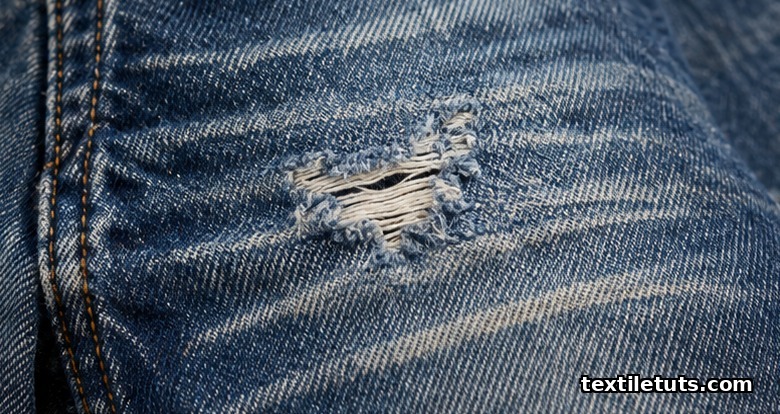
The result is a softer, lighter-weight fabric, often with thinning at stress points such as the knees and seat. There is a real cost. Distressed denim typically has 15–30% lower breaking strength than the same fabric before distressing, per ASTM D5034, because the cellulose surface has been physically or chemically eroded. Visible tears are usually backed with a woven patch or fusible interlining so the garment can be sold as ready-to-wear rather than as workwear-in-progress.
The finishing chemistry also matters for care. Enzyme-washed denim tends to shrink less in subsequent home washes because the cellulase treatment relaxes the fibers in advance; stone-washed denim behaves similarly. Laser-faded denim is the most modern method, replacing pumice and chemicals with a directed CO&sub2; laser that ablates the indigo surface in a programmed pattern, producing fewer chemical effluent streams and lower water use at the mill. All three methods can be combined, and the most “worn” looking pairs usually have been through two or three of them.
Comparison Table: Four Denim Types at a Glance
The table below summarizes the engineering differences between the four denim types using the same test methods cited above. Mass per unit area follows ISO 3801; crocking follows AATCC TM 8; tensile strength follows ASTM D5034; first-wash dimensional change follows AATCC TM 135.
| Property | Raw | Selvedge | Stretch | Distressed |
|---|---|---|---|---|
| Defining trait | Unwashed after dyeing | Woven on shuttle loom | Contains 1–5% elastane | Pre-aged at the mill |
| Typical weight | 12–16 oz/yd² | 10–14 oz/yd² | 8–12 oz/yd² | 8–12 oz/yd² |
| Loom type | Modern or shuttle | Shuttle | Modern | Modern |
| Pre-shrunk (sanforized) | Often not | Often not | Almost always | Almost always |
| First-wash warp shrinkage (TM 135) | 5–10% | 3–7% | 1–3% | 1–2% |
| Tensile loss vs. unfinished (D5034) | 0% | 0% | 0–5% | 15–30% |
| Indigo crocking, dry (TM 8) | 3–4 | 3–4 | 4–5 | 4–5 |
| Primary care risk | Excess shrinkage, indigo transfer | Edge abrasion, indigo transfer | Heat damage to elastane | Tear propagation at thinned zones |
Frequently Asked Questions
Is raw denim the same as selvedge denim?
No. Raw refers to whether the fabric has been washed after weaving, while selvedge refers to the type of loom used. Raw denim can be selvedge, and selvedge denim can be raw, but a pair of jeans can be selvedge without being raw (if it has been washed at the mill) and raw without being selvedge (if it was woven on a wide modern loom and never washed). The two words describe different production steps.
How much will raw denim shrink the first time it is washed?
Per AATCC Test Method 135 dimensional-change testing, unsanforized raw denim typically shrinks 5–10% in the warp direction during the first wash cycle, with smaller (1–3%) shrinkage in the weft. Sanforized raw denim, which has been pre-shrunk mechanically at the mill, shrinks closer to 1–3% total. Cold water and gentle agitation keep the shrinkage toward the low end of each range.
Does stretch denim last as long as all-cotton denim?
Roughly half as long under daily wear. All-cotton denim can last 5+ years of regular rotation; cotton-elastane blend denim typically loses shape and develops bagging at the knees and seat after 18–36 months, because the polyurethane fibers degrade with repeated stretch cycles and exposure to body heat. Higher-quality elastane and lower drying temperatures extend the lifespan noticeably.
Is distressed denim weaker than the same fabric before distressing?
Yes. Breaking-strength tests under ASTM D5034 show stone-washed and enzyme-washed denim losing 15–30% of warp tensile strength versus the unfinished greige fabric. The visible rips and abrasions on a distressed pair are backed with woven patches or fusible interlining to keep the garment wearable after this loss, but the thinned areas will still tear further if snagged.
Does selvedge denim actually last longer than non-selvedge denim?
The selvedge itself is a finished edge and does not by itself increase garment life, but the slower weaving process typically produces a denser fabric with fewer yarn breaks, so a selvedge garment generally outlasts a mass-market denim at the same nominal weight. The right way to test this is side-by-side wear, because basis weight and yarn quality usually matter more than the loom type. A heavy non-selvedge denim will outlast a light selvedge denim in most cases.
References
- ASTM International. D6779-23 Standard Classification System for and Basis for Specifications for Denim Fabrics. ASTM International, West Conshohocken, PA. Defines denim as a 3/1 warp-faced twill and provides the categorization framework used in this article.
- AATCC. Test Method 135-2018: Dimensional Changes of Fabrics After Home Laundering. American Association of Textile Chemists and Colorists, Research Triangle Park, NC. Source for the 5–10% first-warp shrinkage figures cited for raw denim.
- AATCC. Test Method 8-2016: Colorfastness to Crocking: AATCC Crockmeter Method. American Association of Textile Chemists and Colorists. Source for the indigo crocking grades cited in the comparison table.
- ASTM International. D5034-21 Standard Test Method for Breaking Strength and Elongation of Textile Fabrics (Grab Method). ASTM International. Source for the tensile-strength numbers comparing distressed, stretch, and unfinished denim.
- ISO. ISO 3801:1977 Textiles — Woven fabrics — Determination of mass per unit area. International Organization for Standardization, Geneva. Source for the oz/yd² and g/m² fabric-weight figures throughout this article.
- ISO. ISO 139:2005 Textiles — Standard atmospheres for conditioning and testing. International Organization for Standardization. Conditioning baseline for all fabric weights and tensile measurements cited above.
- MDPI Polymers (peer-reviewed). Cellulase Enzyme Washing of Cotton Denim: Process Parameters, Effects on Fabric Strength, and Comparison with Stone Washing. Open-access journal article. Source for the cellulase chemistry and tensile-strength loss cited under distressed denim.
This article is the working reference for denim fabric types. Editorial by Shahrukh Islam, TextileTuts. Sources: ASTM D6779, ASTM D5034, AATCC TM 135, AATCC TM 8, ISO 3801, ISO 139 as cited above.


