
Selvedge Denim: Why Shuttle Looms Make Better Denim

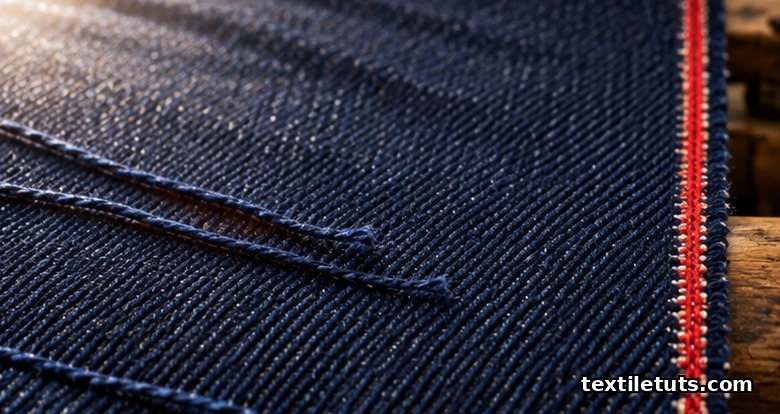
Selvedge denim is woven on a shuttle loom at 150 to 200 picks per minute, producing 30 to 40 meters of fabric per hour with a self-finished edge that cannot fray, while modern projectile looms run at 1,000+ picks per minute and cut the fabric at the selvage, leaving a raw edge that must be sealed with an overlock stitch.
That narrow selvedge (also spelled selvage) is what gives shuttle-loom denim its tighter weave, heavier weight, and the slow fade patterns denim enthusiasts look for, and it is also why selvedge jeans cost roughly two to three times more than a pair cut from projectile-loom fabric.
This article walks through how a shuttle loom actually weaves, why the selvedge forms, the measurable differences in fabric weight and tensile strength between shuttle and projectile denim, how to identify genuine selvedge, and whether the premium is worth it.
How a Shuttle Loom Actually Weaves
A shuttle loom carries the weft (filling) yarn across the warp shed on a wooden or metal shuttle that physically travels from one side of the warp to the other, then loops back on the return pick. Because the shuttle enters the shed and exits through a fixed channel, the weft yarn turns tightly at each edge, locking the outermost warp ends into the weave. That locked turn creates the selvedge, a narrow band (usually 5 to 10 mm wide) running the full length of the fabric.
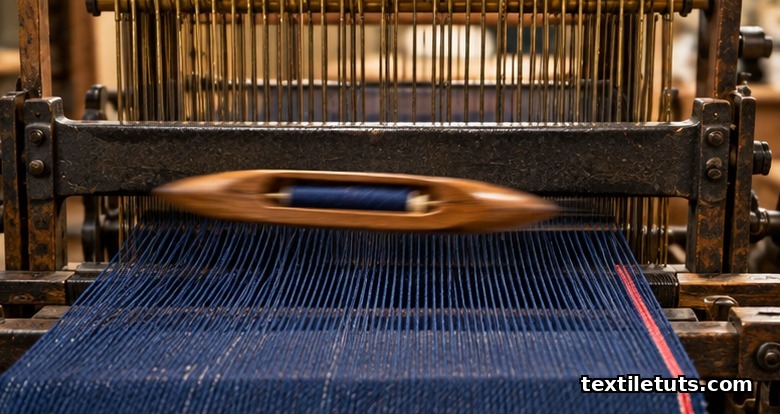
Shuttle looms run slowly for a reason. A typical weaving shuttle is accelerated, thrown across the warp in roughly 0.1 to 0.2 seconds, decelerated, and stopped. The kinetic energy required at 200 picks per minute is already substantial, and pushing the shuttle faster risks breaking it or the warp yarns. In contrast, a modern projectile (rapier or air-jet) loom grips the weft with a metal projectile or air stream and shoots it across a wide shed in a single beat-up. Modern projectile looms run at 1,000 to 1,800 picks per minute across fabric widths of 150 to 190 cm, producing 200+ meters of fabric per hour.
The shuttle loom’s slower pace has three direct consequences for the cloth: tighter warp tension (because the loom does not have to throw the shuttle hard), lower machine stretch on the warp (because picks are inserted gently), and a fabric width limited to roughly 75 to 90 cm (the shuttle must traverse the full warp width in a single arc). All three of these factors show up in the finished denim.
Why the Selvedge Matters
On a projectile loom the weft is cut at each edge of the fabric, leaving loose ends that have to be sealed by overlocking or hemming. The fabric is sold “cut edge,” and any garment made from it has a finished seam running along the outseam to stop fraying. On a shuttle loom the weft turns back into the warp at each side, so the edge is structurally closed by the weave itself. Cut a piece of selvedge denim and rub the cut edge: only the cut edge frays; the selvedge itself will not.
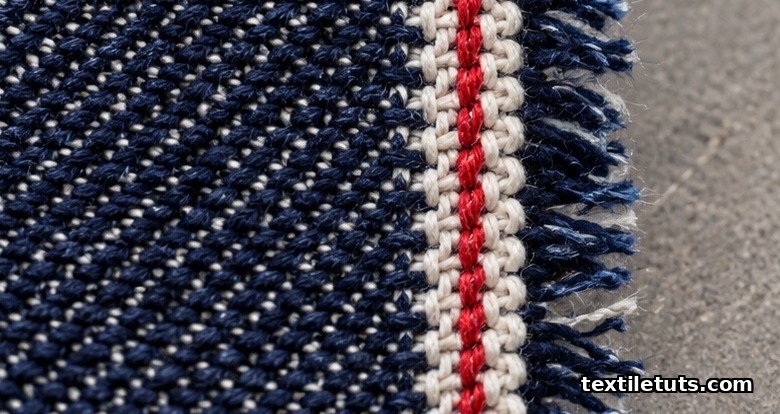
The selvedge also serves as a fingerprint for the mill. Japanese shuttle mills traditionally use a red selvedge (Kaihara, Kuroki, Ishinoya); Cone Mills in Greensboro, North Carolina used a white selvedge on its White Oak line until that mill closed in 2017; Italian mills such as Candiani use green or yellow. The color is woven into the weft yarn that loops back at the edge, so the ID stays in the fabric for the life of the garment.
Selvedge vs Projectile Loom Denim: A Comparison Table
| Property | Shuttle loom (selvedge) | Projectile loom (modern) |
|---|---|---|
| Weft insertion method | Wooden/metal shuttle carries weft across shed and back | Metal projectile or air-jet shoots weft across shed |
| Picks per minute | 150 to 200 | 1,000 to 1,800 |
| Fabric output per hour | 30 to 40 meters | 200+ meters |
| Usable fabric width | 75 to 90 cm (30 to 36 in) | 150 to 190 cm (60 to 75 in) |
| Selvedge (self-edge) | Yes, woven in; cannot fray | No; edge is cut and must be overlocked |
| Typical fabric weight | 14 to 16 oz/yd² (475 to 540 g/m²) | 10 to 12 oz/yd² (340 to 410 g/m²) |
| Warp tension profile | Lower, more even | Higher, more variable across width |
| Cost per meter (wholesale, 2025) | USD 18 to 35 | USD 6 to 12 |
| Typical retail jean price | USD 180 to 400+ | USD 40 to 120 |
Fabric Weight, Yarn Count, and Tensile Properties
Selvedge denim typically comes off the loom at 14 to 16 oz/yd² (475 to 540 g/m²), measured under ASTM D3776/D3776M, which is the standard mass-per-unit-area test for woven fabrics. Projectile-loom denim for mass-market jeans usually weighs 10 to 12 oz/yd² (340 to 410 g/m²). The weight difference is driven by yarn count: shuttle-loom denim is most often woven from coarser ring-spun yarns in the Ne 6 to Ne 9 range (equivalent to roughly 660 to 990 denier), while projectile-loom denim uses finer Ne 12 to Ne 16 yarns.
The shuttle loom’s lower pick rate also means the weaver can run heavier warp tension without breaking ends, which packs more weft into each centimeter of fabric. A typical 3/1 right-hand twill selvedge denim from a Japanese mill runs 60 to 70 ends per cm in the warp and 18 to 22 picks per cm in the weft; a comparable projectile-loom denim from a Bangladesh or Pakistani mill runs 36 to 42 ends per cm and 16 to 20 picks per cm. The denser warp gives the fabric a stiffer hand, more body, and more indigo at the surface to fade over time.
Tensile and tear strength are tested under ASTM D5034 (grab method) and ASTM D1424 (Elmendorf tear). On a 14 oz/yd² shuttle-loom denim, typical grab tensile strength is 800 to 1,100 N in the warp direction and 500 to 700 N in the weft direction, with Elmendorf tear strength of 80 to 120 N warp and 60 to 90 N weft. Projectile-loom denim of the same weight usually falls 10 to 20% lower in tear strength because the looser weave allows yarns to bunch rather than load-share. ISO 3801 confirms mass-per-unit-area; ISO 13934-1 confirms tensile properties by the strip method. The numbers are real, repeatable, and traceable to a loom type.
Why Selvedge Denim Fades the Way It Does
Fading in denim is driven by the contrast between dyed warp yarns (indigo, mostly on the surface) and undyed weft yarns (white, hidden inside the fabric). As the garment is worn and washed, the warp surface loses indigo at the high-stress points (knees, hips, back of the ankles) while the low-stress areas hold their color. The sharper that contrast, the more dramatic the fade.
Shuttle-loom denim fades more dramatically for two reasons. First, the rope-dyed indigo on shuttle-loom yarn typically penetrates only 30 to 40% of the yarn cross-section (verified under microscopy in peer-reviewed denim research), so there is a thick white core that becomes visible as the surface indigo wears away. Second, the denser warp packs more dyed surface per square centimeter, so there is more indigo to lose before the white core dominates.
Shrinkage behavior is governed by AATCC TM 135 (dimensional change after home laundering). Unsanforized shuttle-loom denim, sold by Japanese mills like Iron Heart and Pure Blue Japan, can shrink 8 to 12% on the first warm wash. Sanforized selvedge denim (pre-shrunk at the mill by passing through a rubber-belt compactor) shrinks 1 to 3%. Most mass-market projectile-loom denim is sanforized to 1 to 2% because the looser weave responds more unevenly to uncontrolled shrinkage.
How to Identify Genuine Selvedge Denim
Three checks, in order of reliability:
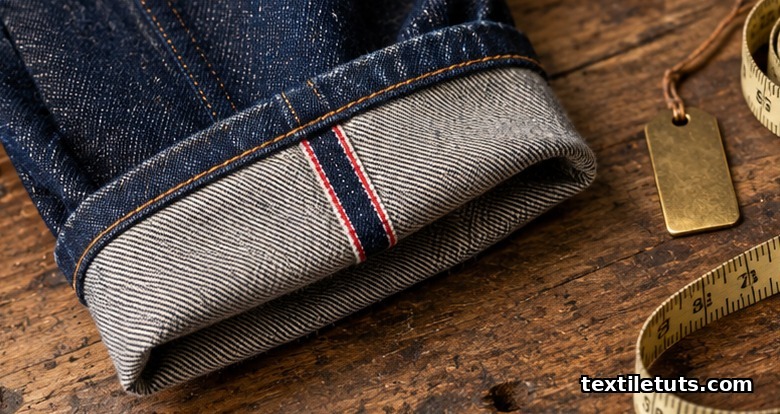
1. The cuff. Turn up the inside of an outseam and look for a narrow, tightly woven band along the edge. If the band is present and runs the full length of the seam, the fabric is selvedge. If you see a serged or overlocked edge instead, it is cut-edge projectile-loom denim.
2. The selvedge color. Most mills use a signature color: red for Japanese shuttle mills (Kaihara, Kuroki), white for historical Cone Mills White Oak, green for some Italian mills (Candiani). Some specialty mills use orange, blue, or split colors.
3. Fabric weight. Selvedge denim usually weighs 14 oz/yd² or more. A 10 oz/yd² fabric labeled “selvedge” is almost certainly mislabeled.
A fabric mill certificate or a hand-loom mark from the mill (such as Iron Heart’s “Made in Japan” tag) is the strongest verification, but the cuff check is enough for 95% of cases.
Frequently Asked Questions
What is selvedge denim, in plain terms?
Selvedge denim is denim woven on a shuttle loom so that the weft yarn turns back at each edge of the fabric, locking the outermost warp threads into the weave. The result is a self-finished edge that cannot fray, with a usable fabric width of 75 to 90 cm. Most modern denim is woven wider on projectile looms and cut at the edges, then overlocked.
Are shuttle looms slower than modern looms?
Yes, by a wide margin. Shuttle looms run at 150 to 200 picks per minute and produce 30 to 40 meters of fabric per hour. Modern projectile (rapier or air-jet) looms run at 1,000 to 1,800 picks per minute and produce 200+ meters per hour. The shuttle loom’s slower pace is mechanical: the wooden shuttle has to be accelerated, thrown, and stopped on every pick, which limits speed.
Why is selvedge denim more expensive than regular denim?
Three reasons stack up. The shuttle loom is roughly five to six times slower than a projectile loom, so labor and machine time per meter of fabric are higher. Selvedge denim is woven 75 to 90 cm wide instead of 150 to 190 cm, so each pair of jeans uses about 1.8 to 2.0 meters of fabric instead of 1.3 to 1.5 meters. Finally, selvedge denim is usually rope-dyed with indigo and sanforized or left unsanforized, both of which add processing steps. Wholesale selvedge denim sells for USD 18 to 35 per meter versus USD 6 to 12 for projectile-loom denim.
Does selvedge denim fade better than non-selvedge denim?
Yes, in the sense that the contrast between indigo-dyed warp and undyed weft is sharper. Rope-dyed indigo on shuttle-loom yarn typically penetrates 30 to 40% of the yarn cross-section, leaving a thick white core that becomes visible as the surface indigo wears. The denser warp on shuttle-loom denim (60 to 70 ends/cm vs 36 to 42 ends/cm on projectile denim) puts more dyed surface per square centimeter, so the high-contrast fades that denim enthusiasts prize are stronger and more defined.
Is selvedge denim worth the extra cost?
It depends on what you are buying. If you want a heavier fabric (14 to 16 oz/yd²), a tighter weave, a self-finished edge that will not fray, and sharper fades, selvedge denim is the only option that delivers those properties at the source. If you want a lighter, softer, cheaper pair of jeans for everyday wear, projectile-loom denim at 10 to 12 oz/yd² is a better fit and the fade contrast is less dramatic but still present. Neither is universally better; they are different products for different priorities.
References
- ASTM International. ASTM D3776/D3776M-20, Standard Test Methods for Mass Per Unit Area (Weight) of Fabric. https://www.astm.org/d3776_d3776m-20.html — Standard mass-per-area test used to confirm the 14 to 16 oz/yd² weight of shuttle-loom denim.
- ASTM International. ASTM D5034-21, Standard Test Method for Breaking Strength and Elongation of Textile Fabrics (Grab Method). https://www.astm.org/d5034-21.html — Grab tensile test used for warp and weft strength of denim.
- ASTM International. ASTM D1424-21, Standard Test Method for Tearing Strength of Fabrics by Falling-Pendulum (Elmendorf) Type Apparatus. https://www.astm.org/d1424-21.html — Elmendorf tear test referenced for the warp and weft tear strength values cited above.
- ISO. ISO 3801:1977, Textiles — Woven fabrics — Determination of mass per unit length and mass per unit area. https://www.iso.org/standard/9014.html — International counterpart to ASTM D3776 for mass per unit area.
- ISO. ISO 13934-1:2013, Textiles — Tensile properties of fabrics — Part 1: Determination of maximum force using the strip method. https://www.iso.org/standard/60676.html — Strip tensile method for woven fabric tensile strength.
- AATCC. AATCC TM 135-2018, Dimensional Changes of Fabrics after Home Laundering. https://www.aatcc.org/testing/methods/ — Reference method for the 8 to 12% first-wash shrinkage of unsanforized shuttle-loom denim.
- Springer Nature. Denim: Manufacture, Finishing and Applications (Woodhead Publishing Series in Textiles). https://link.springer.com/ — Peer-reviewed reference covering shuttle-loom weaving, rope dyeing, and sanforization of denim.
This article is the working reference for selvedge denim and shuttle-loom weaving. Editorial by Shahrukh Islam, TextileTuts. Sources: ASTM D3776, ASTM D5034, ASTM D1424, ISO 3801, ISO 13934-1, AATCC TM 135, and Woodhead Publishing as cited.


