
Tweed Weaving

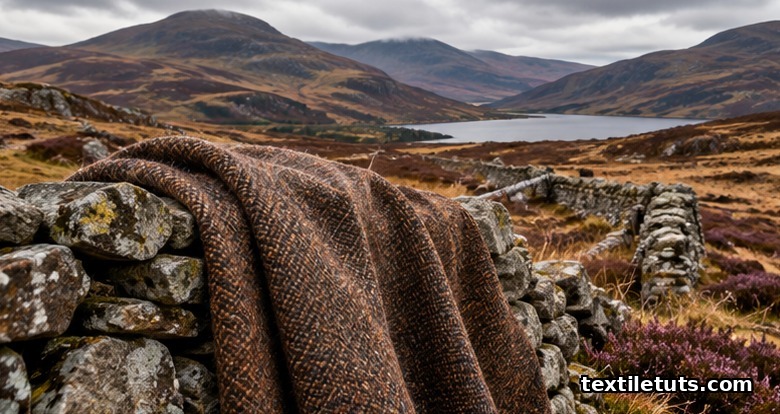
Tweed is a rough, woven woolen fabric of soft, open, flexible texture, traditionally produced in Scotland from 100% virgin wool (most commonly Cheviot or Scottish Blackface) woven in a 2/2 twill at fabric weights of 400–700 g/m².
The name became attached to the cloth in the 1830s after a London clerk reportedly mistook “tweel” (the Scots word for twill) for “tweed,” a river running through the mill’s home area, and the spelling stuck across British textile trade.
This guide covers tweed’s origin, the four recognized Scottish and Irish variants, the spinning and weaving steps behind authentic cloth, the fiber-property science behind its warmth and weather resistance, the common weave patterns used, and the care practices that keep a tweed garment serviceable for decades.
Origin and history of tweed
Tweed developed in the Scottish Highlands and Islands during the 18th and 19th centuries as a hardwearing outer cloth for farmers, gamekeepers, and estate workers. The earliest commercial production was centered in the Border country and the Outer Hebrides, where small-scale hand-loom weavers turned local fleece into a coarse, weather-resistant cloth suited to damp winters.
The cloth’s wider reputation grew after Prince Albert purchased the Balmoral estate in 1848 and commissioned estate tweed in the now-familiar grey-and-red check. Aristocratic patrons followed, and by the 1860s “tweed” was a global synonym for country clothing associated with British landownership and sporting estates. Harris Tweed was registered as a certification mark in 1909, becoming one of the earliest protected geographical indications in textiles.
The Harris Tweed Act of 1993 codified the modern definition: cloth must be handwoven by the islanders at their homes in the Outer Hebrides, finished in the Outer Hebrides, and made from pure virgin wool dyed and spun in the Outer Hebrides. This legal protection distinguishes genuine Harris Tweed from generic woolen fabrics sold under the same name.
The four principal types of tweed
Several regional variants exist under the tweed umbrella, each tied to a specific fiber source, dye tradition, or weave structure.
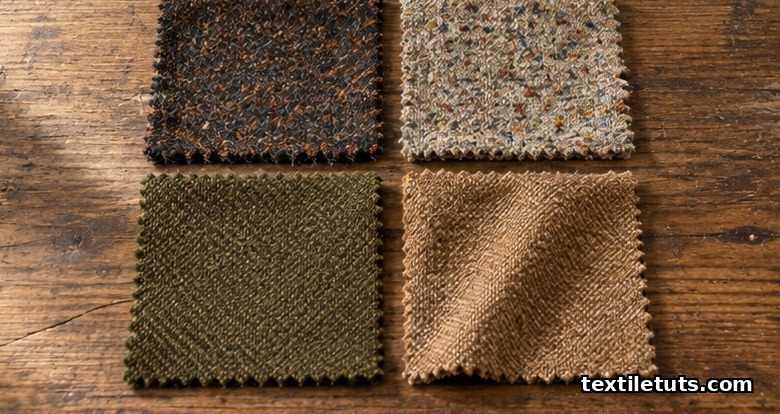
Harris Tweed is the most legally protected, woven by hand on the islands of Lewis and Harris using wool from Scottish Blackface or Cheviot sheep. The cloth is finished, dyed, and spun locally, producing flecked, heathered colors from blended staple fibers rather than twisted-color yarns.
Donegal tweed originates in County Donegal, Ireland, where coarse plain-weave woolen yarn is interwoven with small slubs of contrasting color to give a distinctive speckled appearance. Production uses both hand-loom and power-loom methods.
Cheviot tweed is named for the Cheviot Hills along the English-Scottish border and uses wool from Cheviot sheep, which yield a finer, more lustrous staple than Blackface. The result is a tighter, slightly smoother cloth.
Saxony tweed is woven from Merino-type fibers, often spun on the continent, producing a soft, lighter cloth suited to suiting rather than outdoor wear.
How tweed is made: from fleece to fabric
Authentic tweed production follows a sequence of fiber-preparation steps that differ from worsted processing. Woolen (not worsted) spinning is essential, because the air-trapping fiber arrangement produces the cloth’s warmth and bulk.
1. Scouring and dyeing. Raw fleece is washed to remove lanolin and vegetable matter, then dyed either as loose fiber (top dyeing) or after spinning (yarn dyeing). Heathered effects come from blending dyed and undyed fibers before carding.
2. Carding. Fibers pass through a carding machine that separates and aligns them into a web, then condenses the web into a roving. Woolen carding preserves fiber randomness, which gives tweed its irregular, lofty hand.
3. Spinning. The roving is drafted and twisted on a woolen-spinning frame. Woolen yarns are typically low-twist, thick, and slightly uneven compared with worsted yarns, contributing to the fabric’s surface texture.
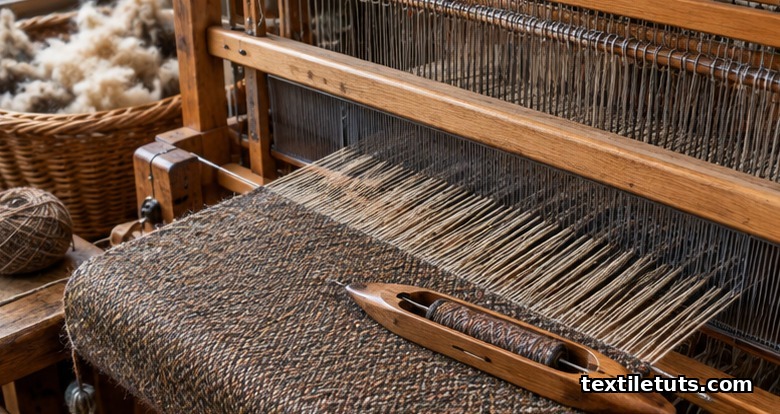
4. Weaving. Warp and weft yarns are interlaced on a loom, most commonly in a 2/2 twill that produces the diagonal lines visible in plain tweed. Patterned tweeds (herringbone, houndstooth, gun club checks) require additional shafts or a dobby mechanism to lift specific warp ends.
5. Finishing. The woven cloth is scoured (washed), beaten or pressed to consolidate the weave, and cropped to a uniform pile height. Some tweeds are raised (brushed) to develop a soft surface nap; others are left crisp.
Fiber properties: why tweed performs the way it does
Tweed’s performance properties come directly from the wool fiber itself and from the woolen-spinning approach. Wool fibers have a natural crimp that traps still air, and the cortex of each fiber is built from coiled keratin protein chains. When wool absorbs moisture (up to 30% of its dry weight without feeling wet), the fiber releases a small amount of heat through the absorption process, an effect called heat of sorption.
The natural water-repellent surface of wool comes from the epicuticle, a thin waxy layer that sheds liquid water while allowing vapor to pass. Combined with the fabric’s open weave, this produces a cloth that breathes during moderate exertion yet sheds rain during sustained exposure.
Wool is also naturally flame resistant: ignition requires temperatures above 570–600 °C and the fiber self-extinguishes when the source is removed. The same keratin structure resists bacterial growth, which is why woolen garments require less frequent washing than cotton or synthetics.
Fabric weight is the principal indicator of end use. Tweeds lighter than 350 g/m² suit spring and summer jackets and trousers; 400–500 g/m² is the classic suiting range; 500 g/m² and above is reserved for heavy topcoats and overcoats.
Common tweed patterns
Most pattern variation in tweed comes from yarn color and weave structure rather than printed decoration. Four patterns dominate.
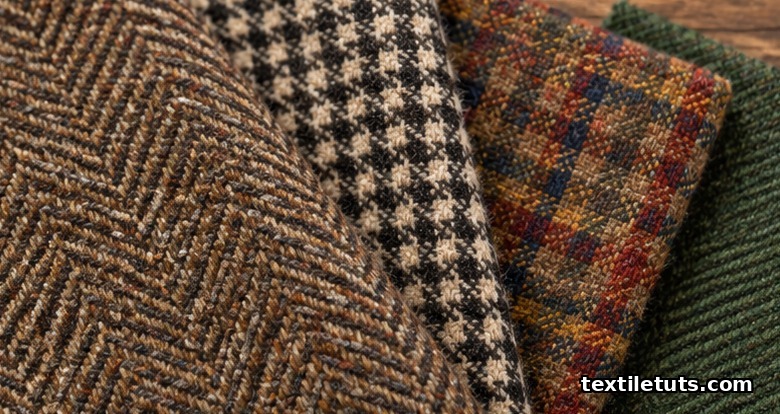
Plain twill. The basic 2/2 twill produces diagonal lines running in one direction, most often visible as a subtle texture in solid-colored cloth.
Herringbone. Created by reversing the twill direction at regular intervals, herringbone forms a broken V-shape that resembles fish bones. The structure lays flatter than plain twill, which is why it is favored for tailored jackets.
Houndstooth. A duotone pattern made by a specific arrangement of warp and weft color blocks, producing small four-pointed shapes that look like a dog’s tooth.
Gun club check. A windowpane-like check, typically in three or four colors, that became standard for country-sport jackets in the early 20th century.
Comparing the four principal tweeds
| Property | Harris Tweed | Donegal | Cheviot | Saxony |
|---|---|---|---|---|
| Fiber source | Scottish Blackface, Cheviot | Irish mountain sheep | Cheviot | Merino-type |
| Typical weight (g/m²) | 450–700 | 300–500 | 350–500 | 250–400 |
| Common weave | 2/2 twill, herringbone | Plain weave with slubs | 2/2 twill, plain | 2/1 or 2/2 twill |
| Production method | Hand-loom, certified | Hand-loom and power-loom | Power-loom | Power-loom |
| End use | Jackets, topcoats | Sport coats, caps | Suiting, jackets | Light suiting |
| Geographic protection | Yes (UK law) | No | No | No |
Care and maintenance of tweed
Tweed’s care regime is shaped by its wool content. Wool fiber scales open in warm water and alkaline conditions, which causes felting shrinkage that cannot be reversed. Standard machine washing is therefore unsuitable for structured tweed garments.
Brush the garment with a soft clothes brush after each wear to remove surface dust and lint. Air the cloth on a wide wooden hanger in a well-ventilated space; wool’s natural odor resistance means most refreshes require airing rather than washing.
For season-end cleaning, dry-clean sparingly, since perchloroethylene solvents can strip natural lanolin and dull the surface over repeated cycles. Spot-cleaning with a damp cloth and a wool-safe detergent handles most marks. Press with a damp pressing cloth on a low iron setting (silk/wool, ~150 °C) to avoid shine and scorching.
Store in a breathable cotton garment bag. Plastic covers trap moisture and can lead to mildew on stored wool. Use cedar blocks or lavender sachets rather than mothballs; both deter clothes moths without leaving chemical residues on the cloth.
Frequently Asked Questions
What makes tweed different from regular wool suiting?
Tweed is woven from woolen-spun yarns, where fibers lie in random directions and trap more air, producing a thicker, warmer cloth. Regular wool suiting uses worsted-spun yarns, where fibers are combed parallel before spinning, yielding a smoother, denser, and lighter fabric suitable for office wear.
Is tweed waterproof?
Tweed is water resistant, not waterproof. The combination of wool’s water-repellent epicuticle and the fabric’s open weave allows the cloth to shed light rain for 30–60 minutes before moisture penetrates. For sustained wet weather, look for a laminated or waxed version or treat the cloth with a wool-safe water-repellent spray.
Why is Harris Tweed more expensive than other tweeds?
Harris Tweed is handwoven in the Outer Hebrides using wool dyed, spun, and finished locally, a process governed by the Harris Tweed Act 1993. The labor-intensive hand-weaving step, the certification overhead, and the legal restrictions on production volume all contribute to a higher retail price than power-loom alternatives.
Does tweed shrink when washed?
Untreated tweed will shrink by 10–25% in length and width if machine washed in warm water due to felting of the wool scales. Dry cleaning or careful hand washing in cold water (≤30 °C) with a wool-specific detergent avoids this dimensional change.
How long does a tweed jacket last?
A well-made tweed jacket worn on rotation typically lasts 15–30 years before the cloth shows visible wear at high-friction points (cuffs, pockets, elbows). Rotating between two jackets and brushing after each wear extends service life further; some estate tweeds from the early 20th century remain in active use today.
References
- International Organization for Standardization. ISO 6938:2012 Textiles: Natural fibres, generic names and definitions. iso.org. Defines wool fiber categories referenced in this article.
- The Woolmark Company. Wool Fiber Properties. wool.com. Reference data on moisture regain, flame resistance, and keratin composition of wool.
- Harris Tweed Authority. Definition of Harris Tweed. harristweed.org. Statutory definition of Harris Tweed under the Harris Tweed Act 1993.
- Encyclopaedia Britannica. Tweed (textile). britannica.com. Historical and manufacturing summary of tweed.
- Cottle, D.J. International Sheep and Wool Handbook. Springer, 2010. link.springer.com. Comprehensive reference on wool types including Cheviot and Scottish Blackface.
- ASTM International. ASTM D461: Standard Test Methods for Felt. astm.org. Standardized methods relevant to woolen fabric evaluation.
This article is the working reference for tweed weaving. Editorial by Mohammad Yousuf (Anik), TextileTuts. Sources: ISO 6938:2012, The Woolmark Company, Harris Tweed Authority, Encyclopaedia Britannica, Cottle (Springer, 2010), ASTM D461 as cited.


