
Trims and Accessories: Complete Guide to Garment Components

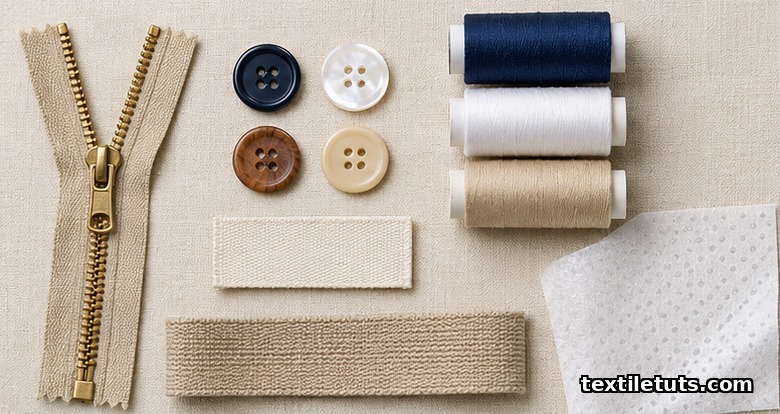
Garment trims and accessories represent 7 to 15 percent of total finished-garment production cost and include both functional components (zippers, buttons, snaps, interlinings, labels, threads, elastic) and decorative elements that must satisfy ISO 15797 industrial-wash, ASTM D4154 zipper-performance, and AATCC TM135 dimensional-change standards before reaching production.
Trims carry the second-largest weight in apparel construction after the main fabric, and a single failing component can reject an entire shipment at the buyer QC stage. This guide covers what trims and accessories are, how the industry classifies them, the material science behind each category, the standards that govern their performance, common defects and how to prevent them, and the sourcing economics behind a finished BOM.
What Counts as a Trim and What Counts as an Accessory
Textile manufacturers and buyers separate components into two functional buckets. Trims are the parts attached to a garment during manufacturing that make it wearable: closures, reinforcements, fasteners, threads, and labels. Accessories are decorative or branding items that may be removable and are not always sewn in, such as belts, scarves, removable brooches, patches, hangtags, and packaging inserts.
The distinction matters in the bill of materials (BOM). Trims are listed under “CMT trim cost” and tested against mandatory performance standards. Accessories usually fall under “packaging and merchandising” and carry softer requirements, though metal accessories in children’s wear must still meet CPSIA lead-content limits under U.S. import law and EN 71-3 migration limits in Europe.
The Six Functional Trim Categories
Every garment, from a basic T-shirt to a tailored blazer, uses at least three trim categories. A complex woven piece like a denim jacket uses all six.
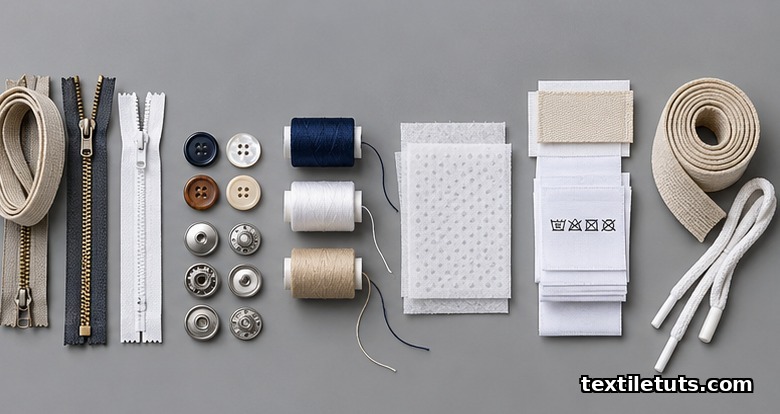
1. Closures: Zippers, buttons, snaps (press studs), hooks and eyes, toggles, hook-and-loop tape, and magnetic clasps. Zippers alone come in four construction types (coil, metal, molded plastic, and vislon) and are graded by slider pull-off strength and chain crosswise strength per ASTM D4154.
2. Sewing threads: Spun polyester, core-spun polyester-cotton, and filament polyester threads. Thread size is denoted by Tex (weight in grams of 1000 m) or by ticket number; a Tex 25 (40s) thread is the global standard for shirting, while Tex 60 to 80 covers denim and outerwear. Thread shrinkage must stay under 3 percent after five home launderings per AATCC TM135 to prevent seam puckering.
3. Interlinings and fusibles: Woven, knit, or nonwoven fabrics coated with thermoplastic resin (usually polyester or polyamide) that are heat-bonded to collars, cuffs, waistbands, and fronts to give shape. Fusible interlining bond strength is verified by ISO 9138 (peel strength) and wash resistance per ISO 15797.
4. Labels and care labels: Main label (brand), size label, composition label, country-of-origin label, and care label. Care labels in the U.S. must follow FTC 16 CFR Part 423 (Care Labeling Rule) and in Europe follow EN ISO 3758 symbols. Care labels must survive 50 home launderings per AATCC TM135 without losing legibility.
5. Linings and pocketings: Inner fabrics used in jackets, trousers, blazers, and bags. Pocket bag fabric is typically a lightweight polyester or cotton; lining is usually viscose, polyester, or acetate.
6. Elastic, drawcords, and tapes: Knit or woven elastic, braided drawcords with metal or plastic tips, twill tape, seam tape, and stay tape. Elastic elongation at load is tested per ASTM D4964.
Decorative Accessories and Brand Identity Items
Accessories include any non-essential components used for branding or styling: metal or plastic badges, embroidered patches, rivets, decorative buttons, bows, sequins, beads, appliques, and appliqué lace. Hangtags, polybags, and tissue paper fall into packaging accessories.
Brand-driven accessories such as embroidered logos or printed patches must match the wash-fastness of the main garment. A patch that survives 30 home washes per AATCC TM135 is the typical minimum for fast-fashion branded items; premium labels target 50 or more washes. Mis-matched wash-fastness is the single most common cause of branded-accessory returns at the consumer stage.
Material Science Behind Common Trims
Buttons are commonly made from polyester resin (most common), metal (brass, aluminum, stainless steel), natural materials (corozo, wood, leather, mother-of-pearl), or polyamide. Plastic button impact resistance is tested by ASTM D5420 (falling-weight impact). Metal buttons must pass nickel-release limits per EN 1811, with a ceiling of 0.88 micrograms per square centimeter per week for prolonged skin contact.
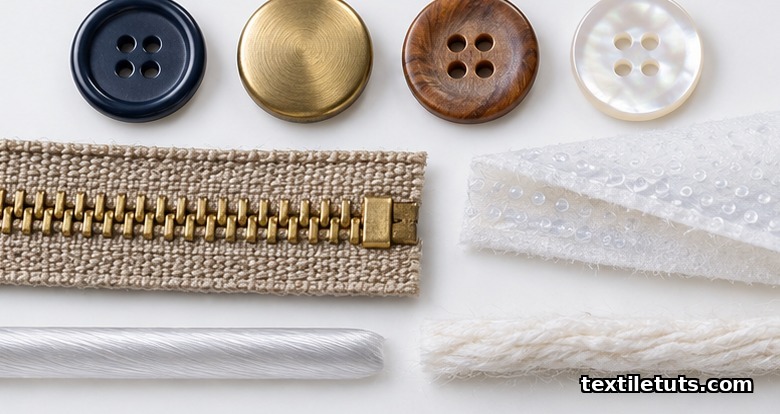
Zippers: Coil zippers use polyester or polyamide monofilament; metal zippers use brass, aluminum, or nickel-silver alloy. Slider pull-off strength, chain crosswise strength, and slider locking strength are all rated by ASTM D4154. A standard 5 mm metal zipper for jeans must resist at least 70 N of slider pull-off force and 750 N of chain crosswise strength.
Fusible interlinings: The hot-melt adhesive layer is typically polyethylene or polyamide with a melt point between 110 degrees C and 160 degrees C. Selecting the wrong adhesive melt point causes two recurring defects: “strike-through” (adhesive seeps through the face fabric during fusing) or “strike-back” (the adhesive fails to bond and forms bubbles after the first wash).
Threads: Continuous-filament polyester has higher tensile strength and lower lint than spun polyester, which is why it is preferred for industrial sewing of denim and technical outerwear. Core-spun polyester-cotton combines a polyester filament core wrapped in cotton fibers, giving the strength of polyester with the heat-resistance of cotton at the needle.
Standards Governing Trim Performance
Garment trim performance is governed by international ISO, ASTM, and AATCC standards. The most commonly referenced in trim QC include:
- ISO 15797: Industrial washing and finishing procedures for test fabrics, including those carrying trims.
- ASTM D4154: Standard performance specification covering zipper and closure performance for knitted and woven apparel.
- AATCC TM135: Dimensional changes of fabrics after home laundering, the baseline test for care label durability.
- ISO 3175: Dry-cleaning procedures for textiles and attached trims.
- ASTM D4964: Standard test method for tension and elongation of elastic fabrics.
- EN ISO 3758: Care labeling code using symbols.
- ASTM D5420: Standard test method for measuring the impact resistance of flat plastic specimens (used for plastic buttons).
- ISO 9138: Test method for determination of bond strength of fusible interlinings.
- EN 1811: Nickel release reference test method for articles intended to come into direct and prolonged contact with the skin.
Common Trim Defects and How to Prevent Them
The four most common trim-related rejections at final inspection:
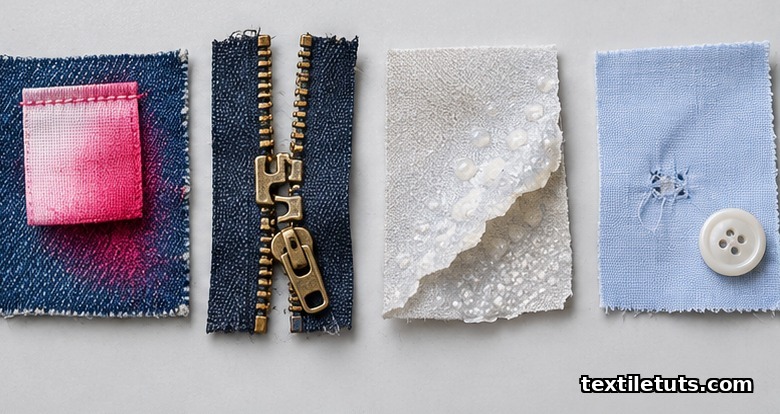
1. Color bleeding or staining: A trim dyed with low-fastness dyes (especially red, navy, and black) bleeds onto the main fabric during washing or perspiration. Test before bulk production with AATCC TM15 (colorfastness to bleeding) and AATCC TM8 (colorfastness to crocking). Most trim mills will issue a separate fastness certificate for each dye lot.
2. Zipper failure: Zipper teeth bend, sliders separate, or pull tabs break. Causes: incorrect slider size for the chain, low-grade metal, or chain crosswise strength below specification. Prevention: source zippers rated to ASTM D4154 with documented lot test certificates, and match slider-to-chain tolerances at the trim receipt stage.
3. Interlining delamination: The fusible layer separates from the face fabric after one or two washes. Cause: adhesive melt point too high for the face fabric, or insufficient bonding pressure or dwell time during fusing. Prevention: match adhesive melt point to face-fabric composition, and verify bond strength with the ISO 9138 peel test on the first 50 pieces of a production lot.
4. Broken or missing buttons: Button pull-off strength is below 20 N, the typical minimum for shirt buttons. Cause: low-stitch-count attachment, weak button material, or improper thread tension. Prevention: use button-sewing machines set to the correct stitch count (typically 12 to 16 stitches per button), and verify with ASTM D3653 button pull-out testing.
Sourcing and Cost Considerations
Trims are usually sourced separately from the main fabric, often by the buying house or the garment manufacturer’s merchandising team. Asia (China, Bangladesh, India, Vietnam) supplies more than 70 percent of the world’s apparel trims, with specialty trim clusters in YKK’s zipper factories (China, Vietnam, Bangladesh), Coats Industrial (thread, multiple Asian plants), and Hangzhou XinRan (interlining).
The trim cost in a finished garment typically breaks down as: thread 2 to 3 percent, zipper 1 to 4 percent, buttons and snaps under 1 percent, labels under 1 percent, interlining 1 to 3 percent, and packing materials 2 to 5 percent. The total trim cost for a woven shirt averages 12 to 18 percent of the CMT (cut-make-trim) cost; for denim, it can reach 22 percent due to rivets, leather patches, and heavier thread.
Eco-friendly alternatives now exist for almost every trim category: recycled polyester thread from PET bottles (GRS-certified), buttons from corozo (tagua palm) or compressed paper, recycled metal hardware, water-based adhesives for fusibles, and cotton care labels printed with low-impact reactive dyes. The TextileTuts editorial team increasingly specifies these alternatives in its internal product reviews where durability requirements allow, and notes the cost premium that buyers should expect.
Frequently Asked Questions
What is the difference between trims and accessories in apparel manufacturing?
Trims are functional components attached during manufacturing that make the garment wearable: zippers, buttons, thread, interlinings, labels, elastic, and linings. Accessories are decorative or branding items that may be removable: belts, scarves, patches, hangtags, and brooches. Trims are tested against mandatory performance standards, while accessories carry softer requirements. The exception is metal accessories in children’s wear, which must meet CPSIA and EN 71-3 limits.
How do you select the right zipper for a specific garment?
Match zipper type to end use: coil zippers for lightweight knits and casual wear, metal zippers for denim and leather, molded-plastic (vislon) zippers for outerwear and workwear. Verify slider pull-off strength (at least 70 N for jeans), chain crosswise strength (at least 750 N for standard 5 mm), and slider locking strength per ASTM D4154. Always source from suppliers with documented lot test certificates for each production batch.
What standards must trims meet for export to the United States and Europe?
U.S.-bound trims must meet CPSIA lead-content limits (90 ppm for substrates, 100 ppm for accessible materials) and FTC care-labeling rules under 16 CFR Part 423. EU-bound trims must meet REACH chemical restrictions, EN 1811 nickel-release limits (no more than 0.88 micrograms per square centimeter per week for skin contact), and EN ISO 3758 care labeling. Performance is verified against ISO 15797, ASTM D4154, AATCC TM135, and ISO 3175 depending on the trim and end use.
How much do trims add to total garment cost?
Trims and packaging add 12 to 18 percent to the CMT cost of a woven shirt, 18 to 22 percent to a denim piece, and 7 to 15 percent to a basic knit T-shirt. Within trims, thread accounts for 2 to 3 percent of the CMT cost, zippers 1 to 4 percent, interlinings 1 to 3 percent, and packaging 2 to 5 percent. Premium trims such as YKK metal zippers or branded buttons can lift the trim share above 25 percent.
What are the most eco-friendly trim options available today?
Recycled polyester thread (GRS-certified from PET bottles), corozo or compressed-paper buttons, recycled metal hardware, water-based fusible adhesives, and cotton care labels printed with low-impact reactive dyes are commercially available and pass standard ISO 15797 wash cycles. Their cost premium over virgin alternatives ranges from 5 to 25 percent depending on the trim category and minimum order quantity. Recycled metal hardware remains the most expensive at roughly 20 to 25 percent above virgin brass.
This article is the working reference for apparel trims and accessories classification, material selection, and quality standards. Editorial by Kazi Sifat Muntasir, TextileTuts. Sources: ISO 15797, ASTM D4154, AATCC TM135, ISO 3175, EN ISO 3758, ASTM D5420, ISO 9138, EN 1811 as cited.


