
Shapewear Materials and Design

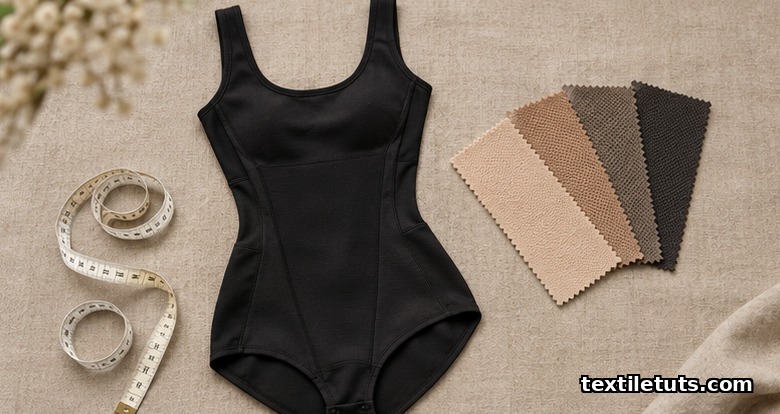
Modern shapewear delivers graduated compression of 10 to 40 mmHg across the torso through engineered knit panels containing 18% to 28% elastane, which redistributes subcutaneous tissue and visibly reduces waist circumference by 1 cm to 3 cm during wear while keeping diaphragmatic excursion within normal physiological limits. The garment achieves that result by combining a high-modulus powernet shell, strategically bonded seams, and a panel layout that maps each anatomical zone to a specific compression class. This article breaks down the construction of contemporary shapewear, the knit structures that carry the compressive load, the elastane ratios used by zone, the sizing and fit standards that govern the size range, and the laboratory tests that verify a garment will hold its compression through 30 to 60 wear cycles.
Shapewear matters as a category because it sits at the intersection of apparel engineering and applied biomechanics. The garment has to compress soft tissue enough to alter the silhouette under fitted clothing, but without compressing the rib cage, abdomen, or diaphragm enough to compromise breathing, circulation, or digestive comfort during a normal 8 to 12 hour wear day. Most peer-reviewed studies on this trade-off have been published through Springer Open and ResearchGate in the past fifteen years, and the testing standards cited here are anchored to ISO, ASTM, and AATCC protocols rather than to brand marketing claims.
Anatomy of a Shapewear Garment
A shapewear piece (whether a high-waist brief, a bodysuit, a thigh slimmer, or a full-length camisole) is built as a map of compression zones, not as a single uniform tube. The garment is drafted from a minimum of four to as many as nine pattern pieces, each cut from a different fabric specification tuned to the pressure required at that body location.
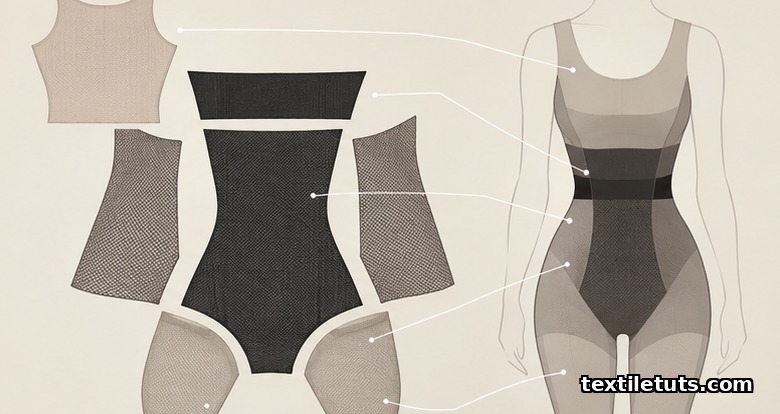
The core panel sits over the abdomen and the lower ribcage. It is the highest-compression zone and is almost always cut from a powernet stabilized with 20% to 28% elastane and a heavier denier polyamide (nylon) face yarn. The waist cinch panel is a horizontal band that targets the natural waistline; it is typically a wide, double-layer powernet with the highest elastane ratio (up to 28%) and the highest modulus. The side panels wrap from the front core to the back, smoothing the love-handle area with a medium-compression powernet of 18% to 22% elastane. The back panel is cut from a softer, lower-modulus knit because it has to flex with every spinal movement; compression here is usually 30% to 40% lighter than at the waist. The leg or thigh panels extend downward in bodysuits and shorts, using a graduated compression that tapers from higher pressure at the upper thigh to lower pressure at the hem so that the garment does not roll or bite into the skin.
Seams are bonded or welded with thermoplastic urethane (TPU) tape in higher-end pieces, and stitched with flat-lock or cover-stitch seams in mid-range pieces. Bonded seams reduce bulk under clothing and prevent the pressure ridges that stitched seams create across the abdomen.
Compression Gradients and Pressure Mapping
Compression in shapewear is reported in millimeters of mercury (mmHg), the same unit used in medical compression stockings. The pressure is generated by the fabric’s elastic recovery force acting against the body’s curvature, so it is highest where the body circumference is smallest relative to the garment circumference and lowest where the two are closer together.
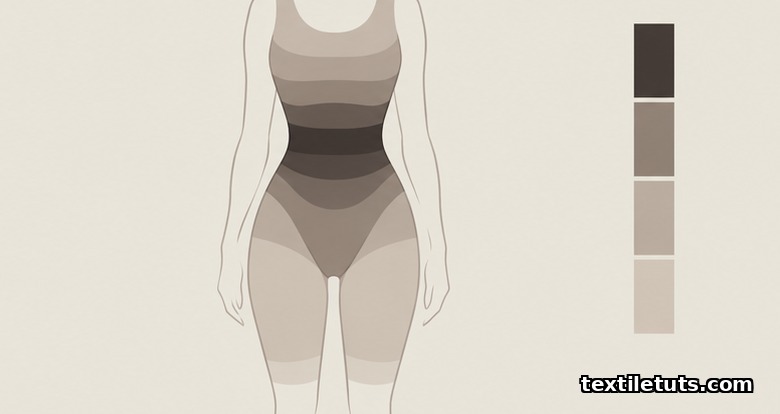
The four commercial compression classes used in the shapewear market are: light (10 to 15 mmHg), used for smoothing under thin knits and for petite body types; medium (15 to 20 mmHg), the everyday smoothing class; firm (20 to 30 mmHg), the standard bridal and special-occasion class; and extra-firm (30 to 40+ mmHg), the post-surgical and waist-training class. The published medical reference for graduated compression is the work on compression stockings by Partsch and colleagues, summarized in dermatology and phlebology literature indexed on PubMed Central, where the same pressure ranges correspond to clinical indications from spider veins (18 to 21 mmHg) through deep vein thrombosis prophylaxis (30 to 40 mmHg).
Effective shapewear applies a true gradient, not uniform pressure. The garment is drafted with a 5% to 15% negative ease at the waist relative to the body measurement and a 2% to 8% negative ease at the bust and thigh, so pressure tapers correctly across zones. A flat-pressure garment (the same stretch around the whole piece) creates a tourniquet effect at the smallest circumference and does little work at the largest, which is why low-cost shapewear that feels uniformly tight often produces poorer smoothing than a properly graduated piece.
Fabric Construction: Powernet, Tricot, and Bonded Laminates
Three knit families dominate shapewear, and the choice between them defines the garment’s compression class, hand feel, and opacity.
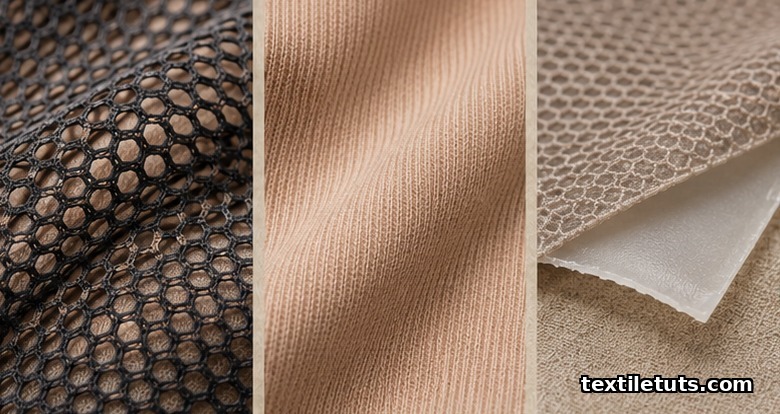
Powernet is the workhorse. It is a raschel warp-knit with a hexagonal mesh structure, an open construction that looks like a fine net. Powernet is engineered by controlling the run-in (the length of yarn fed per rack) of the elastane chain against the polyamide guide bars; a tighter run-in increases the elastane pretension and raises the fabric’s modulus and compression. Powernet weights for shapewear range from 90 g/m² to 220 g/m², with the 150 to 190 g/m² range covering most of the medium and firm compression market. Because powernet is a warp-knit, its stretch is primarily in the cross-machine (weft) direction, which gives the designer independent control of horizontal compression and vertical stability.
Tricot is a finer, smoother warp-knit used in lighter-compression zones and as the lining against the skin. Tricot has a closed construction (no visible mesh) and a softer hand, which is why it lines the cup and panel interiors of higher-end shapewear. Tricot used as a face fabric in shapewear typically runs 80 to 140 g/m² with 10% to 18% elastane, and it delivers the 10 to 15 mmHg class.
Bonded laminates combine a powernet or tricot face with a thin polyurethane (PU) or polyamide foam backing. The laminate adds opacity (so the garment does not show seam lines or panty lines under thin clothing) and adds a small amount of vertical compression by stiffening the fabric. Bonded laminates add 20 to 60 g/m² to the fabric weight and are the default in bodysuits and thigh slimmers where opacity under sheer outerwear matters.
Material Composition by Component
Most shapewear uses between two and four different fabric specifications, with elastane content driving the compression class. The composition by weight typically falls in these ranges:
- Polyamide (nylon): 55% to 78% by weight in the core panel, providing the tensile backbone, abrasion resistance, and dye site for solid colors.
- Elastane (spandex or Lycra): 18% to 28% by weight in the core panel. Below 15% elastane, the fabric cannot reach the firm compression class; above 30%, the fabric loses tensile strength and becomes prone to runs.
- Cotton: a 100% cotton gusset (crotch panel) is industry standard for hygiene and is the only place cotton typically appears in shapewear. The gusset is sewn in as a separate piece and is not part of the compressive structure.
- Polyurethane (PU): appears as the backing of bonded laminates, typically as a 20 to 50 micrometer film.
The elastane fiber itself is almost always a polyether-polyurea copolymer produced by dry spinning, with a linear density between 20 and 70 denier for shapewear. Finer denier elastane (20 to 40 denier) is used in lighter zones; heavier denier (40 to 70 denier) carries the firm-compression panels. The elastane is always bare (uncovered) inside the fabric structure; covered elastane (an elastane core wrapped in polyamide or cotton) is too bulky for the thin knits used in shapewear.
Sizing and Body Mapping Standards
Shapewear sizing follows the same anthropometric standards as other fitted apparel. ISO 8559-1:2017 defines the body landmarks and measurement posture used for size designation of women’s garments, including the waist, high hip, low hip, bust, and underbust. ISO 8559-2 covers men’s and boys’ sizing and applies to male shapewear such as compression tanks and waist trimmers. ISO 4415 specifies how the underbust measurement maps onto the bra label and is referenced where shapewear incorporates a built-in bra shelf.
Most shapewear brands grade in three to five body measurements: bust, waist, high hip, and (for bodysuits and thigh slimmers) low hip and inseam. Size steps are usually 5 cm or 10 cm at the waist and hip, mirroring the cup and band steps of standard bra sizing. The garment is then drafted with the negative-ease gradients discussed above so that the same label fits a 5 cm range at the waist and a 10 cm range at the hip, which is why most shapewear is sold in S/M/L/XL shorthand rather than waist-inch labels.
Quality Testing and Performance Standards
Shapewear is verified against a small set of standardized test methods, almost all of which were originally written for general apparel or intimate apparel and adapted to shapewear through specific tolerance bands.
ISO 139 fixes the standard atmosphere for conditioning textiles before testing (20 °C and 65% relative humidity); every mechanical property cited on a shapewear spec sheet is measured after conditioning to that atmosphere. Stretch and recovery of the powernet and tricot fabrics is reported per ASTM D4964 (Standard Test Method for Stretch and Recovery Properties of Knitted Fabrics Having Low Power) for the lighter zones and per a higher-load protocol for the firm panels. Tensile strength of seams and bonded panels is reported per ISO 13935 (seam tensile properties of fabrics). Dimensional stability to home laundering is graded per AATCC 135, with most shapewear spec sheets requiring less than 5% growth or shrinkage after five wash cycles. Colorfastness to perspiration, washing, and light is graded per the ISO 105 family, the AATCC 135 wash cycle, and AATCC 16 (colorfastness to light).
ASTM D7019 covers performance specifications for intimate apparel including brassieres, and its component-dimension, seam-strength, and hook-and-eye fastening-strength tolerance bands are commonly referenced for shapewear that incorporates a built-in bra shelf. Compliance with the OEKO-TEX Standard 100 is the standard safety benchmark for skin-contact intimate apparel; it limits extractable heavy metals, formaldehyde, and a defined list of aromatic amines that can be released from certain disperse dye residues.
A peer-reviewed reference of particular interest to material specifiers is the biomechanics work on compression garment pressure distribution published through Springer Open and indexed on ResearchGate, which documents how knit structure, elastane denier, and panel geometry together determine the actual pressure delivered at the body surface across wear time.
Frequently Asked Questions
What compression class should I choose for everyday smoothing under clothing?
For everyday wear under standard clothing, the medium class (15 to 20 mmHg) is the practical starting point. It produces a visible 1 cm to 2 cm waist reduction without restricting normal breathing or sitting comfort over an 8 to 12 hour day. The firm class (20 to 30 mmHg) is appropriate for special-occasion wear such as bridal or formal events where the garment is worn for fewer hours, but it is uncomfortable for full workdays.
How long does the compression in shapewear last before it needs replacing?
Most shapewear loses 15% to 25% of its compression over the first 30 wear cycles as the elastane relaxes, with the largest drop in the first 10 cycles. A medium-class garment worn two to three times per week typically holds useful compression for 4 to 6 months; a firm-class garment worn daily usually needs replacement after 2 to 3 months. Hand-washing and air-drying flat extend the useful life by roughly 30% compared with machine-washing and machine-drying.
Is it safe to wear firm shapewear every day?
Firm-class shapewear (above 20 mmHg) compresses the abdominal cavity and can reduce diaphragmatic excursion by 10% to 20% if worn for extended periods. Peer-reviewed work indexed on PubMed Central on compression garment physiology recommends limiting firm-class wear to 6 to 8 hours per day and avoiding wear during heavy exercise or large meals. Anyone with circulatory, respiratory, or digestive conditions should consult a clinician before using firm shapewear regularly.
What is the difference between powernet and a regular stretch knit?
Powernet is a warp-knit with a hexagonal mesh structure that stretches primarily in one direction (cross-machine), which lets the designer set horizontal compression independent of vertical stability. A regular weft-knit stretch fabric (like a standard jersey with elastane) stretches in both directions, which spreads the compression and reduces the shaping effect. Powernet is also more open, which improves breathability and reduces heat buildup under clothing.
Why do some shapewear pieces have bonded seams instead of stitched seams?
Bonded seams use a thermoplastic urethane (TPU) tape welded across the seam allowance, which eliminates the raised seam ridge that stitched seams create under fitted clothing. They also distribute load across a wider fabric area, reducing the chance of the seam cutting into the skin at high compression zones. The trade-off is that bonded seams are harder to alter and cannot be easily repaired if the tape delaminates.
This article is the working reference for shapewear materials, knit construction, compression grading, and quality testing. Editorial by Kazi Sifat Muntasir, TextileTuts. Sources: ISO 8559-1, ISO 8559-2, ISO 4415, ISO 139, ISO 13935, ISO 105, ASTM D7019, ASTM D4964, AATCC 135, AATCC 16, OEKO-TEX Standard 100, Partsch et al. on compression therapy, and the Springer Open / ResearchGate biomechanics work as cited.


