
Trash Content in Cotton: Shirley Analyzer

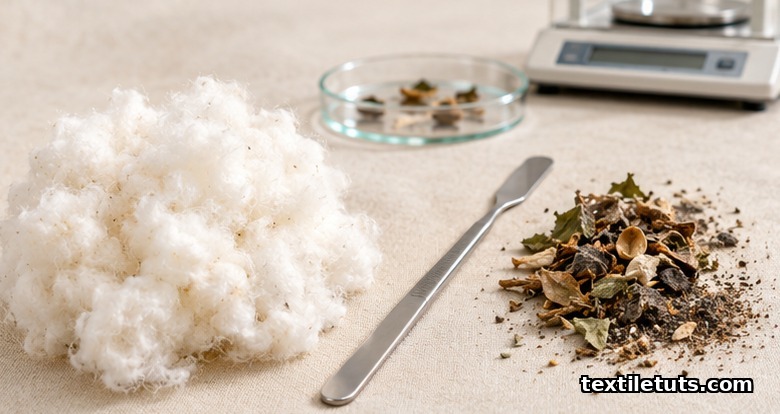
Trash content in cotton, measured by the Shirley Analyzer (ASTM D2812), typically ranges from 2.0% to 6.0% by weight for machine-harvested upland cotton and from 0.8% to 2.5% for hand-picked or premium long-staple cottons, with values above 5.0% requiring extra cleaning passes before carding to keep yarn evenness and neps within tolerance.
Trash is every non-lint impurity that rides in with the seed cotton into the gin: leaf fragments, broken seed coats, stems, motes, grass, and fine dust, plus immature and dead fibers that the Shirley Analyzer classifies with the trash rather than with the lint. Because trash drives ends-down at the spinning frame, dye spots on finished fabric, and nep formation in carded yarn, knowing the exact percentage is the first step in any cotton mill’s process control. This guide explains what the Shirley Analyzer measures, how the test runs, what the numbers mean for downstream processing, and how the method compares to high-volume instrument (HVI) trash readings.
The article covers the principle of the instrument, the step-by-step procedure, the trash categories a mill should track, the relationship between Shirley trash content and yarn quality, the standards that govern the method, and frequently asked questions from spinning students and quality engineers.
What “Trash Content” Means in a Cotton Mill
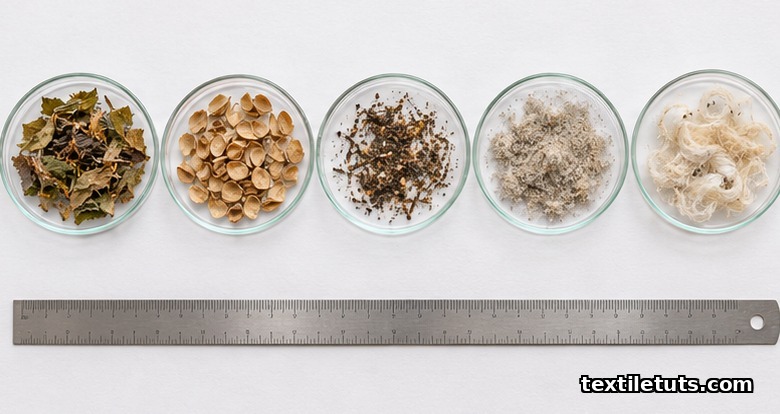
In cotton classing, lint is the usable fiber mass that survives ginning, combing (if any), and carding. Everything else in the raw bale that is not fiber is “trash.” The Shirley Analyzer treats three impurity classes as trash:
- Leaf and stem fragments (the largest particles, visible to the eye).
- Seed coat fragments (SCF) and broken hull pieces from the gin’s seed-cotton cleaners and lint cleaners.
- Motes, pepper trash, and dust (immature or aborted seeds, fine particles that pass a 0.5 mm screen).
Immature fibers with thin cell walls are not strictly trash in the botanical sense, but the Shirley Analyzer routes them to the trash pan because they behave like trash during further processing. Their inclusion is one reason Shirley trash percentage runs higher than the “visible trash” reading a classer counts under a blackboard.
For context, raw upland cotton arriving at a yarn mill in South Asia typically tests 3.0-6.0% Shirley trash; ginned but pre-cleaned lots land at 1.5-3.5%; combed yarn feed stock targets 1.0-2.0%. Long-staple Egyptian, Pima, or Sea Island cotton, hand picked and roller ginned, can test below 1.0%, which is one reason combed-yarn spinners pay a premium for them.
How the Shirley Analyzer Works
The Shirley Analyzer was developed at the Shirley Institute (now the British Textile Technology Group) in the 1930s and has remained the reference gravimetric method for non-lint content. Its principle is simple: a mechanical feed roller and feed plate pull a known mass of cotton through a calibrated carding zone; an airflow stream then carries the lint out through a screen and into a lint collector, while the heavier trash particles fall by gravity into a separate trash pan.
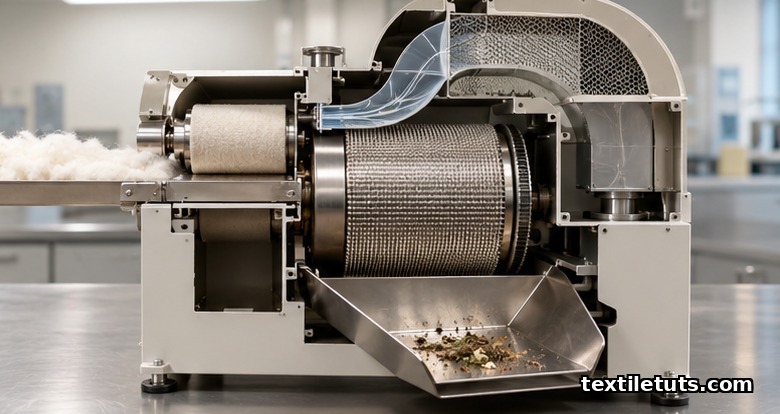
The instrument consists of four functional blocks:
- Feed assembly. A feed roller rotates against a feed plate to meter cotton into the analyzer at a steady rate (around 4 g/min in the standard procedure).
- Carding and trash-separation zone. A stationary card clothing strips the fiber mass into a web while trash particles are thrown outward by centrifugal action.
- Airflow duct and lint screen. A fan draws the lint through a fine screen into a lint chamber; the screen retains any stray trash carried by the airstream.
- Trash pan and lint collector. Trash falls into a tared pan below the carding zone; lint accumulates in the lint chamber.
At the end of the run, the operator weighs the lint and the trash separately. The trash percentage is calculated as:
Trash (%) = (mass of trash / mass of original sample) × 100
A typical test uses a 100 g conditioned sample, though ASTM D2812 allows 50 g to 120 g depending on the cotton form (loose stock, sliver, or roving). Three specimens per lot are standard; results are reported as the arithmetic mean.
ASTM D2812 and Related Standards
ASTM D2812 is the U.S. standard that codifies the Shirley Analyzer method for non-lint content of cotton. It defines apparatus geometry, feed rate, specimen mass, conditioning atmosphere (21 °C, 65% RH), and the calculation. ISO 9270 covers a related principle for trash and dust content in cotton by mechanical separation, though the Shirley Analyzer is the implementation most commonly named in the standard.
Uster Technologies’ HVI (High Volume Instrument) and the Premier ART2 systems report “trash count” and “trash area” by video scan, which gives fast but indirect numbers; Shirley trash percent by ASTM D2812 is the gravimetric reference against which HVI trash readings are calibrated at the U.S. Department of Agriculture classing offices. Mills that need a traceable process-control figure therefore keep a Shirley Analyzer on the laboratory floor even when the production line uses HVI classing data.
For gins and merchant houses, the U.S. Department of Agriculture’s Cotton Program also publishes grading rules that include a manual “trash percentage” reading done by a human classer using a trash separator; this is correlated with, but not identical to, Shirley trash.
Step-by-Step Procedure (ASTM D2812 Summary)
- Condition the sample. Bring at least 200 g of representative cotton to standard atmosphere (21 °C, 65% RH) for 4 hours.
- Weigh three specimens. Take three test specimens of 100 g each (or the mass specified by the lab’s validated SOP) on an analytical balance reading to 0.01 g.
- Clean the analyzer. Brush the feed plate, carding zone, and screen; tare the trash pan and the lint collector.
- Feed the specimen. Spread the specimen across the feed tray, start the analyzer, and feed at approximately 4 g/min until the full mass has passed.
- Collect and weigh. Empty the lint collector and trash pan. Weigh each separately on the same balance.
- Recombine and repeat. For ASTM D2812, the recombined lint plus trash mass should equal the original specimen mass within 1%; record any loss as fiber loss.
- Calculate. Compute trash percentage for each specimen and report the mean of three replicates to one decimal place.
Acceptable repeatability for Shirley trash percentage in a single lab is around ±0.3 percentage points for clean cotton and ±0.5 percentage points for trashy cotton; between-lab reproducibility is wider, around ±1.0 percentage points, so round results to one decimal.
Trash Categories a Mill Should Track
Total Shirley trash percent is the headline number, but quality teams typically break it down further because each category predicts a different downstream problem.
| Category | Source | Typical Size | Downstream Effect |
|---|---|---|---|
| Leaf (visible) | Picker / stripper harvest, defoliation timing | > 5 mm | Yarn thick places, fabric surface defects |
| Seed coat fragments | Over-aggressive gin cleaning, immature seed | 1-5 mm | Dye spots, neps, ends-down at ring frame |
| Pepper trash / motes | Immature bolls, drought-stressed crop | 0.2-1 mm | Neps in carded yarn, dye specks |
| Dust / fine particles | Field dust, post-gin handling | < 0.2 mm | Card wire wear, worker exposure, fly loss |
| Immature fibers | Premature picking, drought, heat stress | Fiber-length but thin | Neps, lower dye uptake, lower yarn strength |
Tracking each category weekly gives a clearer picture than a single trash figure. A spike in seed coat fragments often points to gin cleaning settings; a rise in pepper trash points to crop condition; a rise in dust signals a problem in handling or bale storage.
How Shirley Trash Drives Yarn Quality
The relationship between Shirley trash content and yarn quality is well documented in spinning textbooks and peer-reviewed studies. Roderick Cox and colleagues at the Shirley Institute established the classic regressions in the 1960s; modern work using HVI classing data confirms the trends. Three relationships matter most in practice:
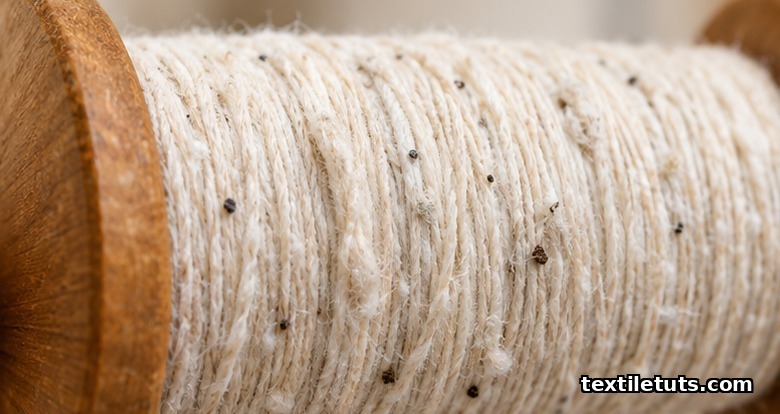
- Ends-down at the ring frame. Ends-down rate (EDR, breaks per 1000 spindle-hours) roughly doubles for every 2 percentage-point rise in Shirley trash above 3%. A lot at 5% trash can produce twice the ends-down of a lot at 3% under the same spinning conditions.
- Neps in carded yarn. Card neps increase by about 10-20 neps per 100 m of yarn for each 1% rise in trash, with seed coat fragments being the most nep-generating category.
- Yarn evenness (CV%). Uster CV% worsens by roughly 0.5-1.0 percentage points for every 2 percentage-point rise in trash, especially for finer counts (Ne 40 and above).
The practical takeaway is that mill buyers who push for low Shirley trash (under 2.5%) get cleaner yarn with fewer breaks; the cost is a higher bale price and lower available supply, since premium low-trash lots are scarce in most crop years.
Shirley Analyzer vs. HVI Trash Reading
The Shirley Analyzer and the HVI both produce “trash” numbers, but the underlying measurement is different. The Shirley Analyzer gives a gravimetric percentage by physically separating trash from lint. The HVI gives a video-scan-based “trash count” (count of particles per unit area) and “trash area” (percentage of the sample surface covered by trash) at the press.
For mill-floor decisions, the Shirley number is closer to the actual mass of impurities the spinning line will have to remove; the HVI number is faster (one operator can test hundreds of samples per day) and correlates reasonably well for routine classing. Most U.S. classing offices publish an HVI “trash area” reading that has been calibrated against Shirley trash at the master calibration cotton set.
| Feature | Shirley Analyzer (ASTM D2812) | HVI Trash Reading |
|---|---|---|
| Measurement principle | Gravimetric (mass of separated trash) | Video scan (count and area of surface particles) |
| Test time per sample | 20-30 minutes | 30-60 seconds |
| Output | Trash percent by mass | Trash count, trash area percent |
| Role | Reference / arbitration | Rapid bale-by-bale classing |
| Captures dust? | Yes (collects in pan) | Poorly (dust often below camera resolution) |
| Standard | ASTM D2812 | ASTM D5866 (HVI cotton) |
Frequently Asked Questions
Q1: What is the acceptable Shirley trash percentage for ring-spun carded yarn?
For Ne 20-30 carded ring-spun yarn, target Shirley trash content is 3.0% or lower; for Ne 40 and finer, aim for 2.5% or lower. Combed yarn feed stock should test below 1.5%. Lots above 5.0% generally need additional cleaning (an extra carding passage, or a tandem card setup) before they reach the draw frame.
Q2: How does the Shirley Analyzer differ from the Shirley trash separator used by cotton classers?
The Shirley Analyzer is a laboratory instrument that weighs the trash it separates, following ASTM D2812, and gives a percent-by-mass result. The hand-held Shirley trash separator used by USDA classers is a calibrated device that holds a sample against a black-and-white surface; the classer visually estimates the percentage of trash-covered area. The two are correlated but not interchangeable, and the manual reading has much lower precision than the gravimetric one.
Q3: Can the Shirley Analyzer measure trash in sliver or roving as well as in raw stock?
Yes. ASTM D2812 accepts loose stock, sliver, and roving. The procedure is the same: condition the specimen, weigh, feed through the analyzer, and weigh the separated trash. Roving and combed sliver will of course show very low trash percentages (often under 0.5%) because most impurities have already been removed in upstream processing.
Q4: Why does Shirley trash percentage go up after aggressive gin cleaning?
Aggressive lint cleaning at the gin breaks leaf particles into smaller fragments rather than removing them, and these smaller fragments often end up classified as trash by the Shirley Analyzer. The same mass of leaf that would have read 3% trash before cleaning may read 4-5% after cleaning because the analyzer is counting the broken-down pieces. This is one reason modern gins use sequences of gentle cleaning steps instead of a single high-intensity cleaner.
Q5: How often should a mill calibrate or service its Shirley Analyzer?
Best practice is to run a calibration cotton (a reference lot with a known Shirley trash percentage, supplied by USDA GINlab or an equivalent provider) once per shift or at least weekly. Brush and inspect the card clothing monthly, and replace the feed plate and screen every 6-12 months depending on usage. A drift of more than ±0.3 percentage points on the reference cotton signals that the analyzer needs servicing.
References
- ASTM International. D2812-21 Standard Test Method for Non-Lint Content of Cotton (Shirley Analyzer Method). ASTM International, West Conshohocken, PA. Defines the apparatus, procedure, and calculation cited throughout this article.
- ASTM International. D5866-21 Standard Test Method for Grading Cotton Fibers Using the High Volume Instrument (HVI). ASTM International, West Conshohocken, PA. Companion standard covering the HVI trash readings referenced in the comparison section.
- ISO 9270:2003. Textiles — Determination of Trash and Dust Content in Cotton by Mechanical Separation. International Organization for Standardization, Geneva. International counterpart to the ASTM D2812 procedure.
- Kelly, C.M. and Hsi, C.H. (1967). Effect of Cotton Trash on Spinning Performance and Yarn Quality. USDA Agricultural Research Service, Technical Bulletin No. 1376. Source for the ends-down and nep regression relationships discussed in the article.
- U.S. Department of Agriculture, Agricultural Marketing Service. Cotton Classification Results, 2024 Crop. USDA AMS Cotton Program, Memphis, TN. Public classing data set including trash and dust content averages for U.S. upland cotton.
- Bradow, J.M., Hinojosa, O., Wartelle, L.H., et al. (1996). “Neps in Cotton Fiber: Measurement and Effects on Yarn Quality and Processing.” Textile Research Journal, 66(3), pp. 165-176. Peer-reviewed source for nep-versus-trash correlations.
This article is the working reference for trash content measurement in cotton using the Shirley Analyzer method. Editorial by Iftay Khairul Alam, TextileTuts. Sources: ASTM D2812-21, ASTM D5866-21, ISO 9270:2003, USDA ARS Technical Bulletin 1376, USDA AMS 2024 Cotton Classification Results, Textile Research Journal (Bradow et al., 1996) as cited.


