
Fiber Maturity: Polarized Light Method

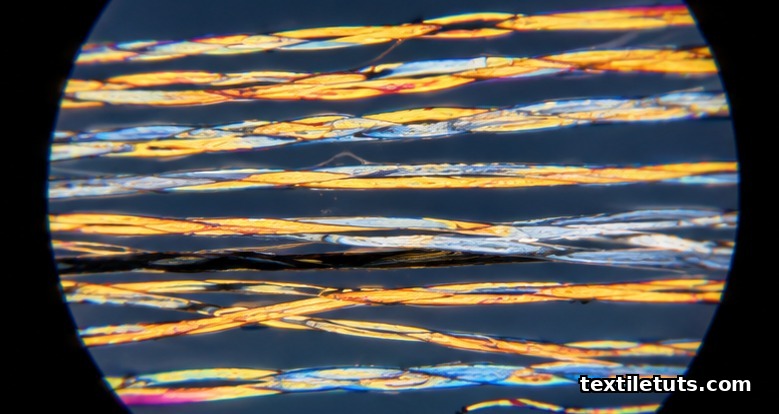
Cotton fiber maturity measured by the polarized light method uses a polarizing microscope fitted with crossed polarizers and a first-order red (530 nm) compensator to classify each fiber as mature, immature, or dead based on interference colors, with mature fibers (secondary cell-wall thickness of 50% or more of the fiber cross-section) producing bright yellow-orange first-order addition colors and immature or dead fibers appearing dark or pale blue. The procedure is codified in ASTM D1442, where technicians count at least 200 fibers per sample and report both a maturity ratio (M, typically 0.70 to 1.00 for Upland cotton) and a percent-mature-fibers figure (PM%, typically 70 to 90% for Upland cotton). The test remains the reference method for cotton maturity worldwide and the standard against which HVI image-analysis results are calibrated.
This article explains what fiber maturity means, how birefringence reveals it under crossed polarizers, what the ASTM D1442 procedure looks like at the bench, how the maturity ratio is calculated, and where the method sits in today’s labs alongside automated image-analysis systems.
What Fiber Maturity Means in Cotton
Fiber maturity describes how completely the secondary cell wall has thickened inside a single cotton fiber. A cotton fiber starts life as a hollow, kidney-bean-shaped tube. As the cell matures, layers of cellulose are deposited on the inside of the primary wall, thickening the wall inward and shrinking the central lumen. A mature cotton fiber has a thick, fully developed secondary wall; an immature fiber has a thin wall and a wide lumen; a “dead” fiber has almost no secondary wall at all, having stopped developing before wall deposition began in earnest.
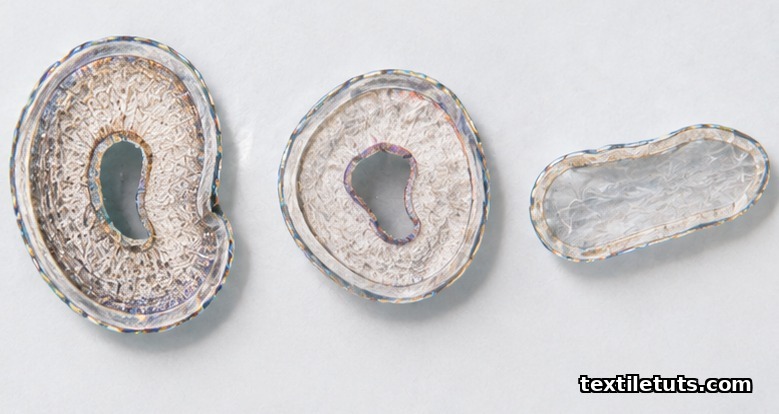
Maturity is one of the three primary cotton fiber-quality descriptors, sitting alongside fineness (micronaire) and length, and it influences nearly every downstream process. Immature fibers generate neps during spinning, take up dye unevenly, lower yarn evenness, and reduce yarn strength. The classic rule of thumb, taught in textile-engineering programs since the 1950s, is that a fiber is considered mature when its secondary-wall thickness equals or exceeds about half the radius of the cross-section, which corresponds to a circular cross-sectional area in which the cell-wall area makes up roughly 50% or more of the total. Polarized light microscopy is the classic way to see this directly.
Why Polarized Light Works: Birefringence of Cellulose
Cellulose is birefringent. The long-chain molecules in the secondary cell wall are oriented nearly parallel to the fiber axis, so the wall has two different refractive indices: one along the fiber axis (nγ roughly 1.578 to 1.595) and one perpendicular to it (nα roughly 1.529 to 1.535). The difference, Δn of about 0.04 to 0.06, is large enough that when cotton fibers are placed between a polarizer and an analyzer that are crossed, they produce vivid interference colors governed by the retardation (Δn multiplied by the wall thickness).
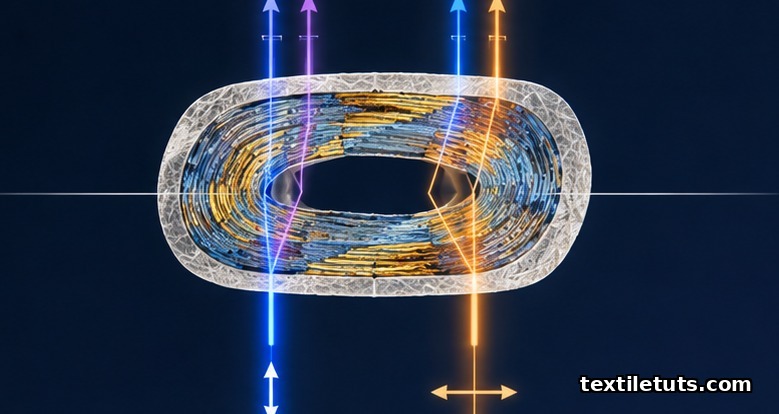
Thicker cell walls give larger retardations; thinner walls give smaller retardations. This is the entire physical principle of the test. A fiber with a thick wall rotates the polarization of light enough that the analyzer lets some through, producing bright additive colors (yellow, orange, or blue under a first-order red compensator). A fiber with a thin wall rotates the light only weakly, so very little passes the analyzer and the fiber looks dark gray or pale blue.
The interference color is described by the Michel-Lévy chart. At retardations around 530 nm (the wavelength of a first-order red plate), mature fibers appear orange or yellow (additive colors), fibers with thin walls show blue or dark, and dead fibers with negligible wall show almost no color at all. The classification threshold in the test is set by where, on that chart, the wall thickness crosses about 50% of the cross-sectional radius.
ASTM D1442 Procedure, Step by Step
The standard that codifies this test is ASTM D1442, “Standard Test Method for Maturity of Cotton Fibers by Polarized Light.” A modern lab bench using it today works in roughly the following sequence.
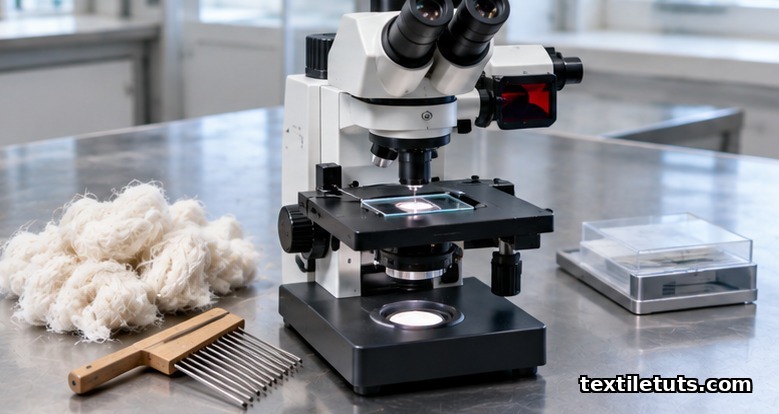
- Sample preparation. A representative fiber tuft is combed and parallelized, and a thin, uniform slide is made by mounting fibers in a drop of water or mineral oil between a microscope slide and a coverslip. The mounting liquid is chosen with a refractive index close to 1.515 to 1.520 to reduce glare from the fiber surface.
- Polarizing microscope setup. The microscope uses a polarizer below the stage, an analyzer above the eyepiece, and a first-order red compensator (gypsum plate, retardation about 530 nm) inserted at 45° to the fiber axis. Total magnification of around 100 to 125× is typical.
- Fiber classification. Each fiber is assigned to one of three categories based on the interference color it shows:
- Normal (mature): distinct orange, yellow, or first-order addition color. The wall is thick.
- Immature: pale blue, gray, or reduced brightness. The wall is thin but present.
- Dead: flat, ribbon-like, very dark or no color. The wall is negligible.
- Counting. At least 200 fibers are classified, traversing the slide in a regular grid so the technician does not select only the most visible fibers.
- Calculation. The counts are combined into a maturity ratio (M) and a percent-mature-fibers figure (PM%).
Calculating Maturity Ratio and Percent Mature Fibers
The maturity ratio reported by ASTM D1442 is the average of the per-fiber maturity ratios, weighted by count. Each fiber is assigned an individual maturity ratio based on its category: 1.0 for normal (mature), 0.5 for immature, and 0.0 for dead. The sample maturity ratio is therefore:
M = (N × 1.0 + I × 0.5 + D × 0.0) / (N + I + D)
For the standard count of 200 fibers (where N + I + D = 200), this simplifies to M = (N + 0.5 × I) / 200. A sample of all-normal fibers gives M = 1.00, a sample of all-immature fibers gives M = 0.50, and a sample of all-dead fibers gives M = 0.00. Well-mature Upland cotton typically shows M in the 0.80 to 1.00 range.
The percent-mature-fibers figure (PM%) is the simpler count of fibers classified as normal, expressed as a percentage of fibers counted:
PM% = N / (N + I + D) × 100
For a 200-fiber count, PM% = N / 2 (in percent). Most textile labs report both M and PM% because they tell slightly different stories: M is more sensitive to dead fibers (because they count as 0), while PM% is more sensitive to the boundary between normal and immature fibers.
| Property | What it measures | Typical Upland range | What a low value signals |
|---|---|---|---|
| Maturity ratio (M) | Average cell-wall thickening, weighted by fiber count | 0.80 to 1.00 | Immature or dead fibers in the lot |
| Percent mature fibers (PM%) | Direct fraction of fibers classified as normal | 75 to 90% | Field stress, premature harvest, or varietal issues |
| Immature fiber content (IFC%) | 100 minus PM%, a process-risk index | 10 to 25% | Nepping risk, dye defects, low yarn strength |
| Micronaire (MIC) | Fineness multiplied by maturity (HVI) | 3.7 to 4.2 (premium range) | Coarse-but-immature or fine-but-mature extremes |
Where Polarized Light Fits in Today’s Lab
The polarized light method is no longer the fastest way to assess maturity in a high-volume commercial lab. Instruments such as the Uster HVI (High Volume Instrument) use image analysis on thousands of fibers per sample and report maturity ratios in seconds. The newer image-analysis methods are codified in standards such as ASTM D7641. The classical polarizing microscope, however, remains the reference method and the teaching tool: it is what undergraduate textile-testing labs in Bangladesh, India, Pakistan, the United States, and Europe use to show students what fiber maturity actually looks like in practice.
The method is also what a lab reaches for when a dispute arises. If a merchant claims a shipment is “low micronaire because the cotton is fine” but the spinning mill finds yarn-quality problems consistent with immaturity, a polarized-light count is the arbitrational way to verify maturity independent of fineness. Image-analysis systems and HVI are calibrated against, and traceable to, polarized-light microscopy results, which is why the method has not disappeared from laboratory practice even after seventy years of automation.
Frequently Asked Questions
What is the difference between maturity ratio and percent mature fibers in cotton testing?
Maturity ratio (M) is the average of per-fiber maturity ratios weighted by count, calculated as M = (N + 0.5 × I) / Total, and ranges from 0 (all dead) to 1.0 (all mature). Percent mature fibers (PM%) is the simple fraction of fibers classified as normal, calculated as PM% = N / Total × 100. Both are reported because M reacts strongly to dead fibers while PM% reacts more uniformly to all non-mature categories.
How many cotton fibers must be counted for a valid polarized light maturity test?
ASTM D1442 specifies that at least 200 fibers must be classified per test specimen, and laboratories commonly run two specimens per sample (400 total fibers) to bring the sampling error down to roughly plus or minus 5 percentage points on PM%. Counting fewer fibers widens the confidence interval quickly, because cotton is biologically variable from fiber to fiber even within a single boll.
Can the polarized light method tell dead fibers apart from immature fibers?
Yes. Dead fibers have essentially no secondary cell wall and show almost no birefringence, so under crossed polarizers with a first-order red compensator they appear flat, ribbon-like, and dark. Immature fibers have a thin wall and produce a pale blue or gray color that is distinctly less bright than the orange-yellow of mature fibers. The trained technician assigns each fiber to one of the three categories directly during the count.
Why is a first-order red (530 nm) compensator used in the test?
The 530 nm compensator (also called a gypsum plate or first-order red plate) shifts the retardation of all fibers by a known amount, splitting the interference colors into two easily distinguished groups: addition colors (yellow, orange) on one side of the fiber and subtraction colors (blue, dark blue) on the other. Without the compensator, all mature fibers look uniformly white and the method loses most of its discriminating power between mature, immature, and dead categories.
Is polarized light maturity testing being replaced by HVI image analysis?
In high-volume commercial labs, image analysis (codified in ASTM D7641) has replaced polarized light for routine testing because it reads thousands of fibers per second and produces a digital record. The polarized light method remains the reference method, the teaching standard in textile-engineering programs, and the arbitration method when a result is contested between buyer and seller.
References
- ASTM International. ASTM D1442-06 Standard Test Method for Maturity of Cotton Fibers by Polarized Light. ASTM International, West Conshohocken, PA. The codifying standard for this test method.
- ASTM International. ASTM D7641-10 Standard Test Method for Determination of Cotton Fiber Maturity by Image Analysis. ASTM International, West Conshohocken, PA. The modern image-analysis counterpart to the polarized-light method.
- International Organization for Standardization. ISO 4912:1981 Cotton fibres — Determination of maturity by polarized light microscopy. ISO, Geneva. Earlier ISO standard using the same polarized-light principle.
- Hsieh, Y.-L. (1999). Structural development of cotton fibers and linkages to fiber quality. In Basra A.S. (ed.), Cotton Fibers: Developmental Biology, Quality Improvement, and Textile Processing. Food Products Press, New York. Book chapter on cellulose deposition and birefringence.
- Wakeham, H., and Spicer, N. (1965). The strength and other properties of cotton fibers. Textile Research Journal, 35(5), 468-478. Foundational peer-reviewed paper correlating cell-wall thickness with mechanical fiber properties.
Editorial by Iftay Khairul Alam, TextileTuts. Sources: ASTM D1442, ASTM D7641, ISO 4912, Hsieh 1999, Wakeham and Spicer 1965 as cited.


