
Lab Setup for Textile Testing

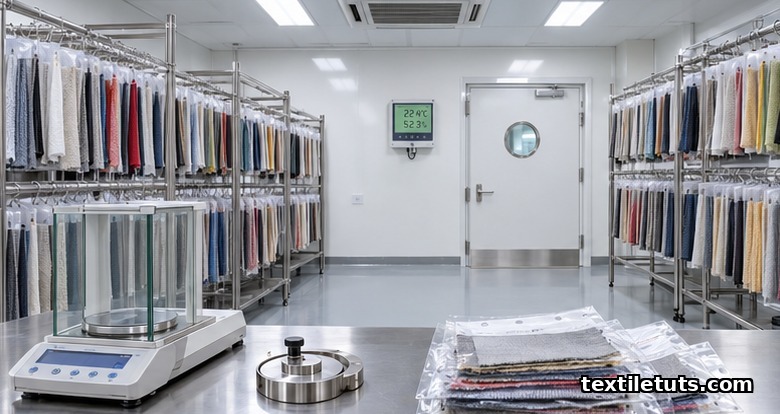
A textile testing lab must be conditioned to 20 °C ± 2 °C and 65% ± 4% relative humidity under ISO 139:2005, because fiber moisture regain alone shifts mass, tensile, and dimensional-change readings by 5–8% between a dry winter room and a humid summer room. That single tolerance band is the reason every credible textile laboratory invests in HVAC, humidifiers, and de-humidifiers before it buys a single tensile tester. The article below walks through the room, the instruments, the consumables, the reference standards, and the operating habits that turn an empty floor into a defensible ISO/IEC 17025 testing facility.
Whether the goal is in-house quality control for a cut-and-sew unit, a third-party lab serving export mills, or a textile-engineering teaching lab at a university, the layout and equipment list look surprisingly similar. The differences live in throughput, accreditation scope, and the depth of the consumable bench, not in the fundamental physics of conditioned testing.
1. The Conditioned Room: Atmosphere, Floor Area, and HVAC
Textile behavior is hygroscopic. Cotton at 65% RH holds roughly 7% moisture by mass; wool holds about 14%; viscose about 12%. If the room drifts to 50% RH, those same fibers release 1–2% of their mass, and any GSM, count, or tensile result computed on that mass is wrong by that exact percentage. ISO 139:2005 and ASTM D1776 codify the solution: a sealed testing room held at 20 °C ± 2 °C and 65% ± 4% RH, with continuous monitoring by a calibrated thermo-hygrograph or digital datalogger.
For a small QC lab covering physical testing, plan at minimum three zones:
- A conditioning room of 9–12 m² where specimens rest for at least 24 hours before tensile, tear, GSM, and dimensional-change tests.
- A wet-lab room of 6–10 m² with a sink, fume hood, and acid-resistant bench for colorfastness, pH, and formaldehyde work.
- A general bench room of 12–20 m² housing tensile testers, crockmeters, pilling boxes, and analytical balances.
Air handling matters. Direct expansion (DX) cooling strips humidity and pushes the room below 40% RH in dry seasons; in monsoon seasons it climbs above 80%. A dedicated air-handling unit with chilled-water cooling plus a steam-bath humidifier holds the band without wild swings. Pull air through a G4 pre-filter and an F7 fine filter; loose fibers in the airstream contaminate balances and abrasion testers.
2. The Core Instrument Bench
For physical testing, the minimum credible set covers mass, tensile, tear, dimensional change, colorfastness, and abrasion. A lab that handles knit, woven, denim, and technical textiles typically starts with the instruments below and adds capacity as throughput grows.
| Property | Instrument | Reference Standard |
|---|---|---|
| Mass per unit area (GSM) | Analytical balance + cutting die (100 cm²) or GSM cutter | ASTM D3776 / ISO 3801 |
| Tensile strength | Universal tensile tester (CRE, constant-rate-of-extension) | ASTM D5034 / D5035, ISO 13934-1/2 |
| Tear strength | Elmendorf pendulum or trouser-tear rig on a CRE machine | ASTM D1424 / D2261, ISO 13937 |
| Dimensional change | Launder-Ometer + dimensional-change bench with rulers | AATCC TM135 / TM150, ISO 5077 |
| Colorfastness to washing | Launder-Ometer + multifiber adjacent fabric | ISO 105-C06, AATCC TM61 |
| Colorfastness to crocking | Crockmeter with cotton crock cloth | AATCC TM8 / TM116, ISO 105-X12 |
| Colorfastness to light | Xenon-arc or fluorescent UV chamber | ISO 105-B02, AATCC TM16 |
| Abrasion resistance | Martindale or Wyzenbeek rig | ISO 12945, ASTM D4966 / D4157 |
| Pilling resistance | Martindale (modified) or ICI pilling box | ISO 12945-1/2, ASTM D4970 |
| Air permeability | Air-permeability tester (e.g., Shirley FX 3300 class) | ASTM D737, ISO 9237 |
| Bursting strength | Hydraulic or pneumatic burst tester | ISO 13938, ASTM D3786 |
| Fabric thickness | Thickness gauge at 1 kPa or 20 kPa pressure | ISO 5084, ASTM D1777 |
The CRE tensile tester is the workhorse. Buy one with a 5 kN load cell for general apparel work and 10 kN or 20 kN for technical textiles, geotextiles, and seatbelt webbing. Confirm the machine carries a valid calibration certificate traceable to NIST, NPL, or NIM and that grip faces match the specimen (pneumatic rubber jaws for knits, flat screw grips for webbing).
3. Wet Lab: Chemistry, Dyeing, and Effluent
A textile lab that runs colorfastness, pH, formaldehyde, or heavy-metal tests needs a separate wet room. Bench height should be 900 mm, surfaced with chemical-resistant epoxy or stainless steel. Install a fume hood with face velocity of 0.4–0.5 m/s for formaldehyde and solvent work; duct the hood separately from the office HVAC so vapors do not migrate.
Minimum wet-lab kit:
- Multi-parameter pH/conductivity meter with temperature probe, calibrated weekly with pH 4, 7, and 10 buffers.
- UV-Vis spectrophotometer for dye-bath and effluent absorbance (420 nm, 620 nm, 660 nm depending on dye class).
- Analytical balance readable to 0.0001 g.
- Stainless-steel SF dye pots or a bench-top IR dyeing machine for small-batch shade matching.
- Multifiber adjacent fabric (TV or DW type), AATCC grey scale for color change, and ISO grey scale for staining.
- ECE (A) non-phosphate reference detergent without optical brightener for ISO 105-C06 and AATCC TM61.
Effluent from a wet lab carries acid, alkali, salt, and sometimes heavy metals. Route dye baths and rinse water through a neutralizing tank before discharge. A typical 50 L neutralization tank with pH probe and dosing pump keeps effluent between pH 6.5 and 8.5, the band most municipal treatment plants accept without surcharge.
4. Conditioning, Cutting, and Sample Preparation
Specimen preparation is where most labs quietly introduce error. The conditioning room should hold enough hanging racks and flat shelves to pre-condition samples for at least 24 hours, or until successive weighings one hour apart differ by less than 0.1%. ASTM D1776 lists the exact rule: condition to constant mass.
Cutting tools matter. A 100 cm² die cutter or a calibrated round-cutter gives repeatable specimen area for GSM; hand cutting with scissors can vary by 3–5% and that error ends up directly in the final GSM. Tensile and tear specimens should be cut from fabric at least 150 mm away from the selvedge and on a bias-cut template where ISO 13937 or ASTM D1424 calls for it.
5. Calibration, Traceability, and Reference Standards
An instrument that has not been calibrated since commissioning is a liability. Build a calibration schedule before the first sample is tested:
- Daily: balance verification with check weights, tensile-tester zero and clamp alignment.
- Weekly: hygrometer check against an Assmann or salt-bath reference, pH meter buffer slope.
- Quarterly: load-cell verification against a calibrated proving ring or dead-weight tester, dimensional-change rulers against a calibrated steel rule, crockmeter crocking-finger pressure.
- Annually: full third-party calibration by an ISO/IEC 17025 accredited calibration lab, with certificates traceable to national metrology institutes.
Keep reference materials on hand. SDC (Society of Dyers and Colourists) multifiber TV strips, AATCC crock cloth, ECE(A) detergent, and ISO grey scales degrade over time; lot-track them and rotate stocks every 12–18 months.
6. Safety, Documentation, and Accreditation
A textile lab handles sharp blades, hot dye baths, UV light, and solvent vapors. Standard precautions: cut-resistant gloves when handling die cutters, nitrile gloves for wet chemistry, UV-blocking goggles for xenon-arc work, lab coats, and an emergency eyewash within 10 m of the wet bench. Post the Globally Harmonized System (GHS) safety data sheets for every chemical in a binder next to the stockroom.
Documentation drives defensibility. A sound paper trail includes a sample receipt log, a test request with method reference, raw data and instrument output, the calibration status of the instrument on the date of test, the operator’s initials, and a report signed by an approved signatory. ISO/IEC 17025:2017 sets the bar for lab competence; methods cited in the report should be the same ones running on the bench, with any deviations noted in the test report.
Proficiency testing closes the loop. Subscribe to inter-lab programs run by AATCC, SDC, or accredited round-robin providers; the results expose method drift before a customer does.
Frequently Asked Questions
How big should a textile testing lab be to start?
Plan a minimum of 35 m² total: roughly 10 m² conditioning, 8 m² wet lab, and 17 m² physical bench. Below that footprint, conditioned-air stability becomes hard to hold and instrument heat (tensile tester motors, xenon arc) will swing the room temperature by 1–2 °C, enough to push RH outside the ISO 139 band.
Which instrument should a new lab buy first?
The GSM cutter plus an analytical balance gives the fastest return. Every other physical test (tensile, tear, dimensional change) needs GSM as a divisor for strength-to-weight ratios. A CRE tensile tester with 5 kN load cell is the second buy, because tensile strength and elongation are the two metrics buyers ask for most.
Can a single technician run both physical and chemical tests?
Yes, but only with cross-training and separate cleaning protocols. Lint from the physical bench contaminates wet chemistry; residual acid or alkali from the wet bench corrodes tensile jaws. Most accredited labs keep at least one dedicated physical-bench operator and one wet-bench operator; a third person handles sample receipt and conditioning.
How long does it take to condition textile specimens?
Under ISO 139, condition specimens for 24 hours or until successive weighings one hour apart change by less than 0.1%. Heavy fabrics (denim, canvas, technical textiles) may need 48 hours. Skipping the conditioning step is the single most common reason a lab sees contradictory GSM readings between morning and afternoon.
What does ISO/IEC 17025 accreditation actually require?
It requires a documented quality management system, traceable calibration for every measuring instrument, validated test methods, trained and authorized signatories, controlled records, internal audits, and successful participation in proficiency testing. For a small lab, the realistic path is 9–12 months of preparation followed by an external audit by an accreditation body such as UKAS, A2LA, NABL, or BAB.
References
- International Organization for Standardization. ISO 139:2005 — Textiles: Standard atmospheres for conditioning and testing. iso.org — Specifies the 20 °C ± 2 °C / 65% ± 4% RH environment that governs every other textile test method.
- ASTM International. ASTM D1776 / D1776M-20 — Standard Practice for Conditioning and Testing Textiles. astm.org — Defines constant-mass conditioning and pairs with ISO 139.
- AATCC. AATCC Test Method 135 — Dimensional Changes of Fabrics after Home Laundering. aatcc.org — The benchmark for shrinkage on woven and knit apparel fabrics.
- ASTM International. ASTM D5034 / D5035 — Standard Test Methods for Breaking Strength and Elongation of Textile Fabrics. astm.org — Grab and strip tensile methods that dominate QC reports.
- International Organization for Standardization. ISO 105-C06:2010 — Colour fastness to domestic and commercial laundering. iso.org — Workhorse colorfastness method using ECE(A) detergent at 40 °C, 50 °C, or 60 °C.
- International Organization for Standardization. ISO 12945 — Determination of fabric propensity to surface fuzzing and to pilling. iso.org — Martindale and ICI pilling-box methods.
- International Organization for Standardization. ISO/IEC 17025:2017 — General requirements for the competence of testing and calibration laboratories. iso.org — The accreditation framework that ties together calibration, method validation, and reporting.
This article is the working reference for setting up a textile testing laboratory. Editorial by Iftay Khairul Alam, TextileTuts. Sources: ISO 139:2005, ASTM D1776, AATCC TM135, ASTM D5034/D5035, ISO 105-C06, ISO 12945, ISO/IEC 17025:2017 as cited.


