
Carpet Weaving: Wilton, Axminster

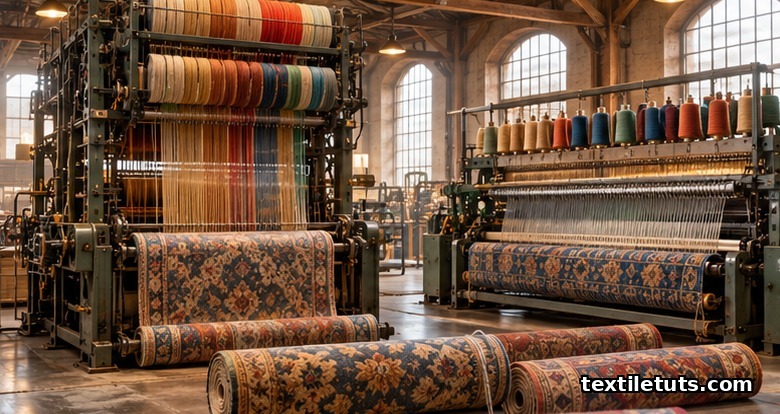
Wilton carpets are woven on a Jacquard loom where continuous pile yarns run through the entire carpet body, producing 6-10 rows per inch (RPI) and total masses of 1,500-2,500 g/m² (per ISO 8543); Axminster carpets are woven on gripper or spool looms that insert each pile tuft individually into the backing, allowing up to 12 colors per pattern but yielding lower densities of 1,200-2,000 g/m².
Both methods date from the 18th and 19th centuries and remain the two standard woven-carpet constructions recognized under ISO 2424 (textile floor coverings vocabulary), but they achieve pattern and density through fundamentally different mechanical principles.
This article walks through the loom mechanics of each method, lays out the ISO and ASTM standards that govern their quality, and answers the questions carpet buyers and textile students most often ask.
How Wilton Carpet Is Woven
Wilton weaving takes its name from the English town of Wilton, where the technique was refined in the late 1700s once Joseph-Marie Jacquard’s punched-card loom became commercially available. The defining mechanical feature is a Jacquard head mounted above a conventional wire loom: each needle in the head is tied to one color of pile yarn, and the cards (or, on modern machines, an electronic controller) dictate which needles lift for every weft insertion. The pile yarn is not cut and reinserted for each row. Instead, all pile yarns (typically 2, 3, or 5 colors) are pre-loaded on creel beams behind the loom and run continuously through the carpet body.
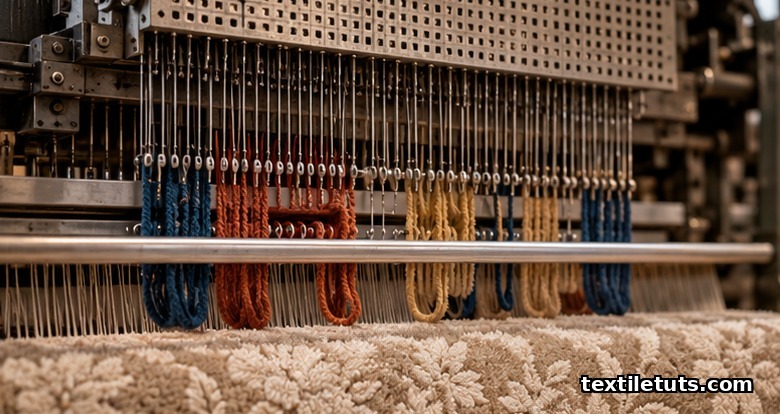
When a particular color is not needed on the surface, that yarn is “buried” beneath the backing warp, hidden inside the carpet body. This is why a 5-frame Wilton loom can produce a 5-color pattern while actually weaving 5 yarns through every row. The trade-off is thickness: the buried yarns add mass without contributing to face yarn, which is why Wilton carpets tend to be heavier than Axminsters of equivalent pile height. The wires inserted at each shed determine pile height (commonly 6-15 mm in residential grades, 8-12 mm in commercial grades) and whether the surface is looped (called Wilton “Brussels”) or cut (called Wilton “plush” or “velvet”).
Quality metrics for Wilton include rows per inch (RPI), measured along the warp direction per ISO 1763; pitch, the number of wires across the loom width per inch; and pile yarn weight, expressed in ounces per square yard or g/m². A typical residential Wilton clocks 7-8 RPI and 8-10 wires per inch, while a high-grade contract Wilton can reach 10 RPI with up to 12 wires per inch. Modern face-to-face Wilton looms weave two carpets simultaneously, cutting them apart between the two layers to double throughput without increasing floor space.
How Axminster Carpet Is Woven
The Axminster loom was patented in 1839 by James Templeton of Glasgow, inspired by Turkish hand-knotted rugs. Instead of running continuous yarns through the carpet, an Axminster loom inserts each pile tuft individually, one row at a time, using either a spool (for wool or thicker synthetic yarns) or a gripper (for finer synthetic filaments). The pile yarn is selected from a creel of up to 12 colors per design and is wrapped around a carrier tube or gripped by a metal needle, then lowered into the backing warp just before the weft is beaten up.
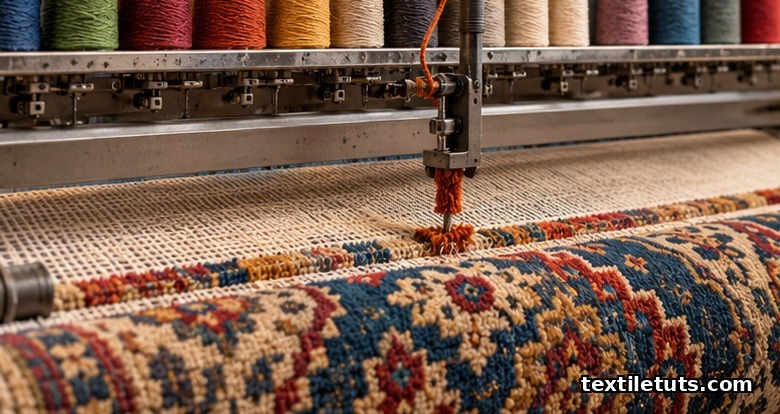
Because each tuft is cut at both ends and anchored only by the jute, cotton, or polypropylene backing, every color appears on the face only where the designer intends. There are no buried yarns, which is why Axminster faces are typically crisper and why a single Axminster loom can run a 12-color pattern with the same machinery that produces a 5-color one. The mechanical price is throughput: an Axminster loom runs slower than a Wilton of equivalent width, and color changes require a re-tie of the creel. The pattern is stored as a chain of colored cones or a computer-controlled yarn-selection sequence, and changing designs stops production while the creel is rebuilt.
Standard Axminster metrics mirror Wilton: 7-10 RPI is typical, with pitch counts similar to Wilton but pile weights slightly lower because the backing carries less hidden yarn. Total carpet mass for a residential Axminster generally falls in the 1,200-2,000 g/m² range measured per ISO 8543, with commercial grades reaching 2,500 g/m². Axminster carpets are almost always cut pile; there is no widely produced looped Axminster variant.
Wilton vs Axminster: Side-by-Side Specifications
| Property | Wilton | Axminster |
|---|---|---|
| Loom type | Jacquard wire loom (single or face-to-face) | Spool or gripper loom |
| Pile insertion | Continuous yarns (2-5 colors fed through every row) | Individual cut tufts per row |
| Maximum colors per pattern | 2, 3, or 5 (one per frame) | Up to 12 (limited by creel capacity) |
| Rows per inch (RPI) | 6-10 (typical 7-8 residential) | 7-10 (typical 7-8 residential) |
| Wires / pitch | 8-12 per inch | 7-10 per inch |
| Total mass (per ISO 8543) | 1,500-2,500 g/m² | 1,200-2,000 g/m² |
| Pile height | 6-15 mm (cut or loop) | 6-12 mm (cut only) |
| Pattern detail | Limited by Jacquard card capacity | Photographic realism possible |
| Production speed | Faster (continuous feed) | Slower (per-tuft insertion) |
| Typical application | Solid and tone-on-tone contract carpet | Multi-color patterned residential and hospitality |
Standards That Govern Both Constructions
Carpet manufacturers and laboratories test Wilton and Axminster carpets under parallel ISO and ASTM standards; the construction method does not change the test method.
- ISO 2424:2012 – Textile floor coverings: Vocabulary. Defines “Wilton” and “Axminster” as distinct constructions under the woven-floor-covering classification.
- ISO 8543:1998 – Determination of total mass per unit area. Used for the g/m² figures cited in the table above.
- ISO 1763:1986 – Determination of number of tufts per unit length. Applicable to the rows-per-inch measurement in both methods.
- ISO 1765:1986 – Determination of thickness. Used to verify overall carpet thickness.
- ISO 1766:1986 – Determination of pile thickness above the substrate. Important for grading looped Wilton versus cut Wilton.
- ASTM D418-18 – Standard Test Methods for Testing Pile Yarn Floor Covering Construction. North American equivalent for woven carpet construction testing.
- ASTM D6859-18 – Standard Test Method for Pile Thickness of Finished Floor Coverings. Equivalent in scope to ISO 1766.
Which Construction Should You Specify?
Choose Wilton when pattern simplicity, high density, and heavy contract-grade wear matter most. Because all pile yarns run continuously through the carpet, Wilton is denser for a given RPI and pitch, and the buried-color architecture gives it a slightly higher pile-weight-per-square-meter than a comparable Axminster. Wilton dominates corporate, hospitality, and cruise-ship installations where solid colors and subtle tone-on-tone patterns are preferred, and where the carpet will see roller-bag and wheeled-chair traffic.
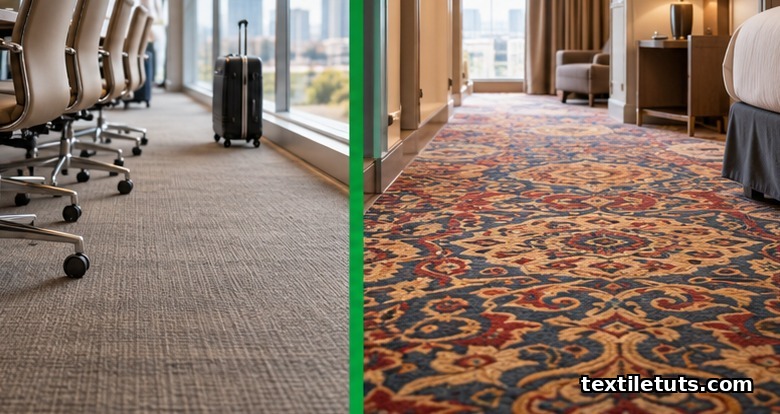
Choose Axminster when the pattern requires more than five colors, when the design is photographic or pictorial, or when face-yarn definition matters more than total mass. Axminster faces tend to look sharper because the pile tuft is anchored only where the designer placed it, with no hidden yarns softening the pattern. Axminster is the historical choice for patterned residential carpet, hotel guest-room corridors with logos or medallions, and casino gaming floors.
For textile students reading a carpet spec sheet, the practical takeaway is structural: Wilton is a wire-loom continuous-yarn weave, Axminster is a per-tuft insertion weave. Knowing the construction lets you judge whether the price reflects the actual yarn weight, density, and pattern complexity, or whether it is being driven by the brand alone.
Frequently Asked Questions
What is the difference between Wilton and Axminster carpet?
The difference is in how the pile is anchored. Wilton uses continuous pile yarns that run through the entire carpet on a Jacquard loom, with unused colors buried beneath the backing. Axminster inserts each pile tuft individually using a spool or gripper on a separate loom, so every tuft appears only where the designer wants it. The result is that Wilton carpets tend to be denser and heavier; Axminster carpets tend to support more colors and crisper pattern detail.
Which carpet lasts longer, Wilton or Axminster?
Lifespan depends more on pile material, density, and traffic than on weave family. A high-grade Wilton at 10 RPI with wool pile can exceed 20 years in a domestic setting, and an Axminster of equivalent pile weight and rows per inch performs similarly. Wilton construction is slightly more resistant to tuft loss because the pile yarns are locked into the backing by continuous interlacing, whereas Axminster tufts are anchored only by the surrounding weft.
Can Wilton carpets have more than five colors?
Standard mechanical Wilton looms are limited to 2, 3, or 5 frames, which means 2, 3, or 5 colors. Modern electronic Jacquard heads can address more than five colors by selecting from a larger creel, but most commercial Wilton carpet on the market is still produced on 2- or 5-frame looms. If a pattern needs more than five colors, Axminster is the practical choice.
Is Axminster carpet more expensive than Wilton?
Axminster is usually more expensive per square meter in patterned grades because the loom runs slower and color changes require re-tieing the creel. The price gap narrows on solid-color Axminster and on dense contract-grade Wilton, where the heavier Wilton face yarn offsets the slower Axminster throughput. Always compare on pile weight (g/m²), RPI, and pitch, not on the weave family alone.
Are Wilton and Axminster carpets still made today?
Yes. Both methods remain in active production across Europe, North America, and Asia. European mills such as Brintons, Cormar, and Condor supply most of the world’s patterned Axminster; Wilton production is more distributed across contract-carpet manufacturers. The loom technology is essentially unchanged in 150 years, which is part of why the construction terms remain stable across ISO 2424 editions.
References
- International Organization for Standardization. ISO 2424:2012 – Textile floor coverings: Vocabulary. iso.org. Defines Wilton and Axminster as distinct woven floor covering constructions.
- International Organization for Standardization. ISO 8543:1998 – Textile floor coverings: Determination of total mass. iso.org. Method for the g/m² figures cited in this article.
- International Organization for Standardization. ISO 1763:1986 – Determination of number of tufts per unit length. iso.org. Method for rows-per-inch (RPI) measurement in both Wilton and Axminster.
- International Organization for Standardization. ISO 1766:1986 – Determination of pile thickness. iso.org. Method for measuring pile thickness above the substrate.
- ASTM International. ASTM D418-18 – Standard Test Methods for Testing Pile Yarn Floor Covering Construction. astm.org. North American test method for woven carpet construction.
- ASTM International. ASTM D6859-18 – Standard Test Method for Pile Thickness of Finished Floor Coverings. astm.org. Equivalent in scope to ISO 1766.
- Textile Institute, Textile Research Journal (SAGE). Structural analyses of woven floor coverings. journals.sagepub.com. Peer-reviewed studies on Wilton and Axminster carpet structure and mechanics.
- ScienceDirect topics: Floor coverings, manufacture and properties. sciencedirect.com. Encyclopedia-level survey of carpet weaving methods, including historical context.
This article is the working reference for Wilton and Axminster carpet weaving. Editorial by Mohammad Yousuf (Anik), TextileTuts. Sources: ISO 2424, ISO 8543, ISO 1763, ISO 1766, ASTM D418, ASTM D6859, and peer-reviewed structural analyses as cited.


