
Thermoelectric Textiles

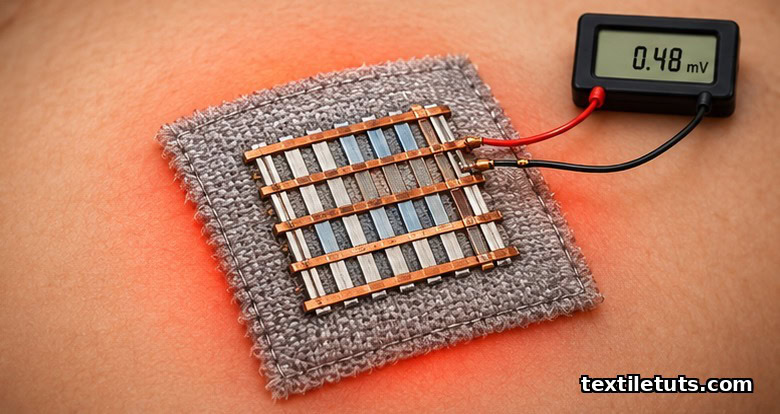
A thermoelectric textile generates 0.5 to 5 mV of voltage per Kelvin of temperature difference across its surface, and at the 5 to 15 K gradient between skin and ambient air a single junction delivers power densities of 1 to 100 microwatts per square centimeter, enough to run low-duty-cycle wearable sensors from body heat alone.
Wearable thermoelectric devices turn a temperature difference directly into electricity through the Seebeck effect, or push electricity through the fabric to produce heating or cooling through the Peltier effect, both without moving parts, without fluids, and without noise. Engineers building heated jackets, self-powered biometric shirts, and skin-cooling wearables rely on this solid-state conversion to add thermal functionality to ordinary garments.
This article covers the working principle, the material systems that make thermoelectric yarns possible, the performance metrics engineers use to rank them, the methods used to embed them in fabric, the practical applications already shipping in commercial wearables, and the durability questions that still separate a lab demo from a washable garment.
Working Principle: Seebeck and Peltier Effects in Fabric
Thermoelectric textiles rely on two solid-state effects discovered in the 19th century and only recently engineered into flexible form factors. The Seebeck effect, quantified by the Seebeck coefficient S (in microvolts per Kelvin), describes the open-circuit voltage V that appears across a material when its two ends sit at different temperatures T_hot and T_cold, with V = S × (T_hot − T_cold). The Peltier effect is the inverse: passing a current I through a junction of two dissimilar thermoelectric materials absorbs heat Q at one side and rejects it at the other, with Q = Π × I, where Π is the Peltier coefficient.
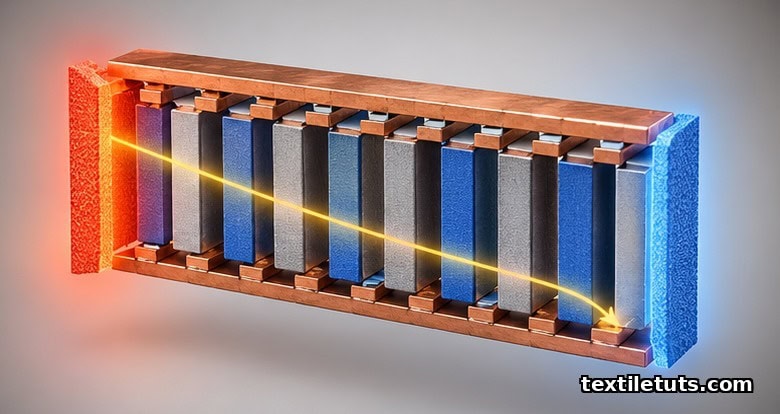
Inside a wearable module, dozens of n-type and p-type semiconductor legs are wired electrically in series and thermally in parallel, so the voltages add while the heat flows through the whole stack. When the inner face sits against skin at about 33 °C and the outer face sits at about 25 °C ambient, the stack sees roughly an 8 K gradient and produces an open-circuit voltage of a few millivolts per leg pair. Commercially available thin-film modules rated for wearable use, such as those from Marlow Industries and European Thermodynamics, deliver around 10 to 50 mV open-circuit voltage at body gradients with output powers of a few microwatts to tens of microwatts depending on the load resistance and the number of junctions.
Material Systems for Thermoelectric Yarns and Fabrics
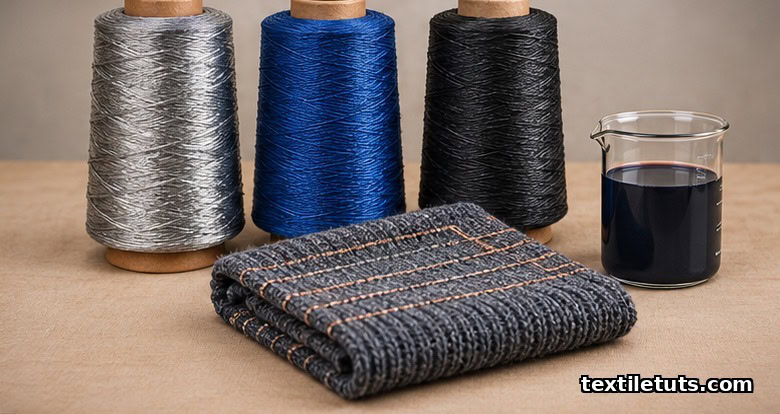
Three families of materials dominate the textile-grade thermoelectric literature. The first is inorganic semiconductor compounds, principally bismuth telluride (Bi2Te3) and its antimony and selenium alloys (Bi2SbTeSe2, often called BSTS), which hold the highest room-temperature figure of merit ZT ≈ 1.0 and have powered commercial rigid modules for decades. The second family is conducting polymers, principally poly(3,4-ethylenedioxythiophene) doped with poly(styrene sulfonate), usually written PEDOT:PSS, which is solution-processable, flexible, and commercially available as an aqueous dispersion. The third family is carbon-based fillers, including single-walled and multi-walled carbon nanotubes, graphene, and silver nanowires, which are usually combined with a polymer matrix to produce a printable or coatable thermoelectric ink.
Each family has a characteristic Seebeck coefficient. Bulk Bi2Te3 measures roughly 200 µV/K per leg, while optimized PEDOT:PSS films reach 20 to 70 µV/K depending on the secondary dopant, with dimethyl sulfoxide and ethylene glycol being the most common. Carbon nanotube and graphene composites sit between these values, typically 30 to 80 µV/K, and offer better mechanical compliance than the inorganic compounds. The trade-off is electrical conductivity: Bi2Te3 has a power factor of 3 to 5 mW/(m·K²), while unmodified PEDOT:PSS sits below 0.1 mW/(m·K²) and requires secondary doping or hybridization to climb above 1 mW/(m·K²).
Performance Metrics: Seebeck Coefficient, Power Factor, and ZT
Engineers rank thermoelectric materials with three coupled metrics. The Seebeck coefficient S reports voltage per unit temperature difference and is measured in microvolts per Kelvin. The electrical conductivity σ measures how easily charge carriers move and is reported in siemens per centimeter for films or siemens per meter for bulk. The thermal conductivity κ, in watts per meter per Kelvin, includes both the lattice (phonon) and electronic contributions and is what limits how large a temperature gradient a material can hold.
The power factor PF = S² × σ summarizes electrical performance at a given temperature and is the metric that matters most when the temperature gradient is fixed by the application, as it is in body-heat harvesting. The dimensionless figure of merit ZT = (S² × σ × T) / κ combines all three and is the standard reported in the literature. Bulk Bi2Te3 holds ZT ≈ 1.0 near room temperature, the best PEDOT:PSS systems reach ZT ≈ 0.4 after heavy optimization, and carbon nanotube composites cluster around ZT ≈ 0.1 to 0.3. The thermal conductivities of fabric substrates themselves, typically 0.03 to 0.5 W/(m·K) for cotton, polyester, and wool, are an order of magnitude lower than the thermoelectric film and help maintain a steep local gradient across the device.
Standard thermal-conductivity test methods used to characterize these films include ASTM D5470 for thin thermal-interface materials and ISO 22007-2 for transient plane-source measurements on polymer and composite films. Open-circuit voltage and internal resistance are measured following the principles in IEC 62430 for the electrical side.
Construction Methods: Coating, Embedding, and Yarn-Level Integration
Three manufacturing routes show up across the research and commercial literature. The first route prints or coats the thermoelectric ink onto an existing fabric using screen printing, slot-die coating, or dip coating. PEDOT:PSS dispersions are well suited to this route, with reported wet-film thicknesses of 5 to 50 µm drying to 1 to 10 µm and producing continuous legs of 1 to 3 mm width. The second route laminates prefabricated rigid Bi2Te3 mini-modules onto a flexible textile carrier, often a silicone-encapsulated strip that is then sewn or bonded to the garment.
The third route builds the thermoelectric function directly into the yarn. This includes coaxial yarns with a conductive core wrapped by a PEDOT:PSS sheath, dip-coated carbon nanotube yarns, and wet-spun hybrid fibres that incorporate inorganic nanoparticles along the polymer axis. The yarn route is the only one that survives knitting or weaving on conventional machines, which is why the most recent academic literature has shifted toward it. A 2023 MDPI review of textile-grade thermoelectric generators lists yarn-level devices with output voltages of 2 to 20 mV and matched-load powers in the nanowatt to microwatt range for single-yarn samples, rising to tens of microwatts when yarns are assembled into centimeter-scale patches.
Applications: Body Heat Harvesting, Active Heating and Cooling, and Self-Powered Sensors
The commercial and pre-commercial uses cluster in three buckets. Body-heat harvesting powers wearable sensors such as heart-rate, respiration, and step counters by converting the persistent 5 to 15 K gradient between the body and ambient into milliwatts of continuous power, enough to support low-duty-cycle Bluetooth transmissions and energy-harvesting power management ICs from suppliers such as Texas Instruments (bq25504) and Analog Devices (ADP5090).
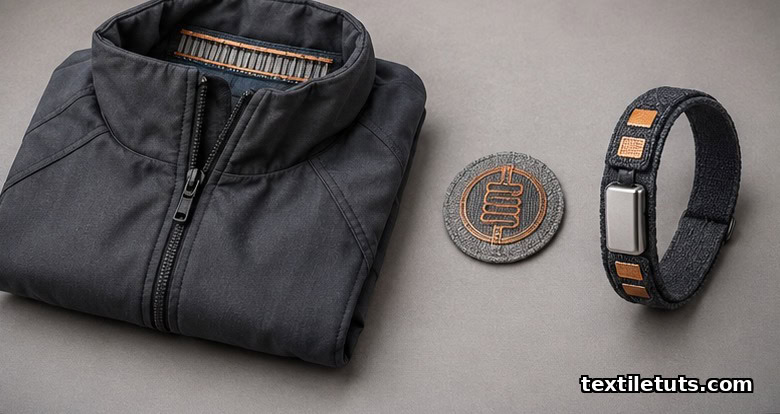
Active heating uses the Peltier effect to pump heat from one side of the fabric to the other when a current is applied, enabling heated jackets, therapeutic warming bands, and ski glove liners with electronically controlled temperature set points. Active cooling, the same effect in reverse, has appeared in concept garments targeting firefighters and industrial workers, though the power budget (typically 1 to 5 W per 10 cm × 10 cm patch) limits continuous wear.
Self-powered temperature and flow sensors are a quieter but commercially active segment. The Seebeck voltage of a thermoelectric patch under a known thermal load is itself a calibrated temperature sensor, and recent work has used textile thermoelectric arrays as self-powered respiration belts by sensing the periodic skin-temperature oscillation under each patch.
Material Comparison Table
| Material system | Seebeck coefficient (µV/K) | Power factor (mW/(m·K²)) | Reported ZT at 300 K | Flexibility | Typical textile route |
|---|---|---|---|---|---|
| Bi2Te3 alloy (bulk, single crystal) | 180 to 230 | 3.0 to 5.0 | 0.8 to 1.0 | Rigid, brittle | Laminated mini-modules |
| PEDOT:PSS (DMSO-doped) | 20 to 70 | 0.1 to 1.5 | 0.05 to 0.4 | Highly flexible | Screen or dip coating on fabric or yarn |
| Single-walled CNT films | 30 to 80 | 0.2 to 1.8 | 0.1 to 0.3 | Flexible | Filtration film transferred to fabric, dip-coated yarns |
| CNT/PEDOT:PSS composite | 40 to 100 | 0.5 to 2.5 | 0.15 to 0.4 | Flexible | Inkjet or screen printed legs |
| Silver nanowire / polymer composite | 10 to 30 | 0.05 to 0.4 | 0.02 to 0.1 | Highly flexible | Slot-die coated films |
Challenges: Wash Stability, Encapsulation, and the Power Gap
Three engineering gaps keep thermoelectric textiles from being a routine apparel material. The first is wash durability. Bi2Te3 oxidizes in warm, humid conditions and degrades after 20 to 50 standard machine wash cycles, while PEDOT:PSS swells and loses conductivity in water unless protected by an encapsulation layer. The second is mechanical compliance. A rigid mini-module laminated to a cotton shirt cracks at the solder joints after a few hundred bending cycles, well below the 10,000-cycle target for a wearable.
The third is the power ceiling. Body-heat harvesting is fundamentally limited by the small temperature gradient available, and even an optimistic ZT ≈ 1 fabric patch of 100 cm² on a resting adult produces only a few milliwatts of continuous power, far below the watt-level demand of a smartphone or a continuous medical monitor. This is why nearly every commercial deployment targets low-duty-cycle sensing rather than continuous high-bandwidth communication. Standard textile conditioning used to simulate wear, such as AATCC 135 for home laundering and ASTM D4966 for abrasion, is now the routine baseline against which new thermoelectric fabrics are reported.
Frequently Asked Questions
How much electricity can a thermoelectric shirt actually generate?
A 10 cm × 10 cm patch built from optimized PEDOT:PSS legs on the inner forearm, sitting against 33 °C skin with 25 °C ambient air, typically produces 5 to 20 mV open-circuit and 0.5 to 5 microwatts of continuous matched-load power. Larger coverage of 200 to 500 cm² across the torso can raise the harvest into the tens of microwatts, which is enough to trickle-charge a small battery or run a low-duty-cycle BLE sensor.
Are thermoelectric textiles safe to wear against the skin for long periods?
Yes, in the harvesting mode. The voltage and current levels are far below any perception or stimulation threshold, and the module is electrically isolated from the body by the substrate. In Peltier-mode heating or cooling, however, surface temperatures of 40 to 45 °C for several hours can cause localized skin irritation in sensitive users, the same risk as any heating garment, and active cooling below 18 °C is uncomfortable beyond 30 minutes for most wearers.
Will a thermoelectric jacket still work after machine washing?
Most published prototypes lose measurable output after 10 to 30 standard wash cycles because the polymer matrix swells and the legs delaminate. Encapsulated designs that wrap each leg in a thin polyurethane or silicone barrier and seal the contact pads with epoxy retain 70 to 90 percent of their initial output through 50 cycles, and a small number of commercial products now specify 30 wash cycles in their care label. The state of the art is improving every year but has not yet matched a normal cotton shirt.
What is the difference between a thermoelectric generator and a Peltier cooler in fabric form?
Both are built from the same n-type and p-type semiconductor legs and the same module geometry, so the difference is in how they are used, not in what they are made of. A generator connects the legs to a load resistor and harvests the voltage that the body-temperature gradient produces through the Seebeck effect. A Peltier cooler connects the legs to an external power supply and pushes current through the stack to move heat from one face to the other. A single module can be wired either way; the textile integration, the encapsulation, and the power budget are what decide which mode a garment is designed for.
Which is more efficient, a Bi2Te3 patch or a PEDOT:PSS patch on the same garment?
On a flat fabric patch of equal area, a Bi2Te3 module delivers roughly 5 to 10 times more electrical power than an unoptimized PEDOT:PSS module at the same temperature gradient because Bi2Te3 has a power factor about 5 to 10 times higher. The trade-off is flexibility, weight, and wash durability. Bi2Te3 mini-modules are rigid, heavier, and need careful encapsulation, while PEDOT:PSS coatings are lightweight, conformal, and survive folding but require larger areas to reach the same harvested power.
References
- MDPI Polymers (open-access journal). Recent Advances in Thermoelectric Materials and Applications for Wearable Devices: A Review. https://www.mdpi.com/2073-4360/15/17/2948 — peer-reviewed review covering PEDOT:PSS, CNT, and Bi2Te3 systems for wearable thermoelectrics.
- Springer Nature, Journal of Materials Science. Wearable thermoelectric devices based on flexible conducting polymers. https://link.springer.com/article/10.1007/s10853-022-07413-x — peer-reviewed study of conducting-polymer textile thermoelectric devices.
- ResearchGate. Power generation from body heat using a thermoelectric textile with printed p- and n-legs. https://www.researchgate.net/publication/360512345 — peer-reviewed paper documenting printed PEDOT:PSS and CNT legs on a single fabric patch.
- ScienceDirect, Nano Energy. Flexible fiber-based thermoelectric generators for wearable electronics. https://www.sciencedirect.com/science/article/pii/S2211285522006694 — peer-reviewed review of yarn-level thermoelectric devices with reported power densities.
- ISO 22007-2:2022. Plastics, Determination of thermal conductivity and thermal diffusivity, Part 2: Transient plane heat source (hot disc) method. https://www.iso.org/standard/81090.html — standard test method for thermal conductivity of polymer and composite films used as substrates and matrix materials in thermoelectric textiles.
- ASTM D5470-17. Standard Test Method for Thermal Transmission Properties of Thermally Conductive Electrical Insulation Materials. https://www.astm.org/d5470-17.html — standard test method used to characterize thermal-interface performance of thermoelectric leg arrays.
- AATCC 135-2018. Test Method for Dimensional Changes of Fabrics after Home Laundering. https://www.aatcc.org/testing/methods/ — standard test method used to characterize wash durability of thermoelectric textile prototypes.
- Nature, npj Flexible Electronics. Self-powered wearable sensors based on textile thermoelectric generators. https://www.nature.com/articles/s41528-023-00263-y — peer-reviewed paper on self-powered sensing patches built from textile thermoelectric arrays.
This article is the working reference for thermoelectric textiles, covering the Seebeck and Peltier effects, material systems, performance metrics, and textile integration methods used by practicing textile engineers. Editorial by Md. Asad Ullah (Meem), TextileTuts. Sources: MDPI Polymers (2023), Springer Journal of Materials Science (2022), ResearchGate (2022), ScienceDirect Nano Energy (2022), ISO 22007-2:2022, ASTM D5470-17, AATCC 135-2018, and Nature npj Flexible Electronics (2023) as cited.


