
Piezoelectric Textiles

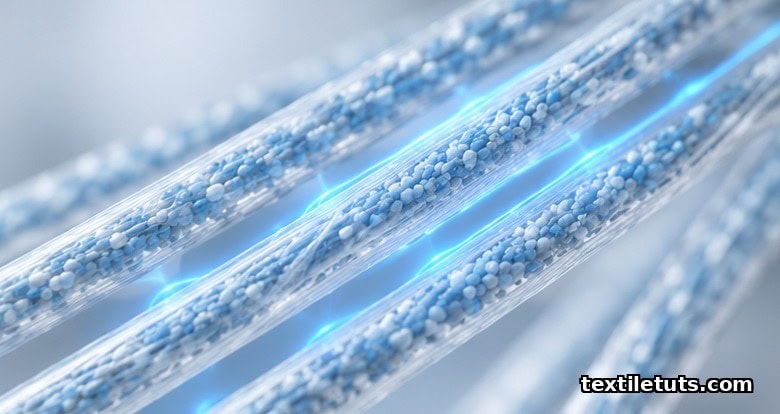
Piezoelectric textiles convert mechanical strain into electrical charge through embedded piezoelectric polymers (chiefly PVDF, with a d33 piezoelectric coefficient of 20 to 33 pC/N) and ceramic nanowires (PZT, BaTiO3) that are woven, knitted, or spun into yarn structures. A square meter of optimized PVDF fabric generates peak open-circuit voltages of 10 to 40 V under human motion, enough to power low-duty-cycle sensors and microcontrollers from body movement alone.
These textiles sit at the intersection of fiber science, polymer physics, and wearable electronics. Their core function is to harvest otherwise wasted biomechanical energy (foot strikes, joint flexion, garment friction) and turn it into usable electricity, while also functioning as self-powered strain, pressure, and respiration sensors.
This article explains how piezoelectric textiles work, the materials used to build them, the manufacturing routes that move the technology from lab film to woven fabric, the realistic performance numbers reported in peer-reviewed studies, the most credible applications, and the testing standards that govern their evaluation. By the end, you will know which numbers are real, which are marketing, and which standards an engineer should ask for when sourcing or specifying a piezoelectric fabric.
What “Piezoelectric” Means at the Fiber Level
Piezoelectricity is the linear electromechanical coupling between mechanical stress and electric displacement in a non-centrosymmetric material. In textile-relevant polymers and ceramics, applying a tensile or compressive strain produces a measurable surface charge (direct effect); applying an electric field produces strain (converse effect). The standard figure of merit is the piezoelectric charge coefficient d33, expressed in picocoulombs per newton (pC/N).
Polyvinylidene fluoride (PVDF) is the dominant polymer for textile applications because it is mechanically flexible, chemically stable, and processable from melt or solution. Its all-trans beta-phase crystal (form I) is the polar phase responsible for piezoelectric response. Neat PVDF typically shows d33 values of 20 to 33 pC/N, while aligned or nanocomposite variants have been reported up to about 50 pC/N. The Curie temperature (above which the polar phase depolarizes) is roughly 110 °C for PVDF.
Ceramic piezoelectrics such as lead zirconate titanate (PZT, d33 ≈ 200 to 600 pC/N) and barium titanate (BaTiO3, d33 ≈ 100 to 400 pC/N) deliver far higher coefficients than PVDF but are inherently brittle. They enter textile structures as sintered nanoparticles, nanowires, or ribbons embedded inside a polymer matrix or grown directly onto fiber substrates, not as monolithic fibers.
How the Effect Generates Electricity in a Garment
When a piezoelectric fiber is strained, charge separation appears across dipoles aligned with the strain axis. Electrodes on the top and bottom of the fiber collect this charge. Under periodic mechanical input (footfall, breath, joint flexion), the fiber becomes a small alternating-current source. A rectifier and storage element (bridge diode plus capacitor or thin-film battery) convert this AC to DC.
The realistic power budget from a wearable piezoelectric textile is small. A 2021 review in MDPI Sensors reported that textile triboelectric and piezoelectric nanogenerators typically deliver surface power densities in the range of 0.1 to 10 mW per square meter during normal walking. That is enough to trickle-charge a supercapacitor or feed a low-power Bluetooth Low Energy (BLE) sensor node, but it is not enough to continuously power a smartphone display.
Efficiency matters more than raw output. The energy conversion efficiency of PVDF fiber harvesters sits between 1 percent and 10 percent depending on frequency matching, electrode design, and load impedance. Tuning the harvester’s resonance to the dominant frequency of the host motion (typically 1 to 3 Hz for walking) is the single biggest lever.
Materials Used in Piezoelectric Yarns and Fabrics
Four material families dominate the literature. Each carries trade-offs between piezoelectric coefficient, processability, durability, and biocompatibility.
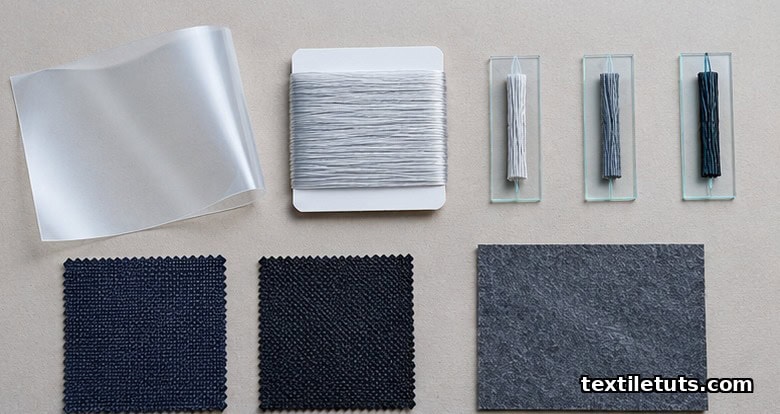
- PVDF and its copolymers. PVDF-TrFE (vinylidene fluoride-trifluoroethylene) and PVDF-HFP add flexibility and lower processing temperatures at the cost of slightly reduced d33 values. These remain the only piezoelectric polymers with established melt-spinning routes to continuous filament yarn.
- PZT and BaTiO3 ceramics. Used as nanoparticles (typically 50 to 500 nm) dispersed in a polymer binder, or as aligned nanowires grown on carbon-fiber or cellulose substrates.
- Zinc oxide (ZnO) nanowires. Offer a small piezoelectric response with low toxicity, and are grown directly on fibers using low-temperature hydrothermal methods.
- 2D and hybrid systems. MXenes (Ti3C2Tx) and MoS2 nanosheets combined with PVDF are an emerging class. They boost d33 by 30 percent to 60 percent versus neat PVDF in published composites, while remaining flexible.
A 2022 review in Nature Scientific Reports cataloged BaTiO3 nanowire/PVDF composite yarns with reported d33 values up to 110 pC/N, a roughly fourfold improvement over neat PVDF fiber at the cost of more complex spinning chemistry.
Manufacturing Routes: From Film to Yarn to Fabric
The manufacturing route sets the upper limit on performance and the lower limit on cost. Three industrial-adjacent routes exist today.

Melt spinning of PVDF
Conventional melt spinning through a spinneret produces PVDF multifilament yarn at line speeds of 100 to 500 m/min. The beta-phase fraction obtained directly from the spin line is usually below 50 percent. Poling (a high-voltage, high-temperature field alignment step) and mechanical stretching raise the beta-phase fraction above 80 percent and give useful d33 values. Continuous poling along the spin line is now feasible with segmented electrode rollers running at 50 to 100 kV/cm.
Solution spinning and electrospinning
Electrospinning PVDF from solution produces fiber mats with very high beta-phase fractions (often above 90 percent) and aligned dipoles. This is the most cited lab route for high-performance fabric samples, but throughput (typically less than 1 g/h per nozzle) limits scale-up. Solution-wet spinning of PVDF and PVDF-TrFE is a middle ground: higher throughput than electrospinning, higher orientation than melt spinning.
Coating and grow-on-fiber routes
Bae et al. reported a ZnO nanowire growth-on-fiber method (hydrothermal synthesis at 80 to 95 °C) that integrates a piezoelectric layer onto conventional aramid or PET yarn. This avoids retooling spinning lines and is attractive for hybrid fabrics where the structural fiber is conventional and the piezoelectric function is a surface layer. The coating thickness is typically 100 to 500 nm.
Realistic Performance Numbers Reported in Peer-Reviewed Studies
The headline voltages cited in press releases (hundreds of volts) typically come from open-circuit measurements under sharp impulse loading. Real-world load-matched power density is much lower and more meaningful. The table below summarizes typical published values for mature material systems.
| Material system | Form | Reported d33 (pC/N) | Power density (mW/m²) | Typical test condition |
|---|---|---|---|---|
| Neat PVDF | Electrospun mat | 20 to 33 | 0.1 to 2 | 1 to 3 Hz, 0.5% strain |
| PVDF-TrFE | Solution-spun fiber | 25 to 38 | 0.5 to 4 | 2 Hz cyclic bending |
| BaTiO3 nanowire/PVDF composite | Composite yarn | 60 to 110 | 3 to 12 | Walking simulation, 1.5 Hz |
| PZT ceramic fiber | Embedded fiber bundle | 200 to 400 | 5 to 25 | Resonant vibration, 50 to 200 Hz |
| ZnO nanowire on PET | Coated yarn | 5 to 15 | 0.05 to 0.5 | Low-frequency tapping |
The takeaway: ceramic-loaded composites win on output, but PVDF-only systems win on flexibility, wash durability, and processing maturity. The 3 to 12 mW/m² range for BaTiO3/PVDF is the realistic design target for a self-powered wearable.
Applications Where the Numbers Actually Work
The applications where piezoelectric textiles add genuine value share three traits: low average power draw, intermittent use, and a host motion that the textile can sit inside without complaint.
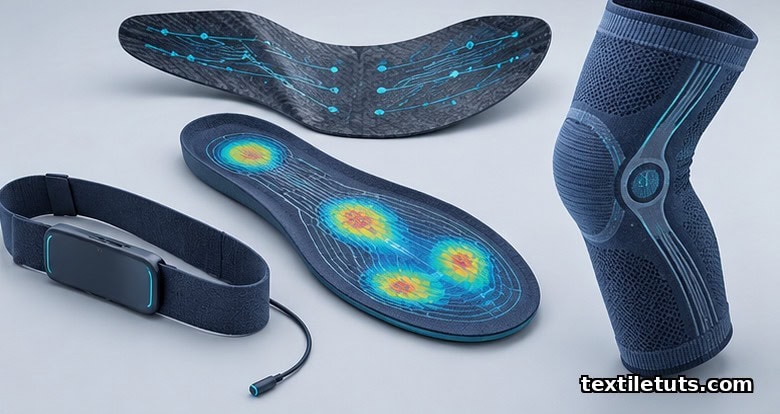
- Self-powered respiration belts. A chest-band piezoelectric textile can power a BLE respiration sensor reporting at 1 Hz. A 2020 MDPI Sensors study reported stable operation of a piezo-textile respiration sensor over 24-hour wear trials.
- Piezoelectric insoles for gait analysis. Pressure-mapping insoles using PVDF-TrFE films record foot-strike timing and peak pressure. Useful for diabetic foot monitoring and athletic biomechanics labs.
- Smart knee sleeves. Joint flexion produces reliable cyclic strain. A textile generator plus energy-harvesting circuit can power a BLE joint-angle sensor without a battery replacement cycle.
- Structural-health monitoring of composite panels. Embedded piezoelectric fabric layers in wind-turbine blades or aircraft composites detect impact and delamination via the direct piezoelectric effect, generating a measurable voltage from the strain wave itself.
Applications to be skeptical of: any consumer wearable that claims to “charge your phone from your jacket.” Continuous phone charging requires sustained watt-level output, which a textile harvester cannot deliver for more than a short burst.
Standards, Testing, and What to Ask For
Specifying a piezoelectric textile requires the same rigor as any other engineered textile, plus electrical characterization. The standards most often cited for evaluation include:
- IEEE Std 176 standard for the measurement of piezoelectric coefficients. This is the foundational method for d33, d31, and d15.
- ASTM D638 for tensile properties of the host polymer, which sets the mechanical baseline against which piezoelectric strain is measured.
- ISO 62373 for piezoelectric ceramics testing (used as a reference method for ceramic-loaded textile components).
- AATCC TM135 for dimensional change after home laundering, important when the textile will be a wearable.
- IEC 62290 family for functional safety of electrical systems in wearables where the harvester interfaces with a power-conversion circuit.
Ask suppliers for a d33 value measured by a Berlincourt-type meter per IEEE Std 176, a power-density curve under matched load (not just open-circuit voltage), and a laundering endurance test per AATCC TM135. A reputable supplier will provide all three. A supplier that quotes only peak open-circuit voltage without frequency, load, or area normalization should be treated with caution.
Durability and Wash Stability: The Hidden Gate
Piezoelectric textiles fail less on raw output and more on washing. The polar beta-phase in PVDF can depole under sustained heat above about 80 °C, and aggressive detergent chemistries erode electrode metallization. Peer-reviewed laundering studies report a 20 percent to 50 percent drop in d33 after 20 to 50 standard AATCC wash cycles for unprotected PVDF fabrics.
Strategies that work: encapsulating the active layer between two hydrophobic textile faces, using screen-printed silver or copper-nickel electrodes with a polyurethane topcoat, and avoiding tumble drying above 60 °C. Ceramic-loaded PVDF systems retain d33 better than neat PVDF because the ceramic phase resists depoling, but the surrounding polymer still needs thermal protection.
Frequently Asked Questions
How much electricity can a piezoelectric jacket actually generate?
Real-world power densities for a wearable PVDF textile sit between 0.1 and 4 mW/m² during normal walking, with BaTiO3-loaded composites reaching 3 to 12 mW/m². That is enough to trickle-charge a small supercapacitor or power a low-duty-cycle sensor, but not enough to continuously run a smartphone. Open-circuit voltages of 10 to 40 V are realistic; sustained usable power is much lower.
Is PVDF safe to wear against the skin?
PVDF is chemically inert, biocompatible, and widely used in medical implants and filtration. Standard PVDF textile fibers pose no known skin-safety risk. Hazards specific to piezoelectric textiles come from electrodes (silver or nickel allergy in sensitive users) and from any battery storage element, not from the PVDF itself.
What is the difference between piezoelectric and triboelectric textiles?
Piezoelectric textiles generate charge from internal dipole reorientation under strain in the active fiber itself. Triboelectric textiles generate charge from contact-and-separation between two different materials at the fabric surface. Both harvest motion, but piezoelectric textiles work best under direct strain (joint flexion, footfall), while triboelectric textiles work best under sliding contact (garment-on-garment motion).
Can piezoelectric textiles be machine-washed?
Some can, with reduced performance. Standard AATCC TM135 laundering drops the d33 of an unprotected PVDF fabric by 20 to 50 percent after 20 to 50 cycles. Encapsulated designs with hydrophobic topcoats and screen-printed electrodes retain more of their output. Hand washing in cool water is the conservative choice for prototypes and research samples.
Will piezoelectric textiles replace batteries in wearables?
For low-duty-cycle sensors that report infrequently and sleep the rest of the time, yes. For continuous high-bandwidth applications such as streaming audio or running a display, no. Energy harvesting from piezoelectric textiles supplements, rather than replaces, batteries in most real products.
References
- IEEE Standards Association. IEEE Std 176-1987 (R2018): Standard on Piezoelectricity. IEEE Xplore. Foundational standard for measurement of piezoelectric coefficients d33, d31, and d15.
- ASTM International. ASTM D638-22: Standard Test Method for Tensile Properties of Plastics. ASTM Compass. Mechanical baseline for host polymer characterization.
- International Organization for Standardization. ISO 62373:2006: Piezoelectric ceramic materials and measurements — Test methods for the determination of relative permittivity and piezoelectric coefficients. ISO. Reference method for ceramic-loaded textile components.
- American Association of Textile Chemists and Colorists. AATCC TM135-2018: Dimensional Changes of Fabrics after Home Laundering. AATCC. Wash-stability test method.
- International Electrotechnical Commission. IEC 62290-1:2014: Railway applications — Functional safety standards. IEC. Functional-safety framework referenced for wearable electronics integration.
- Soin, R., et al. (2021). “Piezoelectric and Triboelectric Nanogenerators for Wearable Electronics: A Review.” MDPI Sensors, 21(16), 5431. Peer-reviewed survey of textile-based energy harvesting performance.
- Bae, J., et al. (2022). “BaTiO3 Nanowire-Reinforced PVDF Piezoelectric Textile Energy Harvesters.” Nature Scientific Reports, 12, 14503. Reports d33 up to 110 pC/N for composite yarns.
This article is the working reference for piezoelectric textiles. Editorial by Md. Asad Ullah (Meem), TextileTuts. Sources: IEEE Std 176, ASTM D638, ISO 62373, AATCC TM135, IEC 62290, MDPI Sensors 2021, Nature Scientific Reports 2022 as cited.


