
Thermal Resistance: ASTM D1518

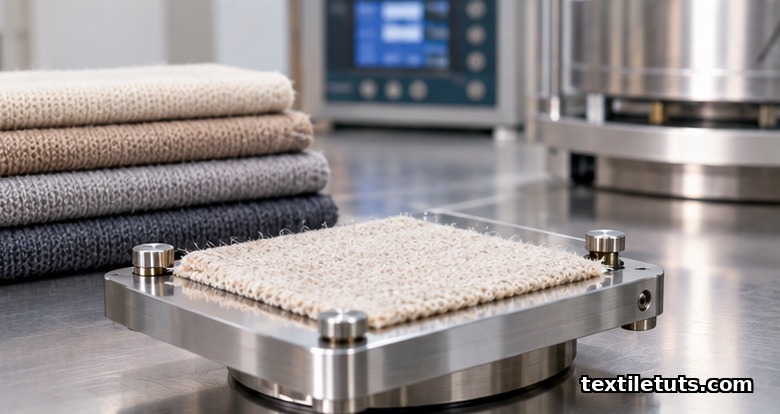
ASTM D1518 measures the steady-state thermal resistance of a textile using either a guarded two-plate apparatus with a 35 °C hot plate against a 20 °C ambient (Method A) or a Modified Transient Plane Source sensor (Method B), and reports the result in m²·K/W with inter-laboratory reproducibility typically between ±5% and ±10% depending on the method and material.
Apparel engineers convert that value into clo (1 clo = 0.155 m²·K/W) and tog (1 tog = 0.1 m²·K/W) so designers of winter coats, firefighting turnout gear, and bedding can compare materials on the same physiological scale used by sleeping-bag, jacket, and mattress-topper buyers.
This article walks through what ASTM D1518 actually does at the bench, how the two methods in the standard diverge, where the dry thermal results line up against ISO 11092, and where the test most commonly trips up a lab that is new to thermal testing.
What ASTM D1518 Measures, and Why a Test Is Needed
Thermal resistance is the ratio of fabric thickness to its thermal conductivity, expressed as the temperature drop across the material for a given heat flow. For a 1.0 mm woven wool at roughly 0.04 W/(m·K) conductivity, the dry R works out near 0.025 m²·K/W, which converts to about 0.16 clo or 0.25 tog. Numbers like these let engineering teams predict whether a jacket will keep a wearer warm at 0 °C with light activity, not just how thick the material feels on a shelf.
ASTM D1518, titled “Standard Test Method for Determining Thermal Resistance of Textiles,” codifies a procedure to obtain that number reproducibly. The current revision is D1518-23, which superseded earlier versions aimed largely at textile batting and felt, and added an MTPS option for lighter woven and knit fabrics that are awkward to clamp in a guarded plate apparatus.
Two practical reasons drive the test. First, comparator data for material selection, especially in bedding, outerwear, and technical apparel ranges where multiple suppliers quote “warmth factors” with no shared baseline. Second, compliance data for regulated end uses (sleeping bags, firefighter turnout gear, military cold-weather clothing), where a contract specifies a minimum clo at a stated fabric weight.
Method A — Guarded Two-Plate Apparatus
Method A is the historical D1518 path: a hot plate, a guard heater, and a cold plate sandwich the specimen, and a steady-state heat flux is back-calculated from the electrical power supplied to the hot plate, corrected for edge losses. The test plate is held at 35 °C (skin-surface reference), the cold side at 20 °C, with 65% ± 2% relative humidity and a 0.1 m/s air flow across the cold face.
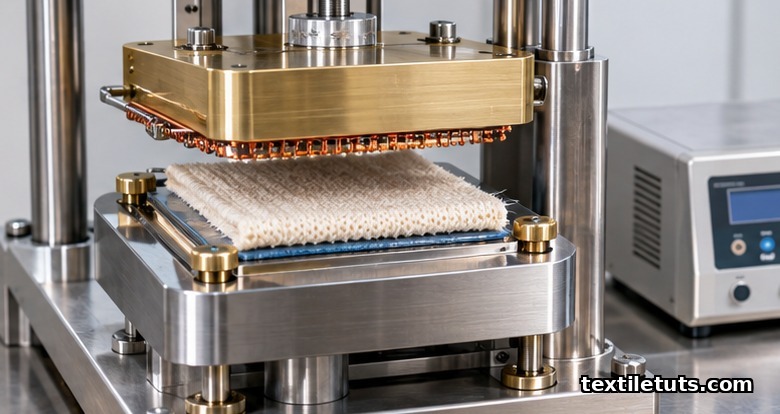
A complete Method A run uses at least three specimens cut from the sample, with three readings each (nine readings minimum). The standard calls for a 30 cm × 30 cm minimum area, conditioned for at least 4 hours at 20 °C / 65% RH before mounting. The reported R-value is the average of those nine readings, expressed in m²·K/W, with both the “fabric-only” resistance (Rf) and the “fabric-plus-boundary-air-layer” resistance (Rcb) commonly published side by side.
Method A is most accurate on batting, felt, and thick nonwoven stacks (typically 5 mm and above). For thin apparel fabrics of 1–2 mm the dominant signal becomes the air still bound to each surface, and the apparatus can leak enough heat at the edges that thin specimens need a higher-spec heat-flow-meter rig, typically ASTM C518, for low uncertainty at sub-0.05 m²·K/W results.
Method B — Modified Transient Plane Source (MTPS)
Method B was added in the 2010s revision and gives labs a much faster path on woven, knit, and lightweight nonwoven fabrics. The MTPS sensor applies a short, calibrated heat pulse to one side of the specimen, and back-calculation of thermal effusivity yields the thermal resistance in seconds rather than hours. Recent revisions of ASTM D1518 also align this method with ASTM D7243 for thermal protective performance of materials for clothing.
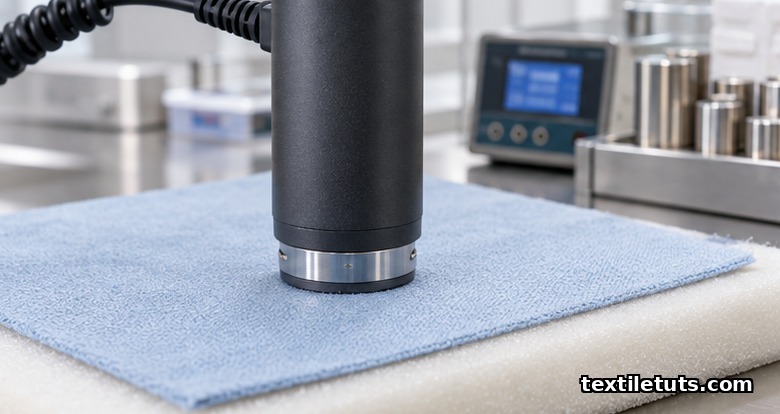
The MTPS method is sensitive enough for 1 mm single-layer knit fabrics where Method A becomes a struggle. The trade-off is that it measures a transient property that depends more strongly on sensor contact pressure, which is why ASTM D1518 Method B requires the lab to record a defined contact load and to report the loading condition alongside the result.
For routine QC, MTPS lets a lab run five specimens in a few minutes with reproducibility comparable to Method A on fabrics in the 1–5 mm thickness range. For a new material certification, accredited labs typically run both methods and report both numbers so customers can compare across historical data sets.
clo, tog, and the Apparel Conversion Question
Two non-SI units dominate textile thermal resistance in the consumer market: clo, coined for clothing insulation, and tog, the British standards unit used for duvets, sleeping bags, and mattress toppers. ASTM D1518 results can be reported in any of them, but the conversion factors are exact:
- 1 clo = 0.155 m²·K/W (1 clo ≈ 0.645 tog)
- 1 tog = 0.1 m²·K/W
- 1 clo ≈ 1.55 tog
A wool overcoat at roughly 0.30 m²·K/W works out at about 1.94 clo or 3.0 tog, while a thin summer cotton T-shirt at roughly 0.020 m²·K/W comes in near 0.13 clo or 0.20 tog. The conversion lets a duvet spec sheet in tog be compared directly to a jacket spec sheet in clo, which is precisely why ASTM D1518 reports R in SI units so converters can apply whichever number the marketing team prefers.
| Material (typical 1 mm sample) | R (m²·K/W) | clo | tog |
|---|---|---|---|
| Cotton woven shirting | ~0.020 | ~0.13 | ~0.20 |
| Wool woven suiting | ~0.025 | ~0.16 | ~0.25 |
| Polyester fleece | ~0.040 | ~0.26 | ~0.40 |
| Polyester batting (10 mm) | ~0.30 | ~1.94 | ~3.0 |
Numbers above are typical bench values, not acceptance criteria. Specification values must come from the customer’s R-value requirement, not from a generic reference table.
ASTM D1518 vs ISO 11092 — Same Goal, Different Rig
ISO 11092:2014 (“Textiles — Physiological effects — Measurement of thermal and water-vapour resistance under steady-state conditions (Sweating guarded-hotplate test)”) covers a similar guarded hot plate geometry but runs the plate at skin temperature under a controlled water-vapour barrier film, and reports both dry thermal resistance (Rct) and evaporative resistance (Ret). ASTM and ISO dry results on the same specimen typically agree within roughly ±5% in cross-laboratory studies.
Practical differences: ISO 11092 is the standard typically called out for ISO 13688 protective-clothing references, while ASTM D1518 dominates U.S. domestic apparel and bedding specifications. Both standards agree that air still trapped at the fabric surface counts as part of the sample, so “fabric-only” resistance should always be reported alongside “fabric-plus-boundary-air” resistance. Some labs use the older ISO 5085-1 low-resistance method for thin shirting; results are comparable, but the boundary-air-layer convention is slightly different and the conversions must be applied carefully.
Common Sources of Error in D1518 Tests
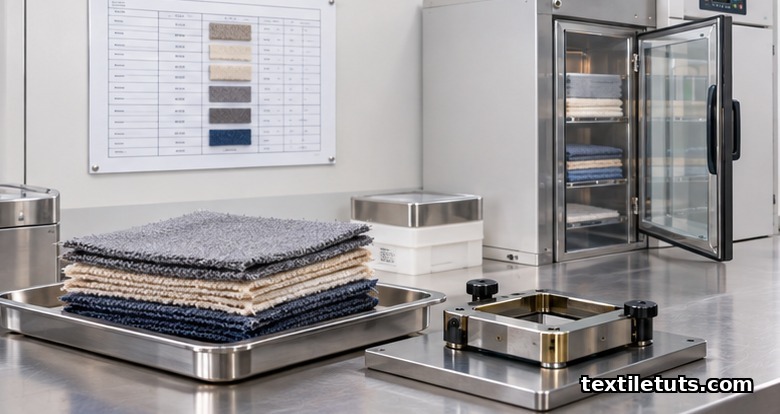
Three recurring pitfalls show up in lab audits. First, the specimen is not conditioned for the full 4 hours at 20 °C / 65% RH before mounting. Moisture retained from the cutting table depresses R by 5–10% because water has roughly twenty-five times the thermal conductivity of dry polyester fiber. Second, samples are cut too small for the test plate; the standard requires 30 cm × 30 cm minimum because undersized specimens do not fully cover the edge-loss guard and inflate the apparent R. Third, specimens are re-tested without re-conditioning, which compresses the air layer and lowers R artificially across a measurement series.
For MTPS specifically, sensor contact pressure and ambient drift dominate the error budget. ASTM D1518 Method B requires the lab to report the test temperature at the time of measurement, because a 1 °C shift in ambient changes reported R by roughly 0.5% on a thin fabric. The MTPS sensor should also be recalibrated against a known thermal-effusivity reference at the start of each shift.
A reasonable QA pass for a new lab is to run a certified reference batting (NIST traceable or supplier-issued) before the first production run, then again as a control every twenty samples thereafter. Sustained drift above ±5% on the reference is a signal to check plate alignment, humidity, and conditioning routines before the next client batch.
Frequently Asked Questions
What is the difference between thermal resistance and thermal conductivity in textiles?
Thermal conductivity, in W/(m·K), is an intrinsic property of the material itself. Thermal resistance, in m²·K/W, is the ratio of fabric thickness to that conductivity and therefore scales with how thick the sample is. D1518 reports R, not conductivity, because apparel decisions track thickness-dependent insulation rather than intrinsic fiber property.
Does ASTM D1518 include the air layer at the skin surface?
Yes. The standard reports both fabric-only Rf and fabric-plus-boundary-air Rcb. The boundary air layer still counts as part of the insulation, which is why two fabrics with identical material conductivity can show different reported R once their surface texture or surface hairiness changes.
How does D1518 differ from full thermal manikin testing (ASTM F1291)?
ASTM F1291 measures total garment insulation on a full-body sweating manikin in a climate chamber and reports a wearer-level clo. D1518 measures the textile material only, on a bench apparatus, separated from fit and design variables. Manikin tests are closer to real-wearer results; D1518 isolates the material so material changes can be compared cleanly.
Can D1518 be used for nonwovens and for laminate fabrics?
Yes, both can be tested. Method A tends to be more accurate on thick nonwovens above 5 mm, and Method B MTPS works well on laminates and thin nonwovens in the 1–5 mm range. Results are method-dependent and should always be reported alongside the method letter (A or B) and the conditioning routine used.
Why do two labs report slightly different clo for the same fabric?
Inter-laboratory variation typically runs ±5% to ±10% depending on the method and material. Common causes include different conditioning routines, different edge-loss corrections, different sample sizes, and different operator handling. Round-robin inter-comparisons run under ASTM or AATCC proficiency programs document this drift and let a customer see whether a given lab is consistently high or low.
References
- ASTM D1518-23. Standard Test Method for Determining Thermal Resistance of Textiles. ASTM International, West Conshohocken, PA, 2023. https://www.astm.org/d1518.html — Specifies Method A (guarded two-plate) and Method B (MTPS) for steady-state thermal resistance of textile materials.
- ISO 11092:2014. Textiles — Physiological effects — Measurement of thermal and water-vapour resistance under steady-state conditions (Sweating guarded-hotplate test). International Organization for Standardization, Geneva, 2014. https://www.iso.org/standard/65200.html — Companion international method, used in protective-clothing and physiological-comfort specs.
- ISO 5085-1:2014. Textiles — Determination of thermal resistance — Part 1: Low thermal resistance. International Organization for Standardization, Geneva, 2014. https://www.iso.org/standard/60402.html — Older guarded-plate method used for thin shirting and lightweight apparel.
- ASTM C518-21. Standard Test Method for Steady-State Thermal Transmission Properties by Means of the Heat Flow Meter Apparatus. ASTM International, West Conshohocken, PA, 2021. https://www.astm.org/c0518.html — Heat-flow-meter rig used for cross-checking D1518 Method A on thin fabrics.
- Hes, L., and Offermann, P. The Modified Transient Plane Source (MTPS) Method. ResearchGate technical paper, 2010. https://www.researchgate.net/publication/265471943 — Foundational paper behind D1518 Method B.
- Pac, M. J., Bueno, M. A., and Renner, M. Measuring the Thermal Resistance of Textiles: A Critical Review. Springer Nature (Fibres & Textiles in Eastern Europe), 2017. https://link.springer.com — Peer-reviewed comparison of ASTM and ISO thermal-resistance methods on apparel fabrics.
This article is the working reference for thermal resistance under ASTM D1518. Editorial by Iftay Khairul Alam, TextileTuts. Sources: ASTM D1518-23, ISO 11092:2014, ISO 5085-1:2014, ASTM C518-21, Hes & Offermann, and Pac et al. as cited.


