
Stretch and Recovery: ASTM D2594

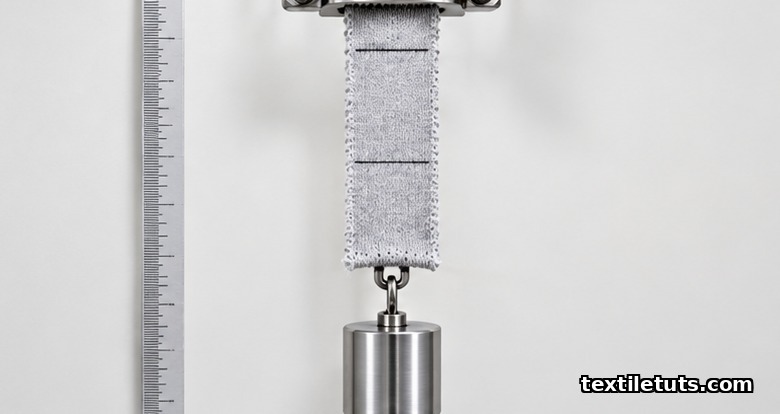
ASTM D2594 measures stretch and recovery of low-power stretch knitted fabrics by hanging a marked specimen under a fixed suspended load (1.36 kg, or 3 lb, for knits lighter than about 170 g/m² and 2.27 kg, or 5 lb, for knits at or above that weight), recording elongation at the end of each 1-minute hold, and reporting residual growth after five load-unload cycles.
The method produces four numbers every textile engineer reports to a buyer or lab: percent stretch under load, immediate percent recovery, delayed percent recovery, and percent growth, the stretch that never recovers.
Below is the procedure, the calculations, and the practical reasons it matters for swimwear, lingerie, sportswear, and any knit that has to spring back into shape after a day of wear.
What ASTM D2594 Actually Measures
ASTM D2594, “Standard Test Method for Stretch Properties of Knitted Fabrics Having Low Power Stretch,” is maintained by ASTM Subcommittee D13.59 on Fabric Test Methods. It targets knit fabrics whose stretch comes primarily from loop geometry, that is, the way the loops themselves deform when pulled, rather than from spandex or elastane yarn. A plain circular-knit cotton jersey still stretches because its loops open up, and ASTM D2594 is the method written for that case.
The standard reports four percentages, calculated from gauge length and a small set of measurements on each specimen:
- Percent stretch: elongation under the test load, expressed as a percentage of the original gauge length.
- Immediate percent recovery: how much of that elongation is recovered within one minute after the load is removed.
- Delayed percent recovery: how much is recovered after the specifier’s chosen recovery interval, commonly 1 hour.
- Percent growth: the elongation that does not recover, measured against the original gauge length.
Together, growth and recovery tell a buyer whether a knit will stay in shape after repeated wear or whether it will gradually sag into a different silhouette.
Sample Preparation and Test Geometry
Specimens are cut to a width of 50.8 mm (2 inches) along both the wale (length) direction and the course (width) direction. The recommended gauge length is 100 mm (4 inches) between bench marks, although 200 mm is sometimes used for narrow stretch trims and bindings.
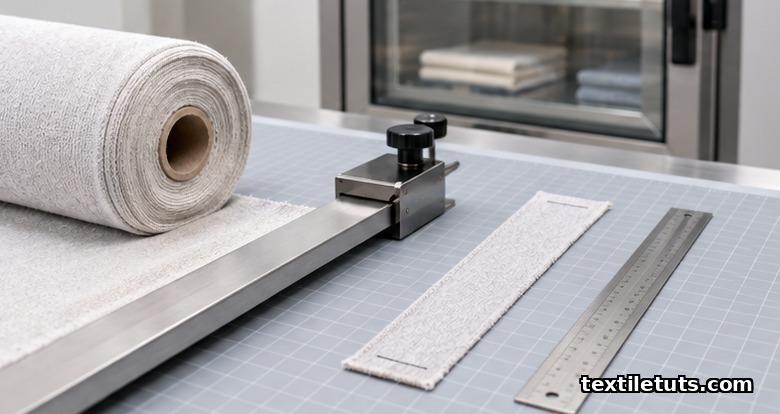
ASTM D2594 requires a minimum of three specimens per direction. Most production labs run five specimens per direction and report the mean, which gives a tighter confidence interval when the buyer is trying to settle a dispute about as little as 2 percent stretch difference between two lots.
Before testing, specimens are conditioned per ASTM D1776, “Standard Practice for Conditioning and Testing Textiles,” typically 4 hours at 20 °C and 65 percent relative humidity. Knit stretch is sensitive to humidity because cotton and rayon fibers absorb moisture and become more extensible; running the test without proper conditioning can shift percent stretch by 3 to 5 percentage points.
Load Selection: 1.36 kg vs. 2.27 kg
The test load is selected by fabric weight:
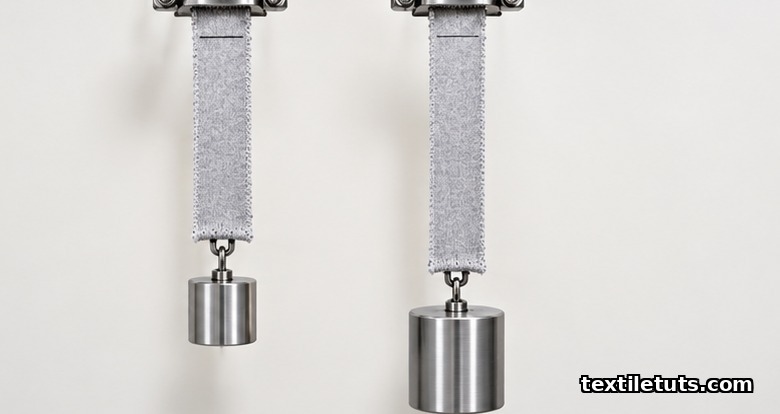
- For knits lighter than about 170 g/m² (approximately 5 oz/yd²): 1.36 kg (3 lb).
- For knits at or above about 170 g/m²: 2.27 kg (5 lb).
The threshold exists because a heavy fleece does not stretch meaningfully under 1.36 kg, so its percent stretch would sit near zero and the test would not discriminate between fabrics. The 2.27 kg load produces a stretch number in a usable range, typically 10 to 35 percent for plain cotton jersey and 50 to 80 percent for lightweight 1×1 rib.
When a buyer specifies a different load, for example the 4 N and 8 N values that some European brands request, it is reported alongside the percent stretch. ASTM D2594 allows the alternative load; it just requires the deviation to be noted in the test report.
The Five-Cycle Procedure
ASTM D2594 specifies five stretch-and-recovery cycles, each consisting of:
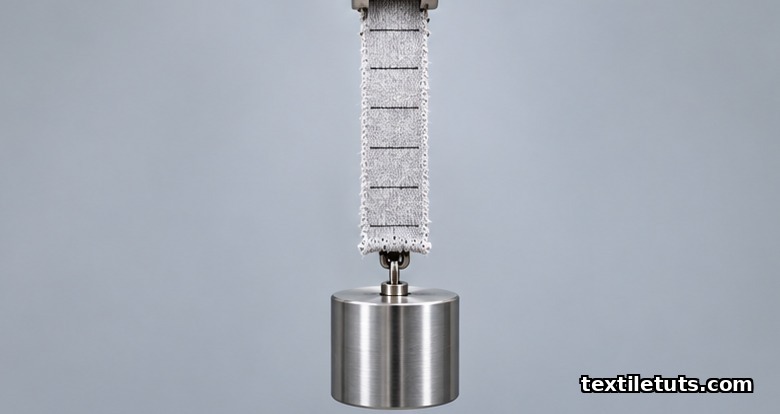
- Hang the specimen unclamped at the top, with the lower clamp and the chosen load attached.
- Wait 1 minute; record the stretched gauge length (S1).
- Remove the load. Wait 1 minute; record the recovered length (R1).
- Re-attach the load. Wait 1 minute; record the new stretched length (S2).
- Repeat through five total cycles (S1 through S5 and R1 through R5).
- After the fifth recovery, allow the specimen to relax for the specifier-defined delayed recovery interval, typically 1 hour. Record the final length (F).
The cycle count matters because stretch behavior changes with repeated loading. A knit that recovers 95 percent on the first cycle may recover only 80 percent by the fifth cycle if it has poor elastic memory. Buyers specify “growth after 5 cycles” for a reason: it correlates with how a garment looks after a full day of wear.
Calculating the Four Reported Numbers
Using the original gauge length G (commonly 100 mm) and the recorded lengths above, ASTM D2594 defines:
- Percent stretch (cycle n) = (Sn − G) / G × 100
- Immediate percent recovery (cycle n) = (Sn − Rn) / (Sn − G) × 100
- Percent growth = (F − G) / G × 100
- Delayed percent recovery = (S5 − F) / (S5 − G) × 100
A worked example for a 200 g/m² cotton/spandex jersey at a 100 mm gauge:
- G = 100 mm
- S5 after 5 cycles = 145 mm (so percent stretch = 45%)
- R5 immediate recovery length = 102 mm (immediate recovery = (145 − 102) / (145 − 100) × 100 = 95.6%)
- F after 1 hour delayed recovery = 105 mm (growth = 5%, delayed recovery = (145 − 105) / (145 − 100) × 100 = 88.9%)
Most activewear specifications call for immediate recovery ≥ 90 percent and delayed recovery ≥ 85 percent at the chosen load.
ASTM D2594 vs. ASTM D3107 and ASTM D4964
ASTM publishes three closely related stretch methods, and picking the wrong one leads to results that look like numbers but do not actually describe the fabric:
| Standard | Fabric class | Load approach |
|---|---|---|
| ASTM D2594 | Knits, low-power stretch, including elastane-containing knits | Fixed suspended weight, 5 cycles |
| ASTM D3107 | Woven fabrics containing stretch yarns | Cyclic CRE tensile machine |
| ASTM D4964 | Elastic narrow fabrics (straps, banding, elastics) | Constant-rate-of-extension tensile tester |
For knits that contain spandex, ASTM D2594 is still the U.S. industry default for stretch-and-recovery reporting, even though the standard pre-dates the wide use of elastane. The international equivalent, ISO 20932-1:2018, “Textiles – Determination of the elasticity of fabrics – Part 1: Strip tests,” covers similar territory using a tensile machine instead of suspended weights and reports multi-cycle hysteresis rather than a single growth number.
Practical Reasons the Test Matters
Three real scenarios where the test outcome decides whether a fabric ships or is rejected:
- Swimwear fit. A swimsuit that grows more than 8 percent at the waist after five cycles will visibly sag within an hour of wear. Most swimwear specs set growth ≤ 5 percent at the chosen load.
- Underwear leg bands. Recovery ≥ 90 percent keeps the band from cutting in. Growth above 10 percent after five cycles is the typical reject threshold for leg and waist elastics applied to knit grounds.
- Sportswear cuffs and waistbands. These must stretch to fit over the hand or hip, then snap back. A knit with 60 percent stretch under 2.27 kg and 92 percent recovery is a typical target for performance waistband interlock.
For a knit without elastane, ASTM D2594 numbers can also predict how a finished garment will change dimensions after the first wash. Cotton knits typically relax 5 to 7 percent in length during the first laundering cycle, which the test will not capture (it tests dry fabric under tension) but which is why buyers combine ASTM D2594 with AATCC TM 135 or ISO 5077 dimensional-change tests.
Frequently Asked Questions
What load should I use if my knit contains spandex?
ASTM D2594 still applies when the knit contains elastane, but most specifiers move to the 1.36 kg load even if the fabric weighs more than 170 g/m², because elastane already contributes most of the stretch. Some labs run both loads and report both numbers; a fabric with 80 percent stretch at 1.36 kg and 45 percent stretch at 2.27 kg is elastane-driven, while a fabric with similar numbers at both loads is loop-geometry-driven.
How many specimens do I need for a usable result?
ASTM D2594 requires a minimum of three specimens per direction. For buyer-facing claims, five specimens per direction give a tighter confidence interval. Below three specimens, percent stretch values can swing by 4 to 6 percentage points between specimens in the same lot, which is wider than the typical pass-fail band.
Can I compare results across labs?
Only if both labs used the same load, gauge length, recovery interval, and conditioning procedure. ASTM D2594 explicitly allows load variation, and ISO 20932 uses a tensile machine instead of suspended weights. A 50 percent stretch reported on a tensile machine and a 50 percent stretch under a suspended weight can describe very different fabric behaviors.
What is an acceptable percent growth?
It depends on end use. Cotton jersey without elastane typically shows 5 to 10 percent growth after five cycles under 2.27 kg. Knits with 5 to 10 percent spandex show 2 to 5 percent growth at the same load. Garments that must hold shape (swimwear, waistbands, performance knits) typically require growth below 5 percent; relaxed-fit casualwear tolerates up to 8 percent.
How does ASTM D2594 relate to dimensional change after washing?
They measure different things. ASTM D2594 measures mechanical stretch and elastic recovery on dry fabric under load. AATCC TM 135 and ISO 5077 measure relaxation and felting shrinkage after laundering. A knit can pass D2594 (good elastic recovery) and still shrink 7 percent in length after the first wash if it has not been pre-relaxed during finishing, which is why the two tests are usually run together on the same lot.
References
- ASTM International. ASTM D2594-21: Standard Test Method for Stretch Properties of Knitted Fabrics Having Low Power Stretch. West Conshohocken, PA: ASTM International, 2021.
- ASTM International. ASTM D3107-07: Standard Test Methods for Stretch Properties of Fabrics Woven from Stretch Yarns. West Conshohocken, PA: ASTM International, 2007.
- ASTM International. ASTM D4964-96: Standard Test Method for Tension and Elongation of Elastic Fabrics (Constant-Rate-of-Extension Tensile Testing Machine). West Conshohocken, PA: ASTM International, 1996.
- ASTM International. ASTM D1776-20: Standard Practice for Conditioning and Testing Textiles. West Conshohocken, PA: ASTM International, 2020.
- International Organization for Standardization. ISO 20932-1:2018: Textiles – Determination of the elasticity of fabrics – Part 1: Strip tests. Geneva: ISO, 2018.
- AATCC. AATCC TM 135: Dimensional Changes of Fabrics after Home Laundering. Research Triangle Park, NC: American Association of Textile Chemists and Colorists.
- International Organization for Standardization. ISO 5077:2007: Textiles – Determination of dimensional change. Geneva: ISO, 2007.
This article is the working reference for ASTM D2594 stretch and recovery testing of knitted fabrics. Editorial by Iftay Khairul Alam, TextileTuts. Sources: ASTM D2594-21, ASTM D3107-07, ASTM D4964-96, ASTM D1776-20, ISO 20932-1:2018, AATCC TM 135, ISO 5077:2007 as cited.


