
Moisture Management: AATCC 195

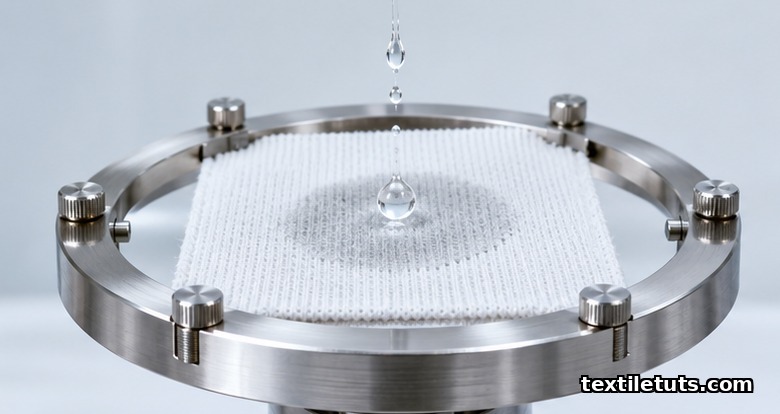
AATCC Test Method 195 (Liquid Moisture Management Properties of Textile Fabrics) measures a fabric’s dynamic liquid moisture transfer in three dimensions using a Moisture Management Tester (MMT), producing seven primary indices plus a single Overall Moisture Management Capacity (OMMC) grading value under controlled laboratory conditions of 20 ± 2 °C and 65 ± 2 % relative humidity.
Developed by the American Association of Textile Chemists and Colorists, the method quantifies how a synthetic sweat droplet (9 g/L sodium chloride solution, 0.2 mL dose) is absorbed on the skin-facing side, transported across the fabric thickness, and spread on the outer side, giving sportswear brands and technical-textile developers a reproducible way to grade next-to-skin comfort performance.
This article explains the seven indices the method produces, how the MMT instrument works, what each output means for fabric selection, and how to read the grading scale that determines whether a fabric is classed as poor, fair, good, very good, or excellent at moving moisture away from the skin.
What AATCC 195 Tests For
AATCC 195 answers a single engineering question: when a sweat droplet lands on one side of a fabric, where does it go next? Sweat that pools against the skin causes the clammy, friction-heavy feeling athletes complain about during long training sessions, while sweat that migrates through the fabric and spreads across the outer surface evaporates quickly and keeps the wearer dry. The method simulates this transport with a controlled liquid drop and records the response at both fabric surfaces simultaneously for 120 seconds.
Unlike the older vertical-wicking tests such as AATCC TM197 or the gravimetric absorbency tests under AATCC TM79, AATCC 195 captures dynamic, time-resolved behavior at both surfaces. That is what allows it to produce a one-way transport capacity value, which is the metric most often cited on performance-fabric specification sheets. The test is repeatable, instrument-based, and works equally well on knits, wovens, and nonwovens as long as a flat 5 × 5 cm specimen can be cut from the fabric.
How the Moisture Management Tester Works
The MMT instrument holds a fabric specimen between two concentric ring sensors (an upper sensor and a lower sensor, each containing seven concentric rings of copper pins). When the test starts, a syringe delivers 0.2 mL of 9 g/L sodium chloride solution (synthetic sweat) onto the top surface in roughly 3 seconds. The instrument then samples the resistance change between every pair of pins on both sensors for 120 seconds at 0.2 second intervals.
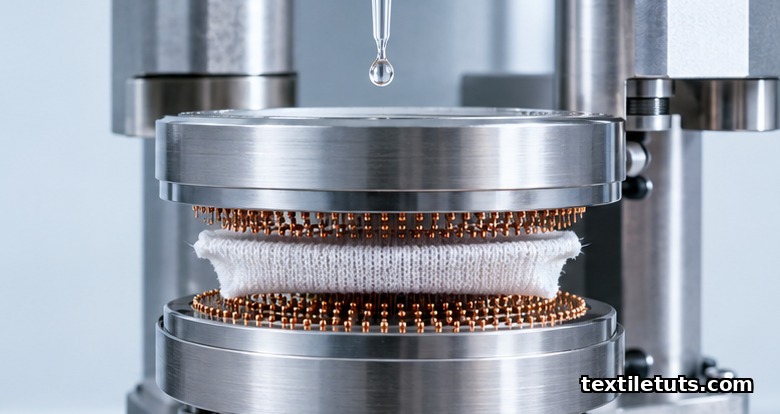
Lower electrical resistance means more liquid is in contact with the fabric at that location. Because every ring pair is read independently, the instrument plots a wetting curve for each of seven radial zones on both surfaces and, from those curves, derives all of the indices below. Each sensor surface is divided into rings of increasing radius (typically 5, 10, 15, 20, 25, 30, and 35 mm) so that wetting radius and spreading speed can be tracked as the wet front moves outward over time.
Standard conditioning is 24 hours at 20 ± 2 °C and 65 ± 2 % RH before testing. Most published round-robin work reports coefficients of variation between 4 % and 12 % for the OMMC value when five specimens are tested in each fabric direction, which is why the method recommends averaging across at least five specimens rather than relying on a single trial.
The Seven Indices and the OMMC Grade
The test produces seven primary indices plus the OMMC. Five specimens per fabric are recommended, and each index is reported as the mean of those specimens. The standard grading table is reproduced in shortened form below.
| Index | Symbol | Unit | What it measures |
|---|---|---|---|
| Top wetting time | WTt | second (s) | Time from drop contact until the top surface starts to wet. |
| Bottom wetting time | WTb | second (s) | Time until liquid first reaches the bottom surface. |
| Top absorption rate | ARt | %/s | Speed at which the top surface absorbs liquid during the wetting phase. |
| Bottom absorption rate | ARb | %/s | Speed at which the bottom surface absorbs liquid once it arrives. |
| Top max wetted radius | MWRt | mm | Maximum radial spread of the wet area on the top surface. |
| Bottom max wetted radius | MWRb | mm | Maximum radial spread on the bottom surface. |
| Top spreading speed | SSt | mm/s | Speed at which the wet area grows outward on the top surface. |
| Bottom spreading speed | SSb | mm/s | Speed at which the wet area grows outward on the bottom surface. |
| One-way transport capacity | OWTC | % | Difference in cumulative moisture between the two surfaces during the test. |
| Overall moisture management capacity | OMMC | unitless, 0 to 1 | Weighted combination of the three most predictive indices; the headline grade. |
How to Read the OMMC Grading Scale
Each of the seven primary indices is graded 1 to 5, where 1 represents poor performance and 5 represents excellent performance. The OMMC is then calculated as a weighted sum of the three most predictive indices (the bottom absorption rate, the bottom spreading speed, and the one-way transport capacity), normalized to a 0 to 1 scale. The standard maps OMMC to a single descriptive grade as follows:
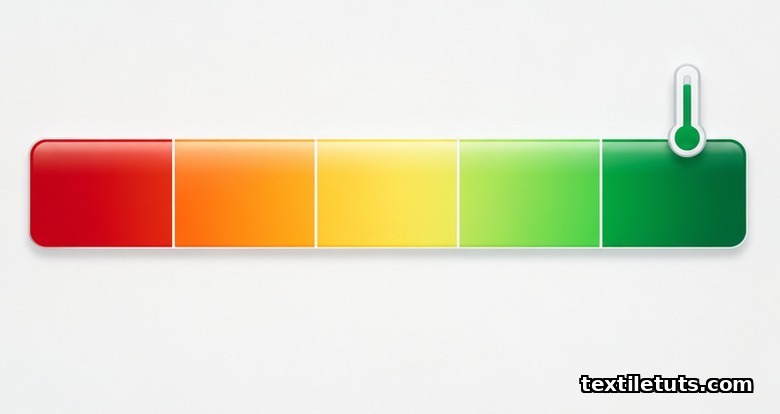
- OMMC 0.20 or less: poor moisture management. The fabric tends to hold sweat against the skin.
- OMMC 0.20 to 0.40: fair moisture management. Suitable for low-intensity wear or as a base-layer liner.
- OMMC 0.40 to 0.60: good moisture management. Acceptable for general activewear.
- OMMC 0.60 to 0.80: very good. Common target for running and training tops.
- OMMC 0.80 and above: excellent. Reserved for high-performance baselayers and competitive-sport knits.
Most commercially available polyester knits fall in the 0.40 to 0.70 range, while untreated cotton knits typically score below 0.30 because cotton absorbs sweat into the fiber instead of transporting it through the structure. Hydrophilic finishes, raised-loop inner surfaces, and bi-component yarns are the three most common construction choices mills use to push OMMC above 0.60.
Sample Preparation and Common Pitfalls
Three practical issues skew AATCC 195 results more than the test itself does. First, finishing residues (silicone softeners, hydrophobic coatings) on a fabric can artificially raise the top wetting time and push the OMMC down even when the base fiber is moisture-friendly; a single hot wash with a non-ionic surfactant usually brings the result back to the true fiber behavior. Second, sample orientation matters: the test should be repeated on the face side and the back side of the fabric, since many knit constructions transport liquid asymmetrically. Third, the test uses 0.2 mL of liquid per trial, which is more than a typical sweat droplet but standard for repeatable inter-laboratory comparison.
Specimen size is 5 × 5 cm, and the method specifies that specimens must be flat, free of wrinkles, and free of surface contaminants at the time of test. A standard round of testing on one fabric sample (5 specimens × 2 sides) takes roughly 25 minutes including setup and instrument calibration. Labs that publish AATCC 195 results in product literature should disclose the number of specimens, the test direction, and whether any pre-conditioning wash was applied, because a mill’s number and a brand’s quoted number can diverge by 0.10 OMMC units when the protocols differ.
How AATCC 195 Compares to Other Moisture Tests
Several other methods look at related but different aspects of fabric moisture behavior. Choosing between them depends on whether you need to measure static absorption, vertical wicking, water-vapor permeability, or dynamic multi-directional liquid transport.
| Method | What it measures | Typical use case |
|---|---|---|
| AATCC TM195 | Dynamic multi-directional liquid transport on both surfaces, with OMMC grade. | Performance sportswear, baselayers, technical knit selection. |
| AATCC TM197 | Vertical wicking of a fabric strip in water over time. | Quick screening of yarn wicking; not skin-side comfort. |
| AATCC TM79 | Absorbency time of a single drop on a flat fabric. | Towel and wipe absorbency, not transport. |
| JIS L 1099 | Two methods (A-1 drop, B potassium acetate dish) for water-vapor permeability. | Japanese performance-fabric specifications, vapor not liquid. |
| ASTM D5802 | Water vapor permeability of fabrics. | Vapor transmission only, no liquid measurement. |
What AATCC 195 Does Not Measure
Three quantities commonly confused with AATCC 195 results are not part of the test. First, water-vapor permeability (the rate at which sweat evaporates through a fabric as vapor) is measured by ASTM D5802 and the JIS L 1099 A-1 and B methods, not AATCC 195; a fabric can score well on OMMC and still feel muggy if its vapor permeability is low. Second, dry thermal resistance (clo value) is a separate comfort metric measured under ISO 11092. Third, odor retention and antimicrobial performance are functional finishes tested under AATCC TM100 and TM147, not the MMT.
This separation is why most performance-fabric brands combine AATCC 195 with at least one vapor-permeability test before making a marketing claim: liquid transport and vapor transport are different physical phenomena, and a comfortable garment needs both.
Where the Test Is Used in Industry
Performance-sportswear brands use AATCC 195 to qualify baselayer knits before bulk production. The test is also part of several buyer-specific performance manuals for running, cycling, and outdoor apparel. Medical-textile developers apply it to barrier layers and surgical-gown fabrics where liquid transport on the patient-facing side affects skin health. Finally, fabric finishers use the test to compare the same greige fabric before and after a finishing treatment, which makes it a useful QC tool for any mill that wants to demonstrate a moisture-management claim with numbers rather than marketing copy.
Frequently Asked Questions
What is AATCC 195 in textile testing?
AATCC 195 is the American Association of Textile Chemists and Colorists test method titled Liquid Moisture Management Properties of Textile Fabrics. It uses the Moisture Management Tester (MMT) instrument to record how a 0.2 mL synthetic sweat drop is absorbed, transferred through, and spread across a fabric over 120 seconds, producing seven primary indices and the Overall Moisture Management Capacity (OMMC) grade.
What does the OMMC value mean?
The Overall Moisture Management Capacity is a unitless value between 0 and 1 that summarizes how effectively a fabric moves liquid from the skin-facing surface to the outer surface. Values below 0.20 are classed as poor, 0.20 to 0.40 fair, 0.40 to 0.60 good, 0.60 to 0.80 very good, and above 0.80 excellent for next-to-skin comfort.
Is AATCC 195 the only standard for moisture management?
No. AATCC TM195 is the primary US standard, and the same Moisture Management Tester methodology has been adopted as ISO 13029 for international use. Related but distinct methods include AATCC TM197 (vertical wicking), AATCC TM79 (drop absorbency), JIS L 1099 (water-vapor permeability), and ASTM D5802 (water-vapor permeability). Each test answers a slightly different question, so the right choice depends on whether liquid transport, vapor transport, or static absorption is the property you need to measure.
Can the test be done on woven fabrics or only knits?
The test can be run on any flat textile, including wovens, knits, and nonwovens. Knits generally score higher on OMMC because their loop structure provides more capillary pathways for liquid transfer. Tightly woven fabrics with hydrophobic finishes often score poorly because the structure resists both absorption and through-thickness transport.
What is one-way transport capacity?
One-way transport capacity (OWTC) is the percentage difference between the cumulative moisture content of the bottom surface and the top surface over the 120 second test. Positive OWTC values mean liquid moved from the top to the bottom of the fabric, which is the desired behavior for a baselayer. Negative values indicate the opposite, where liquid accumulates against the skin rather than transferring through.
References
- AATCC. Test Method 195-2017: Liquid Moisture Management Properties of Textile Fabrics. American Association of Textile Chemists and Colorists, Research Triangle Park, NC.
- Hu, J., Li, Y., Yeung, K. W., Wong, A. S. W., and Xu, W. (2005). Moisture Management Tester: A Method to Characterize Fabric Liquid Moisture Management Properties. Textile Research Journal, 75(1), 57–62.
- AATCC. Test Method 197-2013: Vertical Wicking of Textiles. American Association of Textile Chemists and Colorists, Research Triangle Park, NC.
- AATCC. Test Method 79-2014: Absorbency of Textiles. American Association of Textile Chemists and Colorists, Research Triangle Park, NC.
- JIS L 1099:2012. Testing Methods for Water Vapour Permeability of Textiles. Japanese Industrial Standards Committee, Tokyo.
- ASTM D5802-12(2020). Standard Test Method for Water Vapor Permeability of Textile Fabrics. ASTM International, West Conshohocken, PA.
This article is the working reference for AATCC 195 moisture management testing. Editorial by Iftay Khairul Alam, TextileTuts. Sources: AATCC TM195-2017, Hu et al. (2005), AATCC TM197-2013, AATCC TM79-2014, JIS L 1099:2012, and ASTM D5802 as cited.


