
Thermal-Bonded Nonwoven

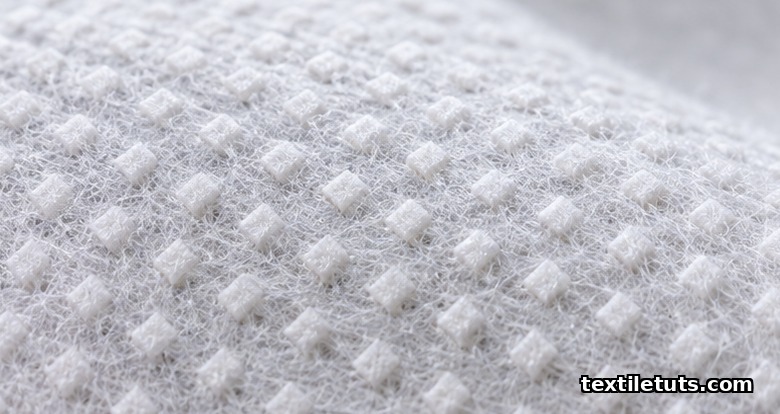
Thermal-bonded nonwoven fabrics are produced by applying heat (typically 130 to 180 °C) and pressure to a web of thermoplastic fibers, fusing the fibers at their crossover points to form a coherent fabric with tensile strengths of 15 to 60 N/5 cm depending on bond area and fiber composition. The bonding occurs because a low-melt component in the web softens, flows, and resolidifies around the higher-melt structural fibers, locking them in place without any chemical binder or water-based binder chemistry. Thermal bonding is the dominant bonding method in single-use hygiene products, wiping cloths, and many medical-textile applications because it is solvent-free, energy-efficient compared to adhesive lamination, and yields a fabric with predictable strength, low lint, and consistent thickness.
This article walks through how thermal bonding works, the two main process variants (calendar bonding and through-air bonding), the fibers used, how the bonded fabric is tested against ISO and ASTM standards, and where thermal-bonded nonwovens show up in real products.
How Thermal Bonding Works
Thermal bonding relies on a controlled temperature window between the softening point of the binder fiber and the melting point of the structural fiber. In a bicomponent fiber, for example, a polypropylene (PP) sheath surrounds a polyester (PET) core. The PP sheath melts at roughly 160 °C while the PET core remains intact up to about 260 °C, so heating the web to 160 to 170 °C melts the sheath just enough to weld fibers together while keeping the core solid and load-bearing. In homopolymer blends, the same effect is achieved by mixing a small fraction of low-melt fibers (often 10 to 30 percent by weight) with regular fibers.
Bonding temperature, dwell time, and line speed together determine how much fusion occurs. Industry data from nonwoven process references report bonding windows of 130 to 160 °C for homopolymer PP webs and 160 to 200 °C for PET/PET low-melt blends, with line speeds commonly 100 to 400 m/min on commercial lines. If the web is under-bonded it delaminates; if over-bonded it becomes stiff, paper-like, and loses absorbent capacity in hygiene applications.
Two Process Variants: Calendar Bonding and Through-Air Bonding
Calendar bonding passes the web between two heated rollers, one of which is engraved with a pattern of raised points. The raised points transfer heat and pressure to small, discrete areas of the web, fusing the fibers only at those points. Typical bond area is 8 to 25 percent of the total surface, with point densities of 20 to 60 points per cm². Light bond area produces a soft, drapable fabric used in coverstock and hygiene topsheets; heavy bond area yields a stiff, paper-like fabric used in industrial wipes or filtration.
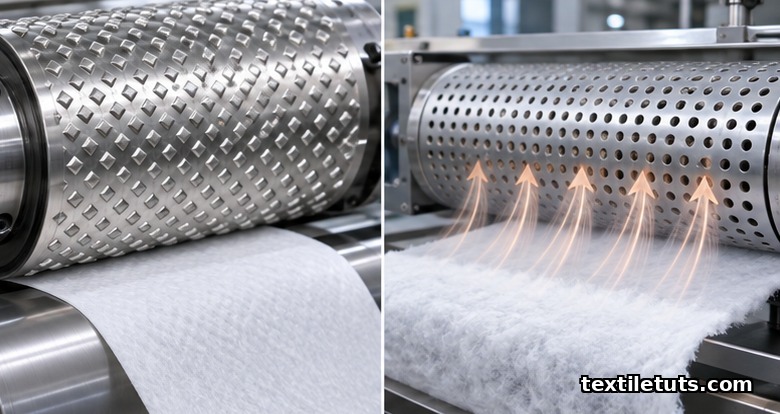
Through-air bonding suspends the web on a perforated conveyor or drum while hot air (180 to 230 °C) is drawn through it. Because the entire web is heated uniformly rather than at discrete points, through-air bonded fabrics retain much more loft (thickness per unit mass) than calendar-bonded ones. A 30 g/m² through-air bonded PP web commonly measures 0.4 to 0.8 mm thick, while the same weight calendar-bonded web may measure only 0.15 to 0.25 mm. Through-air bonding is the standard for absorbent hygiene cores, where loft translates directly to fluid capacity.
Fibers Used in Thermal Bonding
Polypropylene dominates thermal-bonded nonwovens because of its low cost, low melting point (around 165 °C), and resistance to most aqueous chemicals. Polyester is used where higher temperature resistance or better UV stability is required, with bond temperatures pushed into the 180 to 200 °C range and bonding achieved with co-PET or PET/PET low-melt fibers. Polyethylene (PE) and polyethylene/polypropylene bicomponent fibers are common in hygiene products where extra softness is needed.
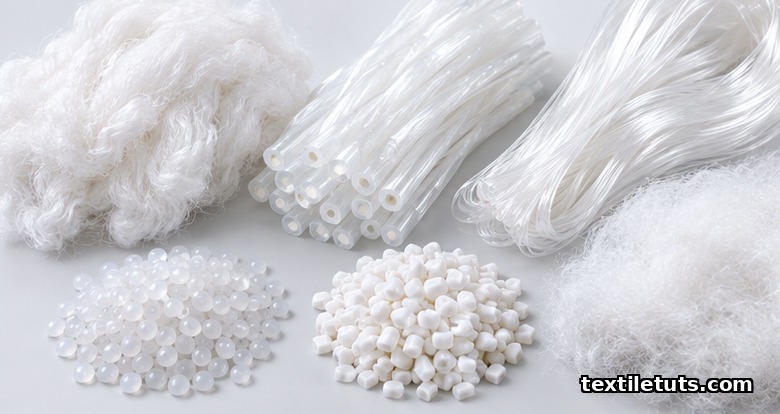
Beyond polyolefins and polyester, thermal bonding extends to bicomponent fibers (sheath/core, side-by-side, or islands-in-the-sea constructions), polylactic acid (PLA) fibers for compostable nonwovens, and specialty fibers such as polyamide or polyphenylene sulfide for high-temperature filtration. The fiber linear density typically ranges from 1.5 to 6.0 denier for hygiene applications and 10 to 25 denier for industrial applications, with staple lengths of 38 to 51 mm when carded webs are used.
Properties of Thermal-Bonded Nonwovens
The mechanical behavior of a thermal-bonded web is set by three variables: the bond area, the bond pattern geometry, and the fiber orientation distribution. Increasing bond area raises tensile strength and stiffness but reduces softness, drapability, and air permeability. Changing the bond pattern from round dots to oval or hexagonal shapes redistributes stress and improves tear strength in the cross direction.
Typical property ranges for a 20 to 60 g/m² thermal-bonded PP nonwoven are:
| Property | Typical range | Test method |
|---|---|---|
| Mass per unit area | 15 to 80 g/m² | ISO 9073-1 / ASTM D6242 |
| Thickness | 0.15 to 1.2 mm | ISO 9073-2 / ASTM D5729 |
| Strip tensile strength (MD) | 15 to 60 N/5 cm | ISO 9073-3 / ASTM D5035 |
| Elongation at break | 20 to 80 percent | ISO 9073-3 / ASTM D5035 |
| Air permeability | 100 to 1500 cm³/cm²/s | ISO 9073-15 |
| Absorbency (for treated webs) | 3 to 12 g/g | ISO 9073-6 |
Liquid absorbency is not inherent to thermal-bonded PP; the fiber itself is hydrophobic. Absorbency requires a surfactant finish applied by the converter after bonding, typically a nonionic or anionic wetting agent at 0.1 to 0.5 percent add-on.
Testing Standards for Thermal-Bonded Nonwovens
ISO 9092:2019 defines a nonwoven as “a manufactured sheet, web or batt of directionally or randomly orientated fibres, bonded by friction, cohesion or adhesion.” Most thermal-bonded nonwovens are tested under the ISO 9073 family of standards, which covers mass per unit area, thickness, tensile strength, elongation, tear resistance, air permeability, hydrostatic head, and absorbency.
In North America, ASTM standards often apply instead of, or alongside, ISO methods. ASTM D1117 covers the evaluation of nonwoven fabrics, while ASTM D6242 (mass per unit area) and ASTM D5732 (bursting strength) are common production-line checks. Many buyers in personal care and medical categories accept both ISO and ASTM data interchangeably, so suppliers often publish results under both method families.
For medical applications such as surgical gowns and drapes, additional performance standards apply, including AATCC 42 (water impact penetration) and AATCC 127 (hydrostatic pressure), both of which are referenced in EN 13795 and AAMI PB70 barrier performance standards.
Applications of Thermal-Bonded Nonwovens
The single largest end-use category is hygiene: baby diapers, feminine care products, and adult incontinence products all contain thermal-bonded nonwovens, with global consumption of PP nonwoven for hygiene topsheets and acquisition layers exceeding several million tonnes per year. Other significant applications include wet and dry wipes, agricultural crop covers, furniture and bedding components, automotive interior linings, roofing and geotextile underlays, filtration media, and protective apparel.
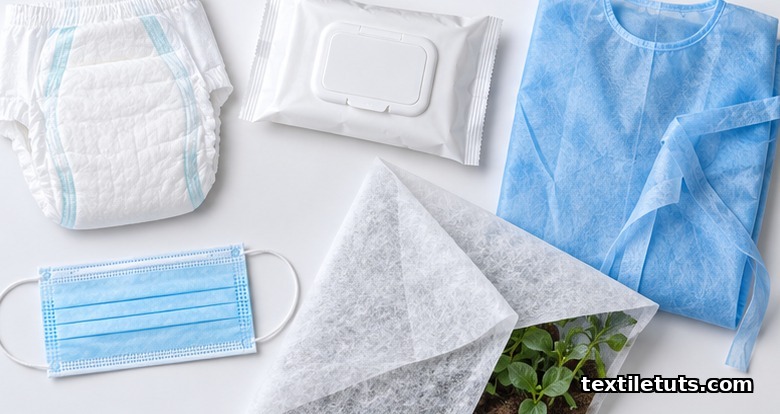
Thermal bonding is also common in medical single-use products (surgical masks, isolation gowns, caps, shoe covers) where it produces low-lint fabrics that meet EN 13795 barrier requirements when combined with a film laminate. In filtration, thermal-bonded webs serve as pre-filters and support layers in HVAC, paint arrestance, and liquid filtration cartridges, often in conjunction with meltblown or needlefelt media.
Thermal Bonding vs. Other Nonwoven Bonding Methods
Each nonwoven bonding method has trade-offs. The table below compares thermal bonding with the three other dominant methods: spunbonding (which is itself a form of thermal bonding integrated with spinning), needlepunching, and chemical bonding.
| Property | Thermal bonding | Spunbond | Needlepunch | Chemical bonding |
|---|---|---|---|---|
| Binder | Heat + pressure (no additive) | Heat only, inline with spinning | Mechanical fiber entanglement | Acrylic or styrene-butadiene latex |
| Typical weight range | 10 to 80 g/m² | 10 to 200 g/m² | 50 to 1000 g/m² | 15 to 150 g/m² |
| Loft / thickness | Low to medium (calendar); high (through-air) | Low | High | Medium |
| Softness | Good with low bond area | Good | Poor to moderate | Moderate |
| Chemical residue | None | None | None | Latex residue possible |
| Common polymers | PP, PET, PE, bicomponent | PP, PET, PA, PLA | PET, PP, viscose, aramid | Polyester, viscose, blends |
Thermal bonding wins on chemical cleanliness (no binder residue), throughput (continuous high-speed lines), and cost for lightweight webs. It loses on loft when compared with needlepunching, and on the ability to bond heavyweight webs above roughly 100 g/m².
Frequently Asked Questions
What is the difference between point bonding and area bonding?
Point bonding (also called point bonding or spot bonding) uses an engraved calendar roller whose pattern covers 8 to 25 percent of the surface, leaving the rest of the web unbonded. Area bonding uses a smooth calendar roller at higher pressure, bonding almost 100 percent of the surface and producing a film-like, paper-like fabric. Point bonding dominates hygiene and wiping applications; area bonding is used for filtration and packaging substrates.
Is thermal-bonded nonwoven fabric breathable?
Yes, when produced at low bond area with through-air or light point bonding, thermal-bonded PP nonwovens at 15 to 30 g/m² typically have air permeabilities of 500 to 1500 cm³/cm²/s, which is more breathable than woven cotton. Breathability drops sharply as bond area increases; a 100 percent area-bonded fabric becomes a film with near-zero air permeability.
Can thermal-bonded nonwoven be recycled?
Single-polymer thermal-bonded webs (for example, 100 percent PP) can be mechanically recycled by shredding and re-extruding into lower-grade nonwoven or injection-molded parts. Multi-polymer webs, especially those containing bicomponent fibers or PE/PP blends, are harder to recycle and are commonly downcycled or incinerated for energy recovery. Several producers now offer mono-material PET or mono-material PP constructions to support closed-loop recycling.
Why is polypropylene the most common fiber for thermal bonding?
PP has a melting point around 165 °C, low density (0.91 g/cm³, giving more coverage per kilogram), excellent chemical resistance, and the lowest fiber cost among common thermoplastics. It bonds at temperatures low enough to use standard calendar oil heaters and high enough that the bonded fabric tolerates steam sterilization at 121 °C, which is why it dominates hygiene and medical nonwovens.
What is the difference between thermal bonding and ultrasonic bonding?
Both rely on heat to fuse fibers, but ultrasonic bonding generates the heat locally through high-frequency vibration (typically 20 to 40 kHz) rather than through a heated roller or oven. Ultrasonic bonding is used for narrow fabrics, pattern bonding, and stitchless garment seaming, while thermal bonding covers full-width continuous webs at much higher throughput.
References
- International Organization for Standardization. ISO 9092:2019 Nonwovens — Definition. iso.org — official ISO definition of nonwoven fabrics.
- International Organization for Standardization. ISO 9073 (series) — Nonwovens — Test methods. iso.org — mass, thickness, tensile, tear, air permeability, and absorbency methods.
- ASTM International. ASTM D1117-19 Standard Guide for Evaluating Nonwoven Fabrics. astm.org — general nonwoven property evaluation.
- American Association of Textile Chemists and Colorists. AATCC 42 / AATCC 127 — Water Resistance and Hydrostatic Pressure Tests. aatcc.org — barrier testing for medical nonwovens.
- Mao, N., & Russell, S. J. (2015). Nonwoven fabric production. In Textile Science and Technology (Woodhead Publishing / Elsevier, peer-reviewed chapter). sciencedirect.com — comprehensive review of thermal, chemical, and mechanical bonding.
- Russell, S. J. (Ed.). Handbook of Nonwovens. Woodhead Publishing / Elsevier (peer-reviewed textbook). sciencedirect.com — detailed treatment of thermal bonding processes and fibers.
This article is the working reference for thermal-bonded nonwoven fabrics, covering process variants, fibers, properties, and standards. Editorial by Md. Asad Ullah (Meem), TextileTuts. Sources: ISO 9092, ISO 9073 series, ASTM D1117, AATCC 42/127, and the peer-reviewed Handbook of Nonwovens as cited.


