
Spunbond Polypropylene Nonwoven

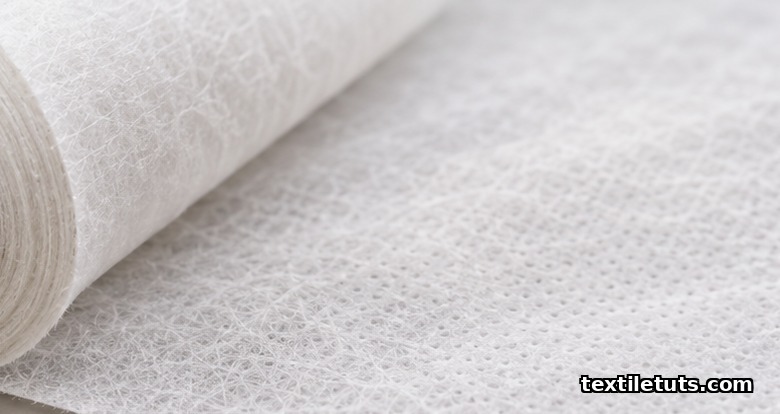
Spunbond polypropylene nonwoven fabric is manufactured by extruding molten isotactic polypropylene (melting point 160-165 °C, melt flow index 25-35 g/10 min) through a spinneret to form 10-30 μm continuous filaments that are laid into a web and thermally bonded at 140-160 °C, producing a fabric with basis weights of 10-200 g/m² and tensile strengths of 15-100 N/5 cm depending on orientation and bonding pattern.
This single-step polymer-to-fabric process makes spunbond polypropylene the largest nonwoven family by global volume, with annual production exceeding 4.5 million tonnes in 2024, used in baby diapers, surgical gowns, crop covers, and road-stabilization geotextiles.
The guide below walks through what spunbond PP is, how the production line turns pellets into fabric, the mechanical and surface properties that drive end-use selection, the test methods that characterize the material, and the limitations you must design around.
What Is Spunbond Polypropylene Nonwoven Fabric?
Spunbond polypropylene nonwoven is a sheet structure made from continuous PP filaments rather than woven or knitted yarns. The defining feature is the filament continuity: filaments are extruded, drawn, and deposited in a single uninterrupted motion onto a moving forming wire, then bonded by heat and pressure. Because there is no yarn spinning, no weaving, and no knitting, the fabric is classified as a nonwoven under ISO 9092:2019 (Nonwovens — Vocabulary).
Polypropylene is the dominant polymer for spunbond because it combines a relatively low melt viscosity, which lets it flow through fine spinneret holes at modest temperatures, with a density of 0.905 g/cm³, the lowest of all commodity thermoplastics. Lower density means more coverage per kilogram, which matters in disposable hygiene applications where every gram of fabric cost is multiplied by billions of units.
Commercial isotactic PP used in spunbond lines typically has a melt flow index (MFI) between 25 and 35 g/10 min (measured at 230 °C / 2.16 kg per ISO 1133-1:2022). Higher MFI grades flow more easily and are used for fine-denier filaments (under 2 denier per filament), while lower MFI grades give slightly higher tensile properties at the cost of higher extrusion pressure.
How Spunbond PP Is Manufactured (the Polymer-to-Fabric Line)
A spunbond line converts PP pellets into finished fabric in five linked stages. Each stage determines a property of the final sheet.
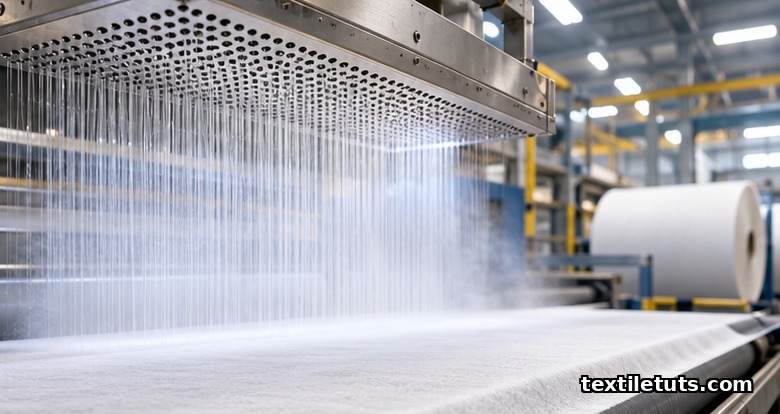
- Polymer feeding and melt extrusion. PP pellets are fed into a heated extruder where the melt reaches 200-230 °C. The melt is filtered through a screen pack and pumped by a gear pump to the spinneret, a metal plate containing thousands of holes typically 0.25-0.40 mm in diameter.
- Filament drawing. Filaments emerging from the spinneret are quenched by cool air and attenuated by a high-velocity air stream that draws the melt down to a final diameter of 10-30 μm. Take-up speeds on modern lines range from 1,000 m/min on legacy Reicofil systems to over 4,000 m/min on Reicofil 4 and 5.
- Web formation. The attenuated filaments are deposited onto a moving forming belt. Random laydown, achieved by oscillating the spinneret or by using a moving deflector, gives isotropic properties; machine-direction laydown gives higher tensile strength in the machine direction than in the cross direction.
- Bonding. The unbonded web is consolidated by one of three routes: thermal calender bonding (the most common, with heated embossed rolls at 140-160 °C and 30-70 N/mm linear pressure), through-air bonding (used for bulky, soft products such as hygiene topsheets), or needle-punching (for heavier geotextiles).
- Winding and finishing. The bonded fabric is wound onto rolls, often after surface treatments such as hydrophilic surfactants (for hygiene applications), antistatic finishes, or UV stabilizers (for outdoor agricultural and geotextile applications).
The calender bonding pattern is itself a design variable. Point-bond patterns typically cover 8-25% of the surface area, and the bond density controls stiffness, softness, and tensile strength simultaneously. Higher bond area means stiffer, stronger, less breathable fabric; lower bond area means softer, weaker, more breathable fabric.
Key Properties: Strength, Hydrophobicity, and Porosity
Spunbond PP has a distinctive property profile that explains its dominance in specific end uses.
Mechanical properties. Tensile strength depends on basis weight and orientation: 15-30 N/5 cm for a 15 g/m² random-laid web, 60-100 N/5 cm for a 100 g/m² machine-direction-laid web. Elongation at break typically falls between 40% and 90%, considerably higher than woven PP tape fabric, which usually fails below 25% elongation.
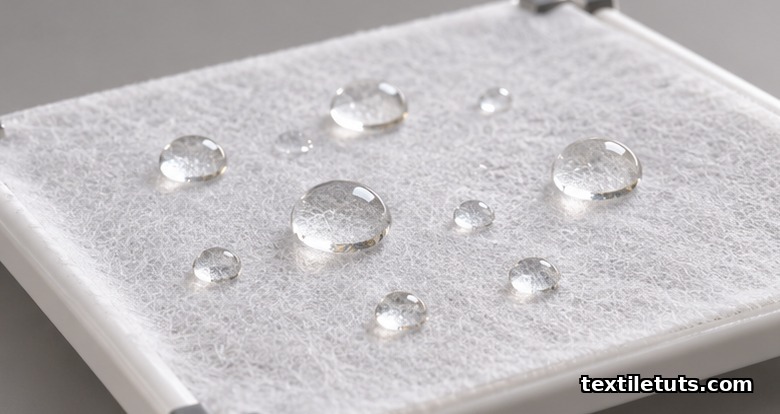
Hydrophobicity. PP has zero water absorption (water uptake under 0.01% after 24 h immersion per ASTM D570-22), and the spunbond structure preserves that hydrophobicity. Water contact angles on smooth PP film exceed 100°, while roughened spunbond surfaces still show contact angles above 90°. This is why spunbond PP is the default backsheet in disposable diapers and the go-to blood-repellent layer in surgical drapes.
Porosity and air permeability. Pore size in a 25 g/m² spunbond typically falls between 10 and 100 μm, large enough for air and water vapor but small enough to block liquid droplets and most aerosolized particles. Air permeability measured per ASTM D737-18 ranges from 100 to 1,500 cm³/cm²/s at 125 Pa, depending on basis weight and bonding intensity.
Thermal behavior. PP softens above 140 °C and melts at 160-165 °C, which sets the upper ceiling for use, finishing, and sterilization. Gamma sterilization at 25-50 kGy, the standard for medical nonwovens, leaves mechanical properties largely intact; steam autoclaving at 121 °C is gentler and is preferred where sterility is needed and the part is reusable.
Applications by Industry
Spunbond PP serves four markets that together account for roughly 90% of volume.
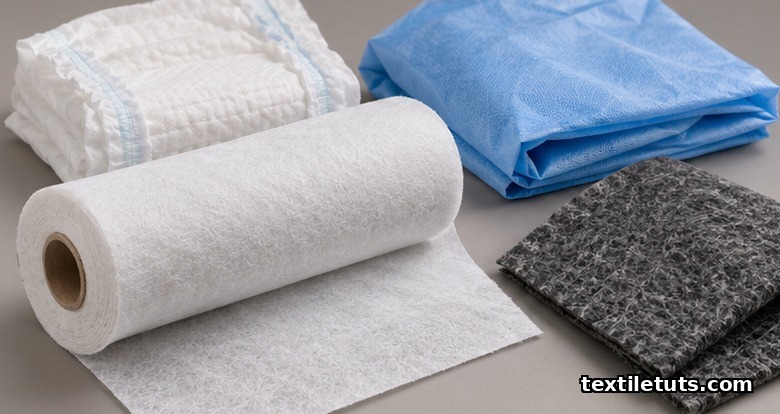
Hygiene (the largest end use)
Baby diapers, feminine hygiene products, and adult incontinence products combine a hydrophilic topsheet, an absorbent core, and a hydrophobic spunbond PP backsheet. A typical baby diaper backsheet is a 15-25 g/m² soft-touch spunbond, often treated with titanium dioxide for a white, cloth-like appearance. The global hygiene nonwovens market exceeded 2.4 million tonnes in 2024, with spunbond PP holding the majority share.
Medical and personal protective equipment
Surgical gowns, drapes, sterilization wraps, and N95-equivalent mask outer and inner layers are commonly produced from spunbond PP, often in a spunbond-meltblown-spunbond (SMS) composite where the meltblown middle layer provides fine-particle filtration. Spunbond PP alone provides the fluid-repellent outer barrier; when paired with a 20-25 g/m² meltblown layer, SMS reaches 99% filtration efficiency at 0.3 μm particle size, the threshold for medical mask classifications under ASTM F2100-23.
Agriculture
Crop covers, mulch films, and weed-control fabrics rely on spunbond PP for UV-stabilized outdoor exposure. Standard spunbond PP loses 50% of its tensile strength after roughly 600 hours of xenon-arc accelerated weathering per ISO 4892-2:2024; adding 1-2% HALS (hindered amine light stabilizer) masterbatch extends that to 2,000-3,000 hours, equivalent to 2-3 growing seasons in temperate climates.
Geotextiles and civil engineering
Needle-punched spunbond PP nonwovens at 100-300 g/m² serve as separation and filtration layers in road construction, landfill drainage, and erosion control. The key requirements here are high puncture resistance (typically 200-600 N per ASTM D4833-07), UV stability for the construction period, and consistent permeability to water flow perpendicular to the plane (typically 50-150 L/m²/s per ISO 11058:2019).
Testing Standards You Will See on the Datasheet
Spunbond PP datasheets almost always list a small set of standard tests. Knowing what each test measures makes supplier datasheets much easier to compare.
| Property | Standard | Typical Spunbond PP Range |
|---|---|---|
| Basis weight (mass per unit area) | ASTM D3776 / ISO 9073-1 | 10-200 g/m² |
| Tensile strength (MD and CD) | ASTM D5034 / ISO 9073-3 | 15-100 N/5 cm |
| Elongation at break | ASTM D5034 / ISO 9073-3 | 40-90% |
| Air permeability | ASTM D737 / ISO 9237 | 100-1,500 cm³/cm²/s |
| Puncture resistance | ASTM D4833 | 200-600 N (geotextile grades) |
| Water contact angle | ASTM D5946 | 90-110° |
| UV accelerated weathering | ISO 4892-2 | 600-3,000 h to 50% strength loss |
| Hydrostatic head (medical grades) | ISO 811 | 20-200 cm H₂O |
Spunbond PP vs Other Common Nonwovens
Spunbond PP is one option among several nonwoven technologies. The most common comparisons a textile engineer will draw are against spunbond polyester, meltblown PP, and needle-punched PP.
| Property | Spunbond PP | Spunbond PET | Meltblown PP | Needle-punched PP |
|---|---|---|---|---|
| Filament form | Continuous, 10-30 μm | Continuous, 10-30 μm | Discontinuous, 1-5 μm | Continuous, 20-50 μm |
| Basis weight range | 10-200 g/m² | 15-300 g/m² | 5-50 g/m² | 80-800 g/m² |
| Tensile strength | Moderate to high | High | Low | Moderate |
| Water repellency | Strong (hydrophobic) | Strong (hydrophobic) | Strong | Weak to moderate |
| Filtration efficiency | Low to moderate | Low | Very high | Low |
| UV resistance | Needs stabilizer | Good inherent | Needs stabilizer | Needs stabilizer |
| Typical end use | Hygiene, medical, agriculture | Roofing, automotive | Filtration, mask middle layer | Geotextile, carpet backing |
The key trade-off is between filament diameter and production speed. Spunbond lines produce 10-30 μm filaments at 1,000-4,000 m/min; meltblown lines produce 1-5 μm filaments at much lower speeds but at higher filtration efficiency per gram. SMS composites combine both to balance comfort, barrier, and strength.
Limitations You Must Design Around
Spunbond PP is not the right answer for every job. Three limitations show up repeatedly.
UV sensitivity. Unstabilized PP loses mechanical strength quickly outdoors. For any application with more than a few weeks of sunlight exposure, specify a UV-stabilized grade and request accelerated weathering data per ISO 4892-2:2024.
Heat sensitivity. PP softens at 140 °C and melts at 160-165 °C. Ironing, hot-press lamination, and autoclave cycles must stay below 130 °C, or the fabric will distort. Spunbond polyester handles higher temperatures but costs more.
Limited barrier performance alone. Plain spunbond PP is breathable and blocks liquids only by hydrophobic effect, not by tight pore structure. For fine-particle filtration or virus barrier, spunbond PP must be paired with meltblown or film layers. A surgical gown made from spunbond PP alone will not meet ASTM F1671-22 (viral penetration).
Frequently Asked Questions
Is spunbond polypropylene nonwoven fabric breathable?
Yes. A 25 g/m² spunbond PP typically shows 400-800 cm³/cm²/s air permeability at 125 Pa (per ASTM D737-18), enough for moisture vapor to pass through. This breathability is what makes it usable as a diaper backsheet and crop cover: liquid water is repelled, but water vapor and air move through the fabric.
Can spunbond polypropylene be recycled?
Yes. PP is a thermoplastic, and clean, uncontaminated spunbond PP can be remelted and re-extruded. Production scrap is routinely reprocessed on the same line. Post-consumer recycling is technically possible but limited in practice because hygiene and medical products are contaminated; mechanical recycling streams typically accept industrial PP scrap rather than post-consumer diapers.
What is the difference between spunbond PP and SMS fabric?
SMS (spunbond-meltblown-spunbond) is a composite: two outer spunbond PP layers for strength and comfort, with a middle meltblown PP layer for fine-particle filtration. SMS is the standard structure for medical gowns, surgical drapes, and Type IIR surgical masks because the meltblown layer provides 95-99% filtration at 0.3 μm, which spunbond alone cannot reach.
Is spunbond polypropylene safe for skin contact?
Yes, for most uses. Spunbond PP is chemically inert, contains no plasticizers or heavy-metal stabilizers, and passes ISO 10993-5 (cytotoxicity) and ISO 10993-10 (skin sensitization) tests for skin-contact applications. For infant and medical applications, request the certification specifically: not every commercial grade carries biocompatibility documentation.
Why does spunbond PP yellow or weaken outdoors?
Sunlight, specifically the UV portion of the spectrum, breaks the C-H and C-C bonds in the PP backbone through a chain-scission reaction. This shows up first as yellowing from chromophore formation, then as embrittlement and strength loss. Adding 0.5-2% HALS (hindered amine light stabilizer) and 0.1-0.3% benzotriazole UV absorber during extrusion slows the reaction, extending outdoor life from 1-2 months (unstabilized) to 2-3 years (well-stabilized).
References
- International Organization for Standardization. ISO 9092:2019 — Nonwovens — Vocabulary. Definition and classification of nonwovens.
- International Organization for Standardization. ISO 9073-1:2023 — Nonwovens — Test methods — Part 1: Determination of mass per unit area. Basis weight measurement.
- International Organization for Standardization. ISO 4892-2:2024 — Plastics — Methods of exposure to laboratory light sources — Part 2: Xenon-arc lamps. UV accelerated weathering protocol.
- ASTM International. ASTM D737-18 — Standard Test Method for Air Permeability of Textile Fabrics.
- ASTM International. ASTM D5034-21 — Standard Test Method for Breaking Strength and Elongation of Textile Fabrics (Grab Test).
- ASTM International. ASTM F2100-23 — Standard Specification for Performance of Materials Used in Medical Face Masks.
- Midha, V.K. and Dakuri, A. Spunbond Technology and Fabrics. Journal of Textile Engineering & Fashion Technology, 2021. Peer-reviewed review of spunbond production and properties.
- Das, D. and Pourdeyhimi, B. Composite Nonwoven Materials: Structure, Properties and Applications. Woodhead Publishing (Elsevier), 2014. Academic reference on nonwoven composite structures.
This article is the working reference for spunbond polypropylene nonwoven fabric. Editorial by Md. Asad Ullah (Meem), TextileTuts. Sources: ISO 9092:2019, ISO 9073-1:2023, ISO 4892-2:2024, ASTM D737-18, ASTM D5034-21, ASTM F2100-23 as cited.


