
Textile Recycling Technologies

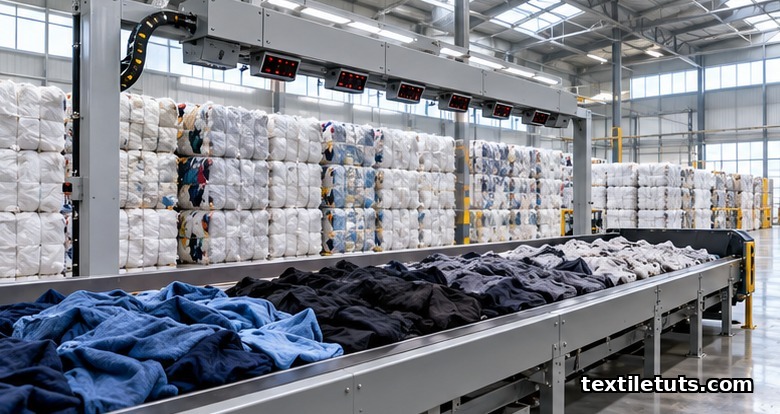
Less than 1% of the roughly 100 billion garments produced globally each year are recycled into new clothing, and an estimated 87% of discarded textiles are landfilled or incinerated, according to the Ellen MacArthur Foundation’s 2017 baseline analysis, a figure still cited by the European Environment Agency in its 2024 update. Closing that gap depends on a stack of complementary technologies: mechanical shredding, chemical depolymerization, enzymatic hydrolysis, and solvent-based purification, each suited to different fiber types, blend ratios, and end markets.
This article explains the four major technology families used by textile recyclers today, the fiber-specific processes for polyester, nylon, and cotton, and the ISO and chain-of-custody standards that govern how recycled content is measured, audited, and disclosed on finished garments.
Why Textile Recycling Matters at the Current Scale
Global textile fiber production roughly doubled between 2000 and 2022, reaching 116 million tonnes in 2022 according to Textile Exchange’s Materials Report. Polyester alone accounts for about 54% of that volume, cotton about 23%, and man-made cellulosics about 7%. The clothing utilization cycle in many regions is short: garments are often worn fewer than ten times before disposal, and the average active lifetime of a piece of clothing has fallen by more than a third since 2000.
The regulatory environment is also tightening. The EU Strategy for Sustainable and Circular Textiles, published in 2022, sets mandatory recycled-content targets for textile products placed on the EU market starting in the late 2020s. California’s SB 707 and the New York Fashion Act introduce extended producer responsibility and due-diligence requirements for fashion brands selling into those states. These rules turn recycling from a sustainability narrative into a compliance obligation.
The economic case is closing at the same time. Virgin polyester is priced against petroleum, while recycled PET flake trades at a 20% to 40% discount to virgin chip in mature markets, according to industry trackers. When that gap widens, mechanical and chemical recycling become profitable without subsidy, which is the threshold most commercial recyclers need to operate at scale.
Mechanical Recycling: Shredding and Re-spinning
Mechanical recycling is the oldest and lowest-cost textile-to-textile route. The process is straightforward: collect, sort by color and fiber, shred into fiber, and re-spin into yarn. Most mechanical lines target cotton-rich post-industrial waste, where contamination is controlled and feedstock is consistent.
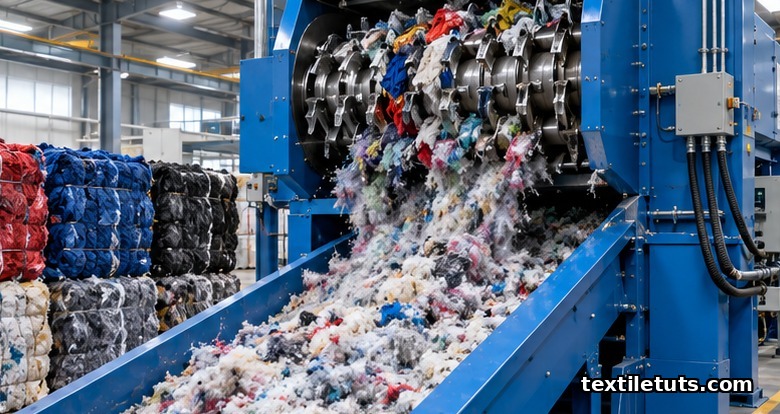
The main limitation is fiber length. Each shredding pass cuts fibers shorter, and after roughly five to seven cycles the resulting yarn is too weak for woven apparel. Recyclers compensate by blending recycled fiber with virgin at ratios between 20% and 50%, and by routing output to lower-stress end uses such as insulation, wiping cloths, carpet backing, and nonwovens.
Sorting is the bottleneck. Modern facilities use near-infrared (NIR) spectroscopy to separate polyester from cotton, but blends under 5% of either fiber still end up in the residue stream. Buttons, zippers, elastane, and prints add further complexity. The SORT2WEAR consortium, a multi-stakeholder program backed by the U.S. Department of Energy, published an updated state-of-the-art review of fiber sorting technology in 2023, and several commercial lines now pair NIR with hyperspectral imaging and air-jet separation.
Chemical Recycling: Depolymerization and Re-polymerization
Chemical recycling returns the polymer to its monomer or to a building block suitable for re-polymerization. For polyester (PET), four processes dominate: glycolysis, methanolysis, hydrolysis, and enzymatic depolymerization. For nylon 6, caprolactam recovery via hydrolysis is the established route.
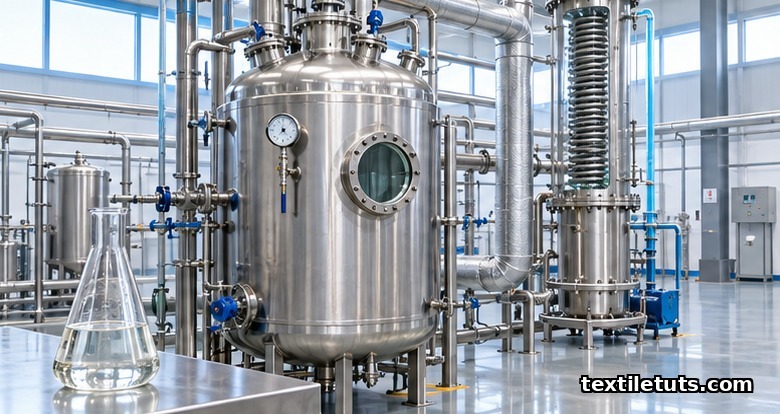
Glycolysis reacts ground PET with ethylene glycol at 180 to 240 °C, breaking the polymer into bis(2-hydroxyethyl) terephthalate (BHET), which is then purified and re-polymerized. Methanolysis uses methanol at similar temperatures and pressures to yield dimethyl terephthalate (DMT), which is also re-polymerized into PET. Hydrolysis, used by several PET bottle recyclers, requires higher temperatures (200 to 250 °C) and either acidic, alkaline, or neutral catalysts to cleave the ester bonds.
Enzymatic depolymerization is the newest route. A landmark 2020 study published in Nature described a leaf-branch compost cutinase enzyme engineered by Carbios to break down 90% of PET in 10 hours at 65 °C. The technology moved to pilot scale in 2021 and to industrial scale-up in 2024, with the first commercial PET-to-PET depolymerization plant announced for Longlaville, France.
For nylon 6, hydrolytic depolymerization recovers caprolactam, the monomer used to make virgin nylon 6. Aquafil’s ECONYL process operates this route commercially, taking carpets, fishing nets, and fabric scraps and yielding yarn with the same specifications as virgin nylon 6.
Fiber-Specific Processes
Polyester recycling is the most advanced because PET is also a packaging polymer with established recycling infrastructure. Recycled PET (rPET) flake from beverage bottles has been extruded into staple fiber and filament yarn for over two decades. The newer frontier is closed-loop textile-to-textile recycling, where post-consumer garments become monomers and re-polymerized into fiber identical to virgin.
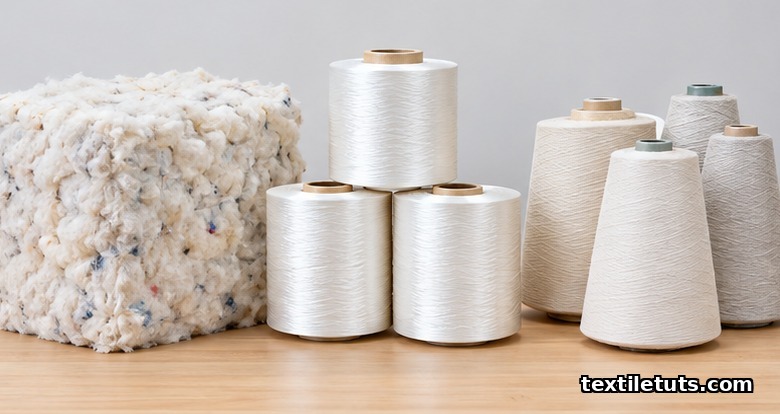
Nylon 6 recycling is dominated by depolymerization back to caprolactam. Aquafil’s ECONYL process recovers nylon 6 from carpets, fishing nets, and fabric scraps, producing yarn with identical specifications to virgin nylon 6. The process has been independently audited under ISO 14021 for recycled-content claims.
Cotton recycling is harder because cellulose degrades with each processing cycle and because most post-consumer cotton is blended with polyester. Mechanical cotton recycling produces shorter fibers used in nonwoven applications. Chemical routes dissolve cellulose and re-spin it as regenerated cellulose, producing fibers branded as Tencel (Lyocell process) or Ioncell. The chemical process can handle cotton/polyester blends by dissolving the cellulose while leaving the polyester recoverable as a secondary stream.
Wool recycling is niche. Mechanical processing dominates because wool’s scale structure makes it difficult to dissolve without damage. Shoddy mills, common in Northern England and the Prato district of Italy, produce recycled wool yarn blended with virgin fiber for coats and knitwear. The shoddy process pulls fabrics apart into individual fibers, then re-spins them with the addition of virgin or synthetic fibers to restore yarn strength.
Standards and Traceability for Recycled Content
ISO 2076:2021 specifies the generic naming conventions for man-made fibers, including those produced from recycled feedstocks. ISO 1833 covers quantitative chemical analysis of fiber blends, which is the test method used to verify recycled fiber content by mass. The Global Recycled Standard (GRS), administered by Textile Exchange, audits the chain of custody from feedstock to finished product and tracks recycled content by mass balance.
For traceability at scale, several pilots use DNA-based fiber markers and isotopic analysis. These methods verify whether a finished garment contains recycled feedstock, addressing a known gap: mass-balance accounting can credit recycled content to products that contain none. The EU’s forthcoming Digital Product Passport, scheduled to roll out in the textile sector in the late 2020s, will require brands to disclose fiber origin, recycled content, and end-of-life pathway.
Process Comparison
| Process | Input Material | Output | Typical Energy Use | Fiber Quality Match to Virgin |
|---|---|---|---|---|
| Mechanical shredding | Cotton-rich textile waste | Staple fiber (short) | Low | Lower (shorter fibers) |
| Glycolysis (PET) | Polyester textile waste, bottles | BHET monomer, then re-polymerized PET | Moderate | Identical |
| Methanolysis (PET) | Polyester textile waste | DMT, then re-polymerized PET | Moderate to high | Identical |
| Enzymatic (PET) | Polyester textile waste | Monomers, then re-polymerized PET | Low | Identical |
| Caprolactam recovery (Nylon 6) | Carpet, net, fabric waste | Caprolactam, then re-polymerized Nylon 6 | Moderate | Identical |
| Cellulose dissolution | Cotton-rich blends | Regenerated cellulose fiber | Moderate | Comparable |
Frequently Asked Questions
What is the difference between mechanical and chemical textile recycling?
Mechanical recycling physically shreds fabric into shorter fibers and re-spins them into yarn, which lowers fiber length and yarn strength each cycle. Chemical recycling depolymerizes the fiber back to its monomer or a building block, which is then re-polymerized into yarn with the same specifications as virgin material. Mechanical lines are cheaper to operate; chemical lines produce fiber that matches virgin quality.
Can blended fabrics like poly-cotton be recycled?
Yes, but the process is more complex. Cellulose-dissolving processes, including the Lyocell and Ioncell routes, can selectively dissolve cotton from a poly-cotton blend while leaving the polyester recoverable as a separate stream. Yields depend on blend ratio and dye chemistry; heavy reactive dyes can interfere with solvent recovery, and small amounts of elastane below 5% typically end up in the residue stream.
Does recycled polyester shed more microplastics than virgin polyester?
Peer-reviewed studies disagree on direction and magnitude. A 2023 study published in Environmental Science & Technology reported that rPET fabrics shed more microfibers per wash than vPET in identical knit constructions, while a 2024 follow-up by the same group attributed much of the gap to yarn linear density and knitting gauge rather than the recycled feedstock itself. Construction and finishing appear to matter at least as much as feedstock origin.
What does the Global Recycled Standard (GRS) verify?
GRS audits the chain of custody from feedstock to finished product. It verifies the percentage of recycled content by mass, restricts the use of hazardous chemicals in processing, and requires social compliance at processing facilities. GRS is one of several standards; others include the Recycled Claim Standard (RCS) and the EU’s forthcoming Digital Product Passport, which will require brands to disclose fiber origin and end-of-life pathway for products sold in the EU.
How many times can a polyester garment be recycled?
PET can be chemically recycled repeatedly with limited quality loss, because depolymerization erases prior thermal history and yields monomers indistinguishable from virgin. The current practical limit is contamination: dyes, finishes, and elastane blended into the fabric accumulate through cycles. Closed-loop systems that handle only PET bottles already operate at industrial scale; closed-loop systems for PET garments are still pre-commercial, with the first plants coming online in 2024 and 2025.
References
- Ellen MacArthur Foundation. A New Textiles Economy: Redesigning Fashion’s Future. 2017. https://ellenmacarthurfoundation.org/a-new-textiles-economy — baseline data on global textile waste and recycling rates, the source of the “less than 1%” figure still cited by regulators.
- Textile Exchange. Materials Report 2023. https://textileexchange.org — annual fiber production and recycled-content statistics, including the 116 million tonnes global figure for 2022.
- European Environment Agency. Textiles and the Environment in a Circular Economy. 2024 update. https://www.eea.europa.eu — policy framing, waste-stream data, and update of the 2017 baseline.
- ISO 2076:2021. Textiles — Man-made fibres — Generic names. International Organization for Standardization — naming convention for fibers including recycled feedstocks.
- ISO 1833 (series). Textiles — Quantitative chemical analysis. International Organization for Standardization — test methods used to verify fiber blend ratios and recycled fiber content by mass.
- Tournier, V., et al. (2020). An engineered PET-depolymerizing enzyme that enables closed-loop recycling. Nature. https://www.nature.com/articles/s41586-020-2149-4 — peer-reviewed evaluation of the Carbios PET hydrolase used in enzymatic textile recycling.
- De Falco, F., et al. (2023). Microfiber release from recycled and virgin polyester fabrics. Environmental Science & Technology. https://pubs.acs.org — peer-reviewed study comparing rPET and vPET microfiber shedding.
This article is the working reference for textile recycling technologies. Editorial by Shahrukh Islam, TextileTuts. Sources: Ellen MacArthur Foundation (2017), Textile Exchange Materials Report (2023), European Environment Agency (2024), ISO 2076:2021, ISO 1833 series, Nature (2020), Environmental Science & Technology (2023) as cited.


