
Low-Water Finishing Processes

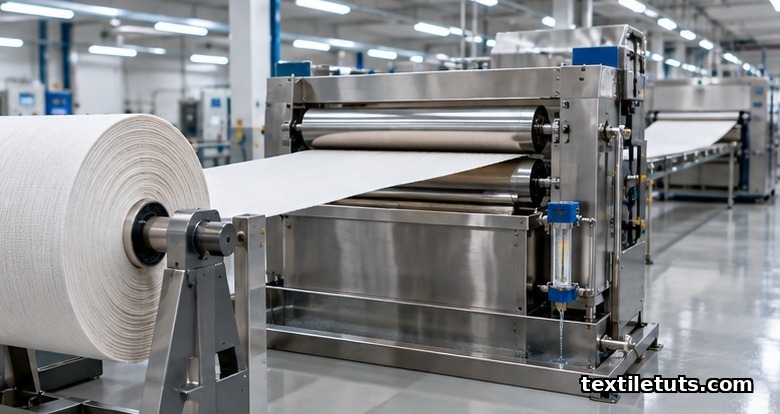
Low-water finishing processes can cut textile water consumption from the conventional 100–150 L per kg of fabric down to 10–50 L per kg by replacing full-immersion wet processing with foam application, plasma treatment, supercritical CO2, and enzyme-based systems.
The textile industry accounts for roughly 20% of global industrial wastewater, and wet finishing alone drives about 60% of that footprint inside a typical cotton mill. New waterless and low-water technologies now let finishing plants reduce process water, steam, and effluent load at the same time, while still meeting ISO and AATCC performance requirements on hand feel, dimensional stability, and colorfastness.
This article explains how each major low-water finishing technology works, the savings it delivers in real production, and where it fits into a modern dyehouse workflow alongside conventional wet processing.
Why Conventional Finishing Uses So Much Water
Wet finishing historically depends on large volumes of water as both a solvent and a heat-transfer medium. Pre-treatment (desizing, scouring, bleaching), dyeing, and after-treatment washing each add 20–40 L of water per kg of fabric in a typical cotton mill, and the loads multiply when long liquor ratios and repeat wash-offs are required to clear surfactants, alkalis, and hydrolysed dye.
The result: a single dyed and finished T-shirt can carry a process water footprint of 100–200 L by the time it leaves the dyehouse, and a polyester dyeing cycle uses around 50–80 L/kg before printing or finishing adds more. That volume is no longer compatible with regional water-stress regulations, customer-driven ZDHC expectations, or the operating cost of effluent treatment for the mill itself.
Foam Finishing
Foam application replaces the water bath with a stabilized foam of 10–30% water content, generated by mechanical mixing of air, water, and surfactant. The foam is knife-coated, screen-printed, or roller-applied onto dry fabric and then crushed by nip rollers or vacuum slots to release the active chemistry (softener, resin, water repellent, flame retardant) directly onto the fiber surface.
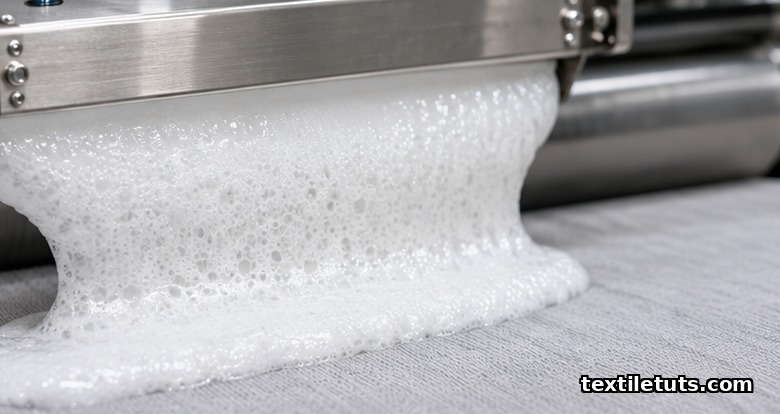
Reported savings versus conventional padding include 50–80% water reduction, 40–60% energy reduction in drying, and 30–50% lower chemical consumption per kg of fabric. Foam finishing is now standard for soil-release finishes, easy-care resins, and fluorocarbon or silicone water repellency on cotton, polyester, and cotton-poly blends, and it is well proven on both knitted and woven fabrics.
Plasma Treatment
Cold plasma is a dry, gas-phase process: the fabric passes through a low-pressure or atmospheric chamber where ionized gas, usually oxygen, nitrogen, or air, modifies the fiber surface without changing bulk properties. Plasma improves wetting, dye uptake, and adhesion of coatings, and can replace wet pre-treatment steps such as singe residue cleaning, light scouring, or starch removal.
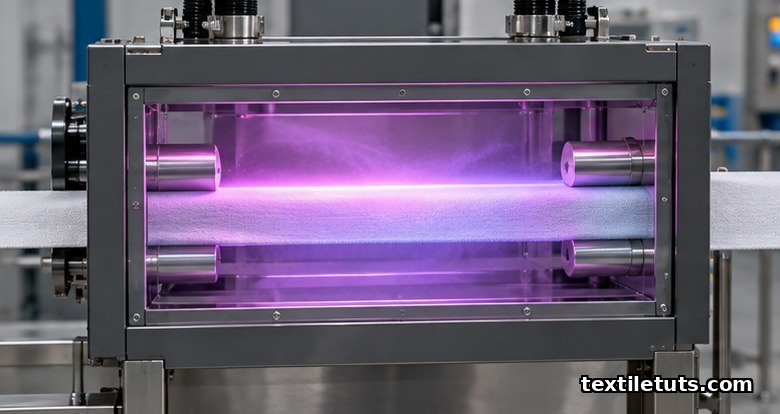
Energy use for atmospheric plasma finishing is reported at 0.2–0.5 kWh/kg, water use inside the plasma chamber is effectively zero, and effluent load drops to a small fraction of conventional wet preparation. Plasma-treated cotton and wool also accept lower-temperature dyeing, which compounds the water and steam savings downstream in the dyehouse.
Supercritical CO2 Dyeing
In supercritical CO2 dyeing, pressurized carbon dioxide above 73 bar and 31 °C acts as the solvent in place of water. Disperse dyes dissolve directly into the CO2 and diffuse into polyester fibers; on depressurization the CO2 returns to gas and is recovered, leaving only the dyed fabric and no process effluent.
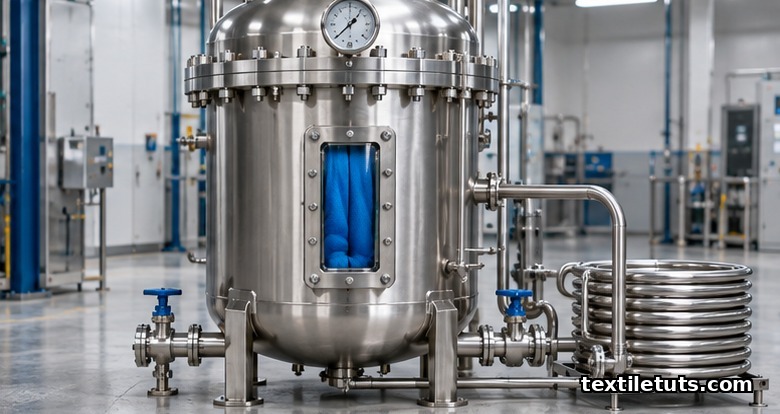
The process uses no process water, recovers 90–95% of the CO2 for reuse, and shortens cycle time from 3–6 hours in aqueous disperse dyeing to 1–2 hours. Commercial systems such as DyeCoo and partners have brought several polyester sportswear lines to retail under a “waterless dyeing” label. The practical trade-off is the high capital cost of pressure vessels and the current limitation to disperse dyes on synthetic fibers, since reactive and vat dyes still require water-based systems.
Enzymatic and Biocatalytic Finishing
Enzymes are specific protein catalysts that work under mild conditions (pH 5–8, 20–60 °C), replacing harsh acids, alkalis, or oxidizers. Common enzymatic steps in low-water finishing include:
- Amylase desizing of starch-sized warp yarn, replacing acid or oxidative desizing
- Pectate lyase and pectinase scouring of cotton, replacing high-temperature caustic boil-off
- Laccase bleaching of denim and knits, replacing potassium permanganate or sodium hypochlorite
- Cellulase biopolishing of cotton knits for surface smoothness and pilling control
- Protease anti-felting treatment of wool, replacing chlorine-Hercosett shrink-proofing
Compared to the chemical equivalents, enzymatic routes typically cut process water use by 30–50%, effluent COD by 40–70%, and energy use by 20–40%, because lower temperatures and shorter rinse cycles are needed. The trade-off is slower reaction kinetics and the requirement for tight pH and temperature control to keep enzyme activity stable.
Low-Liquor-Ratio Dyeing Machines
Liquor ratio (LR) is the ratio of process liquor mass to fabric mass in the dyeing machine. A conventional winch or jet machine runs at LR 8:1 to 12:1; modern low-LR machines run at LR 3:1 to 5:1 using optimized nozzle geometry, controlled fabric circulation, and uniform liquor distribution.
At LR 4:1, water and steam demand fall by roughly 50–60% versus LR 10:1, and the higher chemical concentration often improves dye fixation by 5–10 percentage points. Air-dye and air-flow systems from Then, Thies, and ATYC extend the principle below LR 4:1 for cotton knits and polyester blends, and are now standard equipment in new mills.
Digital Printing and Digital Finishing
Digital inkjet printing of textiles applies dye or pigment only where needed, eliminating the screens, thickener pastes, and wash-offs of rotary and flat-bed screen printing. Water consumption drops by 60–90% per metre of printed fabric, and the smaller residual liquor after fixation needs fewer rinse cycles to clear.
Digital finishing applies the same idea to chemistry: print-on softener, antimicrobial, flame retardant, or water-repellent finishes only where the garment pattern or panel needs them. Adoption is strongest in sampling, made-to-measure apparel, and short-run home textiles, where conventional setup waste and strike-off cycles would otherwise dominate water use.
Comparison: Water Use by Finishing Technology
| Process | Typical water use (L/kg fabric) | Main application | Maturity |
|---|---|---|---|
| Conventional pad-batch finishing | 100–150 | Cotton resin, easy-care, water repellent | Standard baseline |
| Foam finishing | 20–50 | Softener, resin, fluorocarbon repellent | Widely adopted |
| Low-LR dyeing (LR 4:1) | 40–70 | Cotton, polyester, blends | Standard in new mills |
| Enzymatic desizing / scouring | 30–60 | Cotton preparation | Standard |
| Atmospheric plasma | <5 (process water) | Surface activation, adhesion | Adoption phase |
| Supercritical CO2 dyeing | 0 | Polyester disperse dyeing | Commercial (limited) |
| Digital print finishing | 5–20 | Print, spot finish | Growing |
Standards and Compliance Framework
Low-water finishing is now tied to verifiable standards rather than marketing claims. The frameworks that buyers and auditors expect to see include:
- ISO 14001:2015 — environmental management systems for mills that document low-water process changes
- ISO 6330:2021 and ISO 3175 — domestic-wash and dry-cleaning test methods used to validate that foam-, enzyme-, or plasma-finished fabrics still meet the brand’s care-label performance
- AATCC TM135 — dimensional changes of fabrics after home laundering, the most-asked buyer benchmark for knit finishing
- AATCC TM172 — colorfastness to repeated laundering, especially relevant for resin and easy-care finishes
- ASTM D5034 — breaking strength and elongation (grab test), used to confirm that low-water finishing has not damaged tensile performance
Buyers typically combine those certificates with an Higg FEM water module score and a process water audit. Mills that can document ISO 14001 plus a specific low-water technology adoption score materially higher on these questionnaires, and they pay less for effluent treatment in their own utility bill at the same time.
Frequently Asked Questions
Q1: What is a low-water finishing process?
A low-water finishing process replaces the conventional full-immersion wet bath with foam, plasma, supercritical CO2, enzymatic, or low-liquor-ratio technology, typically cutting process water use to 10–50 L per kg of fabric from the conventional 100–150 L per kg in a cotton pad-batch line.
Q2: Does foam finishing change fabric hand feel or durability?
When foam is properly stabilized and crushed at the correct add-on level, foam-applied softeners and resins deliver the same hand feel and wash durability as padding, and in some cases improve uniformity because the active chemistry is concentrated at the fiber surface rather than diluted in a large bath.
Q3: Is supercritical CO2 dyeing commercially available?
Yes, supercritical CO2 dyeing is commercial for polyester disperse dyeing at industrial scale through equipment makers such as DyeCoo and partners in Vietnam, Thailand, and Taiwan, with several global sportswear brands sourcing waterless-dyed polyester fabric since 2020.
Q4: Can plasma finishing fully replace desizing and scouring?
Plasma can replace part of pre-treatment, especially surface cleaning, activation, and improved dye uptake, but for heavy starch sizes or high-impurity cottons it is usually combined with enzymatic desizing or mild scouring rather than used alone, because plasma is a surface treatment and does not remove bulk impurities inside the fiber.
Q5: Will low-water finishing reduce effluent treatment costs?
Yes. Lower process water volume directly reduces the size, energy demand, and chemical dosing of the effluent treatment plant, and switching from oxidative chemistries such as chlorine or permanganate to enzymes cuts effluent COD, color, and adsorbable organic halides, all of which lower treatment operating cost per kg of fabric.
References
- ISO. ISO 14001:2015 Environmental management systems — Requirements with guidance for use. iso.org — baseline environmental management standard for mills adopting low-water processes.
- ISO. ISO 6330:2021 Domestic washing and drying procedures for textile testing. iso.org — care-label performance validation for finished fabrics.
- American Association of Textile Chemists and Colorists. AATCC Test Method 135: Dimensional Changes of Fabrics After Home Laundering. aatcc.org — dimensional-change benchmark used to verify finishing stability.
- American Association of Textile Chemists and Colorists. AATCC Test Method 172: Colorfastness to Powdered Non-Chlorine Bleach. aatcc.org — colorfastness benchmark for resin and easy-care finishes.
- ASTM International. ASTM D5034 Standard Test Method for Breaking Strength and Elongation of Textile Fabrics (Grab Test). astm.org — tensile-performance check used to validate finishing chemistry.
- Springer Open. Water footprint in textile industry: a review. springer.com — peer-reviewed process-water figures cited in the lead.
- MDPI. Supercritical CO2 Dyeing of Polyester: A Review. mdpi.com — peer-reviewed review of process parameters, cycle time, and CO2 recovery.
This article is the working reference for low-water finishing processes. Editorial by Shahrukh Islam, TextileTuts. Sources: ISO 14001:2015, ISO 6330:2021, AATCC TM135, AATCC TM172, ASTM D5034, Springer Open, MDPI as cited.


