
Textile Finishing: Complete Guide to Fabric Treatments

What is textile finishing?
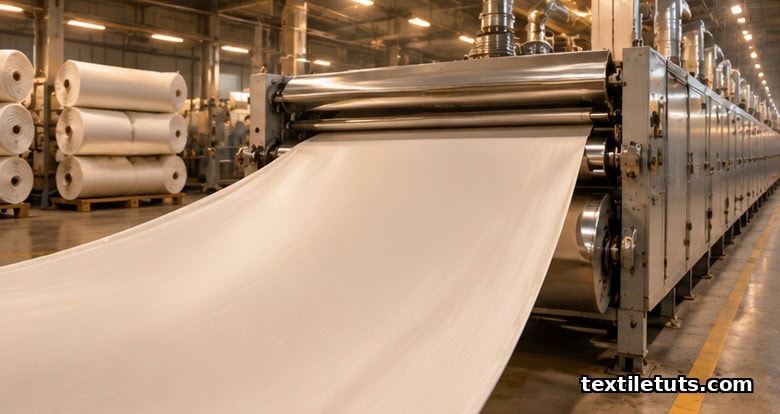
Textile finishing is the final set of processes applied to a fabric after weaving or knitting (and after dyeing or printing) to prepare it for the end use. Finishing covers a wide range of treatments: mechanical (calendering, raising, sanforizing, stentering), chemical (easy-care resin, water repellent, flame retardant, softener), and functional (antimicrobial, UV protection, moisture management). The finishing stage is where the fabric acquires most of its final properties, the hand (softness, drape, stiffness), the appearance (luster, surface texture), and the performance (water repellency, flame resistance, dimensional stability).
Finishing is a major cost driver in textile production. For apparel fabrics, finishing typically accounts for 15-30% of the total manufacturing cost. For technical textiles, finishing can be 50% or more of the cost. The cost reflects the chemicals used (resins, softeners, water repellents), the energy (drying, curing, stenter frame), and the equipment (specialized machinery for calendering, raising, etc.).
Mechanical finishing
Mechanical finishing uses physical processes (heat, pressure, friction) to modify the fabric’s hand and appearance, without adding chemicals. The main mechanical finishes are:
Calendering
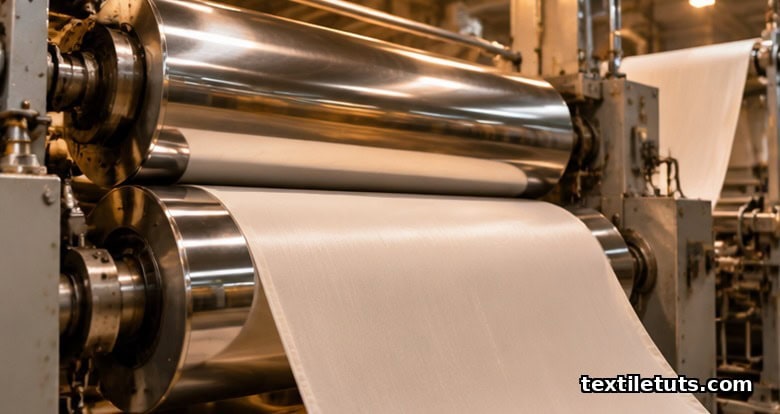
Calendering is the process of passing the fabric between heated rollers under pressure to smooth the surface, control the hand, and impart luster. The basic calender has two or three rollers; the heated main roller can be polished (for high luster), matte (for low luster), or engraved (for patterned effects like moiré or schreiner).
Calendering is used for: luster (polished calender gives a high-sheen fabric for linings and apparel), smoothing (matte calender gives a smooth surface without high luster), embossing (engraved calender gives a permanent pattern in the fabric surface), and compacting (the calender compacts the fabric to reduce its thickness and increase its density).
Raising (napping)
Raising is the process of pulling fibers from the fabric surface to create a soft, fuzzy surface (the “nap” on flannel, the “pile” on fleece, the “peach skin” on some synthetics). The fabric is passed over a rotating cylinder covered with fine needles or wires that pull up fiber ends from the yarn surface.
Raising is used for: flannel (woolen or worsted fabric raised for softness and warmth), fleece (knit fabric raised for the characteristic soft pile), peach-skin synthetics (microfiber fabric raised to a fine velvet-like surface), and blanket fabrics. The amount of raising (light, medium, heavy) determines the final hand and appearance.
Shearing
Shearing cuts the raised fibers to a uniform height, producing a smooth, even surface. The process is used after raising to create a clean, level pile (as in velvet, velour, and some fleece), or independently to remove surface fuzz and improve the fabric’s appearance and pilling resistance.
Sanforizing (pre-shrinking)
Sanforizing is a controlled compressive-shrinking process that limits the residual shrinkage of the fabric to 1-3% (vs. 7-10% for unsanforized fabric). The fabric is fed between a heated cylinder and a rubber belt under controlled tension, compressing the fabric in the warp direction. The compressed fabric, when later washed, does not shrink significantly because the compressive shrinkage has already happened.
Sanforizing is standard for most apparel fabrics. The unsanforized alternative (shrink-to-fit denim, for example) is a niche heritage product where the wearer is expected to size up to account for the first wash shrinkage.
Stentering (heat setting)
Stentering is the process of holding the fabric at width under heat and tension to set the dimensions, remove creases, and (for synthetics) heat-set the fabric. The stenter frame is a long oven with two parallel chains that grip the fabric selvedges and carry it through the oven at controlled width, temperature, and dwell time.
Stentering is the most common finishing process for woven and knit fabrics. It controls the final width of the fabric, sets the dimensional stability, and (with appropriate chemistry applied before stenter entry) can apply functional finishes like water repellents or softeners in a single pass.
Compacting
Compacting is a mechanical process that shrinks the fabric (especially knits) in the length and width to reduce its relaxation shrinkage and improve its dimensional stability. The fabric is passed between rollers under controlled compression, often with heat and moisture, to consolidate the yarn loops.
Compacting is standard for knit fabrics (single jersey, interlock, rib) where loop distortion can cause significant shrinkage if not stabilized. The compacting step brings the fabric to a stable state so the consumer-washed garment retains its size and shape.
Chemical finishing
Chemical finishing uses chemical treatments to modify the fabric’s hand, appearance, or performance. The main chemical finishes are:
Easy-care (wrinkle-resistant) finish
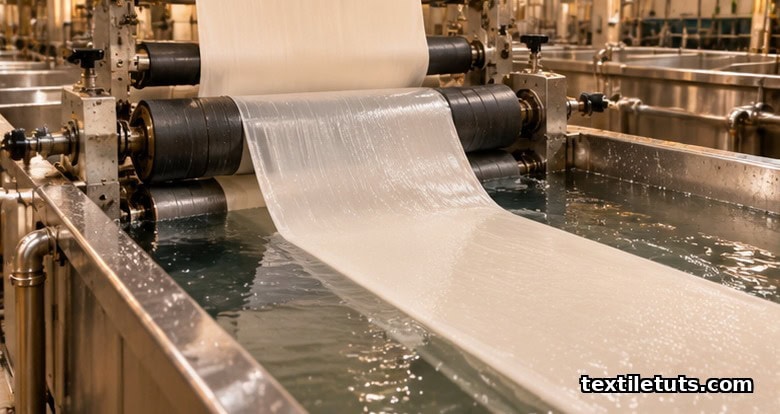
Easy-care finishes use crosslinking resins (typically dimethyloldihydroxyethyleneurea, DMDHEU) to crosslink the cellulose chains in cotton. The crosslinks prevent the chains from moving when the fabric is deformed (e.g., in washing), which prevents the creases that would otherwise form.
The trade-off: easy-care finishes reduce the fabric’s tensile strength (5-15% loss, depending on resin concentration and cure conditions) and can release small amounts of formaldehyde (a known carcinogen). Modern low-formaldehyde resins have reduced this issue, but the finish still slightly compromises the fabric’s natural feel and absorbency.
Easy-care finishes are standard for most cotton shirting, cotton trousers, and other apparel where wrinkle resistance is valued. The finish is durable to 30-50 wash cycles (depending on the resin and cure), after which the easy-care effect gradually diminishes.
Water repellent finish
Water repellent finishes use hydrophobic compounds (silicone emulsions, fluoropolymers, or wax emulsions) to make the fabric surface hydrophobic. The treated fabric sheds water but remains breathable (unlike a waterproof coating, which blocks water vapor as well as liquid water).
Fluoropolymer-based finishes (often called “DWR” for durable water repellent) are the most common and most durable. They are used on outerwear, sportswear, and technical textiles. The issue: fluoropolymers contain perfluorinated compounds (PFCs) that are persistent in the environment and have raised health concerns. The industry is moving toward PFC-free DWR treatments, which use different chemistry (silicone, wax, or hydrocarbon-based) but with lower durability.
Flame retardant finish
Flame retardant finishes use phosphorus- or nitrogen-based compounds (the modern replacements for older halogenated retardants) to make the fabric self-extinguishing when exposed to flame. The treated fabric chars rather than melts, and the char layer prevents further combustion.
Flame retardant finishes are required for: children’s sleepwear (US regulation 16 CFR 1615/1616), contract textiles (NFPA 701 for drapery, NFPA 260 for upholstery), protective clothing (NFPA 1971, 1977, 2112 for fire fighters, wildland firefighters, industrial), and some military applications. The finish must be durable to multiple wash cycles (typically 50+) to maintain the flame retardant performance over the garment’s life.
Softener finish
Softener finishes use cationic, anionic, or non-ionic surfactants to lubricate the fiber surface and improve the hand. The treated fabric feels softer and has better drape. Softeners are among the most common finishes applied to textiles, almost every apparel fabric has some softener applied.
The durability of the softener effect varies: silicone-based softeners are very durable (50+ washes), while conventional surfactant softeners are less durable (5-20 washes). The choice depends on the end use: a dress shirt that will be washed many times needs a durable softener, while a low-cost t-shirt that will be discarded after a few wears can use a cheaper, less durable softener.
Antimicrobial finish
Antimicrobial finishes use silver, zinc pyrithione, quaternary ammonium compounds, or natural agents (chitosan, essential oils) to inhibit the growth of bacteria, fungi, and other microorganisms on the fabric surface. The treated fabric resists odor (from bacterial breakdown of sweat) and microbial degradation (which can weaken the fabric over time).
Antimicrobial finishes are used in: athletic apparel (odor control), medical textiles (infection control), home textiles (mattress ticking, pillow covers), and technical applications (filtration, geotextiles). The finish durability varies widely: silver-based finishes can be very durable (50+ washes), while some organic-based finishes lose effectiveness after 10-20 washes.
The finishing process flow
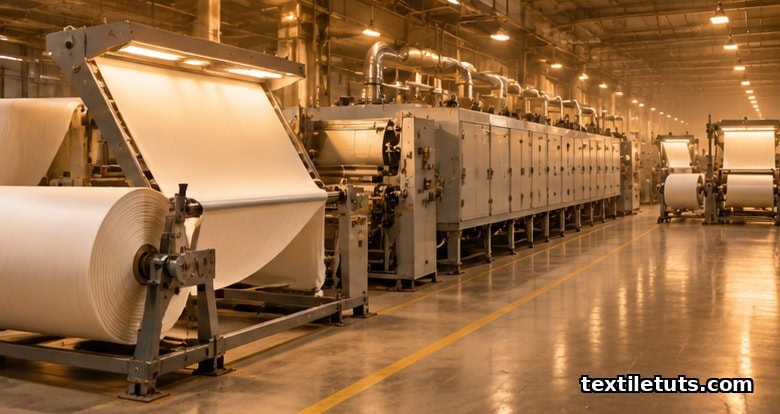
A typical finishing line for a cotton woven apparel fabric has the following steps:
- Bleaching (if not done at the mill) – to whiten the fabric.
- Dyeing or printing, to add color.
- Drying, to remove excess water after wet processing.
- Stentering, to set width, apply functional finishes, and heat-set if applicable.
- Calendering, to smooth the surface and control luster.
- Sanforizing, to pre-shrink the fabric.
- Final inspection, to grade the fabric and detect defects.
For knit fabrics, the flow is similar but compacting replaces sanforizing. For technical textiles, additional processes (coating, lamination, embossing) may be added at the end.
Frequently Asked Questions
What is the difference between finishing and treatment?
In common usage, finishing and treatment are often used interchangeably. Strictly, finishing refers to the entire suite of processes applied to a fabric after weaving/knitting and dyeing, while treatment refers to specific processes (water repellent treatment, flame retardant treatment, etc.). All treatments are finishings, but not all finishings are treatments (e.g., calendering is a finishing but not typically called a treatment).
What is the most common finishing process?
Stentering is the most common finishing process. Almost every woven and knit fabric passes through a stenter frame as the final finishing step. Stentering sets the width, applies functional finishes (via pad application before the stenter), and heat-sets synthetic fabrics. The stenter is the “last stop” before the fabric is rolled and shipped.
What is the difference between water repellent and waterproof?
Water repellent (DWR) means the fabric sheds water but remains breathable. Liquid water beads up on the surface and rolls off, but water vapor can pass through. Waterproof means the fabric blocks both liquid water and water vapor. Waterproof is achieved by a coating or membrane (PU, PTFE, TPU) laminated to the fabric. Water repellent is achieved by a surface finish (silicone, fluoropolymer). A water-repellent fabric can be worn in the rain for a while before wetting through; a waterproof fabric can be worn indefinitely without wetting through.
How does flame retardant finish work?
Flame retardant finishes work by interfering with the combustion process. Phosphorus-based retardants promote char formation (the fabric chars rather than melts, and the char layer insulates the underlying fabric from further combustion). Nitrogen-based retardants release non-flammable gases (like nitrogen or ammonia) that dilute the combustible gases. Halogenated retardants (now mostly phased out due to environmental concerns) release halogen radicals that interrupt the chemical chain reaction of combustion. Modern flame retardants are typically phosphorus-nitrogen synergistic systems.
What is the future of textile finishing?
Three areas: (1) sustainability, waterless and low-water finishing processes (plasma treatment, supercritical CO2 dyeing, enzymatic finishes), recycled water, and PFC-free water repellents; (2) smart finishes, finishes that respond to stimuli (thermochromic, photochromic, moisture-responsive) or that provide additional functions (conductivity for wearable electronics, antimicrobial for healthcare, self-cleaning for outdoor); (3) digital finishing, direct application of finishes via inkjet or other digital technologies, enabling custom finishes per garment or per region. These advances are happening now, with significant investment from major textile chemical companies.
References
- ISO 3175-1:2017, Textiles, Professional care, drycleaning and wetcleaning of fabrics and garments, Part 1: Evaluation of drycleaning and wetcleaning processes. https://www.iso.org/standard/70775.html, relevant for finished fabric stability testing.
- AATCC TM 89-2017, Mercerization in Cotton. https://www.aatcc.org, applicable finishing process for cotton.
- ISO 105-X12:2016, Textiles, Tests for colour fastness, Part X12: Colour fastness to rubbing. https://www.iso.org/standard/50979.html, applicable to finished fabric colorfastness.
This article is the working reference for textile finishing. Editorial by Shahrukh Islam, TextileTuts. Sources: ISO 3175 (care labeling), AATCC TM 89 (mercerization), ISO 105-X12 (rubbing fastness) as cited.


