
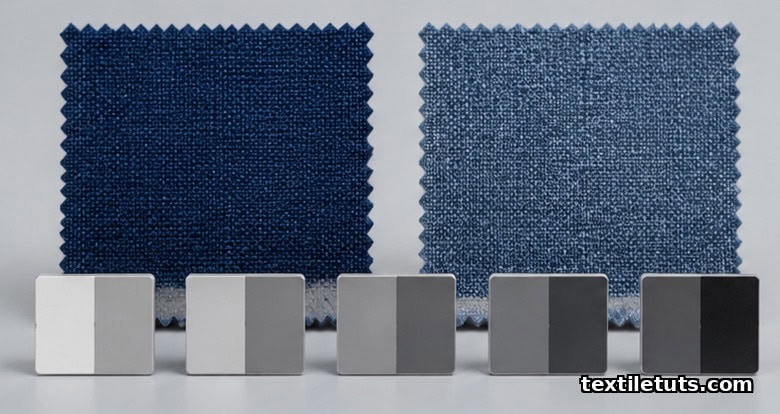
Colorfastness to Wash: ISO 105 C06

What is colorfastness to washing?
Colorfastness to washing is the resistance of a dyed or printed textile to color change (fading) and color transfer (bleeding) when subjected to washing. It is the single most important colorfastness property for any textile that will be laundered, which includes almost all apparel, home textiles, and most technical textiles. The test measures two things: the change in color of the tested specimen (how much the original shade faded) and the transfer of color to adjacent undyed multifiber fabric (how much the dye bled onto other fabrics).
The test is performed by laundering the specimen under defined conditions (temperature, time, detergent, agitation), then evaluating the change in color and the staining of the adjacent fabric against standard gray scales. The result is reported as a grade from 1 (severe change/staining) to 5 (no change/staining). A grade of 4-5 is required for most apparel specifications; a grade of 3-4 is the minimum for less demanding applications.
Why colorfastness to washing matters
Colorfastness to washing is the most common cause of garment rejection in the supply chain. A garment that fades or bleeds in the wash is unsellable, regardless of the quality of the fabric, the construction, or the design. The test predicts the most important in-use performance characteristic of a dyed textile: how it will look after the consumer washes it.
The test is also the basis for consumer care labels. The care label must accurately predict the wash conditions the garment can withstand without significant color change. A garment that is labeled “machine wash warm” but fades in a warm wash is a warranty claim waiting to happen. The colorfastness test gives the manufacturer the data to set the care label accurately.
Test method: ISO 105-C06
ISO 105-C06 is the primary international standard for colorfastness to domestic and commercial laundering. The procedure is:
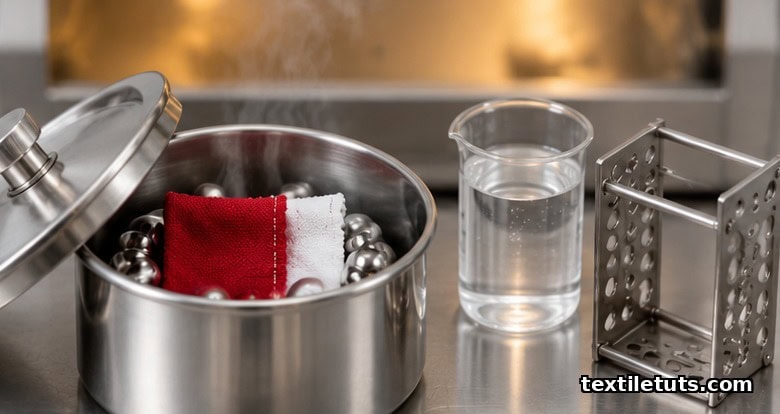
- A specimen of the fabric (typically 10 cm × 4 cm) is sewn to a piece of standard adjacent multifiber fabric (typically 10 cm × 4 cm) along one short edge.
- The composite specimen is placed in a stainless steel container with steel balls (to simulate mechanical agitation) and a standardized detergent solution.
- The container is placed in a water bath at the specified test temperature (40 °C for the standard test, but other temperatures like 50 °C, 60 °C, and 95 °C are used for more severe conditions).
- The bath is agitated for 30 minutes (the standard test), then the specimen is rinsed and dried.
- The change in color of the tested specimen and the staining of the adjacent fabric are evaluated against gray scales under standardized lighting conditions.
The result is reported as two numbers: the color change grade (1-5) and the staining grade (1-5). For example, “Color change 4-5, Staining on cotton 4, Staining on polyester 3-4” means the specimen faded slightly (4-5) and stained the adjacent cotton (4) and polyester (3-4) moderately.
Test conditions and their meaning
ISO 105-C06 specifies four test conditions, each simulating a different wash scenario:
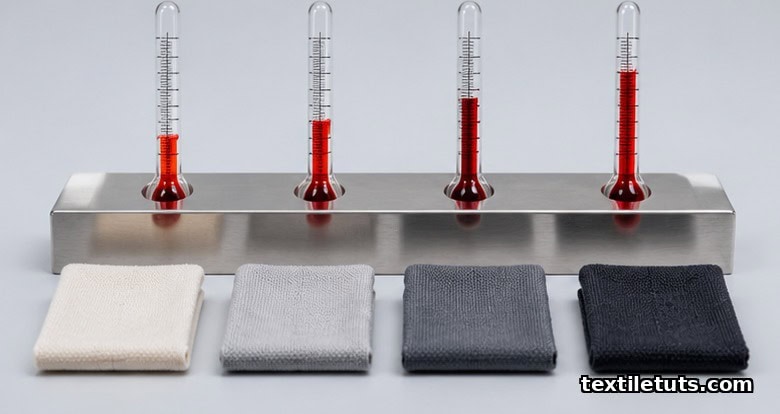
- A1 (40 °C) – standard domestic wash, low temperature. The minimum test for most apparel.
- A2 (40 °C) – standard domestic wash, low temperature, with perborate bleach. Simulates a wash with oxygen bleach.
- B1 (50 °C) – warmer domestic wash, common in Europe and North America.
- B2 (50 °C) – warmer domestic wash with perborate bleach.
- C1 (60 °C) – hot domestic wash, common in North America.
- C2 (60 °C) – hot domestic wash with perborate bleach.
- D1 (95 °C) – commercial laundry wash, used for hospital linens, workwear, and some home textiles.
- D2 (95 °C) – commercial laundry wash with perborate bleach.
Buyer specifications typically require colorfastness at the highest wash temperature that the garment will experience in normal use. A dress shirt that will be washed at 40 °C is tested at A1; a work shirt that will be washed at 60 °C is tested at C1; a hospital gown that will be washed at 95 °C is tested at D1.
Factors affecting colorfastness to washing
Colorfastness to washing is determined by the dye-fiber bond, the dye concentration, the aftertreatment, and the wash conditions.
- Dye-fiber bond, reactive dyes (for cellulose), acid dyes (for protein), and disperse dyes (for synthetics) form covalent or strong ionic bonds with the fiber and give the best wash fastness. Direct dyes, basic dyes, and some vat dyes give lower wash fastness and may require aftertreatment to improve.
- Dye concentration, higher dye concentration (deeper shade) typically gives better wash fastness, because there is more dye to lose before the color change becomes visible.
- Aftertreatment, many dyes are aftertreated with cationic fixing agents (for direct dyes) or crosslinkers (for reactive dyes) to improve wash fastness. The aftertreatment adds cost and processing time but is essential for dark shades on cellulosics.
- Wash conditions, higher temperature, longer time, more agitation, and the presence of bleach all reduce wash fastness. The test is designed to simulate typical home wash conditions; a garment that fails the test will fail in the consumer’s wash.
- Fiber type, synthetic fibers generally give better wash fastness than natural fibers, because the dye-fiber bond is more stable and the fiber itself is more chemically inert.
Acceptance criteria
Buyer specifications vary, but typical acceptance criteria are:
- Apparel (general) – color change 4-5, staining 3-4 minimum
- Premium apparel, color change 5, staining 4-5 minimum
- Home textiles (bedding, towels) – color change 4, staining 3 minimum
- Workwear, color change 4, staining 3 minimum (more severe conditions tested)
- Hospital textiles, color change 4-5, staining 4-5 minimum (95 °C wash with bleach)
Below these minimums, the fabric is likely to fail in the consumer’s wash and is not acceptable for the end use.
Common failure modes
The most common wash fastness failures are:
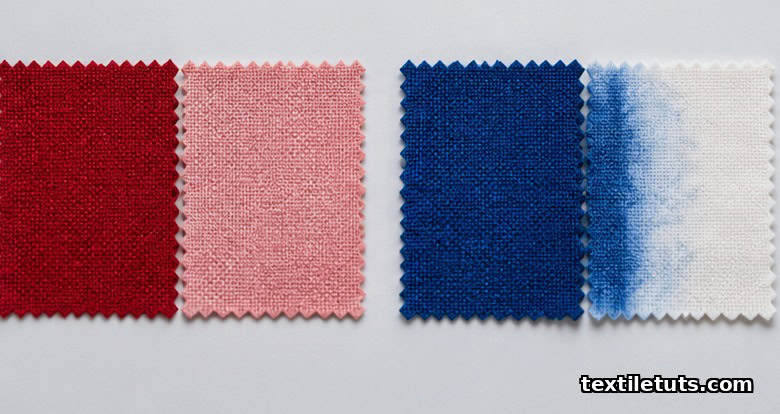
- Shade change (fading) – the dyed fabric loses color during washing. Usually a dye-fiber bond issue (insufficient fixation, poor aftertreatment) or a fiber damage issue (over-bleaching, hydrolytic damage to reactive dye sites).
- Staining of adjacent fabric, the dye bleeds from the tested fabric onto the adjacent multifiber. Usually a dye solubility issue (the dye is partially soluble in the wash liquor and redeposits on the adjacent fabric). Common with direct dyes and basic dyes.
- Shade change of adjacent fabric (cross-staining) – the dye transfers from one color area to another within the same fabric (e.g., a red stripe bleeding onto a white ground). Usually a dye-fiber bond issue specific to the bleeding color.
Most wash fastness failures are due to insufficient dye fixation or insufficient aftertreatment. The fix is in the dye house, not in the testing lab: improve the dyeing process (higher temperature, longer time, proper pH), improve the aftertreatment, or change the dye class to one with better wash fastness for the fiber and shade.
Related tests
ISO 105-C06 is the primary wash fastness test, but related tests cover specific conditions:
- ISO 105-C08 (colorfastness to domestic and commercial laundering with bleach) – extends C06 with the addition of sodium perborate (oxygen bleach).
- ISO 105-C09 (colorfastness to domestic and commercial laundering with oxidative bleach) – uses sodium hypochlorite (chlorine bleach), more severe than C08.
- ISO 105-C10 (colorfastness to washing with soap or soap and soda) – older test using soap and soda instead of modern detergent.
- AATCC TM 61 (colorfastness to laundering: accelerated) – US equivalent, uses a smaller specimen and faster test conditions.
For most apparel and home textiles, ISO 105-C06 is sufficient. The more severe tests (C08, C09) are used when the garment will be washed with bleach, and the accelerated test (AATCC TM 61) is used for quick quality control.
Frequently Asked Questions
What is the difference between color change and staining?
Color change (also called “fade”) is the change in color of the tested specimen itself. Staining is the transfer of color from the tested specimen to the adjacent undyed fabric. Both are reported on 1-5 gray scales. A fabric with good colorfastness has low color change and low staining; a fabric with poor colorfastness has high color change and/or high staining.
Why is wash fastness important for dark colors?
Dark colors (e.g., black, navy, deep red) are particularly vulnerable to wash fastness issues because the visible color change from even a small amount of dye loss is more apparent on a dark ground than on a light ground. A dark navy that loses 5% of its dye in the wash is visibly faded; a light blue that loses 5% of its dye is barely changed. This is why dark colors are typically dyed with the highest-fastness dye class available (reactive for cellulose, acid for protein, disperse for synthetics) and often with extra aftertreatment.
Can wash fastness be improved after dyeing?
Partially. For direct dyes on cellulose, a cationic fixing agent (typically a quaternary ammonium compound) can improve wash fastness by 1-2 grades. For reactive dyes, a post-cure or post-wash with a crosslinker can improve wash fastness. For acid dyes on protein, a syntan aftertreatment can improve wash fastness. These aftertreatments add cost and may affect the shade, so they are typically applied only when needed to meet a wash fastness specification.
What is the difference between wash fastness and light fastness?
Wash fastness is the resistance of a textile to color change and staining during washing. Light fastness is the resistance to color change during exposure to light (typically sunlight). The two are independent: a dye can have good wash fastness but poor light fastness (e.g., some reactive dyes) or good light fastness but poor wash fastness (e.g., some basic dyes). Most buyer specifications require both.
How long does the colorfastness test take?
The ISO 105-C06 test takes approximately 1-2 hours: 30 minutes for the wash cycle, 30 minutes for rinsing and drying, and 30-60 minutes for the evaluation. With multiple test conditions and specimens, a full colorfastness test program can take 1-2 days. The accelerated AATCC TM 61 test takes 30-45 minutes and is used for quick quality control, with the more thorough ISO test run periodically for verification.
References
- ISO 105-C06:2010, Textiles, Tests for colour fastness, Part C06: Colour fastness to domestic and commercial laundering. https://www.iso.org/standard/51021.html, primary international standard for colorfastness to washing.
- ISO 105-C08:2010, Textiles, Tests for colour fastness, Part C08: Colour fastness to domestic and commercial laundering using a non-phosphate reference detergent incorporating a low temperature bleach activator. https://www.iso.org/standard/51022.html, extension with perborate bleach.
- ISO 105-C09:2001, Textiles, Tests for colour fastness, Part C09: Colour fastness to domestic and commercial laundering, Oxidative bleach response using a non-phosphate reference detergent with a low temperature bleach activator. https://www.iso.org/standard/51023.html, extension with chlorine bleach.
- AATCC TM 61-2013, Colorfastness to Laundering: Accelerated. https://www.aatcc.org, accelerated US test method.
This article is the working reference for colorfastness to washing. Editorial by Iftay Khairul Alam, TextileTuts. Sources: ISO 105-C06 (primary international standard), ISO 105-C08/C09 (related standards), AATCC TM 61 (US standard) as cited.


